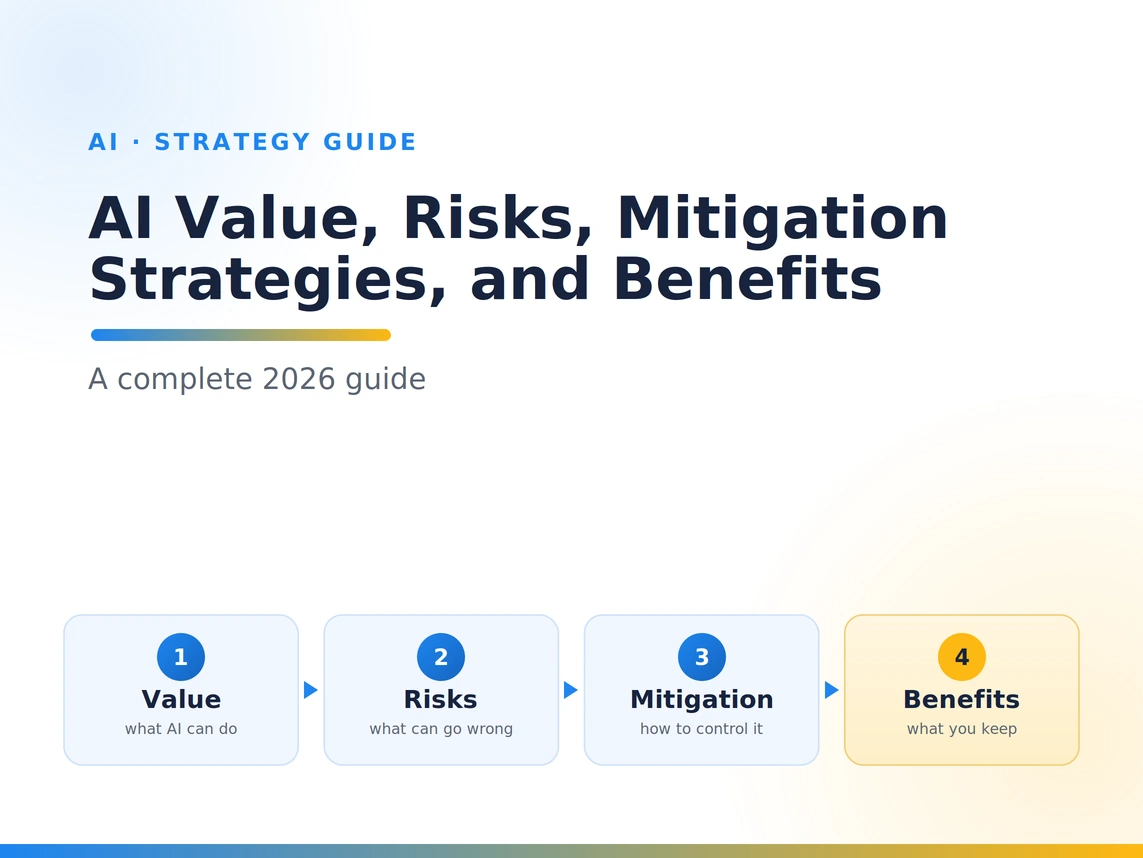
AI value, risks, mitigation strategies, and benefits are the four things every leader has to weigh before trusting a real business process to a model. Put simply: AI creates value by doing cognitive work at machine speed and scale; it carries risks like inaccuracy, data exposure, bias, and compliance exposure; those risks are reduced with governance, human review, and the right architecture; and the benefits you actually keep are the measurable outcomes that survive once the risks are under control. This guide treats AI value risks mitigation strategies benefits as one connected decision, because that is exactly how they behave in practice.
The gap between promise and payoff is real and measurable. In its 2025 State of AI research, McKinsey found that roughly 88 percent of organizations now use AI in at least one business function, yet only about 39 percent could attribute any measurable profit impact to it, and 51 percent had already experienced at least one negative consequence, most often from AI producing something inaccurate. In other words, almost everyone has adopted AI, few can prove it pays, and half have already been burned. The difference between those groups is rarely the model they chose. It is how deliberately they balanced value against risk. I have architected AI systems on both sides of that line, and this guide is the practitioner playbook I wish every client read before the first pilot.
Key Takeaways
- Value and benefits are different. Value is the capability AI adds (speed, prediction, personalization, generation). Benefits are the business outcomes you keep after the risks are controlled (lower cost, faster cycles, revenue, retention).
- The risks are mostly mundane, not science fiction. Inaccuracy, data exposure, bias, cost overruns, and compliance gaps cause far more damage than any runaway robot scenario.
- Mitigation is a discipline, not a feature. Governance, human oversight, grounded data, evaluation, and monitoring turn a risky demo into a dependable system.
- You keep the benefit only if you manage the risk. An AI feature that leaks data or gives wrong answers destroys more value than it creates.
- Regulation is now a hard deadline. Major EU AI Act obligations for high-risk systems apply from 2 August 2026, so compliance is a planning item, not a someday item.
- Start where value is high and risk is reversible. The safest first wins are internal, low-stakes, and easy to supervise.
Value and benefits are not the same thing
The focus keyword for this topic bundles four words together, and two of them, value and benefits, are often treated as synonyms. Keeping them separate is the single most useful mental model I can give you.
Value is the raw capability AI brings to a task. A model can read a thousand support tickets in a second, draft a first version of almost any document, spot a pattern in data that a human would miss, or hold a natural conversation at 3 a.m. That capability is the value. It exists whether or not you ever profit from it.
Benefits are what your business actually banks once that capability is put to work safely and at scale. Lower cost per ticket. A sales team that closes faster because research is automated. A product that retains users because it feels personal. Benefits are downstream of value, and they only appear after the risks between the two have been handled. Plenty of companies have captured AI value in a flashy demo and captured zero benefit in production, because the thing that worked on stage was too unreliable, too expensive, or too risky to ship.
Holding this distinction in mind changes how you evaluate every AI opportunity. You stop asking only “what can this model do?” and start asking “what outcome will survive contact with real users, real data, and real risk?”
AI Value Risks Mitigation Strategies Benefits at a Glance
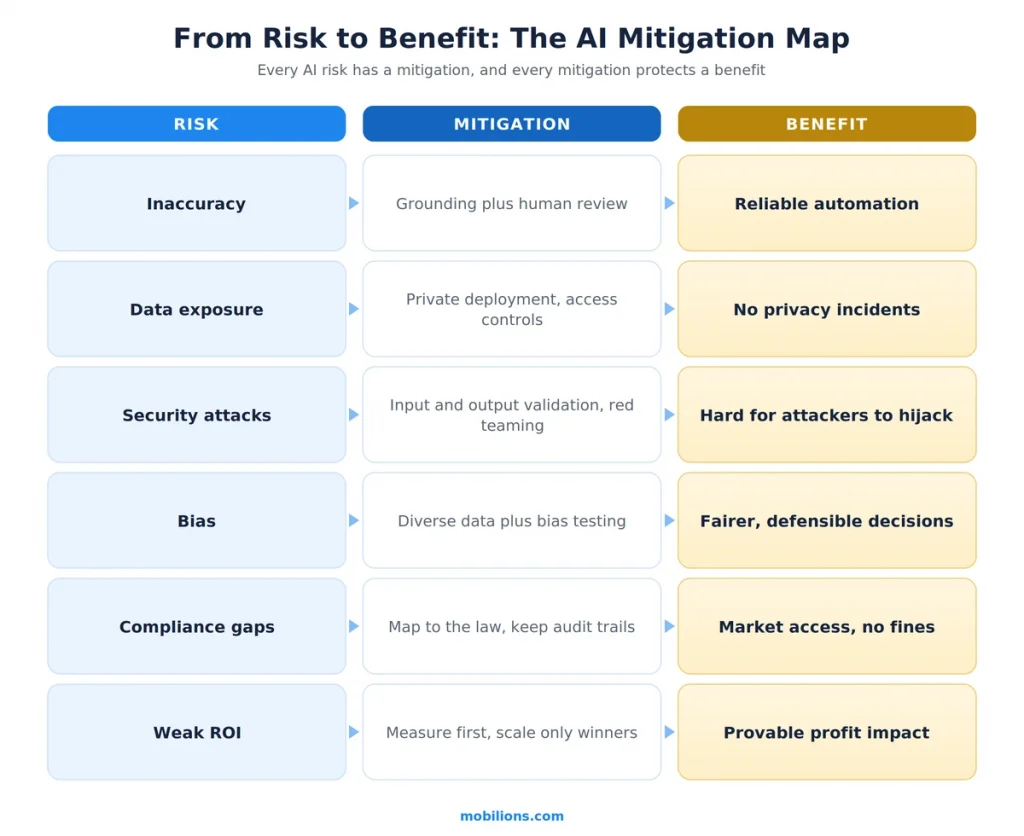
Before we go deep, here is the whole argument in one table. Each row takes a real risk, explains why it matters, gives the mitigation that works, and names the benefit you keep when you get it right.
| Risk | Why it matters | Mitigation strategy | Benefit you keep |
|---|---|---|---|
| Inaccuracy (hallucination) | Wrong answers erode trust and can cause real harm | Ground the model in your own data, add human review on high stakes output | Reliable automation people actually trust |
| Data exposure | Sensitive data sent to a model can leak or be retained | Private deployment, redaction, strict access controls | Automation without a privacy incident |
| Security attacks | Prompt injection and misuse can hijack an AI feature | Input and output validation, red teaming, least privilege | A feature attackers cannot easily turn against you |
| Bias and unfairness | Skewed outputs create legal and reputational damage | Diverse data, bias testing, documented decisions | Fairer outcomes and defensible decisions |
| Compliance gaps | New laws carry heavy fines for high-risk uses | Map uses to regulation, keep records and audit trails | Market access and no regulatory surprises |
| Cost and weak ROI | Runaway inference cost and failed pilots waste budget | Measure value first, monitor spend, scale only winners | Profit impact you can actually show |
| Vendor lock-in | Total dependence on one model is fragile | Abstraction layer, multi-model design, exit plan | Flexibility and negotiating power |
The rest of this guide expands each of these four pillars: the value, the risks, the mitigation strategies, and the benefits.
The value AI creates
AI value comes from a small number of capabilities that repeat across almost every industry. Understanding them helps you spot where AI is genuinely useful and where it is being oversold.
The first source of value is automation of cognitive work. Tasks that used to need a person to read, classify, summarize, or route can now run continuously and instantly. This is where most early value shows up, because the work is high volume and the rules are fuzzy enough that traditional software struggled with it.
The second is better decisions from data. Models find patterns in demand, churn, fraud, and risk that rule based systems miss. The value here is not a fancy dashboard. It is a decision made earlier and more accurately than a human team could manage alone.
The third is personalization at scale. A model can tailor a recommendation, a message, or an experience to one person, then do it again for a million people. Done well, this is one of the strongest drivers of retention and revenue.
The fourth is generation. Drafting text, code, images, and structured content collapses the time from blank page to first version. The value is speed of creation, not finished quality, which matters for how you supervise it.
The fifth is availability. AI does not sleep, take breaks, or have a bad Monday. For support, monitoring, and always on services, that consistency is itself the value.
McKinsey’s research lines up with what I see in the field: about 64 percent of organizations say AI is helping them innovate, and nearly half report gains in customer satisfaction and competitive differentiation. Notice that these are qualitative wins. They are real, but they are not the same as proven profit, which brings us to the honest part.
Where AI value is overstated
Value is real, but it is not evenly distributed. AI is weak wherever the cost of a wrong answer is high and hard to catch, wherever the task needs true understanding rather than pattern matching, and wherever your data is thin or messy. A model is only as good as the context you give it. If your knowledge lives in people’s heads and scattered files, an AI tool will produce confident nonsense until you fix the data underneath it. Treating AI as a magic layer on top of a broken process is the fastest way to capture value in a demo and lose it in production.
The risks of AI, and why most of them are mundane
When people picture AI risk, they imagine dramatic scenarios. The risks that actually hurt businesses are far more ordinary, and that is good news, because ordinary risks can be managed with ordinary discipline. Frameworks like the NIST AI Risk Management Framework exist precisely to bring this discipline into everyday practice. Here are the risks that matter.
Inaccuracy and hallucination. A model can state something false with complete confidence. McKinsey found inaccuracy to be the single most common negative consequence organizations reported, hitting nearly a third of respondents. In a support bot this is embarrassing. In healthcare, finance, or legal work it can be dangerous.
Data privacy and exposure. Every prompt is data leaving your control. Paste a customer list or source code into a public model and you may have created a privacy incident or leaked intellectual property. This is one of the most common and most avoidable mistakes I see.
Security attacks. AI features open a new attack surface. The OWASP Top 10 for LLM Applications puts prompt injection at the top, where a crafted input tricks the model into ignoring its instructions, revealing data, or taking actions it should not. Insecure output handling, sensitive information disclosure, and excessive agency round out the list.
Bias and unfairness. A model trained on skewed data will make skewed decisions, and it will do so at scale and with a false air of objectivity. In hiring, lending, and any regulated decision, that is both an ethical problem and a legal one.
Compliance and regulation. The rules are no longer optional. The EU AI Act entered into force in 2024, prohibited certain practices from February 2025, and applies most of its obligations for high-risk AI systems from 2 August 2026. If you serve EU users or partners, that date is a planning deadline, not a distant possibility.
Cost and weak return. AI can quietly burn money. Inference costs scale with usage, pilots stall before they reach production, and teams pay for capability they never convert into benefit. This is why only 39 percent of organizations in McKinsey’s study could point to any profit impact from AI at all.
Concentration and vendor lock-in. Building everything on a single provider’s model feels fast at first and fragile later. Prices change, models get deprecated, terms shift, and you are exposed to all of it with no alternative ready.
Mitigation strategies that actually work
Mitigation is where value becomes benefit. The most useful way I have found to organize it is the four functions of the NIST AI Risk Management Framework: Govern, Map, Measure, and Manage. They turn a vague sense of caution into concrete steps.
Govern: set the rules before the pilot
Governance is deciding, in advance, what AI is allowed to do in your organization and who is accountable when it goes wrong. That means a short written policy on what data can and cannot go into a model, which use cases need human sign off, and who owns each AI system. This sounds like paperwork, but it is the cheapest risk control you will ever put in place. Most AI disasters trace back to a decision that no one was clearly responsible for. Governance also includes a clear approval path so teams do not quietly ship a high-risk feature without review.
Map: know where the risk actually lives
Before mitigating, identify what could go wrong for a specific use case. A model that drafts internal meeting notes carries almost no risk. The same model answering medical questions for the public is a different animal. Mapping means classifying each use by the stakes involved: how bad is a wrong answer, what data does it touch, and can a human catch a mistake before it causes harm. This single habit stops teams from applying heavy controls to harmless tools and, more importantly, from shipping dangerous ones with no controls at all.
Measure: test, evaluate, and monitor
You cannot manage what you do not measure. Before launch, build an evaluation set of real questions with known good answers and score the model against it, so quality is a number rather than a vibe. Test for the specific failure modes that matter, including the security cases on the OWASP list, with adversarial or red team prompts that actively try to break the system. After launch, monitor accuracy, cost, and unusual behavior continuously, because a model that behaved yesterday can drift tomorrow as inputs change.
Manage: human oversight and graceful failure
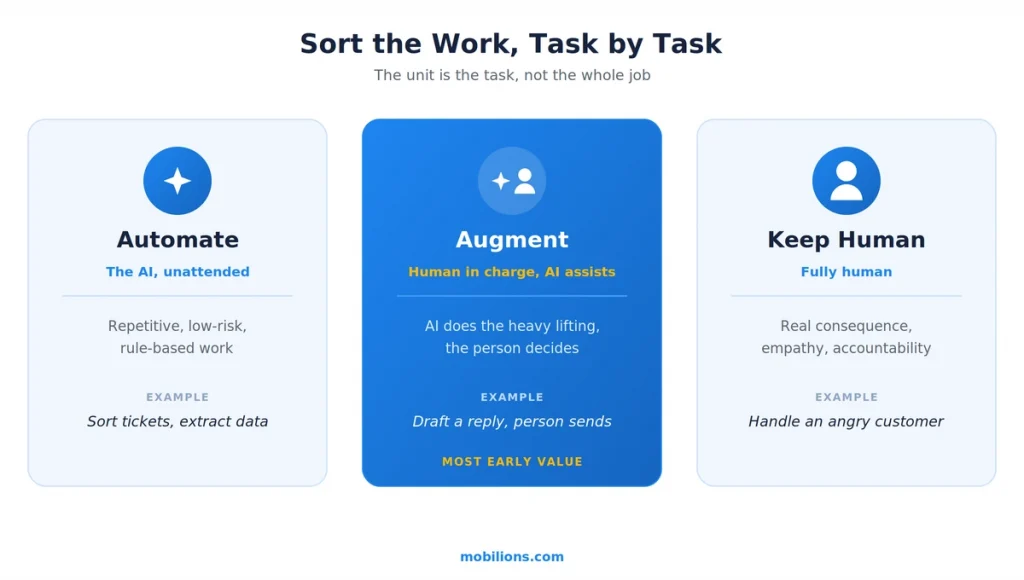
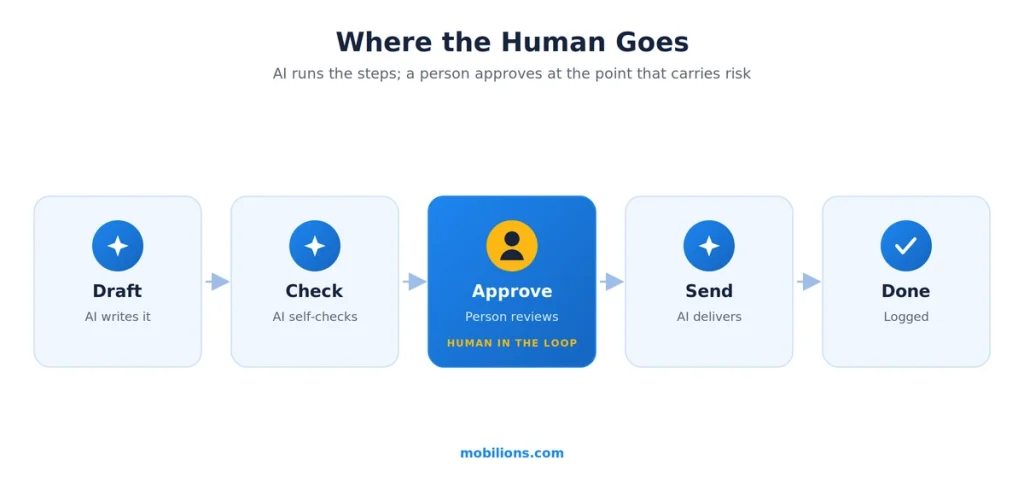
The final function is keeping humans in the loop where it counts and designing systems that fail safely. For high stakes output, a person reviews before anything reaches a customer or a permanent record. This is the core idea behind designing AI to support human workflows rather than replace human judgment wholesale. Ground the model in your own trusted data so it answers from facts instead of guessing, keep sensitive workloads on private or custom AI deployments where you control the data, and add an abstraction layer so you can switch models without rebuilding the product. When the model is unsure, the right behavior is to escalate to a human, not to invent an answer.
McKinsey’s data shows this discipline is spreading: organizations now actively work to mitigate an average of four AI-related risks, up from two in 2022. The companies pulling ahead are not the ones using the most AI. They are the ones managing it best.
The benefits you keep when risk is handled
Once mitigation is in place, the value you captured turns into benefits you can bank. These are the outcomes that survive production.
Lower cost per outcome. Automating high volume cognitive work reduces the cost of each ticket, each document, each review, without cutting the corners that create risk.
Faster cycle times. Research, drafting, and analysis that took days can take minutes, so teams ship and respond faster. Speed compounds across a whole organization.
Higher quality and consistency. A well supervised AI system applies the same standard every time and never has an off day, which raises the floor on quality even when it does not raise the ceiling.
Revenue and retention. Personalization and always on service keep customers engaged and buying, which is where AI most reliably touches the top line.
Resilience and focus. When AI handles the repetitive load, your best people spend their time on the judgment calls, relationships, and creative work that machines cannot do. That is a benefit to morale as much as to output.
The through line is trust. Every one of these benefits depends on people trusting the system enough to rely on it, and that trust is exactly what good mitigation buys you.
A simple framework for weighing value against risk
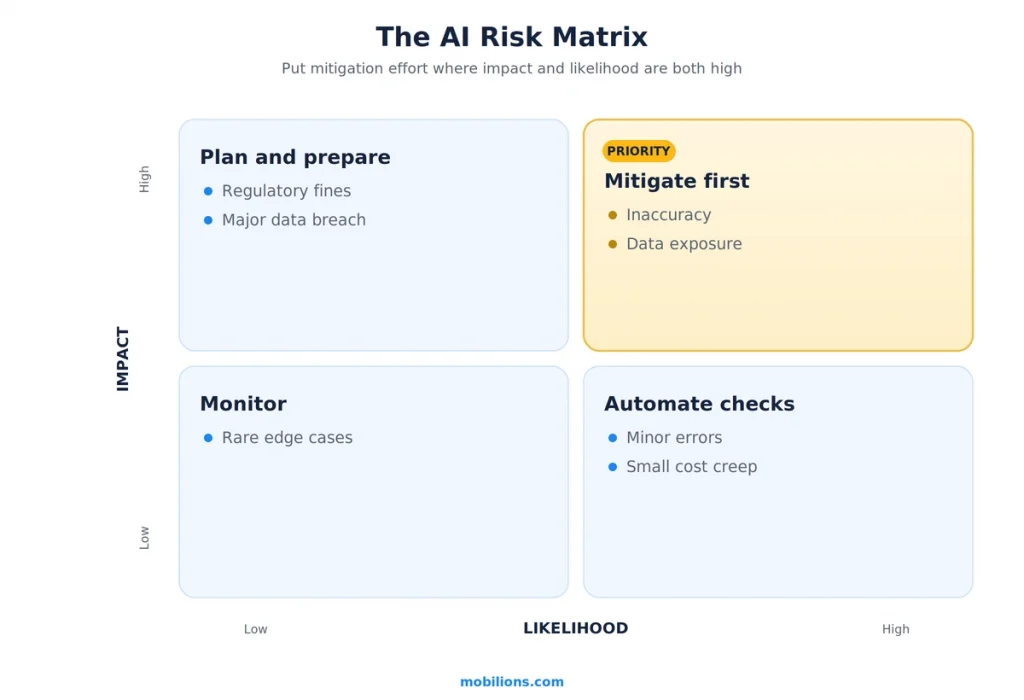
You do not need a committee to decide where to start. For any AI opportunity, score it on two axes and act accordingly.
First, value potential: how much time, cost, or revenue is genuinely at stake if this works? Second, risk level: how bad is a wrong answer, how sensitive is the data, and how hard is a mistake to catch and reverse?
High value and low risk is where you start. These are the internal, low stakes, easy to supervise use cases like drafting, summarizing, and internal search, and they let your team build skill safely. High value and high risk is worth doing, but only with the full mitigation stack: governance, human review, grounding, and monitoring. Low value use cases, at any risk level, can wait no matter how impressive the demo looks. The reversibility test matters most: if a mistake is cheap to catch and undo, you can move fast; if it is not, you slow down and add oversight until it is.
Real-world scenario: an AI customer-support assistant
Consider a company that wants an AI assistant to handle customer support, the single most common AI project I am asked to build.
The value is obvious. The assistant can answer common questions instantly, at any hour, in any language, and free the human team for hard cases. The risks are just as clear. It could give a confidently wrong answer about a refund policy, it could expose one customer’s data to another, and it could be manipulated by a crafted prompt into ignoring its rules.
Here is where mitigation earns its keep. We ground the assistant only in the company’s approved help content, so it answers from real policy rather than guessing. We add strict data controls so it never sees more than the current customer’s information. We validate inputs and outputs against the common attack patterns and red team it before launch. And we design it to escalate to a human the moment it is unsure or the stakes are high, such as anything involving money or account changes.
The benefit the company keeps is a support operation that resolves most routine questions instantly at a fraction of the cost, with customer trust intact and the human team focused on the cases that need them. Same model, same use case. The only reason it delivers benefit instead of a headline is the mitigation layer between the value and the risk.
Common mistakes and myths
Mistake: sending sensitive data to a public model. The convenience is not worth the exposure. Decide what data is allowed near a model before anyone starts pasting.
Mistake: no measurement before scaling. Teams fall in love with a demo and roll it out with no baseline, then cannot tell whether it helped. Measure value on a small use case first.
Mistake: treating mitigation as a launch blocker instead of a design input. Bolted on controls are weak and slow. Build governance and oversight into the system from day one.
Myth: bigger model means better outcome. Past a point, the constraint is your data and your process, not the size of the model. A smaller model grounded in good data beats a giant one guessing.
Myth: AI will replace the whole team. In practice the reliable pattern is augmentation. AI handles volume and speed, humans handle judgment, exceptions, and relationships.
Myth: the real risk is science fiction. The dangerous risks are ordinary and near term: a wrong answer, a data leak, a compliance miss. Those are the ones that cost real money, and the ones you can actually control.
Why Mobilions
Balancing AI value against AI risk is not a research exercise. It is an engineering and governance discipline, and it is what we do. Mobilions has delivered software since 2016, with more than 250 projects completed for over 100 clients across more than 20 countries. We build AI features the way this guide describes: grounded in your own data, wrapped in the right controls, measured against real outcomes, and designed so a human stays in the loop wherever the stakes are high. If you want AI that produces benefits you can prove rather than demos you cannot ship, our AI development team can help you map the value, contain the risk, and build the system properly. You can also explore custom software development or hire dedicated AI engineers to extend your own team.
Summary
AI value, risks, mitigation strategies, and benefits are four parts of one decision. The value is the capability AI adds: automation, better decisions, personalization, generation, and constant availability. The risks are mostly ordinary: inaccuracy, data exposure, security attacks, bias, compliance gaps, weak ROI, and vendor lock-in. The mitigation strategies that work follow the NIST pattern of govern, map, measure, and manage, expressed as clear policy, honest risk classification, real evaluation and monitoring, and human oversight with grounded data. And the benefits you keep, lower cost, faster cycles, higher quality, revenue, retention, and resilience, appear only when the mitigation layer holds. Most organizations have adopted AI. Far fewer have profited from it. The gap is not the model. It is the discipline of managing value and risk together, and that discipline is entirely within your reach.
Frequently asked questions
What is the difference between AI value and AI benefits?
Value is the capability AI adds to a task, such as reading data fast or drafting content instantly. Benefits are the business outcomes you keep once that capability runs safely in production, such as lower cost, faster cycles, or higher retention. Value exists in a demo. Benefits exist on your income statement, and only after the risks between the two are controlled.
What are the main benefits of AI adoption?
Lower cost per outcome, faster cycle times, more consistent quality, higher revenue and retention through personalization and constant availability, and a team freed to focus on judgment and creative work. These benefits are real, but they only materialize when risk is managed. Unmanaged AI often costs more than it saves.
What are the biggest risks of using AI in business?
The most common and damaging risks are inaccuracy (the model stating something false with confidence), data exposure (sensitive information leaving your control), security attacks like prompt injection, bias in automated decisions, compliance gaps under new laws, weak or unproven return on investment, and over dependence on a single vendor. In McKinsey’s 2025 research, inaccuracy was the most reported negative consequence.
What is the real cost of getting AI wrong?
It is rarely a dramatic failure and usually a slow one: wasted spend on tools that never reach production, a confident wrong answer that damages trust, a data leak, or a compliance fine. Research finds most AI value never lands because risk and integration were ignored. The cost of getting it wrong is mostly the value you never capture.
What does risk mitigation actually mean for AI?
Risk mitigation means reducing the chance or the impact of something going wrong, before it does. For AI, it is the set of controls that sit between a capable model and a dependable system: clear policy, testing, human oversight, grounding in trusted data, and monitoring. It does not remove risk, it makes it manageable and reversible.
What are the 4 types of risk mitigation?
The four classic responses are avoid (do not use AI where the risk outweighs the value), reduce (add controls like human review and evaluation), transfer (shift risk through contracts, insurance, or a vendor’s guarantees), and accept (knowingly proceed with a small, monitored risk). Most AI programs use a mix, matched to how high the stakes are.
How do you mitigate AI risks?
Follow the NIST AI Risk Management Framework: govern (set clear policy and accountability), map (classify each use by its stakes and data), measure (test, red team for security, and monitor after launch), and manage (keep humans in the loop on high stakes output, ground the model in trusted data, and design for safe failure). Together these turn a risky demo into a dependable system.
How do you implement AI safely?
Start with a low-stakes, reversible use case, ground the model in your own trusted data, test it against a real evaluation set, and keep a human reviewing high-stakes output. Add a data policy so sensitive information stays private, then monitor after launch. Safe implementation is about controls and staged rollout, not moving slowly for its own sake.
How do you audit the AI tools your team is using?
List every AI tool in use, including the unofficial ones staff adopted on their own. For each, check what data it touches, where that data goes, whether outputs are reviewed, and whether it meets your compliance needs. This shadow AI audit usually surfaces the biggest hidden risk: sensitive data flowing into public tools with no oversight.
What happens if AI makes a wrong decision in your business?
You remain accountable, not the model. That is why high-stakes AI output needs a human in the loop, an audit trail, and a clear owner. A wrong AI decision that reaches a customer can cost money, trust, and compliance standing. Mitigation exists so that wrong outputs are caught before they act, not explained after.
How do you balance AI with human judgment?
Let AI handle volume and speed, and keep humans on judgment, exceptions, and anything high-stakes. The pattern is human in the loop for consequential decisions and human on the loop for monitored routine ones. Over-reliance is its own risk, so design the workflow so people stay accountable and can always override the model.
What is the biggest AI risk companies overlook?
Data exposure through everyday use. Employees paste sensitive customer data, source code, or strategy documents into public models to save time, often with no policy telling them not to. It is one of the most common and most preventable risks, and it is fixed with a clear data policy and a private deployment for sensitive work.
How does AI regulation affect my business in 2026?
If you touch EU users or partners, the EU AI Act matters now. Prohibited practices have applied since February 2025, and most obligations for high-risk AI systems apply from 2 August 2026. That makes compliance a current planning item. Map your AI uses to the law’s risk tiers, keep documentation and audit trails, and treat high-risk uses with extra care.
How do you measure the value or ROI of AI?
Pick one use case, set a baseline for the metric that matters (cost per ticket, hours per report, conversion rate), run the AI system, and compare. Only 39 percent of organizations can currently attribute profit to AI, largely because they scaled before they measured. Measuring a small win first is how you avoid joining them.
Is AI worth the risk for small businesses?
Yes, if you start where value is high and risk is reversible. Internal, low stakes uses like drafting, summarizing, and internal search let a small team capture real value with almost no downside. Save the high risk, customer facing, or regulated uses for after you have built experience and put basic controls in place.
Will AI replace my team, or just change how they work?
For most roles it changes the work rather than removing it. AI takes over repetitive tasks, and people move up to judgment, review, and the exceptions AI cannot handle safely. The teams that benefit treat AI as a tool their people direct and check, not a replacement, and they reskill rather than simply cut.
Can you get AI benefits without taking on risk?
Not entirely, but you can shrink the risk until the benefit clearly outweighs it. That is the whole point of mitigation. By choosing low risk use cases first, grounding models in your own data, keeping humans in the loop, and measuring outcomes, you capture most of the benefit while holding the risk to a level you can manage and reverse.

Mayank Makwana is an AI Solution Architect and Full Stack Developer at Mobilions, where he designs and ships production AI systems — grounded, governed, and owned by the client. He specializes in LLM applications, retrieval-augmented generation (RAG), and AI agents, and also builds modern web applications. He writes senior-level guides on AI architecture, applied machine learning, and web engineering.