Let me start custom AI software development with the most useful number in the field right now. An MIT report in 2025 found that 95 percent of enterprise generative-AI pilots fail to deliver measurable business value. Not 20 percent, not half. Almost all of them. If you are about to spend real money building custom AI, that number should stop you, and then it should teach you, because the reasons those pilots fail are specific and avoidable, and they have almost nothing to do with which model you chose.
I design and ship production AI systems, so here is the answer up front. The 95 percent do not fail because the AI is not smart enough. They fail because the software around the AI was never built to fit the real workflow, the data, and the accountability of the business, which is exactly the part that custom AI software development is supposed to solve and often does not.
The same MIT research found that the few teams who succeed do one thing consistently: they pick a single real problem, build software that integrates deeply into how work actually happens, and partner with people who have shipped this before rather than treating it as a science experiment. This guide is about how to be in that 5 percent: what custom AI software actually is, when to build it, what a real build involves, what it costs, and the mistakes that put projects in the 95 percent.
Key takeaways
If you only have a minute, these are the points that matter most about custom AI software development.
Most AI projects fail on integration, not intelligence. MIT found 95 percent of enterprise generative-AI pilots deliver no measurable value, and the cause is almost always software that does not fit the real workflow and data, not a weak model.
Custom does not mean building everything from scratch. The same research found that buying or partnering with specialists succeeds far more often than pure internal do-it-yourself builds. Custom AI software done well is a focused system built on proven components, often with an experienced partner.
The build has an anatomy, and the model is the small part. Data, retrieval, evaluation, integration, and monitoring are where most of the work and risk live. The model choice is a fraction of the project.
Start with one real problem you can measure. Focused, well-integrated custom AI on a single high-value workflow beats a broad, flashy pilot that impresses in a demo and dies in production.
What is custom AI software development?
Custom AI software development means building an AI system tailored to your specific business, data, and workflow, rather than adopting a generic off-the-shelf tool and hoping it fits. It sits between two things people confuse it with. It is not just calling a model API and getting an answer, and it is not buying a finished AI SaaS product that does one fixed thing. It is the engineering that turns a capable model into a reliable system that does your particular job, on your data, inside your process, with the accountability your business needs.
That distinction matters because the generic tools, as capable as they are, hit a wall in real organizations. The MIT research put it precisely: general tools work well for individuals because they are flexible, but they stall in enterprise use because they do not learn from or adapt to your workflows.
Custom AI software is the layer that closes that gap. It is the retrieval that grounds the model in your documents, the evaluation that keeps it reliable, the integration that puts it inside the tools your team already uses, and the guardrails that make it safe to trust. When we scope AI development with clients, defining that layer clearly is the first job, because it is the layer that decides whether the project lands in the 5 percent or the 95.
Why do most AI projects fail, and what do the 5 percent do?
It is worth sitting with the failure data, because it is the clearest guide to doing this right. The MIT findings are blunt: executives tend to blame regulation or model performance, but the real problem is flawed integration. The tools do not adapt to the workflow, there is a learning gap on both sides, and the pilot never becomes part of how work actually happens. A related pattern showed up in budgets: more than half of generative-AI spending went to sales and marketing tools, while the highest return actually came from unglamorous back-office automation.
This lines up with the broader picture. McKinsey’s State of AI research found that while 88 percent of organizations now use AI in some form, only 39 percent report any real impact on their bottom line. It is the same adoption-without-value gap the MIT pilots show, and for the same reason: buying or building the AI is the easy part, and redesigning the software and the workflow around it is the part almost everyone skips.
The teams that succeed share a profile. They pick one pain point rather than trying to transform everything, they execute it well end to end, and they partner smartly instead of treating a from-scratch internal build as a point of pride. This connects to the single most counterintuitive finding, which deserves its own section because it changes how you should think about the word custom.
Build, buy, or partner? The honest decision
Here is the finding that surprises people. In the MIT data, buying AI solutions from specialized vendors succeeded about 67 percent of the time, while internal do-it-yourself builds succeeded only about a third as often. Read quickly, that sounds like an argument against custom AI entirely. Read carefully, it is not. It is an argument against a specific way of doing custom AI: a team with no track record trying to build a bespoke system from scratch, in isolation, as a first attempt.
The useful way to hold all of this is a spectrum. At one end is buying a finished AI SaaS product, which is fast and cheap and correct when your need is common and a good product already exists. At the other end is a fully bespoke internal build, which gives maximum control and maximum risk.
Custom AI software development, done well, lives in the productive middle: a system built specifically for your problem and your data, assembled from proven components and models rather than reinvented, and built by or with people who have shipped these systems before. That middle is where the control of custom meets the success rate of partnering, and it is precisely the shape the MIT survivors describe.
| Approach | Best when | Tradeoff |
|---|---|---|
| Buy an AI SaaS product | Your need is common and a proven product fits | Fast and cheap, but you get what it does, not what you need |
| Custom, built with a specialist partner | The problem is specific to your business and worth owning | The control of custom with a far higher success rate |
| Fully internal from scratch | You have a proven in-house AI team and rare requirements | Maximum control, but the lowest success rate in the data |
So when should you build custom at all? When the problem is genuinely specific to your business, when it touches your proprietary data or workflow in a way no product covers, when it is core enough to be worth owning, and when getting it right is a real advantage. If the need is generic, buy. If it is specific and valuable, build it custom, and build it the way the 5 percent do.
What does a custom AI build actually involve?
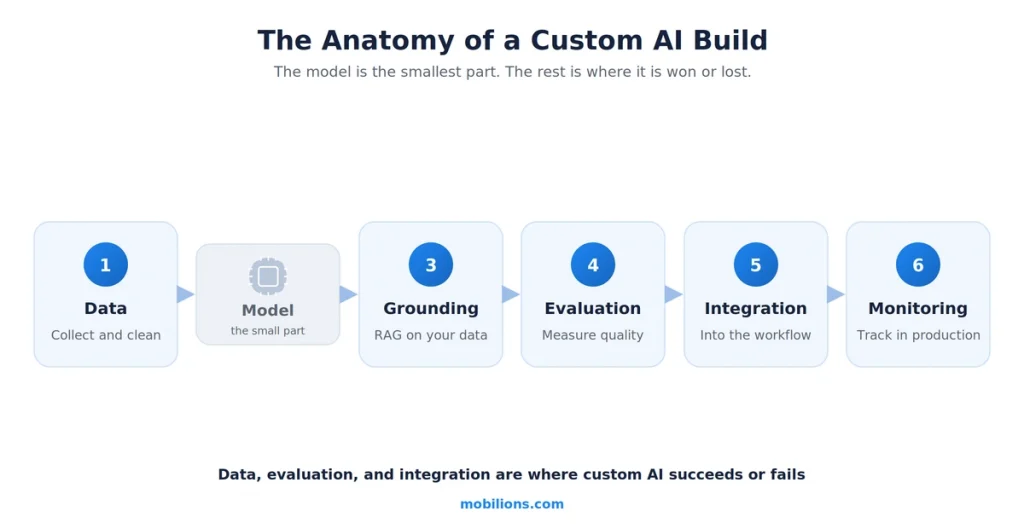
The biggest misconception is that a custom AI project is mostly about the model. It is not. In a real build, choosing and calling the model is one of the smaller pieces. Here is the anatomy of a serious custom AI system, and where the effort actually goes.
| Stage | What happens | Why it is hard |
|---|---|---|
| Data | Collect, clean, and structure the data the AI will use | Most projects underestimate this; bad data caps everything downstream |
| Model choice | Pick the right model and the right approach to using it | Cheaper and faster than teams expect, if the rest is right |
| Grounding | Connect the model to your knowledge with retrieval (RAG) or tuning | This is what makes answers accurate and specific to you |
| Evaluation | Measure quality, accuracy, and failure rates systematically | Without this you are guessing whether it works |
| Integration | Put the AI inside the real tools and workflow | The step the 95 percent skip, and the reason they fail |
| Monitoring | Track quality, cost, and drift in production over time | Models and data change; unmonitored systems quietly degrade |
The pattern to notice is that the model sits in the middle and is the least of your problems. Data quality, grounding, evaluation, and integration are where custom AI software is won or lost, and they are exactly the parts a generic tool cannot do for your specific business. This is also why a custom AI build is as much a custom software project as a modeling one, and why treating it as a pure data-science exercise is a common way to end up in the 95 percent.
RAG, fine-tuning, or prompting? The key technical decision
One choice comes up on almost every custom AI build: how to make a general model behave like an expert on your specific domain. There are three main options, and picking well saves a lot of money.
Prompting, including careful prompt engineering, is giving the model good instructions and context in the request itself. It is the cheapest and fastest, and for many tasks it is enough. Retrieval-augmented generation, or RAG, connects the model to your own documents and data so it answers from your knowledge rather than its training, and it is the workhorse for most custom business AI because it keeps answers current, grounded, and traceable without retraining anything. Fine-tuning actually adjusts the model’s weights on your data, which is powerful for teaching a consistent style or a narrow specialized behavior, but it is more expensive, needs quality training data, and goes stale as your data changes.
| Approach | Best for | Cost and effort |
|---|---|---|
| Prompting | Well-defined tasks a strong model can already do | Lowest |
| RAG | Answering from your own current documents and data | Moderate, and the usual default |
| Fine-tuning | A consistent specialized style or narrow behavior | Highest, and stales as data changes |
The honest default for most custom AI software is RAG, often combined with good prompting, and fine-tuning only where it clearly earns its cost. Teams that reach for fine-tuning first usually spend more and get less than teams that ground a strong model well with retrieval.
What are the hardest parts of custom AI?
A few realities decide whether a custom AI system is trustworthy, and they are worth knowing before you scope one. Data is first and biggest, because an AI system is only as good as the data it stands on, and cleaning and structuring that data is usually the largest and most underestimated part of the work. Evaluation is second, because unlike normal software, AI does not simply pass or fail, so you need a real way to measure accuracy and catch regressions, and without it you are shipping on vibes.
Reliability is third: models can be confidently wrong, so a serious build designs for that with grounding, confidence thresholds, human review where it matters, and clear limits on what the AI is allowed to decide, which is the same discipline behind integrating AI into real workflows. Cost is fourth and ongoing, because a custom AI system has real per-use inference costs and needs monitoring, so the budget does not end at launch.
How much does custom AI software development cost?
Cost varies widely with scope, data readiness, and how much the system has to integrate, but here is an honest picture of the ranges we see.
| Tier | What you get | Cost |
|---|---|---|
| Focused pilot | One workflow, RAG on your data, real evaluation | $30,000 to $80,000 |
| Production system | Integrated, monitored, multiple workflows | $80,000 to $250,000 |
| Enterprise platform | Multi-team, complex data, strong governance | $250,000+ |
Two honest notes on cost. First, the model and its API usage are usually a small line item; the data work, integration, and evaluation dominate the budget. Second, a custom AI system has ongoing costs that off-the-shelf buyers sometimes forget: inference costs per use, monitoring, and periodic re-evaluation as your data and the models change. Budget for the system to live, not just to launch.
A real-world scenario
To make this concrete, picture a company whose support team answers the same complex product questions all day from a sprawling internal knowledge base. The tempting move is a flashy company-wide AI assistant. The move that lands in the 5 percent is narrower and smarter.
A systematic reading of this guide sorts it. They pick one pain point, support answers, rather than boiling the ocean. They ground a strong general model in their actual knowledge base with RAG, so answers are current and traceable, instead of fine-tuning a model that would go stale. They build real evaluation so they know the accuracy before it touches a customer, and they integrate it directly into the support tool the team already uses, with a human approving customer-facing replies.
They monitor quality and cost in production. And because they have not shipped one before, they build it with a partner who has, rather than making it a first-time internal science project. The result is a focused, integrated, measured system that actually deducts hours from real work, which is precisely what the 95 percent never achieve.
Myths and common mistakes
A few misconceptions send projects straight into the 95 percent.
The first myth is that better models solve the problem. They do not. The MIT data is clear that failure is about integration and workflow, not model quality, so pouring effort into model selection while neglecting data and integration is backwards.
The second mistake is boiling the ocean. A broad, transform-everything AI initiative impresses in a slide and dies in production. One focused, measurable problem is how the survivors start.
The third mistake is treating custom as build-everything-from-scratch-internally. The data says that is the lowest-success path. Custom done well means a focused system on proven components, built by or with people who have done it before.
The fourth mistake is skipping evaluation. If you cannot measure the accuracy and failure rate of your AI, you do not know if it works, and you will find out in front of a customer.
The honest caveat worth stating plainly: this is a hard field with a genuinely high failure rate, and anyone who tells you custom AI is a quick plug-in is either selling something or has not shipped one. The good news is that the failures are predictable and avoidable, and the path into the 5 percent is well marked. It just requires doing the unglamorous parts, data, evaluation, and integration, properly.
What separates the 5 percent from the 95 percent?
Everything above collapses into one contrast. The projects that deliver value and the projects that quietly die are not divided by budget or by which model they used. They are divided by a handful of choices, made at the start, about how the work is scoped and built.
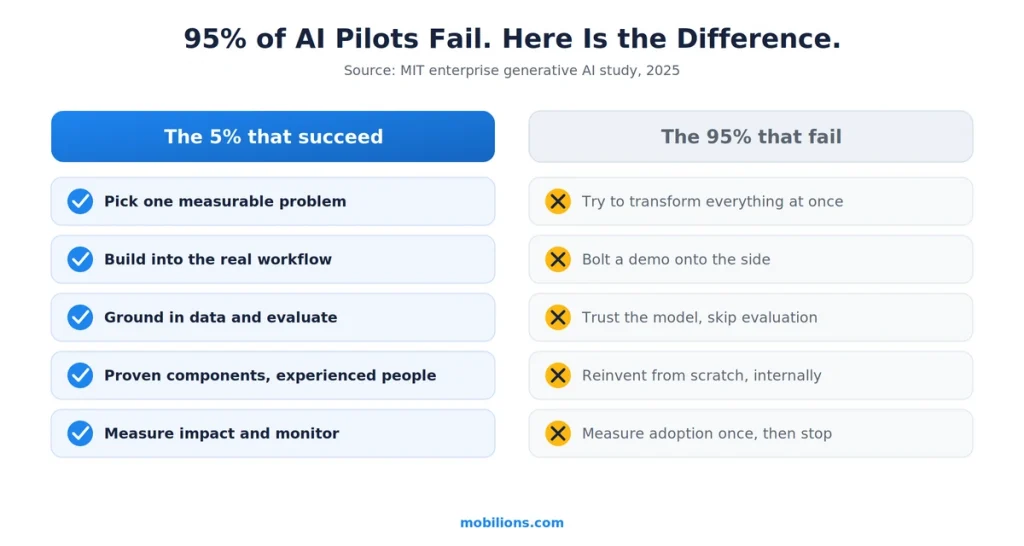
| The 5 percent | The 95 percent |
|---|---|
| Pick one measurable problem | Try to transform everything at once |
| Build the AI into the real workflow | Bolt a demo onto the side of the business |
| Ground the model in real data and evaluate it | Trust the model and skip evaluation |
| Assemble proven components with experienced people | Reinvent everything from scratch, internally, first time |
| Measure impact and monitor in production | Measure adoption once, then stop looking |
None of these are about the AI being clever. They are about the software engineering and the judgment around the AI, which is the entire point of custom AI software development and the reason it is worth doing properly rather than fast. If you get the left column right, the model in the middle almost takes care of itself.
Why Mobilions
Mobilions has been building custom software, mobile apps, and AI solutions since 2016. We have delivered more than 250 projects for over 100 clients across 20-plus countries, which means we have shipped the kind of focused, integrated, evaluated custom AI software this guide describes, not just demoed models. The MIT data is clear that the way into the successful 5 percent is to pick one real problem, integrate deeply, and build with people who have done it before rather than as a first-time internal experiment.
That is exactly the work our AI development team does, and if you would rather not learn the 95 percent lesson the expensive way, or you need to hire AI engineers who have shipped production systems, that is the conversation we have with teams every week.
Summary
Custom AI software development in 2026 is defined by one hard fact: 95 percent of enterprise AI pilots fail, and almost always because the software around the model never fit the real workflow, data, and accountability of the business, not because the model was weak. Custom AI software is the engineering that closes that gap, and doing it well means a focused system built on proven components, grounded in your data with RAG, measured with real evaluation, integrated into the actual workflow, and built with people who have shipped one before.
It does not mean building everything from scratch internally, which the data shows is the lowest-success path. Pick one real, measurable problem, get the unglamorous parts right, and you land in the 5 percent that actually deliver value.
Frequently asked questions
What is custom AI software development?
It is building an AI system tailored to a specific business, its data, and its workflow, rather than using a generic off-the-shelf tool. It is the engineering that turns a capable model into a reliable system that does your particular job on your data, including retrieval, evaluation, integration, and guardrails, not just calling a model API.
What is the difference between custom AI software and regular software?
Regular software follows fixed rules and returns the same output every time. Custom AI software learns from data and handles language, patterns, and judgment, so its output is probabilistic rather than exact. That difference is why AI needs extra engineering regular software does not: grounding, evaluation, guardrails, and monitoring to stay reliable in production.
Why do so many AI projects fail?
MIT found that 95 percent of enterprise generative-AI pilots fail to deliver measurable value, and the cause is integration, not model quality. The tools do not adapt to the real workflow, there is a learning gap, and the pilot never becomes part of how work actually happens. Failure is predictable and avoidable.
Should I build custom AI or buy an off-the-shelf tool?
Buy when your need is common and a proven product fits, because it is faster and cheaper. Build custom AI software when the problem is specific to your business, touches your proprietary data or workflow, and is worth owning. The data favors building with an experienced partner over a from-scratch internal do-it-yourself effort, which has the lowest success rate.
Should I outsource AI development or build an in-house team?
Building a full in-house AI team is slow and costly, and pure do-it-yourself internal builds show the lowest success rate in the data. For most companies, partnering with an experienced AI team is faster and safer for the first production system, then bringing skills in-house over time once the system is proven and running.
How much does custom AI software development cost?
A focused pilot on one workflow with RAG and real evaluation runs about $30,000 to $80,000, a production system with integration and monitoring runs $80,000 to $250,000, and an enterprise platform runs $250,000 or more. The model is usually a small line item; data work, integration, and evaluation dominate the cost, plus ongoing inference and monitoring.
What is the real cost of hiring an AI developer or agency?
In 2026, freelance AI developers charge roughly $35 to $100 per hour in the US and $30 to $60 in Eastern Europe, with senior specialists at $80 to $120 and US consultancies at $125 to $175. An experienced agency usually costs less than a US senior hire and carries less risk than a solo freelancer, because vetting and accountability come built in.
What are the hidden costs in custom AI development?
The model API is rarely the big number. The costs that surprise teams are data cleaning and preparation, building real evaluation, integration into existing systems, ongoing inference at scale, and monitoring and maintenance after launch. A good partner names these upfront, because ignoring them is how a cheap pilot turns into an expensive surprise.
Is custom AI software worth the investment?
It is worth it when it solves one specific, measurable problem tied to your own data or workflow that an off-the-shelf tool cannot. Focused custom AI on a real bottleneck, like back-office automation or support, often pays back quickly. Broad, unfocused AI initiatives are the ones that waste money, not custom AI itself.
Can I build custom AI software without coding?
Partly. No-code AI tools are strong for quick internal automations and simple apps, but in 2026 they hit a wall at roughly 60 to 70 percent of what a real product needs. They struggle with custom logic, proprietary data integration, scale, and true ownership. For production custom AI on your own data, you still need engineering.
What is the difference between RAG and fine-tuning?
RAG, retrieval-augmented generation, connects a model to your own documents so it answers from your current knowledge without retraining. It is the usual default for custom business AI. Fine-tuning adjusts the model’s weights, which suits a narrow specialized style but costs more and goes stale as data changes. Most custom AI uses RAG with good prompting, and fine-tuning only where it earns its cost.
What is the difference between RAG and fine-tuning?
RAG, retrieval-augmented generation, connects a model to your own documents so it answers from your current knowledge without retraining. It is the usual default for custom business AI. Fine-tuning adjusts the model’s weights, which suits a narrow specialized style but costs more and goes stale as data changes. Most custom AI uses RAG with good prompting, and fine-tuning only where it earns its cost.
What does a custom AI build actually involve?
Data collection and cleaning, model choice, grounding the model in your knowledge with RAG or tuning, systematic evaluation, integration into your real tools and workflow, and production monitoring. The model choice is one of the smaller pieces; data, evaluation, and integration are where most of the effort and risk are.
How long does it take to build custom AI software?
A focused pilot typically takes a few months, and a fully integrated production system takes longer depending on data readiness and how many workflows it touches. The timeline is driven far more by data quality and integration complexity than by the model itself.
Can I test custom AI with a pilot before full development?
Yes, and you should. A focused pilot or proof of concept on one workflow, with real data and honest evaluation, tells you whether the approach works before you commit to a full build. It reduces risk, proves value to stakeholders, and is exactly how the successful 5 percent avoid expensive dead ends.
What questions should I ask an AI development company before hiring?
Ask how they ground the model in your data, how they measure accuracy, how they handle wrong answers and guardrails, who owns the code and data, and what ongoing cost looks like. Ask for a shipped example, not a demo. Vague answers on evaluation and ownership are the clearest warning signs.
What are the biggest risks in custom AI development?
Poor or messy data, no real evaluation so you cannot tell if it works, models that are confidently wrong without guardrails, weak integration so the AI never enters the real workflow, and unmanaged ongoing costs. Every one of these is addressable by design, and skipping them is how projects join the 95 percent that fail.
Can small and mid-size companies afford custom AI software?
Yes, if they scope it right. A focused custom AI system solving one real, measurable problem is well within reach for a mid-size company and often pays back quickly, especially in back-office automation. The expensive failures come from broad, unfocused initiatives, not from starting small and specific.

Mayank Makwana is an AI Solution Architect and Full Stack Developer at Mobilions, where he designs and ships production AI systems — grounded, governed, and owned by the client. He specializes in LLM applications, retrieval-augmented generation (RAG), and AI agents, and also builds modern web applications. He writes senior-level guides on AI architecture, applied machine learning, and web engineering.