Fitness mobile app development in 2026 costs roughly $25,000 to $40,000 for a lean MVP, $70,000 to $110,000 for a solid cross-platform app (about 12 to 16 weeks), and $120,000 to $300,000+ for a feature-rich, multi-platform product. Wearable sync with Apple Health, Google Fit, Fitbit, and Garmin is now expected, not optional. The smart path for most founders is a cross-platform MVP with five to seven core features, validate real usage and retention, then invest further. The market is large (around $13.5 billion in 2026 and growing about 13 percent a year), but most apps fail on retention, so build for the second week, not just the first download.
Fitness app development looks simple from the outside, a few workout screens and a timer, and expensive and confusing the moment you actually start pricing it. The truth sits in between. A fitness app is a real software product with wearable integrations, health data, subscriptions, and a brutal retention problem, and what you build and how you build it decides whether it earns money or joins the graveyard of abandoned fitness apps.
This guide is the practical version for founders and fitness businesses. It covers what fitness mobile app development actually involves in 2026, whether the market is worth entering, the features users expect, real cost and timeline ranges, the native-versus-cross-platform decision, monetization, why apps fail, and how to choose a development team. We build mobile apps at Mobilions, so this is a builder’s view with real numbers, not a sales pitch dressed as a guide.
What fitness mobile app development actually involves in 2026
It helps to see the whole scope before the price tags, because the cost follows directly from it. A modern fitness app is several systems working together.
There is the app itself on iOS and Android, the workout and content engine (plans, exercises, timers, tracking), wearable and health integrations so the app reads steps, heart rate, and workouts from the devices people already wear, a backend for accounts, data, and sync, subscriptions and payments, and the analytics you need to understand retention. On top of that sit the parts founders often forget: onboarding, notifications, a content pipeline to keep workouts fresh, and ongoing maintenance after launch.
The reason fitness apps cost more than a simple utility is this integration surface. Reading health data correctly, syncing across devices, and keeping subscriptions and content flowing is where the engineering hours go, and it is also what separates an app people keep from one they delete in a week.
Is a fitness app worth building? The 2026 market
Before spending anything, it is fair to ask whether the market justifies it, and the numbers are encouraging with a catch.
The fitness app market is large and growing, roughly $13.5 billion in 2026 and projected to keep expanding at about 13 percent a year, according to market research. Health and fitness apps also monetize better than most categories: subscriptions drive the majority of revenue, most of it from annual plans, and the category has one of the highest lifetime values on the App Store. Wearable-connected fitness is the fastest-growing slice as more people own a Fitbit, Garmin, or smartwatch.
The catch is that a big market is also a crowded one, and averages hide a harsh distribution: a small number of apps take most of the money while the majority struggle to retain users. So the honest answer to “is it worth it” is yes, the market is real and monetizable, but only if your app earns its place through genuine value and retention. Building one because the market is big, without a reason users would stay, is how you become part of the losing majority.
Features users actually expect
Feature scope is the single biggest driver of cost, so it pays to separate what is essential from what is nice to have.
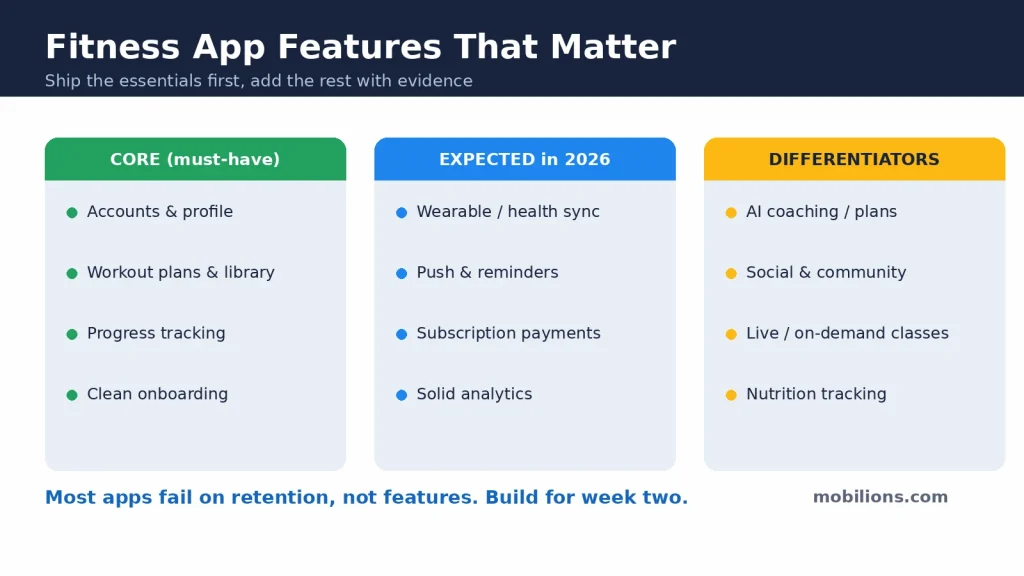
Core, non-negotiable features: account and profile, workout plans and exercise library, activity and progress tracking, and clean onboarding. Expected in 2026, not optional: wearable and health-app sync (Apple Health via Apple’s HealthKit, Google’s Health Connect, plus Fitbit and Garmin), push notifications and reminders, and subscription payments. Differentiators worth considering: AI-assisted plans or coaching, social and community features, live or on-demand classes, nutrition and macro tracking, and gamification. Often overlooked but important: solid analytics, a content management system so you can update workouts without a new release, and accessibility.
The mistake is trying to ship all of it at once. The features that matter most for launch are the core set plus wearable sync and a reason to come back; everything else can follow once real users tell you what they want.
How much does fitness mobile app development cost?
Here are honest 2026 ranges. Your number depends on features, platforms, team location, and design polish, but these brackets are realistic.
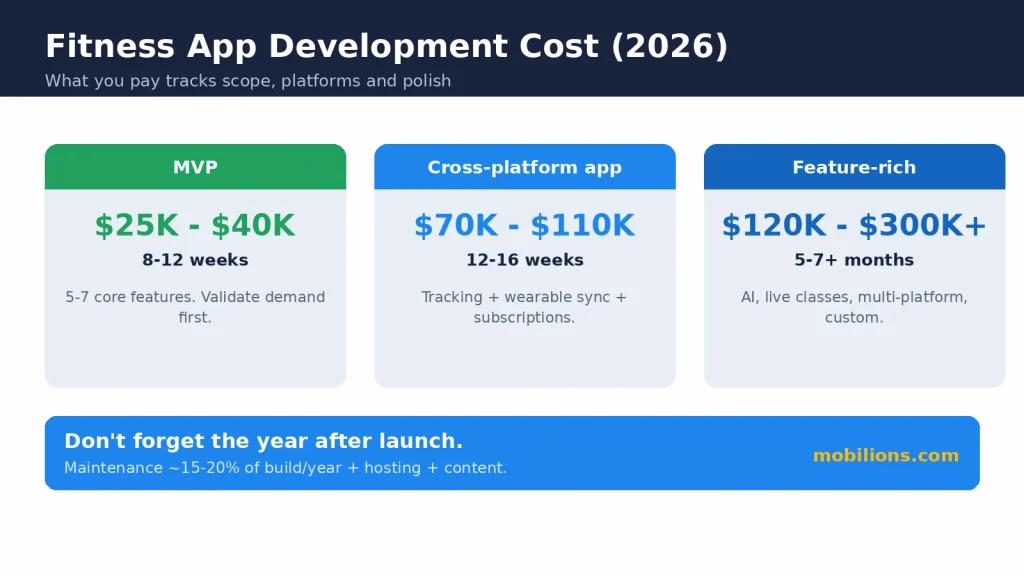
A lean MVP with five to seven core features runs about $25,000 to $40,000. A solid cross-platform app with tracking, wearable sync, and subscriptions typically lands $70,000 to $110,000 over roughly 12 to 16 weeks. Add templated workout plans, macro tracking, barcode scanning, and richer content and you are looking at $120,000 to $190,000 over five to seven months. A feature-rich, multi-platform product with AI, live classes, and heavy custom design can reach $300,000 or more.
Then there are the costs founders miss: ongoing maintenance (budget roughly 15 to 20 percent of build cost per year), backend and hosting, third-party services (payments, analytics, push), app store fees, and content creation to keep the app fresh. An app is not a one-time purchase; it is a product you fund over its life. Planning only for the build and not the year after it is the most common budgeting mistake.
How long does it take?
Timeline tracks scope closely, so use these as planning anchors.
A basic MVP typically takes 8 to 12 weeks. A full-featured cross-platform app runs 4 to 7 months. A large, multi-platform product with AI and custom everything can take longer still. Those windows assume a focused scope and prompt decisions from your side; the fastest way to blow a timeline is to keep changing the requirements mid-build. A good team will push you to lock an MVP scope precisely so you can launch, learn, and then expand, rather than chasing a perfect first version that never ships.
Native vs cross-platform: the real decision
This choice shapes both cost and quality, so it deserves a clear-eyed look rather than a religious one.
Native (Swift for iOS, Kotlin for Android) gives the best possible performance and the tightest access to device and health features, at a cost: you build two apps, which roughly doubles the effort and price. Cross-platform (Flutter or React Native) builds one codebase for both platforms, cutting time and cost substantially while delivering performance that is more than good enough for the vast majority of fitness apps. For most founders in 2026, cross-platform is the sensible default, especially for an MVP, because it gets you to both stores faster and cheaper.
The pragmatic pattern many teams use: start with a cross-platform MVP to validate demand, then, if and when you have real traction and a specific need for native performance, invest in native for the platform that matters most. Choosing native from day one for a product you have not validated is how budgets disappear before you have a single retained user.
iOS, Android, or both?
A related question, with a simple framing. If budget is tight and you want to validate, launch on both at once via cross-platform, which a single Flutter or React Native build gives you almost for free compared with two native apps. If you must pick one to start, choose the platform where your audience actually is: iOS users tend to spend more on subscriptions, while Android has larger global reach, so the right answer depends on your market, not on a general rule. For most consumer fitness apps targeting the US and similar markets, launching on both through cross-platform is the cleanest path.
Build custom or use a template?
Templates and app builders exist, and they have a place, so here is the honest trade-off.
A template or no-code builder can get a very simple fitness app live cheaply and fast, which is fine for a basic idea you want to test with minimal money. The limits show up quickly: templates struggle with deep wearable integration, custom workout logic, real scalability, and the polish that retention depends on, and you do not own the foundation. A custom build (or a custom MVP) costs more but gives you the integrations, the experience, and the ownership that a real product needs. A reasonable rule: use a template only to test a concept with near-zero budget; build custom the moment you are serious about retention and growth.
How to monetize a fitness app
Revenue model matters as much as features, and the data points clearly in one direction.
Subscriptions are the dominant and most durable model for fitness apps, with annual plans driving most of that revenue, so a freemium-to-subscription funnel (free core, paid premium plans, coaching, or content) is the default worth designing around. Other models include one-time purchases or unlocks, in-app purchases for specific content, ads (usually weak for fitness and often at odds with a premium feel), and B2B2C deals with gyms, employers, or insurers. For most consumer fitness apps, a well-designed subscription with a genuine free tier and clear premium value is the model to build for, and it should be designed in from the start, not bolted on later.
Why fitness apps fail (and how to avoid it)
Most fitness apps do not fail on features; they fail on retention, so this is where to focus.
The common pattern is a strong first download and a collapse by week two, because the app gave people no reason to come back or asked too much too soon. The fixes are consistent: nail onboarding so users reach value fast, use notifications and streaks thoughtfully to build habit without nagging, sync with wearables so tracking is effortless, keep content fresh so there is always a reason to open the app, and measure retention obsessively from day one. Building for the first install instead of the second week is the single most expensive mistake in this category, and it is entirely avoidable with the right priorities.
How to choose a fitness app development company
Since the team you pick largely determines the outcome, evaluate it properly.
Look for a partner with real mobile and health-integration experience (ask to see fitness or health apps they have shipped), a clear MVP-first process rather than a push to build everything at once, transparent pricing with no vague lump sums, and honest answers about trade-offs, cost, and timeline. Ask what is included (design, backend, testing, store submission, post-launch support), who owns the code (you should), and how they handle maintenance. Watch for red flags: prices that seem too good to be true, no relevant portfolio, reluctance to explain the plan, or promises to build a huge app cheaply and fast. The right questions up front save far more than they cost.
How Mobilions helps
We build fitness and health mobile apps end to end, and we have shipped software since 2016. For founders, we start with a tight MVP: the core features plus wearable sync and the retention basics, built cross-platform so you reach both stores fast and affordably, with a clear path to native later if your traction justifies it. We handle the hard parts properly, Apple Health and Google Fit integration, subscriptions, sync, and analytics, design for the second-week return rather than just the first download, and hand you full ownership of the code. We are also honest when a smaller build or a phased plan serves you better than the biggest version.
What we will not do is sell you a $300,000 app when a $40,000 MVP is what you need to validate the idea, because the point is a product that earns its keep, not the largest possible invoice.
The bottom line
Fitness mobile app development in 2026 is a real investment with real returns for the apps that earn retention. Budget roughly $25,000 to $40,000 for an MVP, $70,000 to $110,000 for a solid cross-platform app, and more for a feature-rich product, and remember the ongoing costs after launch. Expect wearable sync as standard, build cross-platform first for most cases, and design subscriptions and retention in from the start.
The market is large and monetizes well, but it is crowded and unforgiving, and most apps fail on the second week rather than the first. Start focused, validate with a real MVP, measure retention, and expand from evidence rather than ambition. Do that, and a fitness app is one of the better products you can build in 2026. Rush a bloated first version without a retention plan, and it will be one of the more expensive lessons.
If you want a straight estimate and an MVP plan for your specific fitness app idea, that is exactly the conversation our senior mobile engineers have with founders every week.
Book a discovery call for an honest scope and quote, no obligation. You can also explore our mobile app development services and how we work with fitness and wellness businesses.
Key takeaways
- Fitness mobile app development in 2026 costs about $25,000 to $40,000 for an MVP, $70,000 to $110,000 for a solid cross-platform app, and $120,000 to $300,000+ for feature-rich, multi-platform products.
- Wearable and health-app sync (Apple Health, Google Fit, Fitbit, Garmin) is now expected, not a premium add-on.
- Timelines run about 8 to 12 weeks for an MVP and 4 to 7 months for a full app; changing scope mid-build is the main cause of delays.
- Cross-platform (Flutter or React Native) is the sensible default for most apps and MVPs; go native later if traction and performance needs justify it.
- Budget for ongoing costs (maintenance about 15 to 20 percent of build per year, hosting, content, store and service fees), not just the build.
- Subscriptions, especially annual plans, are the dominant and most durable monetization model; design the funnel in from the start.
- Most fitness apps fail on retention, not features; nail onboarding, wearables, fresh content, and second-week return, and choose a team with real health-app experience.
Frequently asked questions
How much does it cost to build a fitness app in 2026?
A lean MVP with five to seven core features costs about $25,000 to $40,000. A solid cross-platform app with tracking, wearable sync, and subscriptions typically runs $70,000 to $110,000, and a feature-rich, multi-platform product can reach $120,000 to $300,000 or more. The final number depends on features, platforms, team location, and design, and you should also budget ongoing costs of roughly 15 to 20 percent of the build per year.
How long does it take to develop a fitness app?
A basic MVP usually takes 8 to 12 weeks, and a full-featured cross-platform app takes 4 to 7 months. Larger products with AI, live classes, and custom design take longer. These timelines assume a focused, locked scope, changing requirements mid-build is the most common cause of delays, so agreeing a precise MVP scope up front is the fastest route to launch.
Should I build my fitness app native or cross-platform?
For most founders, cross-platform (Flutter or React Native) is the sensible default, especially for an MVP, because it builds one codebase for both iOS and Android, cutting time and cost while delivering more than enough performance for a fitness app. Native (Swift and Kotlin) gives the best performance and device access but roughly doubles the cost. A common pattern is a cross-platform MVP first, then native later if traction justifies it.
iOS, Android, or both, which should I launch on?
If you build cross-platform, you can launch on both at once for close to the cost of one, which is usually the best path for validation. If you must pick one, choose where your audience is: iOS users tend to spend more on subscriptions, while Android has larger global reach. For most US-focused consumer fitness apps, launching on both through a cross-platform build is the cleanest option.
What features should a fitness app have?
The core essentials are accounts, workout plans and an exercise library, progress tracking, and clean onboarding. In 2026, wearable and health-app sync, notifications, and subscription payments are expected too. Differentiators like AI coaching, social features, live classes, and nutrition tracking are worth adding once the core proves itself. Avoid shipping everything at once, launch with the essentials plus a strong reason to return.
Is a fitness app a good investment?
The market is large, around $13.5 billion in 2026 and growing about 13 percent a year, and fitness apps monetize better than most categories, mainly through subscriptions. But it is crowded, and most apps fail on retention, so it is a good investment only if your app delivers genuine, repeatable value that keeps users coming back. Validate with an MVP and measure retention before investing heavily.
Why do so many fitness apps fail?
Most fail on retention rather than features: a strong first download followed by a collapse in week two, because the app gave users no reason to return or demanded too much too soon. The fixes are fast onboarding, thoughtful notifications and streaks, effortless wearable-based tracking, fresh content, and measuring retention from day one. Building for the first install instead of the second week is the category’s most expensive mistake.
How should I monetize my fitness app?
Subscriptions are the dominant and most durable model, with annual plans driving most revenue, so a freemium-to-subscription funnel (free core plus paid premium content or coaching) is the default to design around. Other options include in-app purchases, one-time unlocks, ads (usually weak for fitness), and B2B2C deals with gyms or employers. Design the subscription and its free-tier value from the start rather than adding it later.
Can I use a template or app builder for a fitness app?
A template or no-code builder can launch a very simple app cheaply, which is fine for testing a basic idea with minimal budget. But templates struggle with deep wearable integration, custom logic, scalability, and the polish retention needs, and you do not own the foundation. Use a template only to test a concept with near-zero budget, and build custom once you are serious about retention and growth.
How do I choose a fitness app development company?
Look for real mobile and health-integration experience (ask to see shipped fitness or health apps), an MVP-first process, transparent pricing, and honest answers about trade-offs. Confirm what is included, who owns the code (you should), and how maintenance works. Watch for red flags like prices that seem too good to be true, no relevant portfolio, or promises to build a huge app cheaply and fast.
Does Mobilions build fitness mobile apps?
Yes. We build fitness and health apps end to end, starting with a focused cross-platform MVP, core features plus wearable sync and retention basics, with a clear path to native later. We handle Apple Health and Google Fit integration, subscriptions, sync, and analytics, design for the second-week return, and hand you full ownership. Book a discovery call for an honest scope, timeline, and quote for your idea.

Dhaval Patel is a Senior Mobile Developer at Mobilions with deep, hands-on experience shipping Android, iOS, and cross-platform apps. He has helped build products used by teams across 20+ countries. He writes practical guides on mobile app development, app performance, and the real-world trade-offs of building for phones and tablets.