Grocery delivery app development in 2026 is not one app, it is a system: a customer app, a shopper or driver app, and an admin dashboard, usually connected to store inventory. A basic single-store MVP runs roughly $25,000 to $60,000 over 2 to 4 months. A real multi-store or quick-commerce platform (Instacart-style) with routing, inventory sync, and dark-store fulfilment runs $150,000 to $500,000 and up, over 5 to 9 months. The market is huge and growing fast (online grocery is close to $0.9 trillion in 2026), but the hard part is operations, real-time tracking, substitutions, and delivery logistics, not the shopping screens. Start with one model and one region, get the operations right, then scale.
Grocery delivery app development looks like building a shopping app with a delivery button, and that misunderstanding is exactly why so many of these projects blow their budgets. What you are actually building is a small logistics company that happens to have an app on top. The catalogue and cart are the easy part. Keeping inventory accurate, routing drivers, handling out-of-stock substitutions, and tracking an order in real time is where the real engineering and the real cost sit.
This guide is the practical version for founders, retailers, and startups. It covers what grocery delivery app development actually involves, whether the 2026 market is worth entering, the business models to choose from, the features each app needs, honest cost and timeline ranges, the parts that are genuinely hard, how to monetize, and how to pick a team. We build delivery and marketplace apps at Mobilions, so this is a builder’s view with real numbers, not a brochure.
What grocery delivery app development actually involves
Before any pricing makes sense, you need to see the full system, because the cost comes straight from it. A working grocery delivery product is at least three connected apps plus a backend.
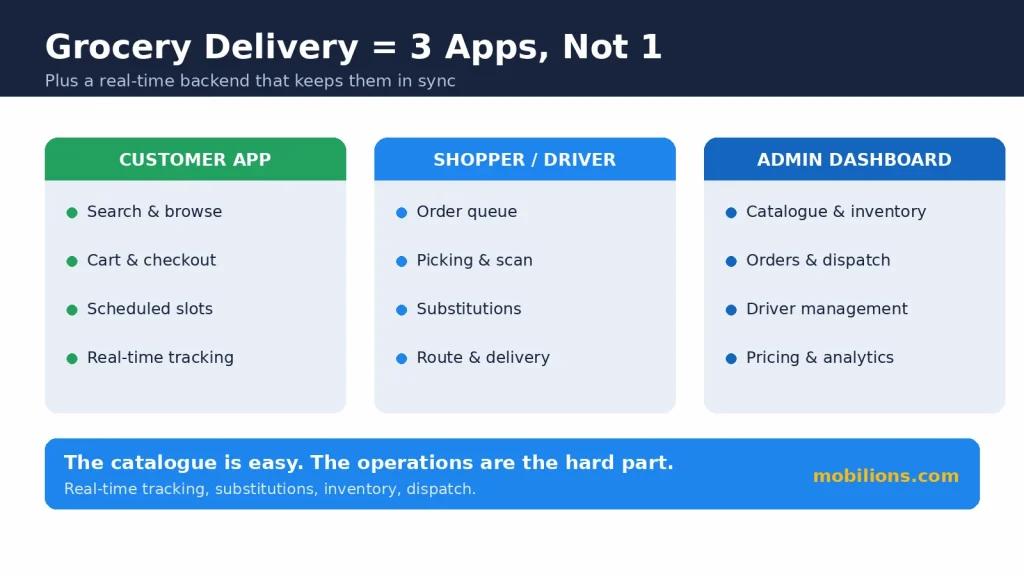
There is the customer app (browse, search, cart, pay, track), the shopper or driver app (accept orders, pick items, handle substitutions, navigate, deliver), and the admin dashboard (catalogue, inventory, orders, drivers, pricing, analytics). Underneath sits a backend that ties them together in real time, plus integrations with payments, maps and routing, notifications, and often a store or POS system for live inventory. Depending on your model, you may also need a store-partner interface and a dark-store or warehouse workflow.
That is why grocery delivery costs more than a typical app. You are not building one screen flow; you are building three coordinated apps and the real-time operations engine that keeps them in sync. Get that engine right and the business works. Get it wrong and you have a pretty catalogue that cannot actually fulfil an order.
Is a grocery delivery app worth building in 2026?
The market case is strong, with an important caveat about where the difficulty lives. Online grocery is one of the largest and fastest-growing digital markets: it sits close to $0.9 trillion globally in 2026 and is projected to keep growing at more than 20 percent a year, according to market research. Quick commerce, the 15-to-30-minute delivery model, is growing even faster, and grocery is its anchor category. Dark stores, small local fulfilment hubs, are expanding rapidly to make that speed possible.
So the demand is real and rising. The caveat is that this is an operationally hard, thin-margin business dominated by well-funded players, and the winners compete on fulfilment speed, accuracy, and unit economics, not on app design. A grocery delivery app is worth building if you have a genuine edge, a store network, a region the incumbents serve poorly, a niche (organic, ethnic, bulk), or a fulfilment advantage, and it is a hard place to be without one. Build for the operations, not just the app.
The main business models
Your model decides your architecture and your cost, so choose it deliberately before you build. There are four common ones.
Multi-vendor marketplace (Instacart-style): you connect many stores and shoppers to customers without owning inventory. Widest reach, most complex to build, because you are coordinating many partners, shoppers, and catalogues.
Single-store or chain app: a retailer’s own delivery app for its own stores and inventory. Simpler and the most common starting point for an existing grocery business.
Quick-commerce / dark store: you own small local fulfilment hubs and promise very fast delivery (15 to 30 minutes). Operationally intense and capital-heavy, but the fastest-growing model.
Hyperlocal / store-fulfilled: you use existing stores as fulfilment points, which is how large retailers have scaled delivery cheaply. A pragmatic middle path.
Most new entrants should start with the narrowest model that fits their real advantage, usually a single-store or single-region app, prove the operations, and expand. Trying to launch a full multi-vendor marketplace as a first product is the classic way to run out of money before the operations work.
Must-have features, app by app
Scope drives cost, so it helps to separate the essentials for each app from the extras.
Customer app (essential): smart product search and browse, cart and checkout, multiple payment options, scheduled delivery slots, real-time order tracking, order history and reorder, and substitution preferences. Shopper/driver app (essential): order queue, in-store picking list, barcode or item scan, substitution handling with customer approval, route navigation, and proof of delivery. Admin dashboard (essential): catalogue and inventory management, order and dispatch management, driver management, pricing and promotions, and analytics.
Nice-to-have and differentiating features, AI personalization, demand forecasting, loyalty and subscriptions, multi-language, and advanced route optimization, matter, but they come after the core three-app loop works end to end. The mistake is padding the customer app with features while under-building the shopper and admin sides, which is where fulfilment actually happens.
| App | Core job | Watch out for |
| Customer | Browse, order, track | Real-time tracking, substitutions |
| Shopper / driver | Pick, substitute, deliver | Picking flow, routing, offline areas |
| Admin | Catalogue, orders, drivers | Live inventory sync, dispatch logic |
How much does grocery delivery app development cost?
Here are honest 2026 ranges. They are wide because “grocery delivery app” spans a single-store MVP and a national marketplace.
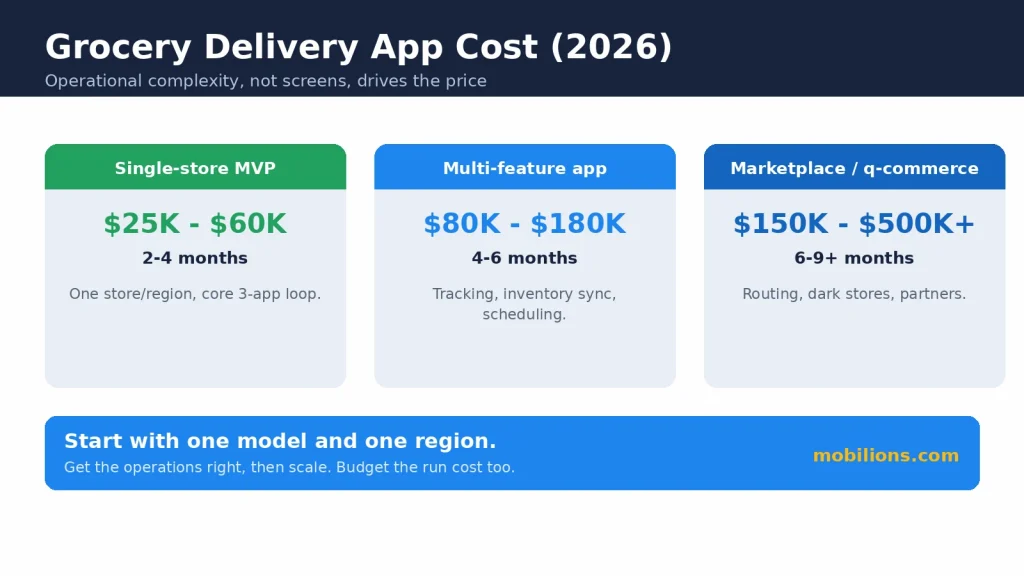
A basic single-store MVP (one store or region, core customer app plus a simple driver and admin flow) runs roughly $25,000 to $60,000 over 2 to 4 months. A solid multi-feature app with real tracking, inventory sync, scheduling, and a proper admin runs $80,000 to $180,000. A multi-store or quick-commerce platform with routing, dark-store workflows, and partner systems runs $150,000 to $500,000, and a large enterprise marketplace can exceed $1,000,000. The single biggest cost driver is not the customer app; it is the operational complexity, routing, real-time inventory, multi-party coordination, behind it.
Then there are the ongoing costs founders miss: maintenance (roughly 15 to 20 percent of build per year), backend and hosting that must scale with orders, third-party services (maps, payments, SMS, push), app store fees, and the operational cost of running deliveries themselves. An app is the smaller line item; running the operation is the bigger one. Budget for both from the start.
How long does it take?
Timeline tracks model and scope closely. A single-store MVP typically takes 8 to 16 weeks. A full multi-feature app runs 4 to 6 months. A multi-store or quick-commerce platform runs 6 to 9 months or more. Those windows assume a locked scope and a single model to start; the fastest way to overrun is to try to build every model and feature at once. A good team will push you to launch a focused first version in one region so you can learn the operations before scaling them.
How it is built: the tech behind it
A quick, non-technical picture of the moving parts, because it explains where the effort goes. The apps are usually built cross-platform (Flutter or React Native) to reach iOS and Android efficiently, on top of a backend that handles orders, users, and real-time state. Real-time tracking uses live location and websockets so the customer sees the driver move.
Payments run through a provider like Stripe rather than being built from scratch. Routing and navigation use a maps platform such as Google Maps Platform for driver directions and delivery estimates. And inventory either lives in your admin or syncs from a store or POS system so the catalogue reflects what is actually in stock.
The engineering value is in wiring these together reliably under real order volume, which is exactly the part that is easy to underestimate.
The parts that are genuinely hard
It is worth naming where projects actually struggle, because that is where your budget and your team’s quality really matter.
Real-time tracking that stays accurate as drivers move through dead zones is harder than it looks. Substitutions, an item is out of stock, the shopper needs a fast, clear way to offer an alternative and get approval, are a constant source of customer frustration when done badly. Live inventory that reflects reality prevents the worst experience of all, ordering something that is not there. Routing and dispatch, assigning orders to the right driver and sequencing deliveries efficiently, is a genuine optimization problem at scale.
And peak load, everyone orders at similar times, means the system has to hold up when it matters most. These are the difference between an app that demos well and one that runs a real operation, and they are where an experienced team earns its fee.
How to monetize a grocery delivery app
Revenue comes from several levers, and most platforms combine them. Delivery fees and service fees on each order are the direct model. Markups on product prices are common in marketplaces. Subscriptions (a membership for free or cheaper delivery) improve retention and are widely used by the leaders. Commissions from partner stores apply in marketplace models. And in-app advertising or promoted products become a real revenue line at scale. The honest point about grocery is that margins are thin, so the model has to be designed carefully around real unit economics, what it actually costs you to fulfil an order, rather than assumed. A beautiful app with negative unit economics is not a business.
Why grocery delivery apps fail
Most failures are not about the app; they are about the operation and the economics. The common patterns: launching too broad (many stores or the whole city) before the fulfilment works, so quality collapses; ignoring unit economics until the delivery costs eat the revenue; under-building the shopper and admin sides so orders cannot be fulfilled smoothly; poor inventory accuracy that leads to constant substitutions and refunds; and competing on app features against incumbents who compete on speed and price.
The fixes are consistent: start narrow, get the operations and the numbers right in one region, build the fulfilment side as seriously as the customer side, and expand only from evidence. Treating this as an app project rather than an operations business is the root mistake.
How to choose a development company
Because the operational engine decides success, pick a team that has built one before. Look for a partner with real delivery, logistics, or marketplace experience (ask to see comparable apps they have shipped), an MVP-first, one-model-first process rather than a push to build everything, transparent pricing with a clear scope, and honest answers about the operational hard parts, not just the screens. Confirm what is included (the three apps, backend, integrations, testing, support), who owns the code (you should), and how they handle scaling and maintenance. Red flags: a quote that only prices the customer app, no relevant portfolio, hand-waving about real-time tracking and inventory, or a promise to build a full marketplace fast and cheap.
How Mobilions helps
We build delivery and marketplace apps end to end, and we have shipped software since 2016. For grocery, we start by pinning down your model and your real advantage, then build a focused first version, the three-app loop for one store or region, with the operational parts (real-time tracking, substitutions, inventory, dispatch) built properly rather than faked for a demo. We build cross-platform to reach both stores efficiently, integrate payments, maps, and inventory the right way, design around your actual unit economics, and hand you full ownership of the code. We scale it with you once the operation works in one place.
What we will not do is quote you a cheap customer app and leave the fulfilment side hollow, because that is precisely the app that cannot run a real delivery business.
The bottom line
Grocery delivery app development in 2026 is a systems-and-operations build, not a shopping-app build. Budget roughly $25,000 to $60,000 for a single-store MVP, $80,000 to $180,000 for a solid app, and $150,000 to $500,000 or more for a multi-store or quick-commerce platform, and remember the operation costs more to run than the app costs to build. The market is enormous and growing fast, but it is operationally hard and margin-thin, and it rewards fulfilment quality over interface polish.
Choose one model and one region, build the customer, shopper, and admin apps as one coordinated system, get real-time tracking, substitutions, inventory, and unit economics right, and expand from evidence. Do that, and grocery delivery is a large opportunity. Treat it as an app instead of an operation, and it is an expensive way to learn how hard logistics is.
If you want a straight estimate and a first-version plan for your specific grocery model, that is exactly the conversation our senior engineers have with founders and retailers every week.
Book a discovery call for an honest scope and quote, no obligation. You can also explore our mobile app development services and how we work with ecommerce and retail businesses.
Key takeaways
- Grocery delivery app development means at least three apps, customer, shopper/driver, and admin, plus a real-time backend and store integrations, not a single shopping app.
- A single-store MVP runs about $25,000 to $60,000 (2 to 4 months); a multi-store or quick-commerce platform runs $150,000 to $500,000+ (6 to 9 months).
- The market is huge and fast-growing (online grocery near $0.9 trillion in 2026, quick commerce growing even faster), but it is operationally hard and margin-thin.
- Choose a model first, multi-vendor marketplace, single-store, quick-commerce/dark store, or hyperlocal, and start with the narrowest one that fits your advantage.
- The hard parts are real-time tracking, substitutions, live inventory, routing/dispatch, and peak load, not the shopping screens; build the shopper and admin sides as seriously as the customer app.
- Monetize through delivery and service fees, markups, subscriptions, commissions, and ads, but design around real unit economics because margins are thin.
- Most failures come from launching too broad, ignoring unit economics, and under-building fulfilment; start narrow, get one region right, and scale from evidence.
Frequently asked questions
How much does it cost to build a grocery delivery app in 2026?
A basic single-store MVP runs about $25,000 to $60,000 over 2 to 4 months. A solid multi-feature app with real tracking, inventory sync, and a proper admin runs $80,000 to $180,000, and a multi-store or quick-commerce platform runs $150,000 to $500,000 or more. The biggest cost driver is operational complexity, routing, real-time inventory, multi-party coordination, not the customer-facing screens, and you should also budget ongoing maintenance and operating costs.
How long does it take to develop a grocery delivery app?
A single-store MVP typically takes 8 to 16 weeks, a full multi-feature app takes 4 to 6 months, and a multi-store or quick-commerce platform takes 6 to 9 months or more. These assume a locked scope and one model to start. Trying to build every model and feature at once is the main cause of overruns, so launching a focused first version in one region is the fastest route.
How many apps do I need for a grocery delivery service?
At least three: a customer app (browse, order, track), a shopper or driver app (pick, substitute, navigate, deliver), and an admin dashboard (catalogue, inventory, orders, drivers). Depending on your model you may also need store-partner interfaces or a dark-store workflow. They are tied together by a real-time backend, and under-building the shopper and admin sides is a common, costly mistake.
What features does a grocery delivery app need?
The customer app needs search, cart and checkout, multiple payments, scheduled slots, real-time tracking, and substitution preferences. The driver app needs an order queue, picking list, substitution handling, navigation, and proof of delivery. The admin needs catalogue and inventory management, order and dispatch control, driver management, pricing, and analytics. AI personalization and route optimization are valuable additions once the core loop works.
What business model should I choose?
The main options are a multi-vendor marketplace (Instacart-style), a single-store or chain app, a quick-commerce dark-store model (15 to 30 minute delivery), or a hyperlocal store-fulfilled model. Most new entrants should start with the narrowest model that fits their real advantage, usually single-store or single-region, prove the operations, then expand. Launching a full marketplace as a first product is the classic way to run out of money.
Is a grocery delivery app a good business in 2026?
The market is large and growing fast, online grocery is near $0.9 trillion in 2026 and quick commerce is growing even quicker, so demand is real. But it is operationally hard, margin-thin, and dominated by well-funded players who compete on fulfilment speed and unit economics, not app design. It is a good business only if you have a genuine edge: a store network, an underserved region, a niche, or a fulfilment advantage.
What makes grocery delivery apps technically hard?
The hard parts are real-time driver tracking that stays accurate through dead zones, fast and clear substitution handling when items are out of stock, live inventory that reflects reality, routing and dispatch that assign and sequence deliveries efficiently, and holding up under peak order load. These operational systems, not the shopping screens, are where projects struggle and where an experienced team makes the difference.
How do grocery delivery apps make money?
Through delivery fees, service fees, markups on product prices, subscriptions (memberships for free or cheaper delivery), commissions from partner stores in marketplace models, and in-app advertising or promoted products at scale. Because grocery margins are thin, the model must be designed around real unit economics, what it actually costs to fulfil an order, rather than assumptions. A polished app with negative unit economics is not a viable business.
Should I build native or cross-platform?
Most grocery delivery apps are built cross-platform (Flutter or React Native) so the customer, driver, and admin apps reach iOS and Android efficiently without doubling the cost. Cross-platform performance is more than adequate for these apps, and it lets you get the whole three-app system to market faster, which matters more here than squeezing out native performance you do not need at launch.
How do I choose a grocery delivery app development company?
Look for real delivery, logistics, or marketplace experience (ask to see comparable shipped apps), an MVP-first and one-model-first process, transparent pricing that covers all three apps and the backend, and honest answers about the operational hard parts. Confirm what is included, who owns the code (you should), and how they scale and maintain it. Watch for quotes that price only the customer app or promise a full marketplace fast and cheap.
Does Mobilions build grocery delivery apps?
Yes. We build delivery and marketplace apps end to end, starting by pinning down your model and advantage, then building a focused first version, the customer, driver, and admin apps as one system, with real-time tracking, substitutions, inventory, and dispatch built properly. We integrate payments, maps, and inventory the right way, design around your unit economics, and hand you full ownership. Book a discovery call for an honest scope and quote.

Dhaval Patel is a Senior Mobile Developer at Mobilions with deep, hands-on experience shipping Android, iOS, and cross-platform apps. He has helped build products used by teams across 20+ countries. He writes practical guides on mobile app development, app performance, and the real-world trade-offs of building for phones and tablets.