Search for realtime ai tools frameworks 2026 and you get two very different kinds of results. One pile is generic “top AI frameworks” listicles that name TensorFlow, PyTorch, and LangChain and never once mention latency. The other pile is narrow vendor comparisons of a single pair of voice tools. Neither actually answers the question a founder or engineer is asking when they build something real-time, which is: what runs fast enough to feel live, and which pieces do I actually need.
Here is the answer up front. Real-time AI is not one tool. It is a stack with two layers that most articles blur together. On top sits an orchestration layer, the framework that runs the speak-listen-respond loop or streams tokens to a screen, such as the OpenAI Realtime API, LiveKit, Pipecat, or Vapi. Underneath sits a serving layer, the runtime that actually runs the model fast enough, such as vLLM, TensorRT-LLM, or SGLang. Get the wrong piece at either layer and the whole experience feels slow. The rest of this guide walks both layers, gives you the real latency numbers that define “real-time,” and ends with a simple way to choose.
Key takeaways
If you only have a minute, these are the points that matter most about the realtime ai tools frameworks 2026 landscape.
Real-time is a latency budget, not a vibe. To feel natural, a voice agent needs to answer inside roughly one second end to end, and that budget is split across speech-to-text, the model, and text-to-speech. If any stage blows its share, the whole thing feels laggy.
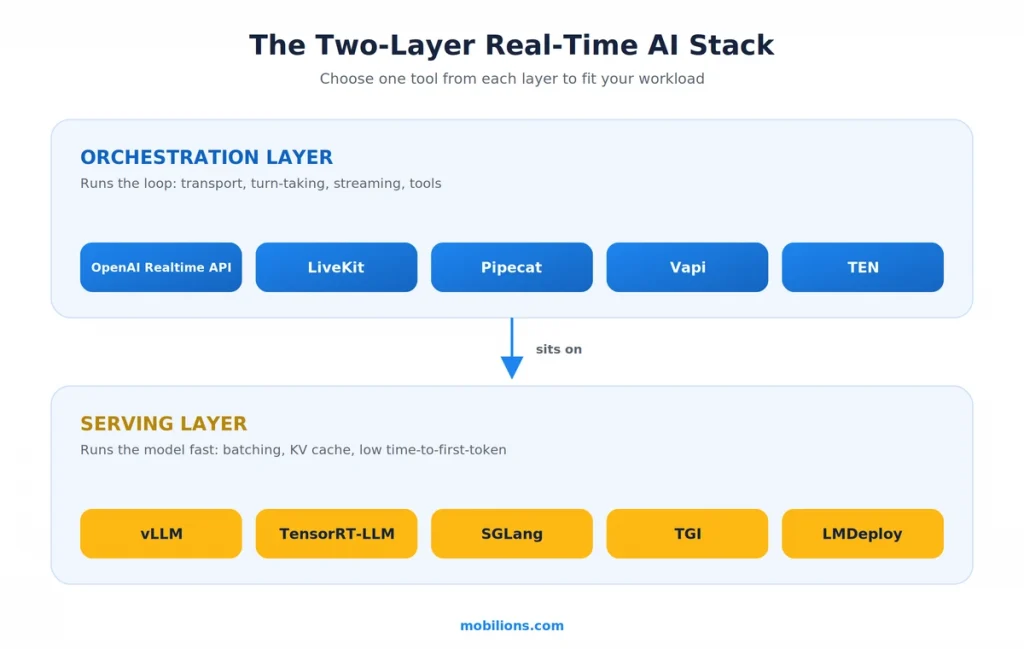
The stack has two layers. Orchestration frameworks (OpenAI Realtime API, LiveKit, Pipecat, Vapi, TEN) run the conversation loop. Serving runtimes (vLLM, TensorRT-LLM, SGLang, TGI, LMDeploy) run the model. You choose one from each layer, and they solve different problems.
Managed versus open-source is the real decision. A managed API like the OpenAI Realtime API or Vapi gets you live in days but costs per minute and gives less control. Open-source frameworks like LiveKit and Pipecat take more setup but let you self-host, swap models, and tune latency.
The model is rarely the only bottleneck. Network transport, turn detection, and time-to-first-token often matter more than raw model speed, which is why the serving runtime and the orchestration framework both matter.
What does “real-time AI” actually mean in 2026?
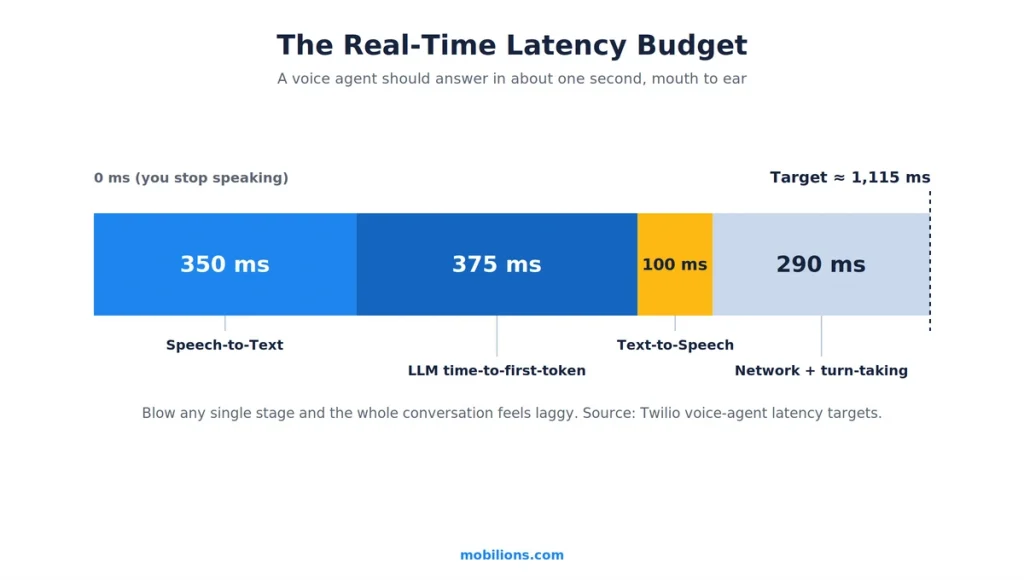
Before naming tools, it helps to define the target, because “real-time” gets used loosely. For a conversational voice agent, real-time has a concrete budget. Twilio’s own guide to voice-agent latency puts the target mouth-to-ear turn gap at about 1,115 milliseconds, with 1,400 milliseconds as the upper limit before a conversation starts to feel broken. Humans have a deep, ingrained aversion to pauses in speech, so even a few hundred extra milliseconds reads as awkward.
That budget is not spent in one place. It is split across the pipeline, and each stage has its own target. Speech-to-text should land around 350 milliseconds. The language model’s time to first token should land around 375 milliseconds. Text-to-speech should start speaking within about 100 milliseconds. Add network transport on top, and you can see how quickly the budget disappears. There is also the question of knowing when the user has finished talking. A naive system waits for a fixed silence window, often 500 milliseconds, before it responds, and smarter turn-detection models try to shave that down without cutting the speaker off.
Two things follow from this. First, real-time is an engineering constraint you design against, not a feature you switch on. Second, the bottleneck is often not the model at all. It is transport, turn detection, or the time to first token. That is exactly why the tools split into two layers, and why picking the right one at each layer matters more than picking the single “best” framework.
The two layers of the real-time AI stack
Almost every real-time AI product is built from two layers, and confusing them is the most common reason teams pick the wrong tool.
The orchestration layer runs the loop. For voice, that is the cycle of listening, transcribing, thinking, and speaking, plus handling interruptions when the user talks over the agent. For a text copilot, it is streaming tokens and tool-call events to the screen as they happen. Frameworks here include the OpenAI Realtime API, LiveKit, Pipecat, Vapi, and TEN.
The serving layer runs the model. This is the inference runtime that takes a prompt and produces tokens as fast as the hardware allows, with tricks like continuous batching and KV-cache reuse to keep latency low under load. Runtimes here include vLLM, TensorRT-LLM, SGLang, Hugging Face TGI, and LMDeploy.
| Layer | What it does | Tools |
|---|---|---|
| Orchestration | Runs the conversation or streaming loop, transport, turn-taking, tools | OpenAI Realtime API, LiveKit, Pipecat, Vapi, TEN |
| Serving | Runs the model fast (batching, KV cache, low time-to-first-token) | vLLM, TensorRT-LLM, SGLang, TGI, LMDeploy |
If you use a fully managed voice API, you may never touch the serving layer directly, because the provider runs it for you. The moment you self-host an open model to cut cost or keep data in-house, the serving layer becomes your problem, and its choice drives your latency. Keep the two layers separate in your head and most of the confusing tool comparisons online sort themselves out.
What are the real-time AI agent and voice frameworks in 2026?
This is the orchestration layer, and it is where the most movement happened in 2025 and into 2026. Here are the tools worth knowing, and what each is actually good at.
OpenAI Realtime API with gpt-realtime-2. OpenAI’s Realtime API is the fastest path to a strong speech-to-speech voice agent. The original gpt-realtime reached general availability in August 2025 with remote Model Context Protocol (MCP) server support, image input, and direct SIP phone calling. On May 7, 2026 OpenAI advanced the line with gpt-realtime-2, the first voice model with GPT-5-class reasoning. It expands the context window from 32K to 128K tokens and adds tunable reasoning levels from minimal to xhigh, so you spend a little latency on harder thinking only when a call needs it. OpenAI reports it scoring 15.2 percent higher on Big Bench Audio and 13.8 percent higher on Audio MultiChallenge than the prior gpt-realtime-1.5. Pricing stays about $32 per million audio input tokens and $64 per million audio output tokens.
Two companion models shipped the same day. gpt-realtime-translate does live speech translation from 70-plus input languages into 13 output languages at about $0.034 per minute, and gpt-realtime-whisper is a low-latency streaming transcription model at about $0.017 per minute. A later iteration, gpt-realtime-2.1 and a cheaper gpt-realtime-2.1-mini, followed as minor updates. Reach for the Realtime API when you want a capable voice agent fast and are comfortable on OpenAI’s platform.
LiveKit Agents. LiveKit is the open-source heavyweight for real-time media. It is built on WebRTC using selective forwarding units, which is the same technology that powers serious video conferencing, so it scales to many participants and supports video, not just audio. You can self-host it, though it still relies on LiveKit’s WebRTC network, and there is a managed LiveKit Cloud with a free tier of 1,000 minutes. It exposes real controls for voice activity detection and interruptions, which you want when you are tuning how the agent handles being talked over. Reach for LiveKit when you need scale, self-hosting, video, or fine control.
Pipecat. Pipecat is the other major open-source option, and often named as LiveKit’s closest competitor. It is Python-first with a flexible pipeline design that supports parallel processing and arbitrary component order, which makes it a favorite for teams that want to assemble their own stack of speech-to-text, model, and text-to-speech from different vendors. Its Smart Turn detection has iterated quickly. If you want maximum composability and you live in Python, Pipecat is a natural fit. You can see the project on its GitHub repository.
Vapi. Vapi is the managed, get-live-fast option. It is closed-source and API-based, uses WebSockets, and, importantly, provisions phone numbers directly and assigns them to agents, so telephony is built in rather than bolted on. It handles the common patterns, such as appointment scheduling and support bots, with less configuration than the open-source frameworks, at the cost of less control and audio only. It is a strong pick when speed to launch beats deep customization.
TEN Framework. TEN is the most flexible and the most demanding. It uses a graph-based JSON configuration to wire sub-processes together across multiple languages, including C++, Go, and Python, which is powerful for teams with unusual requirements and heavy for teams without them. Consider it when the mainstream frameworks genuinely cannot express what you need.
| Framework | Model | Best fit | Main tradeoff |
|---|---|---|---|
| OpenAI Realtime API | Managed | Fastest path to a strong speech-to-speech agent | Per-minute cost, tied to OpenAI |
| LiveKit Agents | Open-source | Scale, video, self-hosting, fine control | More setup; needs its WebRTC network |
| Pipecat | Open-source | Composable Python stack, mix-and-match vendors | You assemble and tune the pieces |
| Vapi | Managed | Fastest launch, built-in telephony | Closed-source, audio-only, less control |
| TEN Framework | Open-source | Maximum flexibility, multi-language | Heavy graph configuration |
What runtimes serve real-time model inference in 2026?
This is the serving layer, and it decides how fast your self-hosted model actually responds. Independent 2026 H100 benchmarks make the differences concrete. The common thread across all of them is that they treat the KV cache, the model’s short-term memory during generation, as the thing to optimize, paging it, quantizing it, and reusing it.
vLLM is the sensible default, and in 2026 it is still where most teams should start. Its PagedAttention technique splits the KV cache into fixed blocks and cuts memory waste to under 4 percent, versus 60 to 80 percent for naive allocation, and it pairs the widest model support with strong throughput. On recent H100 tests it holds time to first token near 120 milliseconds under load. If you are not sure what to serve with, start here.
TensorRT-LLM is the latency king on NVIDIA hardware. It compiles fused kernels per model and shape, and its KV reuse can cut time to first token by up to 14 times on an H100. Choose it when you are NVIDIA-only and latency is the whole point, and you can afford the per-model tuning.
SGLang is built for agents and RAG. Its RadixAttention reuses shared prefixes through a tree structure, which is exactly the pattern in multi-turn agents and retrieval systems, and it reports up to 6.4 times more throughput and 3.7 times lower latency on structured workloads. If your real-time system is an agent that reuses a lot of context, this is worth a hard look.
Hugging Face TGI v3 shines on long context and chat, processing around 3 times more tokens and running up to 13 times faster than vLLM on long prompts. LMDeploy pushes raw throughput per GPU, with its TurboMind engine reporting up to 1.8 times the throughput of vLLM and 4-bit inference about 2.4 times faster than FP16.
| Runtime | Best at | Notable number |
|---|---|---|
| vLLM | General-purpose default | 14 to 24x throughput vs HF Transformers |
| TensorRT-LLM | Lowest latency on NVIDIA | Up to 14x lower time-to-first-token on H100 |
| SGLang | Agents, RAG, multi-turn | Up to 6.4x throughput, 3.7x lower latency |
| TGI v3 | Long context and chat | Up to 13x faster on long prompts |
| LMDeploy | Max throughput per GPU | Up to 1.8x throughput vs vLLM |
The takeaway is not that one runtime wins. It is that time to first token, not total generation time, is what a user feels in a real-time system, and the runtimes differ most on exactly that. If you build production real-time systems the way our AI development team does, the serving runtime is a deliberate choice tuned to the workload, not a default you inherit.
What about streaming for text and agent interfaces?
Not every real-time AI product is voice. A copilot that types its answer live, an agent that shows its tool calls as they happen, a dashboard that updates as a model reasons, all of these are real-time too, and they lean on streaming rather than audio pipelines. The pattern here is token streaming, where the interface renders each token as the model produces it instead of waiting for the whole response, which turns a multi-second wait into an experience that feels instant even when total time is unchanged.
Agent frameworks made this richer through 2025 and 2026 by moving from token streams to event streams. LangChain’s streaming documentation covers how LangGraph streams not just tokens but tool calls, state updates, and intermediate steps, so a user watching an agent work sees it think in real time rather than staring at a spinner. Under the hood this usually rides on server-sent events or WebSockets. The engineering lesson mirrors the voice one. Perceived latency is what matters, and streaming the first useful output early beats optimizing the total time to finish.
How do you choose the right real-time AI tools and frameworks in 2026?
Strip away the tool names and the whole realtime ai tools frameworks 2026 decision comes down to four questions, in order.
First, is it voice or text? Voice pulls you toward the OpenAI Realtime API, LiveKit, Pipecat, or Vapi, because you need transport, turn detection, and a speech pipeline. Text and agent UIs pull you toward a streaming setup on top of your model, with an agent framework like LangGraph handling the event stream.
Second, managed or self-hosted? If speed to launch and low operational burden matter most, a managed API such as the OpenAI Realtime API or Vapi gets you live in days. If cost at scale, data residency, or deep control matter more, an open-source framework such as LiveKit or Pipecat lets you self-host and swap components, and now the serving runtime becomes your decision too.
Third, if you are self-hosting the model, what is the workload shape? A general chat load points to vLLM. A latency-critical NVIDIA deployment points to TensorRT-LLM. An agent or RAG system that reuses context points to SGLang. Long documents point to TGI.
Fourth, what is your latency budget, and where is it going? Measure the pipeline before optimizing. Teams routinely tune the model when the real culprit is transport or turn detection. If you are weighing whether to build this in-house or bring in help, that is a genuine build-versus-buy decision worth making deliberately rather than by default, and if you go in-house, hiring engineers who have shipped low-latency systems before saves a lot of measuring-and-guessing later.
A real-world scenario
To make this concrete, picture a mid-size company that wants a real-time voice agent for customer support, handling phone calls, answering from its own knowledge base, and escalating to a human when it is stuck.
A systematic reading of the four questions sorts the build quickly. It is voice and it needs telephony, so the shortlist is the OpenAI Realtime API, LiveKit, or Vapi. Because the team wants to keep customer data in-house and expects high call volume where per-minute pricing would hurt, they lean open-source and self-hosted, which points to LiveKit for transport and telephony via a SIP provider. Because the agent answers from a knowledge base, it is a RAG workload that reuses a lot of shared context, so on the serving layer they choose SGLang for its prefix reuse. And because the whole thing lives or dies on latency, they instrument the pipeline first and discover, as teams usually do, that their biggest win is tightening turn detection, not swapping the model.
That is the pattern in practice. The real-time result comes from choosing one tool per layer to fit the workload, then measuring the latency budget, rather than chasing a single framework that claims to do everything.
Myths and common mistakes
A few misconceptions cause most of the wasted effort in real-time AI projects.
The first myth is that real-time just means fast. It does not. It means fast enough, consistently, inside a specific budget, with graceful behavior when a stage runs slow. A system that is usually quick but occasionally stalls for three seconds feels worse than one that is steadily good.
The second myth is that the model is the bottleneck. Often it is not. Network transport, turn detection, and time to first token frequently cost more than raw generation speed, which is why serious teams measure the whole pipeline before touching the model.
The third mistake is skipping the serving layer decision. Teams pick a great orchestration framework, self-host a model on whatever runtime came first, and then wonder why responses lag under load. The runtime is a real choice with real latency consequences.
The fourth mistake is over-buying. Not every product needs a self-hosted, fully tuned stack. For a low-volume internal tool, a managed API you ship in a week is the right call, and building bespoke infrastructure is effort spent where it does not move the needle.
The honest caveat worth stating plainly: this space moves fast. The specific numbers and version names in this guide are accurate for 2026, but the frameworks ship constantly, and the right answer six months from now may name a tool that is young today. The two-layer mental model and the latency-budget discipline will outlast any single tool, which is exactly why they are the parts worth internalizing.
Why Mobilions
Mobilions has been building custom software, mobile apps, and AI solutions since 2016. We have delivered more than 250 projects for over 100 clients across 20-plus countries, and that includes production real-time AI, the kind of low-latency voice and streaming systems this guide describes, not just written about. When we scope a real-time build, we choose deliberately at both layers, orchestration and serving, and we measure the latency budget before optimizing anything. If you are planning a real-time AI feature and want to pressure-test the architecture before committing, that is the conversation our AI development team has with founders and product teams every week, and where it makes sense we pair it with custom software and integration work rather than treating them as separate projects.
Summary
Real-time AI in 2026 is best understood as a two-layer stack. The orchestration layer runs the loop, with the OpenAI Realtime API and Vapi leading the managed options and LiveKit, Pipecat, and TEN leading the open-source ones. The serving layer runs the model fast, with vLLM as the default, TensorRT-LLM for lowest latency, SGLang for agents and RAG, and TGI for long context. What ties it together is the latency budget, roughly a one-second target for voice, split across the pipeline, where time to first token and turn detection often matter more than the model itself. Choose one tool per layer to fit your workload, measure before you optimize, and you have the durable way to read the realtime ai tools frameworks 2026 landscape no matter which specific tool leads next quarter.
Frequently asked questions
What are the best real-time AI frameworks in 2026?
It depends on the layer. For orchestration, the OpenAI Realtime API and Vapi lead the managed options, while LiveKit and Pipecat lead the open-source ones. For model serving, vLLM is the general-purpose default, TensorRT-LLM is the lowest-latency choice on NVIDIA, and SGLang is strongest for agents and RAG. Most real-time products use one tool from each layer.
What is the difference between AI tools and AI agents?
What is the difference between AI tools and AI agents? An AI tool performs one bounded task on request, like transcribing audio or generating text. An AI agent plans multiple steps, calls tools and APIs, reacts to results, and pursues a goal with less hand-holding. Real-time agents add live data and low latency, so they can act on what is happening right now rather than on a static prompt.
What is the OpenAI Realtime API and what is gpt-realtime-2?
The Realtime API is OpenAI’s speech-to-speech platform for building voice agents. Its flagship model, gpt-realtime-2, launched on May 7, 2026 as the first voice model with GPT-5-class reasoning, a 128K context window, and tunable reasoning levels. Pricing is about $32 per million audio input tokens and $64 per million audio output tokens.
Which AI agent framework should I actually use?
Match the framework to the job. For voice, choose LiveKit or Pipecat when you want open-source control, or the OpenAI Realtime API or Vapi when you want speed to launch. For text and multi-step agents, LangGraph handles planning, tool calls, and event streaming. There is no single best framework, only the right one per layer and workload.
How fast does a real-time voice agent need to respond?
To feel natural, the end-to-end mouth-to-ear turn gap should be around 1,115 milliseconds, with about 1,400 milliseconds as the upper limit before it feels broken. That budget splits across speech-to-text near 350 milliseconds, the model’s time to first token near 375 milliseconds, and text-to-speech near 100 milliseconds, plus network transport.
What is the best runtime for real-time LLM inference?
vLLM is the general-purpose default that most teams should start with, thanks to PagedAttention and broad model support. TensorRT-LLM gives the highest throughput and lowest latency on NVIDIA hardware once you accept its compilation step. SGLang is strongest for agents and RAG because its RadixAttention reuses shared context across turns.
Can AI agents connect to my database and use real-time data?
Yes. Real-time agents reach live data through tools, function calling, and connectors such as Model Context Protocol servers, so they can query a database, call an internal API, or read a live feed at the moment of the request. The work is wiring those connections securely with the right access controls, not the model itself.
Can AI agents search the web for real-time information?
Yes, when you give them a search or retrieval tool. The agent calls the tool, receives fresh results, and grounds its answer in them rather than relying only on training data. This matters for anything time-sensitive, like prices or news, and it is one reason retrieval quality often decides how useful a real-time agent feels.
How much does it cost to run a real-time AI agent?
Two models exist. Managed voice APIs bill per token or per minute, for example the OpenAI Realtime API at roughly $32 and $64 per million audio input and output tokens, which is quick to start but grows with usage. Self-hosting on your own GPUs trades that for fixed infrastructure cost, which wins at high, steady volume.
How long does it take to build a real-time AI agent?
A working prototype on a managed API can take days. A production system with your own data, telephony, guardrails, and a self-hosted model usually takes several weeks to a few months, driven mostly by integration, testing, and latency tuning rather than the model. Starting managed, then moving self-hosted once validated, is a common path.
How secure are real-time AI agents with business data?
As secure as you design them. Self-hosting keeps data in your own environment, while managed APIs mean data leaves your network, so read the provider’s retention terms. Either way, encrypt data in transit and at rest, apply least-privilege access for every tool the agent can call, and log actions so you can audit what happened.
Can multiple AI agents work together in real time?
Yes. Multi-agent systems split work across specialized agents, for example one that plans, one that retrieves, and one that acts, coordinated by an orchestration layer or an agent-to-agent protocol. It adds power for complex tasks but also latency and failure points, so use it only when a single agent genuinely cannot handle the job.
Is real-time AI only about voice?
No. Streaming text interfaces, live copilots, and agents that show their steps as they work are all real-time. They rely on token and event streaming, for example through LangGraph, rather than audio pipelines, but the same principle applies: stream the first useful output early so the experience feels instant even when total time is unchanged.
Should I use a managed real-time AI API or an open-source framework?
Use a managed API such as the OpenAI Realtime API or Vapi when speed to launch and low operational burden matter most. Use an open-source framework such as LiveKit or Pipecat when cost at scale, data residency, or deep control matter more, keeping in mind that self-hosting also makes the model-serving runtime your decision.
Why is latency the hardest part of real-time AI?
Because it accumulates across the whole pipeline, and the bottleneck is often not the model. Network transport, turn detection, and time to first token frequently cost more than raw generation, so the fix usually comes from measuring the entire budget rather than only speeding up the model itself.
What is time to first token and why does it matter?
Time to first token is how long the model takes to produce its first output after receiving a prompt. In a real-time system the user feels this delay directly, because it is the gap before anything starts happening, which is why serving runtimes optimize it heavily and why it often matters more than total generation speed.

Mayank Makwana is an AI Solution Architect and Full Stack Developer at Mobilions, where he designs and ships production AI systems — grounded, governed, and owned by the client. He specializes in LLM applications, retrieval-augmented generation (RAG), and AI agents, and also builds modern web applications. He writes senior-level guides on AI architecture, applied machine learning, and web engineering.