Cloud cost optimization is no longer a quarterly cleanup task you hand to the finance team. It is an engineering discipline that decides whether your infrastructure scales profitably or quietly bleeds money every hour it runs. In 2026, the pressure is sharper than it has been in years, and the teams that treat cost as a first-class design constraint are the ones shipping faster and spending less.
This guide lays out a practical strategy Mobilions uses when we scope, build, and support production systems for clients. It covers where the waste actually hides, how to fix it without slowing delivery, and how DevOps, multi-cloud, and hybrid infrastructure decisions change the math. No theory for its own sake. Just the moves that move the bill.
Why cloud spend got worse in 2026, not better
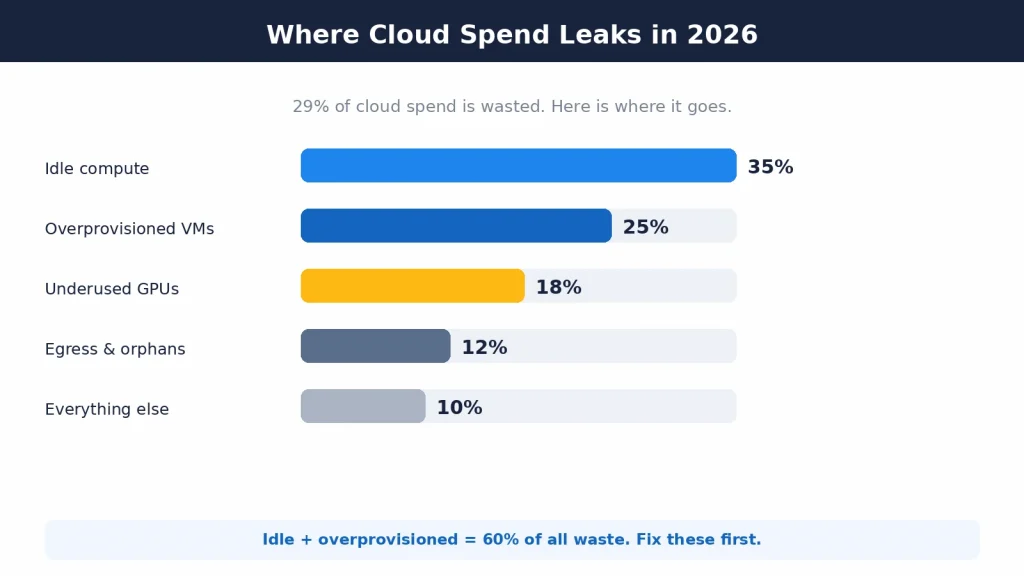
For five straight years, the industry told a comfortable story: cloud waste was falling as teams matured. That story broke in 2026. According to Flexera’s State of the Cloud report, wasted cloud spend climbed back to roughly 29 percent, reversing a half-decade of steady decline.
The reason is not that engineers forgot how to optimize. It is that the workloads changed faster than the governance around them. AI moved from experiment to production, and it brought expensive hardware with it.
Only about 2 percent of CIOs report spending less on cloud than they projected. For almost everyone else, overspend is the default state, not the exception. As footprints grow, complexity grows faster than the discipline needed to control it, which is exactly why cloud cost optimization has become an engineering priority rather than an afterthought.
Two culprits dominate the waste. Idle compute accounts for around 35 percent of it, and overprovisioned instances for another 25 percent. In plain terms, most organizations are paying for capacity that either sits still or was sized for a peak that rarely arrives.
Then there is the newest line item. GPUs now make up close to 18 percent of spend at AI-forward organizations, up from about 4 percent in 2023. Statically provisioned GPU fleets often run at just 30 to 40 percent utilization, which means more than half of that premium hardware is burning money while it waits for work. That idle premium hardware is now one of the biggest targets for cloud cost optimization in 2026.
What cloud cost optimization actually means
Cloud cost optimization is the ongoing practice of matching what you pay to the value you get, without sacrificing performance, reliability, or delivery speed. It is not about switching everything off or picking the cheapest region and hoping for the best.
Done well, it answers three questions continuously. What are we running, and does it earn its keep? Are we buying it the smartest way? And who is accountable when a number moves the wrong direction?
The industry name for this discipline is FinOps, and the FinOps Foundation frames it around three phases that run in parallel rather than in sequence. Inform is about visibility. Optimize is about action. Operate is about making good behavior automatic.
The phases are not owned by one team. Finance tends to live in Inform. Engineering tends to live in Optimize. Leadership tends to live in Operate. The point is that everyone is working the same problem from a different angle at the same time.
The strategy: five layers that compound
The mistake most teams make is chasing one tactic, like buying reserved capacity, and calling it a program. Real savings come from layering moves that reinforce each other. Here is the order we recommend, because each layer makes the next one cheaper and safer.
Layer 1: See the money before you touch it
You cannot optimize what you cannot attribute. The first layer is visibility, and it starts with tagging. Every resource needs an owner, an environment, and a cost center attached to it, enforced at deploy time rather than begged for after the fact.
This matters more than it sounds. A striking 74 percent of organizations that already own cloud cost tools say they lack the time or people to act on the recommendations those tools produce. Visibility without accountability just generates dashboards nobody reads.
Tie every major service to a unit metric that the business understands. Cost per active user, cost per transaction, cost per model inference. When spend is expressed in units the business cares about, a rising bill becomes a conversation instead of a surprise.
Layer 2: Right-size and kill the idle
With attribution in place, the fastest wins are almost always right-sizing and shutting down waste. Idle and oversized resources are the single largest source of cloud waste, so this is where the early return lives.
Right-sizing means analyzing real usage and resizing compute, memory, and storage tiers to fit it. A database provisioned for a launch-day spike two years ago is probably three sizes too big today. Storage that was hot when it was written is probably cold now and belongs in a cheaper tier.
Killing the idle means non-production environments that sleep on nights and weekends, orphaned volumes and load balancers nobody deleted, and snapshots that outlived their purpose. None of this is glamorous. All of it is free money.
Layer 3: Buy compute the smart way
Once your footprint reflects real demand, you can commit to it confidently. This is where pricing models do the heavy lifting, and the discounts are large enough to change a P&L.
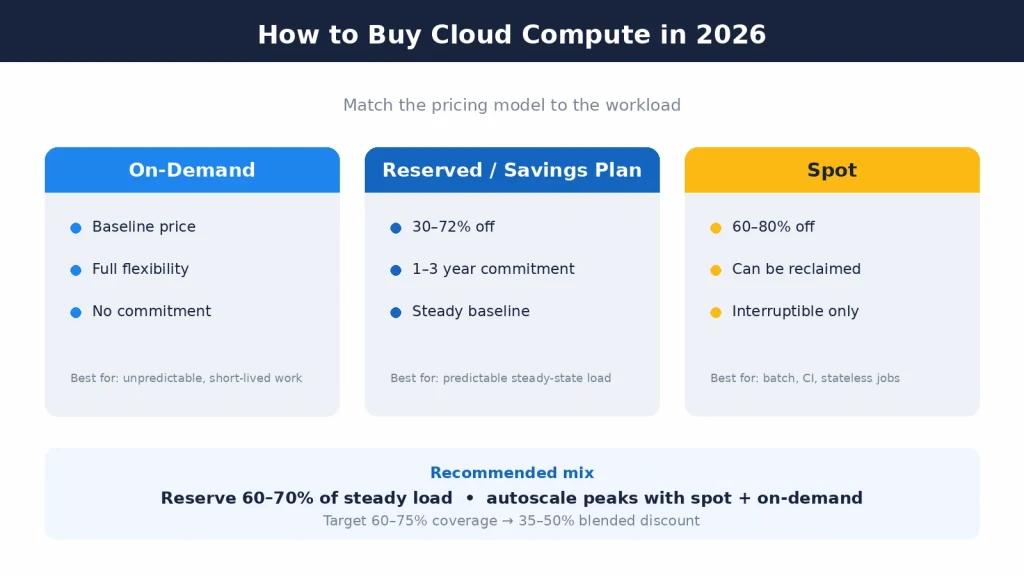
Reserved Instances and equivalent commitments deliver roughly 30 to 70 percent off standard rates in exchange for a one to three year commitment. Savings Plans on AWS run from about 40 to 72 percent while letting you change instance families and mix compute types. On Google Cloud, one-year commitments reach around 57 percent and three-year terms up to 70 percent.
Spot capacity is the other lever. It uses a provider’s spare capacity at 60 to 80 percent off, with the catch that it can be reclaimed at short notice. That makes it ideal for fault-tolerant, interruptible work like batch jobs, CI pipelines, and stateless processing.
The practical playbook is to reserve 60 to 70 percent of your steady-state baseline, then handle peaks with autoscaling groups that mix on-demand and spot. Aim for a commitment coverage ratio of 60 to 75 percent. Most teams end up with a blended effective discount of 35 to 50 percent once you account for partial coverage and the on-demand spikes.
Layer 4: Automate optimization into the pipeline
Manual optimization does not survive contact with a fast-moving engineering team. The fourth layer is making the right choice the automatic one, which is where DevOps and cloud cost optimization become the same conversation.
Autoscaling should be the default, not a special case, so capacity tracks demand instead of sitting parked at peak. Cost checks belong in CI/CD, where a pull request that doubles the projected monthly cost gets flagged before it merges, not after the invoice arrives. Tools like Infracost do exactly this, showing the cost impact of a change inside the pull request.
Infrastructure as code makes this enforceable. When environments are defined in version control, you can bake in guardrails: no untagged resources, no oversized defaults, no public storage by accident. Policy becomes code, and drift becomes visible.
Layer 5: Govern it as a habit
The final layer is the Operate phase in practice. Anomaly detection catches a runaway job or a misconfigured autoscaler within hours instead of at month-end. Budgets and alerts route to the team that owns the spend, not to a central inbox.
Maturity shows up in the numbers. Organizations without a real FinOps program waste somewhere between 32 and 40 percent of their cloud spend. Teams at the mature end bring that down to 15 to 20 percent, and the most disciplined get idle waste closer to 14 percent. That gap is the prize.
Kubernetes and containers: where waste hides in plain sight
Containers promised efficiency, and they can deliver it, but only with active management. Left alone, Kubernetes is one of the most reliable ways to overpay.
The data is sobering. Average CPU utilization across tens of thousands of production clusters sits around 8 percent before any optimization is applied. Teams request far more than they use, because requesting generously feels safer than getting paged.
The fix is a combination of honest resource requests, bin-packing workloads onto fewer nodes, and autoscaling at both the pod and node level. Set requests from observed usage, not from guesses, and let the cluster scale down when the work is gone.
Do this and the savings are structural, not one-time. A cluster running at 45 to 60 percent utilization instead of 8 percent is doing the same work on a fraction of the machines, every hour, forever.
The AI cost problem you cannot ignore
AI workloads have rewritten the cost conversation, and every serious cloud cost optimization strategy in 2026 has to account for them. Nearly all FinOps teams, around 98 percent, now manage AI spend, up from roughly 63 percent a year earlier.
The core issue is GPU utilization. Measured across more than 20,000 clusters, average enterprise GPU utilization has been reported as low as 5 percent. You are renting the most expensive hardware in the building and using a sliver of it.
The answers borrow from everything above and add a few specifics. Schedule GPU work so fleets stay busy instead of idling between jobs. Right-size to the smallest accelerator that meets the latency target. And measure cost per inference, not just cost per hour, because that is the number that tells you whether a feature pays for itself.
The upside is real. Disciplined AI cost programs have driven cost-per-answer down dramatically in production deployments, in some analyses from cents per response to a fraction of that. The efficiency was always there. It just had to be scheduled and measured.
Multi-cloud, hybrid cloud, and the placement decision
Where a workload runs is a cost decision as much as a technical one, and this is where multi-cloud and hybrid strategies earn their reputation, for better and worse.
Multi-cloud gives you leverage and resilience, but it introduces a tax that surprises teams: egress. Standard internet egress on the major hyperscalers runs about $0.087 to $0.12 per gigabyte, and moving data between providers means paying to get it out. For data-heavy applications, cross-cloud transfer can quietly rival compute in cost.
Hybrid cloud takes a different angle. It keeps high-volume, predictable, or sensitive data in a private environment and bursts only specific workloads to public cloud when elasticity is genuinely needed. Done right, it sidesteps a lot of egress and gives you predictable pricing on the steady-state core.
The placement question is why hybrid keeps gaining ground. By some counts, 37 percent of enterprises have moved at least one workload from public cloud back to private infrastructure in the past two years, up from 14 percent in 2022. The average repatriated workload saves around 32 percent of its annual cost after hardware is amortized.
The lesson is not “leave the cloud.” It is that workload placement is a dynamic decision. Elastic and spiky work belongs on hyperscaler compute. Steady, heavy, latency-sensitive, or compliance-bound work often runs cheaper and just as well on private or colocated infrastructure. The winning architectures treat placement as something you revisit, not something you decided once during migration.
A quick example: what this looks like in practice
Consider a mid-sized SaaS product running a predictable API tier, a spiky background-processing tier, and a growing AI feature. Before optimization, everything runs on-demand, the Kubernetes cluster sits at single-digit utilization, and a GPU node runs 24/7 for a feature used mostly during business hours.
The strategy applies in order. Tagging reveals the AI feature is a third of the bill. Right-sizing shrinks the oversized API instances and the cluster consolidates onto fewer nodes. The steady API baseline moves to a one-year Savings Plan at roughly half price, while background jobs move to spot capacity at a deep discount.
The GPU node gets scheduled to match real demand instead of running around the clock, and cost is now tracked per inference. Anomaly alerts route to the owning team, and a cost check in CI flags any change that spikes the projection.
None of these moves is exotic. Stacked together, they routinely take a 25 to 40 percent bite out of a bill while making the platform more predictable, and that is the entire point of a real cloud cost optimization strategy: durable savings that do not cost you delivery speed.
A 90-day rollout plan
You do not need a year to see results. A focused quarter, run in the right order, gets most teams from surprise bills to a controlled, predictable spend.
Days 1 to 30: see everything
Spend the first month on visibility and quick wins. Enforce tagging at deploy time, connect a cost tool, and map spend to the teams and features that create it.
While the tags settle, take the free money. Shut down idle non-production environments overnight, delete orphaned volumes and snapshots, and move cold storage to cheaper tiers. These moves carry almost no risk and usually pay for the whole exercise on their own.
Days 31 to 60: right-size and commit
With clean attribution, right-size compute, memory, and storage against observed usage. Resist the urge to buy commitments until the footprint reflects real demand, because reserving oversized capacity just locks in the waste.
Once the baseline is honest, buy it the smart way. Put a one-year Savings Plan or reservation under your steady-state load, move interruptible work to spot capacity, and set your coverage ratio in the 60 to 75 percent range.
Days 61 to 90: automate and govern
The last month makes the gains permanent. Turn on autoscaling by default, add a cost check to your CI/CD pipeline, and route anomaly alerts to the teams that own the spend.
Finish by writing the guardrails into infrastructure as code so the next hundred deploys inherit them. After 90 days you should have visibility, a right-sized footprint, committed discounts, and automation that keeps all three from drifting.
Common mistakes that quietly inflate the bill
The first mistake is optimizing once. Cloud spend drifts the moment you look away, because every deploy adds resources and few remove them. Optimization is a loop, not a project.
The second is buying commitments before right-sizing. Lock in a three-year reservation on an oversized fleet and you have just guaranteed three years of overpaying. Fix the footprint first, then commit to it.
The third is treating cost as finance’s job. Engineers make the decisions that create the spend, so they have to see the price of those decisions in the tools they already use. Cost visibility that never reaches the people who cause the cost changes nothing.
The fourth is ignoring the boring line items. Egress, idle non-production environments, forgotten storage, and orphaned resources rarely show up in a single alarming number. They add up to a large one.
How Mobilions approaches cloud cost optimization
We build and support production software, so we treat cost as an engineering property from day one rather than a cleanup phase after launch. That means tagging and unit metrics are part of the initial architecture, not a retrofit.
Our engineers scope workloads against real demand, choose pricing models deliberately, and bake autoscaling and cost guardrails into the delivery pipeline. When a hybrid or multi-cloud split saves money without adding fragility, we design for it. When it just adds egress and complexity, we say so.
The result our clients care about is simple. The systems we ship run predictably, scale when they need to, and do not surprise anyone at the end of the month. That is what good cloud cost optimization buys you: room to grow without the bill growing faster than the business.
Frequently asked questions
What is cloud cost optimization?
Cloud cost optimization is the continuous practice of aligning what you spend on cloud infrastructure with the value it delivers, without hurting performance or reliability. It combines visibility, right-sizing, smart purchasing, automation, and governance so you pay for what you actually use.
How much can cloud cost optimization save?
It depends on your starting maturity. Organizations without a structured program typically waste 32 to 40 percent of cloud spend, while disciplined teams bring waste down to 15 to 20 percent. A focused first pass with right-sizing and commitment purchases often reduces a bill by 25 to 40 percent.
What is the difference between FinOps and cloud cost optimization?
Cloud cost optimization is the set of technical and financial actions that reduce waste. FinOps is the operating model and culture that makes those actions continuous and shared across engineering, finance, and leadership. FinOps is the framework, optimization is the work it drives.
When should I use reserved instances versus spot instances?
Use reserved instances or savings plans for steady, predictable baseline workloads you will run for a year or more, since they trade commitment for 30 to 70 percent discounts. Use spot instances for interruptible, fault-tolerant work like batch jobs and CI, where 60 to 80 percent savings outweigh the risk of reclamation.
Does multi-cloud reduce or increase costs?
It can do either. Multi-cloud improves leverage and resilience, but it adds egress and operational complexity that can erase the savings for data-heavy workloads. It reduces cost only when placement is deliberate and cross-cloud data movement is kept low.
Is hybrid cloud cheaper than public cloud?
For predictable, high-volume, or compliance-bound workloads, hybrid or private infrastructure is often cheaper because pricing is stable and egress is minimized. For spiky, elastic workloads, public cloud usually wins. The cheapest answer is usually a hybrid split that matches each workload to the right home.
How do AI and GPU workloads change cloud cost strategy?
AI concentrates spend in expensive GPUs that frequently run at very low utilization. The strategy adds GPU scheduling to keep fleets busy, right-sizing to the smallest accelerator that meets the target, and measuring cost per inference so you know whether each AI feature pays for itself.
Who should own cloud cost optimization in a company?
It is a shared responsibility. Engineering owns the technical decisions that create spend, finance owns forecasting and accountability, and leadership owns the policies and priorities. A FinOps practice or an experienced engineering partner keeps all three aligned.
Ready to stop overpaying for your infrastructure?
If your cloud bill is growing faster than your business, the fix is rarely a single switch. It is a strategy applied in the right order by engineers who understand both the systems and the spend. Talk to Mobilions about a cloud cost optimization plan built for how your product actually runs.

Adarsh Singh is a DevOps Engineer at Mobilions focused on cloud infrastructure, CI/CD, and reliable deployments. He helps teams ship faster and more safely with automated pipelines and infrastructure as code. He writes practical guides on cloud, DevOps, and platform engineering.