Custom software development cost in 2026 usually lands anywhere from about 15,000 dollars for a focused MVP to 1,000,000 dollars or more for an enterprise platform, and the spread is that wide for a reason: price follows scope, not screens. The real question is not “what does software cost” but “what does my software cost once security, integrations, testing, and a year of support are in the number.”
This guide breaks down custom software development cost the way an engineering team actually estimates it: what drives the budget, real ranges by project size, hourly rates by region, what a fair quote includes, the hidden and ongoing costs people forget, and how to spend less without cutting the parts that keep software running. The figures here are industry ranges to plan with, not quotes, because only your scope sets the real number.
Key Takeaways
- Custom software development cost is driven by scope, integrations, security and compliance, team seniority and location, and the design, testing, and project management around the code, not the number of screens.
- Rough 2026 ranges: an MVP runs about 15,000 to 80,000 dollars, a mid-complexity platform about 75,000 to 250,000 dollars, and a complex SaaS or enterprise system 200,000 dollars to over 1,000,000.
- Hourly rates swing from about 25 dollars offshore to 250 dollars in North America, so team location and seniority move the budget as much as the feature list.
- A real quote covers scoping, architecture, the build, security, testing, deployment, and support, broken down by phase. A fixed price given before scoping is either padded or missing the hard parts.
- Budget for ongoing cost too: maintenance and hosting typically run 15 to 25 percent of the build cost each year.
What Drives Custom Software Development Cost
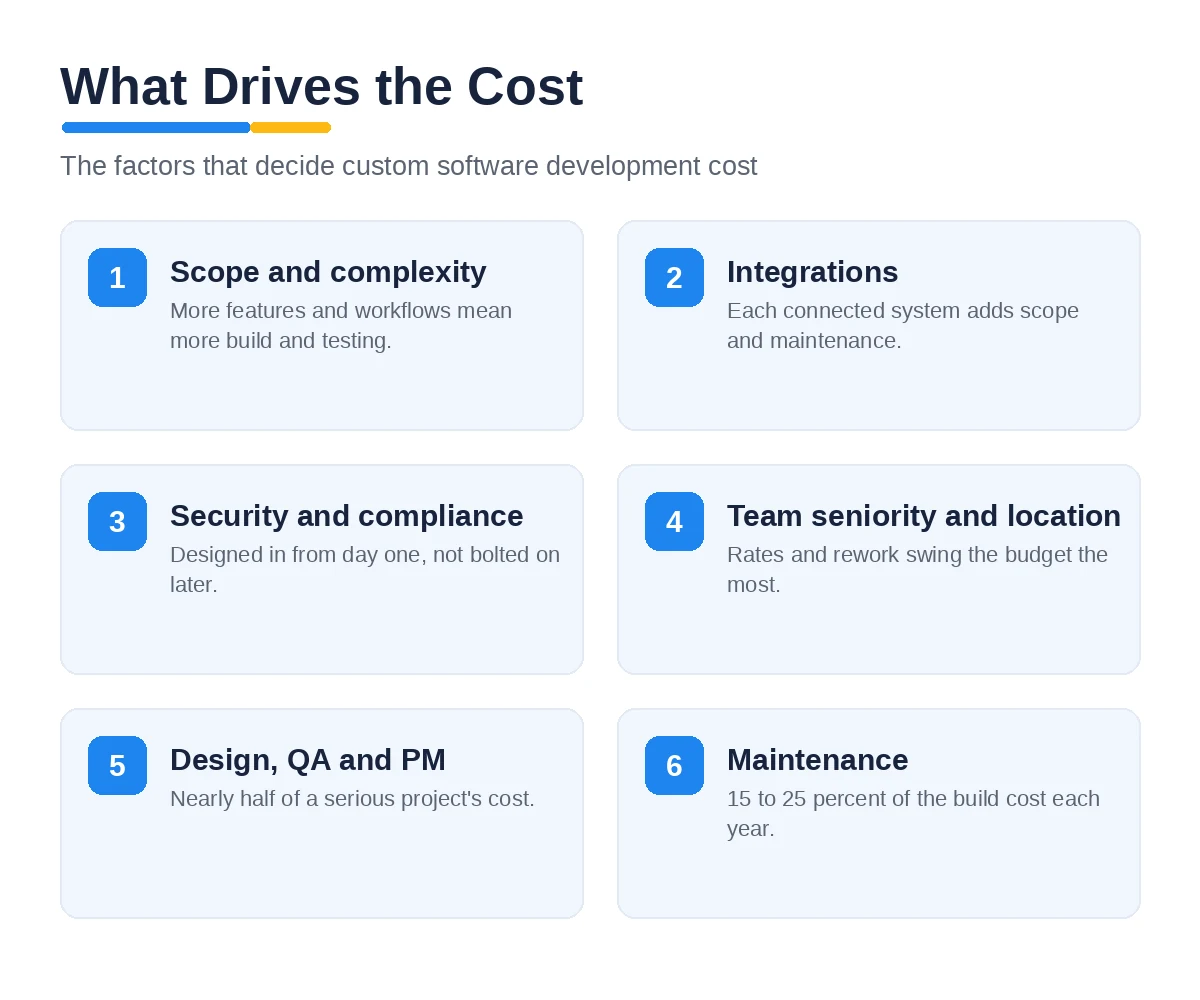
Before any range means anything, it helps to know what actually moves the number. Two apps with the same screen count can differ by 5x once you look under the surface. These are the factors that decide where your project lands.
Scope and complexity
Scope is the single biggest lever. A simple internal tool with a few workflows is a different animal from a multi-tenant product with roles, billing, and real-time data. Every feature adds build time, testing surface, and edge cases to handle, so a tight, well-defined scope is the cheapest decision you will make.
Integrations
Each system you connect to, a payment provider, a CRM, an ERP, a third-party API, adds scope, testing, and ongoing maintenance. Integrations are where “simple” projects quietly get expensive, because real-world data and other people’s APIs rarely behave the way the docs promise.
Security and compliance
Security has to be designed in, not added at the end, and for regulated work it drives real cost. Designing to a recognized baseline like the OWASP application security guidance, or building for SOC 2, HIPAA, or ISO 27001, can add a meaningful share to scope. It is not optional spend; it is the difference between software you can ship and a liability.
Team seniority and location
Who writes the code, and where they sit, changes the rate more than almost anything else. Senior engineers cost more per hour but ship faster, make fewer expensive mistakes, and need less rework, which is often cheaper overall than a large junior team billed at a low rate.
Design, QA, and project management
The code is only part of the bill. Discovery, UX and UI design, quality assurance, and project management together can make up close to half of a serious project. Skipping them does not save money; it moves the cost to bug-fixing, rework, and delay after launch.
Custom Software Development Cost by Project Size
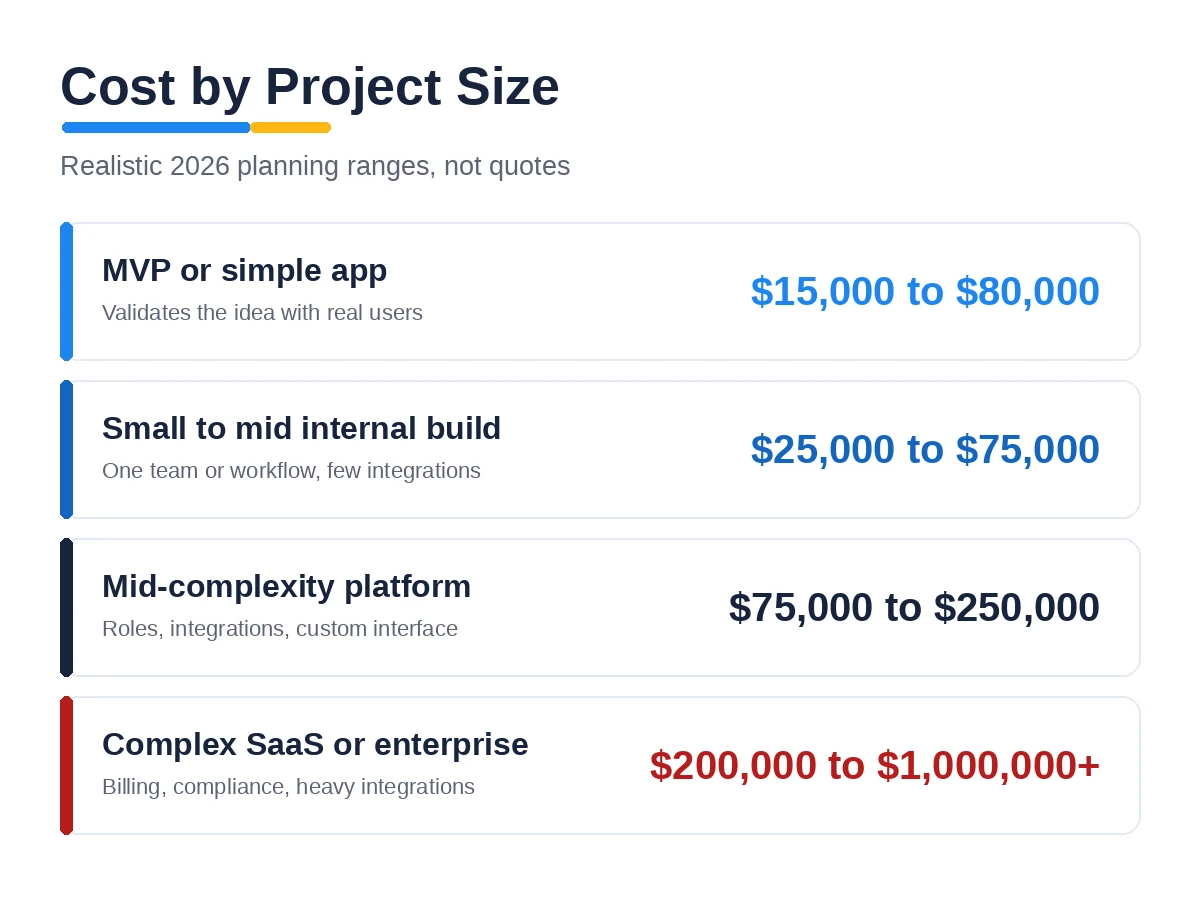
With those drivers in mind, here are realistic 2026 ranges by project size. Treat them as planning bands, not quotes, because scope inside each band varies widely.
- MVP or simple app: roughly 15,000 to 80,000 dollars. A focused first version that validates the idea with real users, built in a few weeks to a couple of months.
- Small to mid internal build: roughly 25,000 to 75,000 dollars. A tool for one team or workflow, with a handful of integrations and clear, bounded scope.
- Mid-complexity platform: roughly 75,000 to 250,000 dollars. Multiple user roles, several integrations, a real data model, and a custom interface, delivered over several months.
- Complex SaaS or enterprise system: roughly 200,000 to over 1,000,000 dollars. Multi-tenant products with billing, heavy integrations, compliance, or ERP-class requirements.
For context, industry data from Clutch puts the average custom software project around 132,000 dollars over roughly 13 months, but that average covers everything from small tools to enterprise builds, so it sits higher than most small-business budgets.
Hourly Rates by Region
Most custom software is still priced on time, so regional rates shape the total. Rough 2026 senior-developer ranges look like this.
- North America: about 100 to 250 dollars an hour, with agency blended rates at the top end.
- Western Europe: about 70 to 160 dollars an hour.
- Eastern Europe and Latin America: about 35 to 120 dollars an hour, a common nearshore middle ground.
- Asia and offshore: about 25 to 60 dollars an hour, though senior specialists cost more.
Cheaper is not automatically better value. The real cost is rate multiplied by hours, and a senior team at a higher rate that scopes well and reworks less often beats a low rate that ships slowly and breaks in production.
What a Real Quote Should Include
A trustworthy quote prices the whole lifecycle, not just the visible app. If a proposal lists only screens and skips the integration layer, security, and testing, the number is not real, and the gap comes back as cost and delay later.
A mid-complexity build of about 136,000 dollars, for example, might split roughly into discovery and architecture 12,000, UX and UI 18,000, frontend 28,000, backend 34,000, integrations 18,000, QA 14,000, and project management 12,000. The exact split shifts per project, but notice that design, QA, and management together are nearly half the total.
Ask for the quote broken down by phase, and ask what is explicitly not included. How honestly a team answers that tells you how real the number is.
Hidden and Ongoing Costs to Plan For
The build price is not the full cost of ownership. The most common surprises are the ones that arrive after launch.
- Maintenance and hosting: typically 15 to 25 percent of the build cost per year, for updates, security patches, and infrastructure.
- Change and scope creep: evolving requirements can shift a budget by 30 to 50 percent, which is why scoping discipline matters.
- Compliance: regulated work can add a meaningful share to scope, and it is rarely quick or cheap to retrofit.
- Third-party fees: payment processors, cloud services, and API usage are ongoing line items, not one-time costs.
A good partner names these upfront. Poor scoping, not a high rate, is the leading cause of budget overruns, so clarity early is the cheapest insurance you can buy.
How to Lower Custom Software Development Cost Without Cutting Corners
Spending less is about sequencing and scope, not shaving the parts that keep software safe and maintainable.
Start with an MVP. Build the smallest version that delivers real value, put it in front of users, and let what you learn fund the next phase. It is the surest way to avoid paying for features nobody needed. Start with an MVP.
Scope tightly and write it down. A clear, documented requirements list is the cheapest way to tighten an estimate and avoid rework. Decide what is in and what is explicitly out before the build starts.
Use AI-assisted development where it helps. Teams using AI tooling are seeing roughly 10 to 20 percent lower build cost on suitable work, though it speeds delivery more than it replaces engineering judgment.
Consider build versus buy honestly. Sometimes an off-the-shelf product, or a hybrid of bought tools plus custom glue, is the cheaper right answer. A team that tells you that is one you can trust with the bigger builds. If you only need to extend your own team, staff augmentation is often the leaner option.
How Mobilions Approaches Custom Software Cost
Mobilions is a custom software development company where the same senior engineers who scope your product build it, launch it, and support it, so estimates are grounded in what it actually takes to ship, not an optimistic sales number. We scope before we price, break the quote down by phase, and tell you plainly when buying or a hybrid is the cheaper, smarter call than a custom build.
You own the source code, the IP, and the infrastructure throughout, and every case study on our site is real, shipped software. Since 2016 we have delivered more than 250 projects for over 100 clients across 20-plus countries. If you are budgeting a build, a senior engineer will give you an honest estimate of what it takes to ship it, with no obligation.
Frequently Asked Questions
How much does custom software development cost in 2026?
It depends almost entirely on scope. A focused MVP runs about 15,000 to 80,000 dollars, a mid-complexity platform about 75,000 to 250,000 dollars, and a complex SaaS or enterprise system 200,000 dollars to over 1,000,000. Industry data puts the average project around 132,000 dollars, but that spans small tools to enterprise builds.
What drives custom software development cost up or down?
Scope and complexity, the number of integrations, security and compliance requirements, the seniority and location of the team, and the design, QA, and project management around the code. Two apps with the same screen count can differ several times over once these are factored in.
How much does an MVP cost to build?
A focused MVP typically costs about 15,000 to 80,000 dollars and reaches real users in a few weeks to a couple of months. Building an MVP first is the surest way to validate the idea before committing to a larger budget.
Why do software development hourly rates vary so much by region?
Rates reflect local labor markets and seniority. North America runs about 100 to 250 dollars an hour, Western Europe 70 to 160, Eastern Europe and Latin America 35 to 120, and offshore Asia 25 to 60. The real cost is rate multiplied by hours, so a faster senior team can beat a cheaper slower one.
What should a custom software quote include?
The whole lifecycle: scoping and architecture, the build, security, testing and QA, deployment and infrastructure, and support after launch, broken down by phase. A quote that prices only screens and skips integrations, security, and testing is not a real number.
Are there hidden costs in custom software development?
Yes. The common ones are maintenance and hosting after launch, third-party fees for payments, cloud, and APIs, compliance work, and scope changes. A good partner names these upfront, because poor scoping, not a high rate, is the leading cause of overruns.
How much does software maintenance cost per year?
Plan for roughly 15 to 25 percent of the original build cost each year, covering updates, security patches, infrastructure, and small improvements. Software is never finished at launch, so ongoing cost is part of the real budget.
Does AI make custom software cheaper?
Somewhat. Teams using AI-assisted development are seeing roughly 10 to 20 percent lower cost on suitable work, mostly by speeding delivery. It does not replace engineering judgment, architecture, or testing, so it lowers cost rather than eliminating it.
Is fixed-price or time-and-materials better?
Fixed price suits well-defined, bounded projects, while time-and-materials suits evolving work where scope will change. Be cautious of a fixed price quoted before the problem is scoped; it is usually padded or missing the hard parts.
How can I reduce custom software development cost without hurting quality?
Start with an MVP, scope tightly and write the requirements down, use AI-assisted development where it helps, and consider build versus buy honestly. Cut sequencing and scope, never the security, testing, and support that keep software running.

Tushar Patel is the founder and CEO of Mobilions, an AI-first software engineering company. With over a decade helping businesses build custom software, mobile apps, and AI solutions, he leads strategy and delivery for teams shipping products across 20+ countries. He writes practical, senior-level guides on software development, hiring engineering talent, and scaling products.