Tag: startup

  • Fractional CTO Cost and Rates: What You Actually Pay in 2026

    Fractional CTO Cost and Rates: What You Actually Pay in 2026

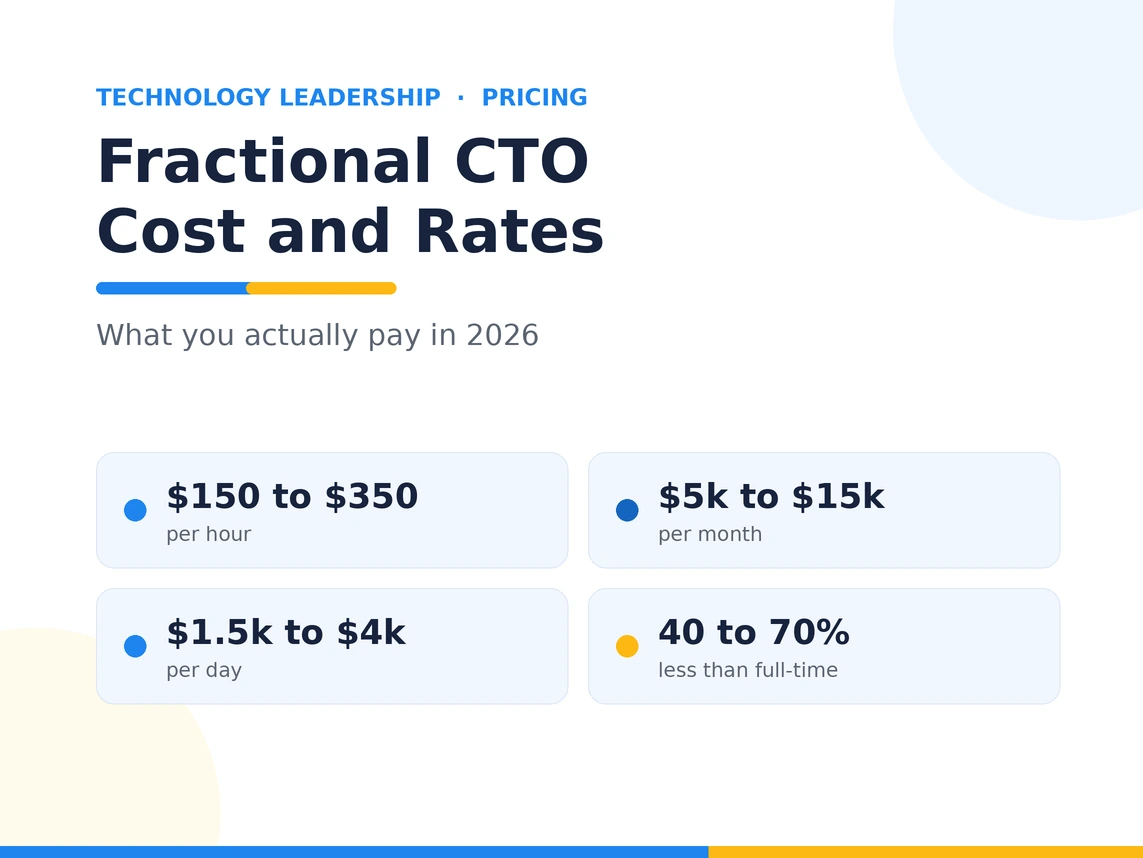
    A fractional CTO costs about $5,000 to $15,000 a month for most engagements, or roughly $150 to $350 an hour if you pay by the hour. That is the short answer, and for a lot of founders it is all they need to know before the next question, which is always the same: is that a lot, or a little?

    It depends entirely on what you compare it to. Set it next to a full-time CTO, who runs $200,000 to $400,000 a year before equity, and a fractional CTO looks like a bargain. Set it next to a junior developer, and it looks expensive, until you watch the junior build the wrong thing for six months.

    Hiring senior leaders part-time is a real, growing model, not a workaround. Harvard Business Review has covered how part-time senior leaders help a business, and for early companies the appeal is simple: you get the experience you need without a cost you cannot carry yet.

    This guide breaks down the real numbers: what a fractional CTO cost actually looks like across the different ways they charge, what moves the price up or down, the costs nobody warns you about, and how to tell whether the spend is paying for itself. If you are still fuzzy on the role itself, start with our guide on what a fractional CTO is and come back.

    Key takeaways

    • Most engagements land at $5,000 to $15,000 a month, or $150 to $350 an hour. Light advisory can start near $3,000, and near-full-time can pass $25,000.
    • There are four ways to pay: hourly, a monthly retainer, a day rate, or cash plus a little equity. The retainer is the most common because it is predictable.
    • It usually costs 40 to 70 percent less than a full-time CTO once you count salary, equity, benefits, and the recruiting fee.
    • Price tracks seniority and scope, not a fixed rate card. A specialist prepping you for a raise costs more than a generalist steadying a small team.
    • The real question is not the rate, it is the return. A good fractional CTO pays for the fee by stopping one expensive mistake.

    How much does a fractional CTO cost?

    Here are the numbers most US engagements fall into in 2026.

    By the hour, expect $150 to $350, with most experienced people sitting around $200 to $250. Early-stage or lighter work can dip toward $100 an hour. At the other end, a specialist doing technical due diligence for a funding round can charge $500 an hour or more, because that work is high stakes and they do not do much of it.

    On a monthly retainer, the common band is $5,000 to $15,000. A day or so a week of advisory sits near the bottom, around $3,000 to $5,000. Two to three days a week of real hands-on leadership sits in the middle. A near-full-time arrangement, where the CTO is in your business most of the week, can run $25,000 a month or higher.

    By the day, rates run about $1,500 to $4,000, which is mostly used for short projects or a fixed piece of work rather than an ongoing relationship.

    Notice the spread. A fractional CTO cost is not one price, it is a range you land inside based on how senior the person is and how much of them you need. The next sections are about where inside that range you actually end up.

    The four ways a fractional CTO charges

    Most of the confusion about cost comes from mixing up the pricing models. There are four, and each fits a different situation.
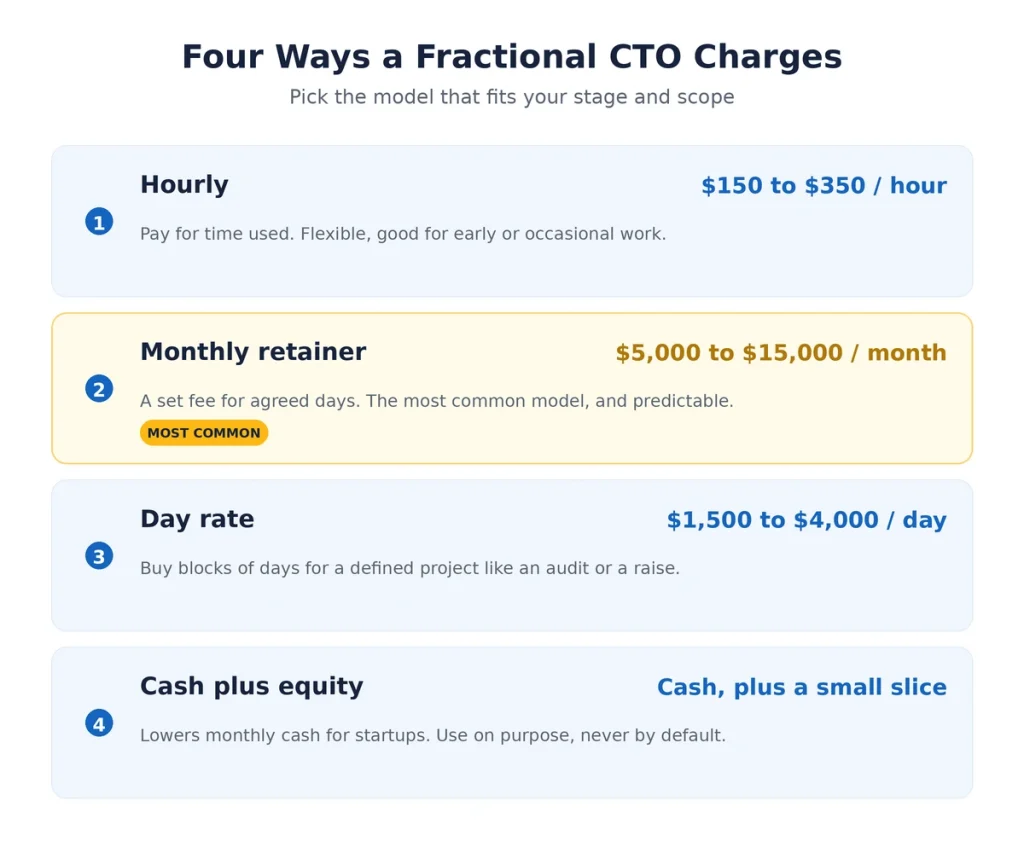
    Four ways a fractional CTO charges: hourly, monthly retainer, day rate, and cash plus equity, with 2026 price ranges

    Hourly. You pay for the time you use. This is honest and flexible, and it suits early or occasional work where the scope is not fixed. The downside is that it can make you ration the very advice you are paying for, watching the clock instead of asking the question.

    Monthly retainer. You pay a set fee for an agreed level of involvement, usually a certain number of days a week. This is the most common model, and for good reason. The cost is predictable, you can budget for it, and nobody is counting minutes. Most ongoing engagements settle here.

    Day rate. You buy blocks of days, which works well for a defined project like an architecture review, a security cleanup, or getting you ready for due diligence. You know the total before you start.

    Cash plus equity. Some cash-tight startups offer a small slice of equity to lower the monthly cash cost. This can align everyone’s incentives, but it dilutes you, and it only makes sense with a CTO who is genuinely invested in the long game. Most fractional arrangements are pure cash with no equity at all. Give away equity on purpose, never by default.

    Fractional CTO cost vs a full-time CTO

    This is the comparison that makes the model make sense, so it is worth doing properly rather than waving at “it is cheaper”.
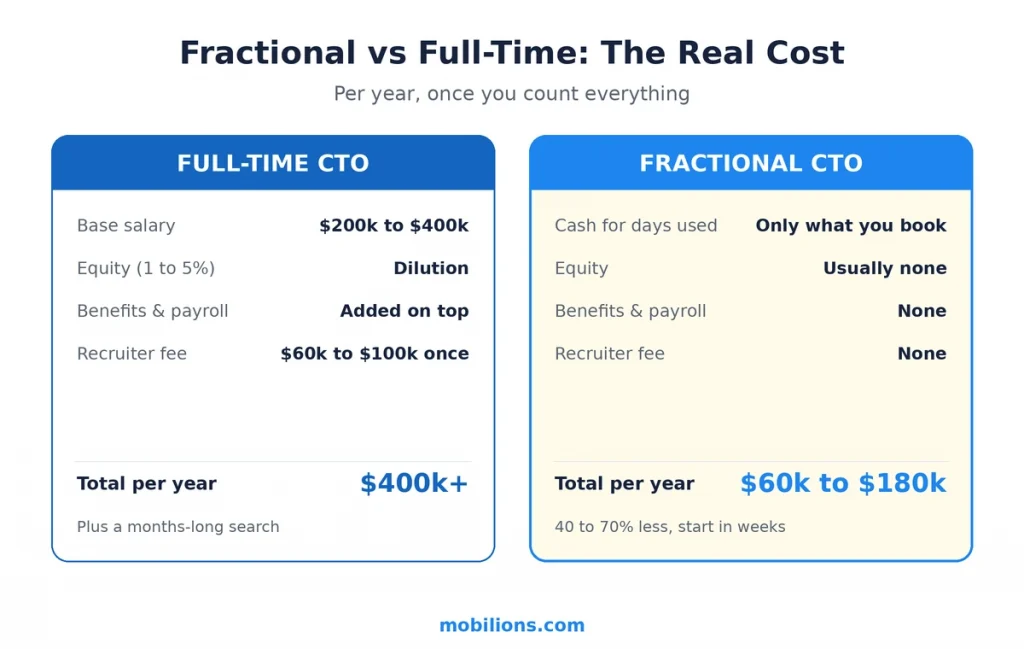
    Fractional CTO vs full-time CTO yearly cost: full-time over $400k with salary, equity, benefits and recruiter fee, versus fractional $60k to $180k

    A full-time CTO in the US earns a base salary of $200,000 to $400,000. For context, the median pay for technology managers as a whole is about $170,000, per the US Bureau of Labor Statistics, and a CTO sits above that band.

    Then you add equity, typically 1 to 5 percent that vests over four years, plus benefits, payroll taxes, and the rest of the cost of an employee. All in, you are often past $400,000 a year. Before any of that, you pay a recruiter $60,000 to $100,000 just to find the person, and the search can take months.

    A fractional CTO strips almost all of that away. You pay cash for the days you use, usually no equity, no recruiting fee, and no long search. In annual terms the commitment is often $60,000 to $180,000. For the strategic work that matters most in the early days, that is frequently 40 to 70 percent less than a full-time hire, for the same quality of decision.

    The catch is honest and simple. You are not getting a full-time person. When your company grows to the point where the technology needs a leader in the room every day, the math flips and a full-time CTO becomes the right spend. The fractional model is not a permanent discount on a CTO. It is the right answer for a specific stretch of a company’s life, and knowing when that stretch ends is part of using it well.

    What actually changes the price

    Two founders can get quotes that are twice as far apart as they expected. Here is what drives that.

    Seniority. Someone who has been a CTO at a company like yours, and has the scars to show for it, costs more than a capable generalist. You are paying for judgment, and judgment is the whole point.

    Scope. “Come to a weekly call and advise” is a different job from “own our architecture, manage the offshore team, and get us through a Series A”. The second costs more because it is more.

    Stage and stakes. Work tied to a funding round or a security problem carries more risk and more pressure, so it prices higher than steady-state guidance.

    Hours. This is the simple lever. One day a week costs far less than three. Most of your cost is just how much of the person you are booking.

    Specialization. A fractional CTO who is deep in AI, fintech compliance, or high-scale infrastructure charges a premium in their niche, because that specific knowledge is rare and worth it when you need it.

    The hidden costs nobody mentions

    The fee is not the whole story, and pretending it is leads to disappointment. A few costs hide around the edges.

    The first is your own time. A fractional CTO is not a vending machine. You get the value when someone on your side sets priorities, answers questions, and acts on the plan. If nobody internal engages, you are paying for advice that goes nowhere.

    The second is onboarding. It takes a couple of weeks for anyone to learn your product, your code, and your team. You pay for that ramp, and it is normal, so plan for a short runway before the big wins land.

    The third is the cost of the wrong hire. A cheap fractional CTO who points you at the wrong architecture is not cheap. Fixing that later costs far more than the difference in rate. This is the one place where paying up is almost always the better deal.

    What you actually spend, by stage

    Real budgets are easier to picture by where your company is.

    If you are a pre-seed or bootstrapped founder, you are usually buying a day or less a week to get the big decisions right and keep an eye on whoever is building. Think roughly $3,000 to $7,000 a month, and treat it as insurance against expensive early mistakes.

    If you have raised a seed round and have a small team, you likely want two to three days a week of real leadership: architecture, hiring, and process. That is the classic $8,000 to $15,000 a month engagement, and it is where most of the value shows up.

    If you are approaching Series A, you might briefly want a heavier arrangement to get through due diligence and set the team up, then taper down or move to a full-time hire. Higher for a stretch, then it changes. That flex is the feature, not a bug.

    Is a fractional CTO worth the cost?

    For the right company at the right time, yes, and the reason is not the rate. It is the return.

    A fractional CTO earns the fee by preventing the mistakes that actually sink early companies: the architecture that cannot scale, the security hole that becomes a breach, the six months of building the wrong thing, the failed technical due diligence that kills a round. Any one of those costs more than a year of the fee. Stopping one pays for the whole engagement.

    Here is the honest version, though. It is not worth it if you only need more hands to write code, because that is a developer, not a CTO. It is not worth it if nobody on your side will engage with the plan. And it stops being the right spend once you are big enough to need a full-time leader every day. Spend the money when you are buying senior judgment you cannot get any cheaper. Skip it when you are not.

    How to get the most for your money

    A few habits make the spend work harder.

    Start with a short paid trial, a couple of weeks or a small project, before you commit to a long retainer. You learn more about fit in two weeks of real work than in any number of calls.

    Agree on what good looks like up front. Write down the outcomes you want and how you will both know they happened. Vague mandates like “fix everything” waste money, because nothing gets prioritized.

    Then use the person for what they are worth. Bring them the hard calls, the hiring, the architecture, the investor conversations. Do not spend a $250-an-hour leader on work a junior could do.

    And watch for a few red flags while you are at it. Be wary of anyone who wants to rewrite everything on day one, who is so spread across clients they are never available, or who talks only about technology and never about your customers or your money. The right person makes your team stronger, not more dependent on them.

    Why Mobilions

    At Mobilions we have built software since 2016, and shipped more than 250 projects for over 100 clients across more than 20 countries. When we take on fractional technology leadership, it comes with engineers behind it who have actually built and scaled the kind of system you are worried about, so the advice is grounded in production, not slides.

    We price the work to your stage, you own every line of code and decision, and we will tell you honestly when a fractional CTO is the wrong spend and something simpler will do.

    If you want senior leadership without a full-time hire, our fractional CTO service is built for exactly that, and a dedicated development team can build under that leadership when you are ready. The same engineers handle the custom software development underneath, and if you would rather talk it through first, tell us what you are building and we will give you an honest read on the cost.

    Summary

    A fractional CTO costs about $5,000 to $15,000 a month, or $150 to $350 an hour, and usually 40 to 70 percent less than a full-time CTO once you add up salary, equity, benefits, and the recruiter. The exact number depends on how senior the person is, how much of them you book, and how high the stakes are, not on a fixed rate card.

    Budget a few thousand a month for light early advice, and more for hands-on leadership through a seed stage. Treat the ramp-up weeks and your own engagement as part of the cost, not extras.

    The rate is the easy part to fixate on and the wrong thing to optimize. What matters is whether the person stops the mistakes that would cost you far more than their fee. If you are making technology calls above your depth and cannot yet justify a full-time hire, put a fractional CTO on a short paid trial and judge them on the first two weeks. That is the cheapest way to find out if the spend is worth it, and it usually is.

    Frequently asked questions

    How much should you pay a fractional CTO?

    Most US fractional CTOs cost $5,000 to $15,000 a month, or $150 to $350 an hour. Light advisory can start near $3,000 a month, and near-full-time involvement can pass $25,000. What you should pay depends on how senior the person is and how many days a week you actually need, so match the rate to the scope.

    What is a fair hourly rate for a fractional CTO?

    A fair hourly rate for an experienced fractional CTO in the US is roughly $150 to $350, with most landing around $200 to $250. Specialists in areas like AI, fintech, or security charge more. Many prefer a flat monthly retainer over hourly billing, which makes your cost predictable and stops you rationing the advice you are paying for.

    How much does a fractional CTO cost compared to a full-time CTO?

    A full-time CTO costs $200,000 to $400,000 in base salary, and often over $400,000 fully loaded with equity and benefits, plus a recruiting fee. A fractional CTO usually runs $60,000 to $180,000 a year for the strategic work, which is commonly 40 to 70 percent less. You trade full-time presence for senior judgment at a fraction of the cost.

    What are the different fractional CTO pricing models?

    There are four. Hourly, where you pay for time used. A monthly retainer, a set fee for an agreed level of involvement, which is the most common. A day rate, for defined projects. And cash plus a small equity slice, used by cash-tight startups. Most ongoing engagements use a retainer because the cost is predictable.

    How much equity should a fractional CTO get?

    Most fractional CTOs take no equity and are paid in cash. When equity is used to lower the monthly cash cost, it is usually a small amount, often well under one percent, with clear vesting. Give equity only on purpose, to align a CTO who is genuinely in it for the long term, and never as a default because cash is tight.

    How many hours a week does a fractional CTO work?

    Usually 10 to 20 hours a week for one company, often described as two to three days. Lighter advisory engagements are less, and intensive ones around a raise or a launch are more. Because hours are the main cost lever, you set them in the contract to match your stage and budget.

    What is the total cost of hiring a fractional CTO?

    Beyond the monthly fee, budget for two things. First, a couple of weeks of onboarding while they learn your product and team, which is normal ramp-up you still pay for. Second, your own time, since the value only lands when someone internal engages with the plan. There is no recruiting fee or equity in most arrangements, which keeps the total low.

    Are there hidden costs with a fractional CTO?

    The main ones are the onboarding ramp, your team’s time to work with them, and the cost of a bad hire. A cheap fractional CTO who sets the wrong architecture is the most expensive option, because fixing it later dwarfs the difference in rate. Paying for real seniority is usually the cheaper path overall.

    Is a fractional CTO worth it for an early-stage startup?

    For many early startups, yes. You get senior decisions on architecture, hiring, and security at the moment those calls are cheapest to get right and most expensive to get wrong. It is worth it when you need judgment more than coding hours. It is not worth it if nobody on your side will act on the guidance.

    How long should you hire a fractional CTO for?

    Most engagements run 6 to 18 months and are month-to-month, so you can scale up or down as things change. Many start with a short trial, then settle into a steady retainer, and later taper off or convert to a full-time CTO. The flexibility is a big part of why the model is cost-effective.

    Can a fractional CTO build my MVP?

    A fractional CTO leads the MVP build rather than writing most of the code themselves. They set the architecture, choose the stack, and direct the developers or agency doing the work. If you want them heavily hands-on in the code, expect it to cost more and to use up the senior time you are really paying them for.

    How do I budget for a fractional CTO?

    Match the spend to your stage. Pre-seed and bootstrapped founders often budget $3,000 to $7,000 a month for light leadership. Seed-stage teams that need hands-on involvement usually spend $8,000 to $15,000. Plan for a higher stretch around a raise, then a taper. Treat the fee as insurance against far larger mistakes.

    Do fractional CTOs charge for a trial period?

    Usually yes, a trial is paid, but it is small and scoped, like a two-week assessment or a single project. It is the best money you can spend before a longer commitment, because you learn more about fit from real work than from interviews. A good CTO will happily start this way.

    Why do fractional CTO rates vary so much?

    Rates track seniority, scope, stage, hours, and specialization. A generalist advising a small team a day a week costs a fraction of a specialist owning your architecture and steering a Series A. The wide range is not random pricing, it is different jobs. Get quotes against a clear scope so you are comparing like with like.

    Is a fractional CTO cheaper than a development agency?

    They solve different problems, so it is not a straight price comparison. An agency builds what you specify. A fractional CTO decides what to build and often manages the agency doing it. Many teams pay for both, a fractional CTO for direction and an agency or developers for the build, which is still far cheaper than a full-time CTO plus a team.

    What should be in a fractional CTO contract?

    Cover the scope and hours, the fee and payment terms, and clear ownership of all intellectual property so everything built is yours. Add confidentiality, a notice period, and how you will measure success. Getting IP assignment and expectations in writing up front protects you and keeps the engagement clean if you ever part ways.

    When should I switch from a fractional to a full-time CTO?

    Make the switch when your engineering team is large enough to need a leader in the room every day, or when investors expect a named, full-time technical head, which is common by Series B. A good fractional CTO will tell you when that moment is near and often helps you hire their own replacement.

  • What Is a Fractional CTO? Role, Cost, and When to Hire

    What Is a Fractional CTO? Role, Cost, and When to Hire

    A fractional CTO is a senior technology leader you hire part-time to run your technology strategy, guide your engineers, and make the big architecture and hiring decisions, without the salary and equity of a full-time chief technology officer.

    You get executive-level judgment for a few days a month, on a contract you can end when you no longer need it. For a founder who is not technical, or a company that cannot yet justify a full-time CTO, that is often the missing piece.

    So the short answer to what is a fractional CTO is this: the same strategic leadership a full-time CTO gives, delivered part-time and paid in cash, usually with no equity and no long-term commitment.

    The role has grown fast. On LinkedIn, the number of people identifying as fractional leaders rose from about 2,000 in 2022 to more than 110,000 in 2024, and the share of job postings mentioning fractional work has roughly tripled since 2018.

    This guide covers what a fractional CTO does, how the role differs from a full-time CTO and an advisor, what it costs in 2026, when to hire one, and how to hire well.

    Key takeaways

    • A fractional CTO is a part-time senior technology executive. You get strategy, architecture, and technical leadership for a few days a month instead of a full-time salary.
    • It costs a fraction of a full-time hire. Most engagements run about $5,000 to $15,000 per month, often 40 to 70 percent less than a full-time CTO once salary, equity, and benefits are counted.
    • It fits early and non-technical teams best. Startups before Series A, non-technical founders, and small teams that need senior judgment more than extra coding hours are the clearest fit.
    • It is leadership, not hands-on coding. A good fractional CTO sets direction and manages the build, including your agency or offshore team, rather than writing most of the code themselves.
    • You can start and stop easily. Engagements are usually month-to-month and last 6 to 18 months, so you scale the commitment up or down as the company changes.

    What is a fractional CTO?

    A fractional CTO is a chief technology officer who works for your company part-time, on an ongoing basis, usually remotely. The word fractional means you buy a fraction of a senior executive’s time, commonly two to three days a week or less, instead of employing them full-time. They serve a small number of companies at once and give each one real leadership, not just occasional advice.

    The point of the role is senior judgment when it counts. Early companies often need the experience of someone who has built and scaled technology before, but they do not need, and cannot afford, that person forty hours a week.

    A fractional CTO closes that gap. You get the senior decisions right early, when getting them wrong is most expensive, and you pay only for the time you use.

    Fractional leadership is now common across the C-suite, with fractional CFOs, CMOs, and CTOs all growing. Technology leaders are a meaningful slice of that market, and the model is popular because it turns a large fixed cost into a flexible one you can size to the moment.

    What does a fractional CTO do?

    A fractional CTO owns the technology decisions that shape whether your product can grow. The work is strategic and managerial, and it usually covers the following.

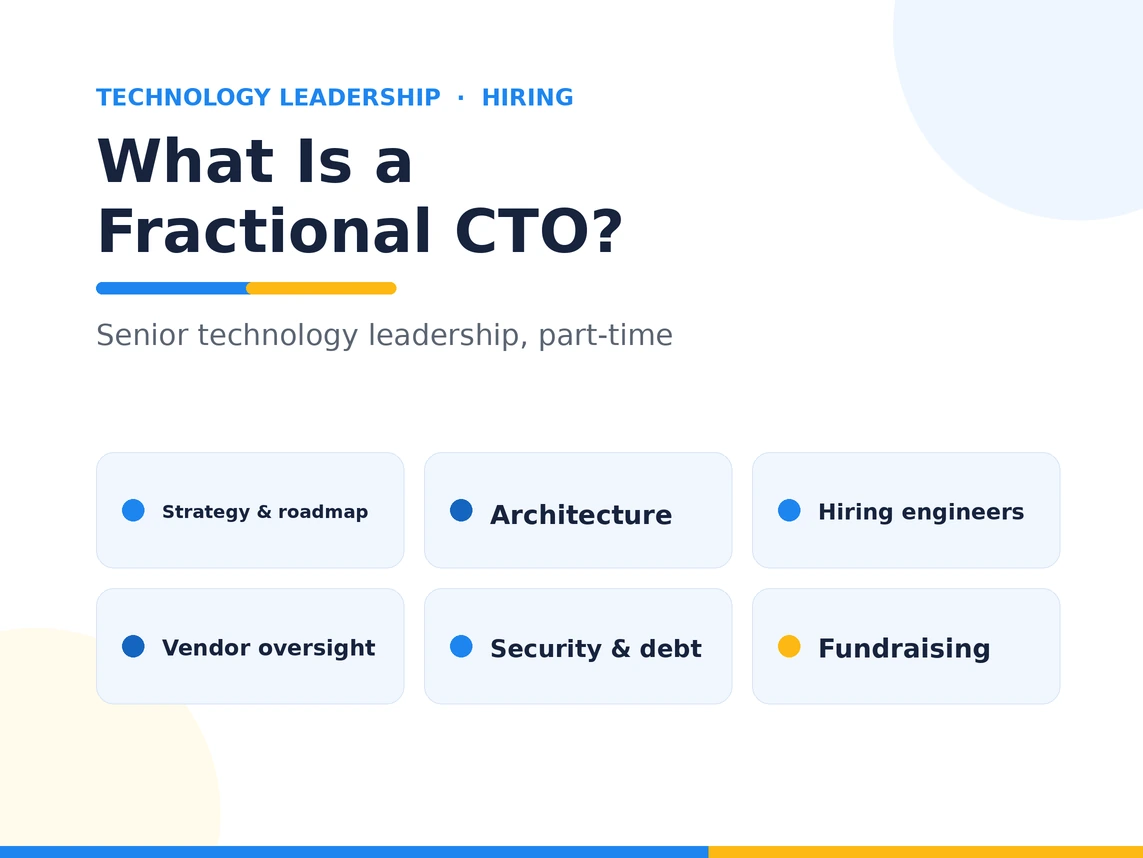
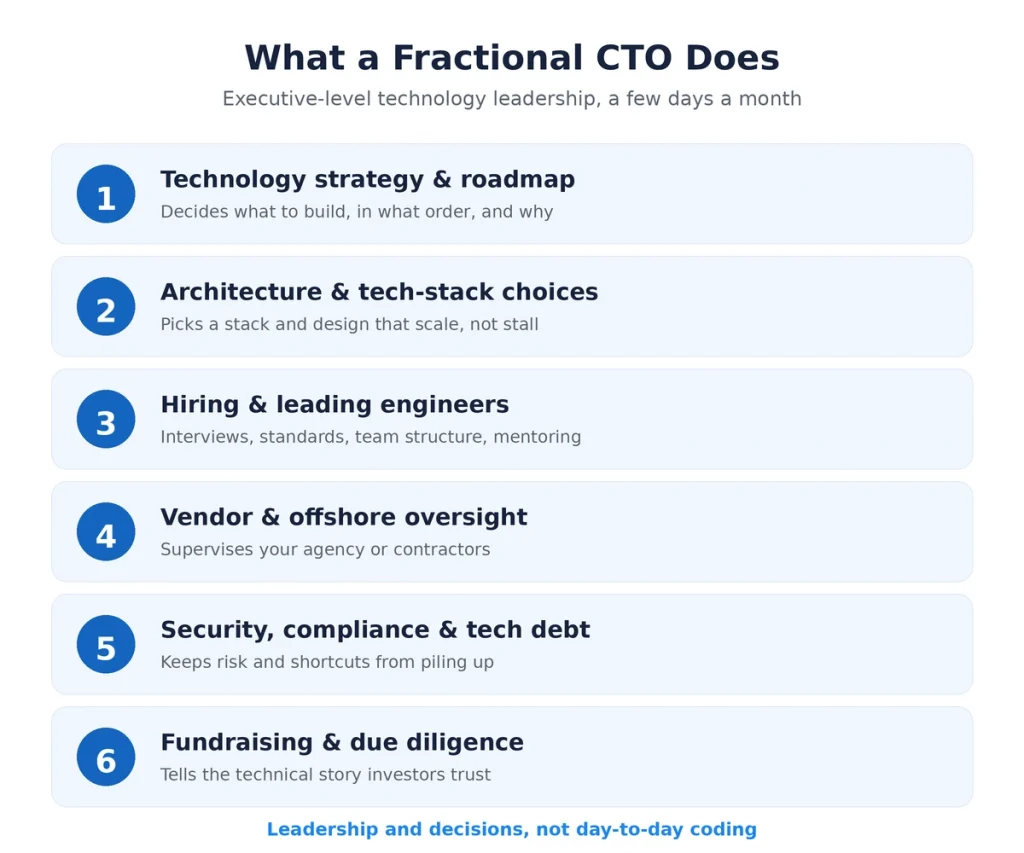
    What a fractional CTO does: technology strategy and roadmap, architecture, hiring engineers, vendor oversight, security and technical debt, and fundraising due diligence

    Technology strategy and roadmap. They decide what to build, in what order, and why, and they keep the technology aligned with the business goals. This is the core of the job.

    Architecture and technical decisions. They choose the tech stack, review the architecture, and make sure early choices will hold up as usage grows rather than collapse at the first spike.

    Hiring and leading engineers. They interview and assess developers, set engineering standards, structure the team, and mentor the people you already have. Strong technical hiring is one of the biggest reasons to bring one in.

    Vendor and team oversight. They manage your development agency, contractors, or offshore team, so an outside build has real senior supervision instead of running unchecked.

    Security, compliance, and technical debt. They oversee security and compliance, and they keep technical debt from quietly building into a wall you cannot get past.

    Fundraising and due diligence. When you raise, they tell the technical story to investors and handle the technical due diligence that a serious round requires.

    What a fractional CTO usually does not do is sit and write most of your code. They may prototype or dig into a hard problem occasionally, but their value is direction and decisions, not daily hands-on building. If what you need is more coding hours, that is a developer, not a CTO.

    Fractional CTO vs full-time CTO, advisor, and co-founder

    The fastest way to understand the role is to compare it with the alternatives people weigh against it.

    RoleCommitmentTypical costBest when
    Fractional CTOPart-time, ongoing, month-to-monthCash, roughly $5,000 to $15,000 per monthYou need senior leadership but not full-time
    Full-time CTOFull-time employee$200,000 to $400,000 plus equity and benefitsYou have a larger team that needs daily leadership
    Interim CTOFull-time but temporaryFull-time rate for a fixed termYou need to bridge a gap during a transition
    Technical advisorA few hours a month, advice onlySmall retainer or equityYou want occasional guidance, not execution
    Technical co-founderPermanent, full commitmentLarge equity stakeTechnology is the core product and you need an owner
    Dev agencyBuilds to your specProject or monthly feeYou need to build, and someone else sets the direction

    The key distinctions are worth stating plainly.

    A full-time CTO is fully dedicated and present every day, which a fractional CTO is not. Once your team is large enough to need daily leadership, you move to full-time.

    An interim CTO is temporary and full-time, brought in to cover a gap for a few months. A fractional CTO is part-time and ongoing by design.

    A technical advisor only advises, usually a few hours a month, and does not run anything. A fractional CTO decides, directs, and is accountable for the outcome.

    A technical co-founder is a permanent partner who owns a large equity stake because the technology is the product. A fractional CTO is a paid leader you can bring on and let go without that commitment.

    A development agency builds what you tell it to build. A fractional CTO is the person on your side who decides what to build and manages the agency doing it. The two work well together, with the fractional CTO directing the build.

    How much does a fractional CTO cost?

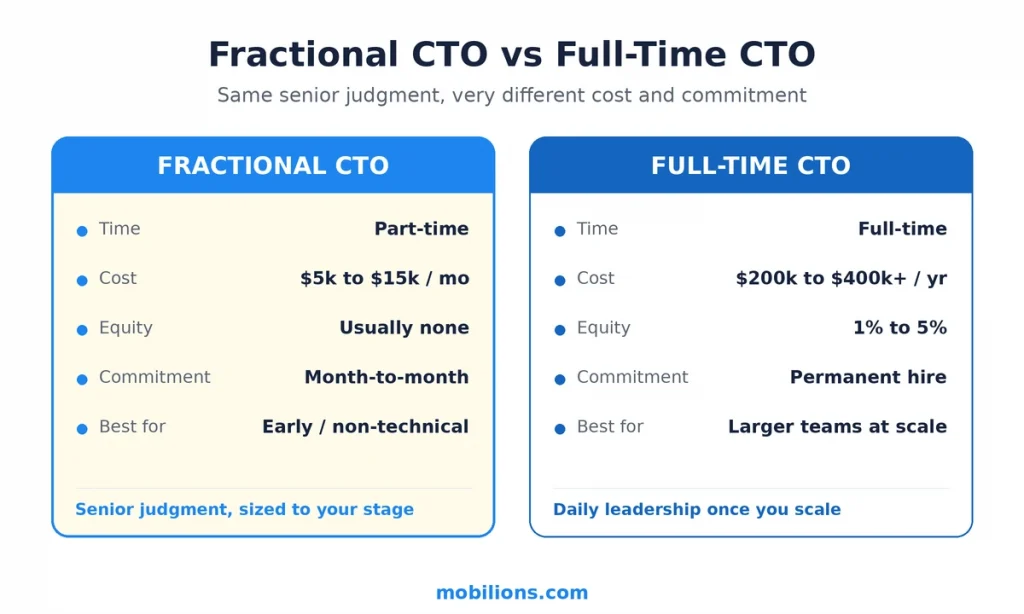
    Fractional CTO vs full-time CTO comparison of time, cost, equity, commitment, and best fit

    A fractional CTO in the United States typically costs about $5,000 to $15,000 per month for most engagements in 2026, depending on how many days a week you need. Hourly, that usually works out to roughly $150 to $350 per hour, with most experienced leaders landing around $200 to $250. Light advisory can start near $3,000 a month, and a near-full-time embedded arrangement can reach $25,000 or more.

    The reason founders choose the model is the comparison with a full-time hire. A full-time CTO in the United States commonly costs $200,000 to $400,000 in base salary, and once you add equity, bonus, and benefits the fully loaded cost often passes $400,000 a year. On top of that sits a one-time recruiting fee that can run $60,000 to $100,000 to find the person at all.

    A fractional CTO removes almost all of that. You pay cash for the days you use, usually no equity, and you can stop when the need changes. In annual terms the commitment is often $60,000 to $180,000, which is frequently 40 to 70 percent less than a full-time leader for the strategic work that matters most early on.

    Cost scales cleanly with time. As a rough guide, expect to pay in proportion to the days per week you book, so one day a week costs far less than three. If you want the full pricing breakdown by engagement type, see our fractional CTO service page, which lays out how we structure and price the work.

    When should you hire a fractional CTO?

    You should hire a fractional CTO when you need senior technology judgment but cannot yet justify a full-time CTO. A few clear signals tell you the moment has arrived.

    You are a non-technical founder. You are making technology decisions you are not equipped to make alone, or you have been burned by outsourced development that underdelivered. A fractional CTO gives you a trusted senior person to own those calls.

    Your product was built by juniors or an agency. The code works for now, but no senior person is watching the architecture, the security, or the technical debt. That gap gets expensive as you grow.

    You are about to raise. Investors will ask hard technical questions and run technical due diligence. A fractional CTO prepares the story and stands behind it.

    You are hitting scaling problems. You keep adding people, but features come slower and the system feels fragile. That is usually an architecture and leadership problem, not a headcount problem.

    You are between CTOs. Your technical leader left, and you need steady hands while you decide what comes next.

    The best-fit companies are non-technical founders, bootstrapped and early-stage startups, and small and midsize businesses, usually before or around Series A with a handful of engineers. The role fits a team that needs senior direction more than it needs another pair of hands on the keyboard.

    How a fractional CTO works day to day

    Most fractional CTOs work about 10 to 20 hours a week for a company, often framed as two to three days, and almost always remotely. Engagements are usually month-to-month and run somewhere between 6 and 18 months, though many start with a short assessment period so both sides can see the fit before committing further.

    The engagement usually takes one of three shapes. Some start with a focused assessment, a couple of weeks to diagnose the technology and hand you a prioritized plan. Most settle into an ongoing retainer, a set rhythm of leadership each month with regular check-ins with you. Some are time-boxed around a single milestone, such as a launch or a raise.

    Two practical points matter in the contract. Intellectual property should be assigned to you in writing, so everything built during the engagement is clearly yours. And most arrangements are paid in cash with little or no equity, though cash-tight startups sometimes offer a small equity component to align incentives. Decide that deliberately, not by accident.

    A real-world scenario

    Consider a non-technical founder who raised a small pre-seed round, hired an offshore agency to build the product, and got something that demoed well and won early customers. Six months in, the app started slowing down, a security scare surfaced, and the agency kept saying everything was fine.

    The founder brought in a fractional CTO two days a week. In the first weeks, the CTO audited the code, found the real issues, and set priorities the agency had been ignoring. Over the next few months they restructured the build, put in proper engineering standards, and prepared the technical story for the seed round. The agency kept building, but now under real supervision.

    The founder did not hire a full-time CTO, and did not need to. They got the senior decisions right, at a cost they could afford, exactly when those decisions mattered most. That is the shape of a good fractional engagement.

    How to hire a good fractional CTO, and the red flags

    Hire for judgment and fit, not just a resume. Look for someone who has actually built and scaled products like yours, who can explain technical tradeoffs in plain language, and who asks about your business goals before talking about technology. Ask for references from founders they have worked with, and start with a short paid assessment before a longer commitment.

    Watch for a few red flags. Be careful with anyone who wants to rewrite everything from scratch on day one, who cannot say no to a bad idea, who is spread across so many clients that they are never available, or who talks only about technology and never about your customers or your revenue. A good fractional CTO builds your team’s capability rather than making you dependent on them forever.

    The honest caveat: when not to hire one

    A fractional CTO is the wrong choice in a few situations, and it is worth being honest about them.

    If your engineering team is already large, with multiple teams that need a leader present every day, you need a full-time CTO, not a part-time one. If you are at Series B or beyond, investors will usually expect a named, full-time technical leader. And if technology is the actual core of your product and you need someone permanently invested as an owner, that is a technical co-founder, not a fractional hire.

    The model also fails without a real sponsor. If no one on your side can set priorities and make decisions with the CTO, or if the mandate is a vague “fix everything,” even a great fractional CTO cannot help. The role works when you know roughly what you need and want senior leadership to get there.

    Why Mobilions

    Choosing and directing technology is leadership work, and building the product underneath it is engineering, which is what we do. Mobilions has built software since 2016, delivering more than 250 projects for over 100 clients across more than 20 countries. That means when we guide your technology strategy, we do it with the scars and judgment of people who have shipped and scaled real systems, not just advice from the sidelines.

    If you need senior technology leadership without a full-time hire, our fractional CTO service gives you exactly that, and our dedicated development teams can build under that leadership. If you are weighing your options, talk to us and we will tell you honestly whether a fractional CTO is what you need.

    Summary

    A fractional CTO is a senior technology leader you hire part-time to run strategy, architecture, hiring, and technical oversight, without the salary, equity, and commitment of a full-time chief technology officer. It typically costs about $5,000 to $15,000 a month, often far less than a full-time hire, and fits non-technical founders and early-stage teams that need senior judgment more than extra coding hours.

    The role is leadership, not day-to-day coding, and it works best when you have a clear sponsor and a real need. Bring one in when you are making technology decisions above your comfort, building through an agency without oversight, or preparing to raise. Hire for proven judgment, clear communication, and a plan that builds your team rather than replacing it forever.

    Frequently asked questions

    What is a fractional CTO?

    A fractional CTO is a senior technology leader who works for your company part-time, usually remotely, to run your technology strategy, architecture, and engineering leadership. You get the judgment of an experienced chief technology officer for a few days a month, paid in cash, without the full-time salary, equity, or long-term commitment of a permanent hire.

    What does a fractional CTO actually do?

    A fractional CTO sets your technology strategy and roadmap, makes architecture and tech-stack decisions, hires and leads engineers, oversees your agency or offshore team, and handles security, technical debt, and investor due diligence. The work is leadership and decisions, not daily hands-on coding. In short, they own the technical calls that decide whether your product can scale.

    How much does a fractional CTO cost?

    A fractional CTO typically costs about $5,000 to $15,000 per month in 2026, or roughly $150 to $350 per hour, depending on how many days a week you need. Light advisory can start near $3,000 a month, and a near-full-time engagement can reach $25,000 or more. It is commonly 40 to 70 percent cheaper than a full-time CTO.

    What is a fair hourly rate for a fractional CTO?

    A fair hourly rate for an experienced fractional CTO in the United States is roughly $150 to $350 per hour, with most landing around $200 to $250. Specialists in areas like AI, fintech, or security can charge more. Many engagements are billed as a flat monthly retainer instead of hourly, which makes budgeting simpler.

    What is the difference between a fractional CTO and a full-time CTO?

    A full-time CTO is a dedicated employee, present every day, paid a full salary plus equity and benefits that often total over $400,000 a year. A fractional CTO does the same strategic leadership part-time, for cash, usually with no equity, on a contract you can end. You move to full-time once your team needs daily, hands-on executive leadership.

    Fractional CTO vs hiring developers: which should I choose?

    Choose a fractional CTO when you need senior direction, and developers when you need more building capacity. They solve different problems. Developers write the code, but without senior oversight they can build the wrong thing or the fragile thing. A common, effective setup is one fractional CTO setting the direction and supervising a team of developers or an agency.

    How do I know if my startup is ready for a fractional CTO?

    You are ready when you are making technology decisions above your own expertise, building a product without senior technical oversight, or preparing to raise and facing technical due diligence. Most companies bring one in before or around Series A, with a small engineering team. If you mainly need more coding hours rather than judgment, you are not there yet.

    How many hours per week does a fractional CTO work?

    A fractional CTO usually works about 10 to 20 hours a week for a single company, often described as two to three days. Some lighter advisory engagements are less, and some intensive ones are more. Because they serve a few companies at once, the exact hours are set in the contract and matched to what your stage actually needs.

    Can a fractional CTO help build my product, or do they just advise?

    A fractional CTO helps build your product by directing how it is built, choosing the architecture and stack, setting standards, and managing the team or agency doing the work. They may occasionally prototype or solve a hard problem hands-on, but they are not there to write most of the code. If you need heavy hands-on building, pair them with developers.

    Should I give equity to a fractional CTO?

    Most fractional CTO engagements are paid in cash with little or no equity, which keeps the arrangement flexible and avoids dilution. Some cash-tight startups offer a small equity component to align incentives and lower the monthly cost. If you do, put clear vesting terms in writing. Equity should be a deliberate choice, not a default.

    What is the typical contract length for a fractional CTO?

    Most fractional CTO engagements are month-to-month and run somewhere between 6 and 18 months in practice. Many start with a short assessment period of a few weeks so both sides can confirm the fit before committing further. The flexibility is part of the point, since you can scale the commitment up, down, or off as the company changes.

    Can one fractional CTO work with multiple companies at once?

    Yes, working with a few companies at once is normal for a fractional CTO and is how the model works. A good one caps the number so each client gets real attention and there are no conflicts of interest. Ask any candidate how many clients they carry and how they protect your confidentiality and their availability to you.

    What is the difference between a fractional CTO and a technical advisor?

    A technical advisor gives occasional high-level guidance, often a few hours a month, and does not run anything. A fractional CTO owns execution, makes decisions, leads the team, and is accountable for outcomes. Put simply, an advisor talks and suggests, while a fractional CTO decides and directs. You pay a fractional CTO more because they carry real responsibility.

    How is a fractional CTO different from a consultant or an agency?

    A consultant or agency works for you as an outside vendor that delivers a report or builds to your spec. A fractional CTO sits on your side of the table as your technology leader, setting the spec and managing those vendors, including the agency. They represent your interests, not a sale, and they stay accountable for the direction over time.

    Is it risky to hire a fractional CTO instead of an employee?

    The main risks are limited hours, split attention across clients, and a leader who never transfers knowledge to your team. You manage them by hiring someone with proven references, agreeing clear goals and a communication cadence, and requiring that they build your team’s capability. The flexibility usually outweighs the risk, since you can end a poor fit quickly.

    What happens to my intellectual property when I work with a fractional CTO?

    Your intellectual property should be assigned to you in writing, so everything created during the engagement belongs to your company. A proper fractional CTO contract includes an IP assignment clause plus confidentiality and clear termination terms. Confirm this before you start, and never begin real work without a signed agreement that makes ownership explicit.

    How long does it take a fractional CTO to add value?

    A good fractional CTO usually adds visible value within the first 30 to 45 days, far faster than the several months a full-time executive search and ramp would take. Early wins tend to be an honest assessment, a clear set of priorities, and the most urgent risks closed. Deeper results, like a rebuilt architecture or a stronger team, follow over the months after.