A fractional CTO costs about $5,000 to $15,000 a month for most engagements, or roughly $150 to $350 an hour if you pay by the hour. That is the short answer, and for a lot of founders it is all they need to know before the next question, which is always the same: is that a lot, or a little?
It depends entirely on what you compare it to. Set it next to a full-time CTO, who runs $200,000 to $400,000 a year before equity, and a fractional CTO looks like a bargain. Set it next to a junior developer, and it looks expensive, until you watch the junior build the wrong thing for six months.
Hiring senior leaders part-time is a real, growing model, not a workaround. Harvard Business Review has covered how part-time senior leaders help a business, and for early companies the appeal is simple: you get the experience you need without a cost you cannot carry yet.
This guide breaks down the real numbers: what a fractional CTO cost actually looks like across the different ways they charge, what moves the price up or down, the costs nobody warns you about, and how to tell whether the spend is paying for itself. If you are still fuzzy on the role itself, start with our guide on what a fractional CTO is and come back.
Key takeaways
- Most engagements land at $5,000 to $15,000 a month, or $150 to $350 an hour. Light advisory can start near $3,000, and near-full-time can pass $25,000.
- There are four ways to pay: hourly, a monthly retainer, a day rate, or cash plus a little equity. The retainer is the most common because it is predictable.
- It usually costs 40 to 70 percent less than a full-time CTO once you count salary, equity, benefits, and the recruiting fee.
- Price tracks seniority and scope, not a fixed rate card. A specialist prepping you for a raise costs more than a generalist steadying a small team.
- The real question is not the rate, it is the return. A good fractional CTO pays for the fee by stopping one expensive mistake.
How much does a fractional CTO cost?
Here are the numbers most US engagements fall into in 2026.
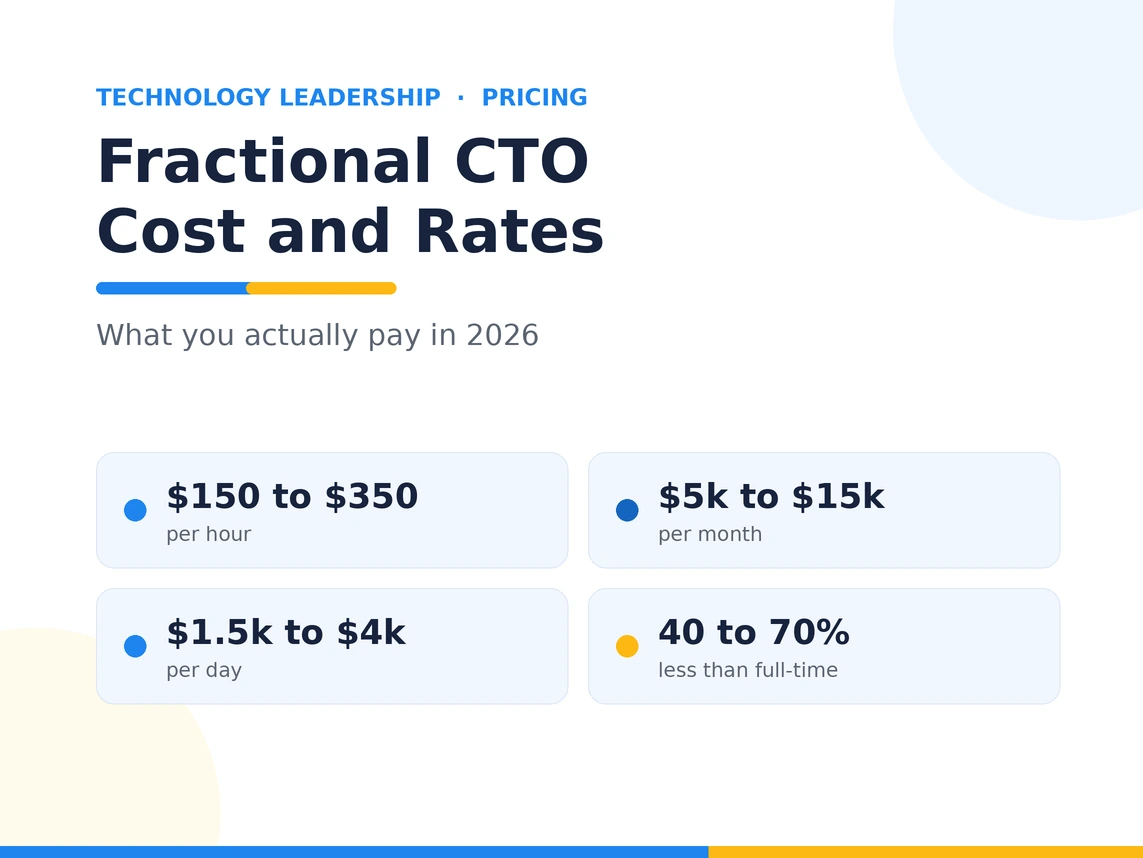
By the hour, expect $150 to $350, with most experienced people sitting around $200 to $250. Early-stage or lighter work can dip toward $100 an hour. At the other end, a specialist doing technical due diligence for a funding round can charge $500 an hour or more, because that work is high stakes and they do not do much of it.
On a monthly retainer, the common band is $5,000 to $15,000. A day or so a week of advisory sits near the bottom, around $3,000 to $5,000. Two to three days a week of real hands-on leadership sits in the middle. A near-full-time arrangement, where the CTO is in your business most of the week, can run $25,000 a month or higher.
By the day, rates run about $1,500 to $4,000, which is mostly used for short projects or a fixed piece of work rather than an ongoing relationship.
Notice the spread. A fractional CTO cost is not one price, it is a range you land inside based on how senior the person is and how much of them you need. The next sections are about where inside that range you actually end up.
The four ways a fractional CTO charges
Most of the confusion about cost comes from mixing up the pricing models. There are four, and each fits a different situation.
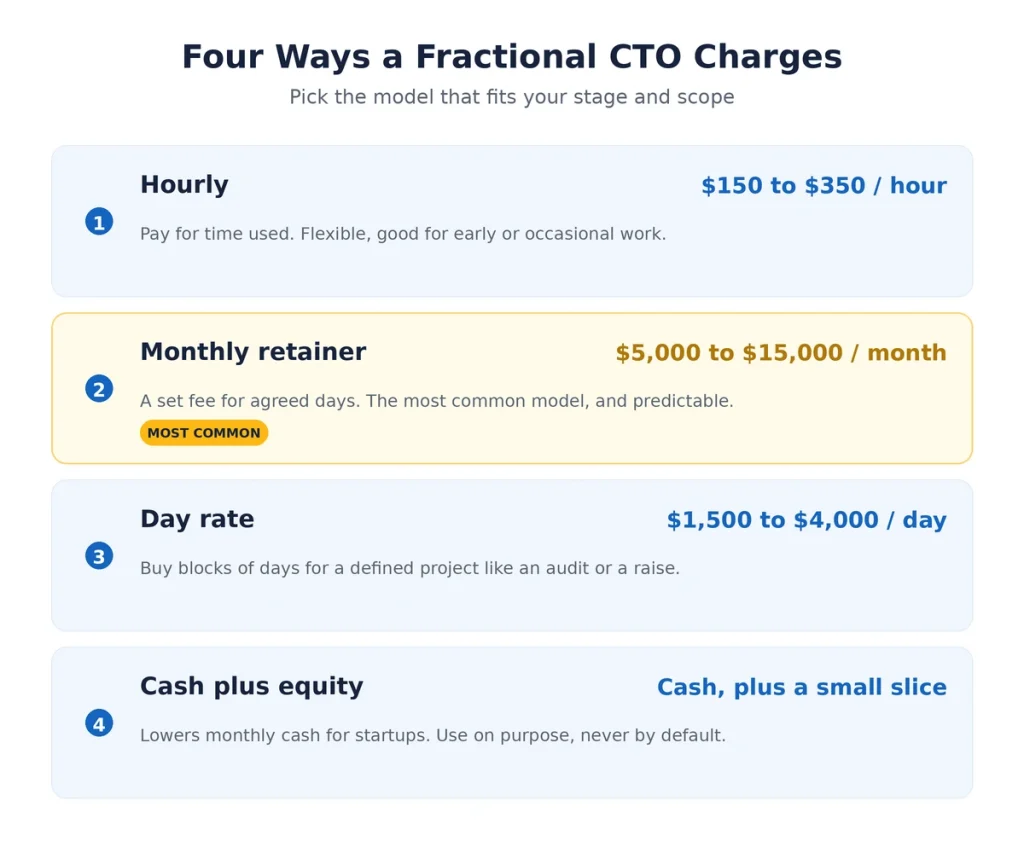
Hourly. You pay for the time you use. This is honest and flexible, and it suits early or occasional work where the scope is not fixed. The downside is that it can make you ration the very advice you are paying for, watching the clock instead of asking the question.
Monthly retainer. You pay a set fee for an agreed level of involvement, usually a certain number of days a week. This is the most common model, and for good reason. The cost is predictable, you can budget for it, and nobody is counting minutes. Most ongoing engagements settle here.
Day rate. You buy blocks of days, which works well for a defined project like an architecture review, a security cleanup, or getting you ready for due diligence. You know the total before you start.
Cash plus equity. Some cash-tight startups offer a small slice of equity to lower the monthly cash cost. This can align everyone’s incentives, but it dilutes you, and it only makes sense with a CTO who is genuinely invested in the long game. Most fractional arrangements are pure cash with no equity at all. Give away equity on purpose, never by default.
Fractional CTO cost vs a full-time CTO
This is the comparison that makes the model make sense, so it is worth doing properly rather than waving at “it is cheaper”.
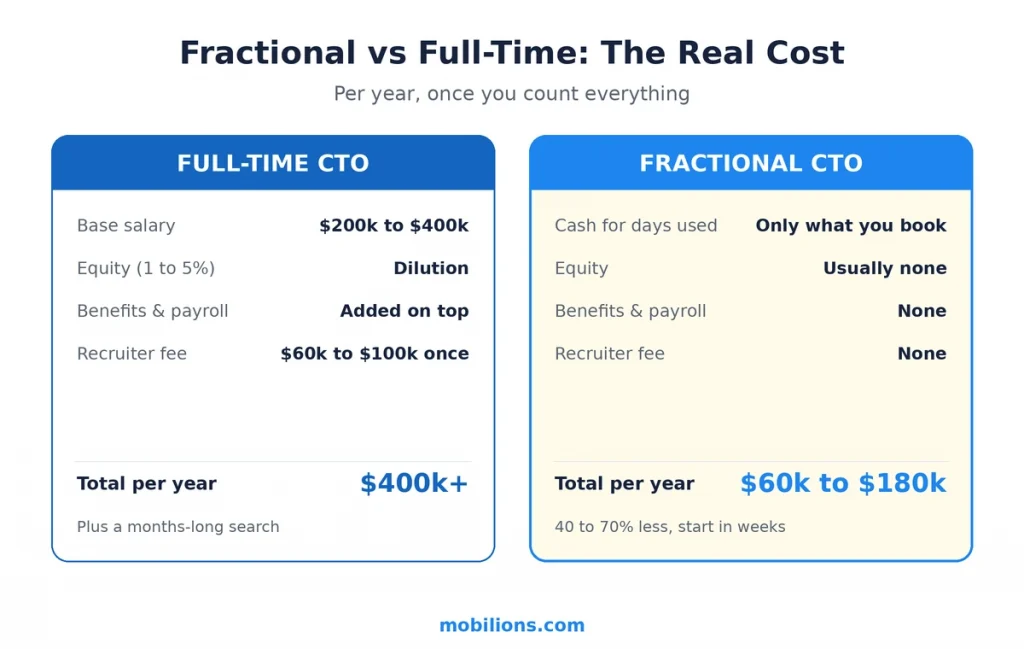
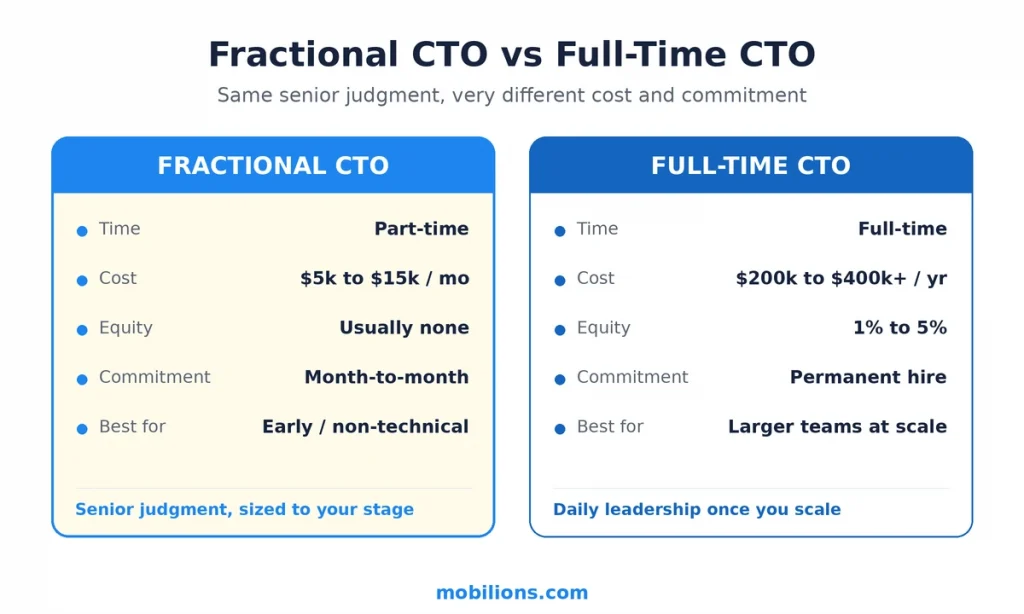
A full-time CTO in the US earns a base salary of $200,000 to $400,000. For context, the median pay for technology managers as a whole is about $170,000, per the US Bureau of Labor Statistics, and a CTO sits above that band.
Then you add equity, typically 1 to 5 percent that vests over four years, plus benefits, payroll taxes, and the rest of the cost of an employee. All in, you are often past $400,000 a year. Before any of that, you pay a recruiter $60,000 to $100,000 just to find the person, and the search can take months.
A fractional CTO strips almost all of that away. You pay cash for the days you use, usually no equity, no recruiting fee, and no long search. In annual terms the commitment is often $60,000 to $180,000. For the strategic work that matters most in the early days, that is frequently 40 to 70 percent less than a full-time hire, for the same quality of decision.
The catch is honest and simple. You are not getting a full-time person. When your company grows to the point where the technology needs a leader in the room every day, the math flips and a full-time CTO becomes the right spend. The fractional model is not a permanent discount on a CTO. It is the right answer for a specific stretch of a company’s life, and knowing when that stretch ends is part of using it well.
What actually changes the price
Two founders can get quotes that are twice as far apart as they expected. Here is what drives that.
Seniority. Someone who has been a CTO at a company like yours, and has the scars to show for it, costs more than a capable generalist. You are paying for judgment, and judgment is the whole point.
Scope. “Come to a weekly call and advise” is a different job from “own our architecture, manage the offshore team, and get us through a Series A”. The second costs more because it is more.
Stage and stakes. Work tied to a funding round or a security problem carries more risk and more pressure, so it prices higher than steady-state guidance.
Hours. This is the simple lever. One day a week costs far less than three. Most of your cost is just how much of the person you are booking.
Specialization. A fractional CTO who is deep in AI, fintech compliance, or high-scale infrastructure charges a premium in their niche, because that specific knowledge is rare and worth it when you need it.
The hidden costs nobody mentions
The fee is not the whole story, and pretending it is leads to disappointment. A few costs hide around the edges.
The first is your own time. A fractional CTO is not a vending machine. You get the value when someone on your side sets priorities, answers questions, and acts on the plan. If nobody internal engages, you are paying for advice that goes nowhere.
The second is onboarding. It takes a couple of weeks for anyone to learn your product, your code, and your team. You pay for that ramp, and it is normal, so plan for a short runway before the big wins land.
The third is the cost of the wrong hire. A cheap fractional CTO who points you at the wrong architecture is not cheap. Fixing that later costs far more than the difference in rate. This is the one place where paying up is almost always the better deal.
What you actually spend, by stage
Real budgets are easier to picture by where your company is.
If you are a pre-seed or bootstrapped founder, you are usually buying a day or less a week to get the big decisions right and keep an eye on whoever is building. Think roughly $3,000 to $7,000 a month, and treat it as insurance against expensive early mistakes.
If you have raised a seed round and have a small team, you likely want two to three days a week of real leadership: architecture, hiring, and process. That is the classic $8,000 to $15,000 a month engagement, and it is where most of the value shows up.
If you are approaching Series A, you might briefly want a heavier arrangement to get through due diligence and set the team up, then taper down or move to a full-time hire. Higher for a stretch, then it changes. That flex is the feature, not a bug.
Is a fractional CTO worth the cost?
For the right company at the right time, yes, and the reason is not the rate. It is the return.
A fractional CTO earns the fee by preventing the mistakes that actually sink early companies: the architecture that cannot scale, the security hole that becomes a breach, the six months of building the wrong thing, the failed technical due diligence that kills a round. Any one of those costs more than a year of the fee. Stopping one pays for the whole engagement.
Here is the honest version, though. It is not worth it if you only need more hands to write code, because that is a developer, not a CTO. It is not worth it if nobody on your side will engage with the plan. And it stops being the right spend once you are big enough to need a full-time leader every day. Spend the money when you are buying senior judgment you cannot get any cheaper. Skip it when you are not.
How to get the most for your money
A few habits make the spend work harder.
Start with a short paid trial, a couple of weeks or a small project, before you commit to a long retainer. You learn more about fit in two weeks of real work than in any number of calls.
Agree on what good looks like up front. Write down the outcomes you want and how you will both know they happened. Vague mandates like “fix everything” waste money, because nothing gets prioritized.
Then use the person for what they are worth. Bring them the hard calls, the hiring, the architecture, the investor conversations. Do not spend a $250-an-hour leader on work a junior could do.
And watch for a few red flags while you are at it. Be wary of anyone who wants to rewrite everything on day one, who is so spread across clients they are never available, or who talks only about technology and never about your customers or your money. The right person makes your team stronger, not more dependent on them.
Why Mobilions
At Mobilions we have built software since 2016, and shipped more than 250 projects for over 100 clients across more than 20 countries. When we take on fractional technology leadership, it comes with engineers behind it who have actually built and scaled the kind of system you are worried about, so the advice is grounded in production, not slides.
We price the work to your stage, you own every line of code and decision, and we will tell you honestly when a fractional CTO is the wrong spend and something simpler will do.
If you want senior leadership without a full-time hire, our fractional CTO service is built for exactly that, and a dedicated development team can build under that leadership when you are ready. The same engineers handle the custom software development underneath, and if you would rather talk it through first, tell us what you are building and we will give you an honest read on the cost.
Summary
A fractional CTO costs about $5,000 to $15,000 a month, or $150 to $350 an hour, and usually 40 to 70 percent less than a full-time CTO once you add up salary, equity, benefits, and the recruiter. The exact number depends on how senior the person is, how much of them you book, and how high the stakes are, not on a fixed rate card.
Budget a few thousand a month for light early advice, and more for hands-on leadership through a seed stage. Treat the ramp-up weeks and your own engagement as part of the cost, not extras.
The rate is the easy part to fixate on and the wrong thing to optimize. What matters is whether the person stops the mistakes that would cost you far more than their fee. If you are making technology calls above your depth and cannot yet justify a full-time hire, put a fractional CTO on a short paid trial and judge them on the first two weeks. That is the cheapest way to find out if the spend is worth it, and it usually is.
Frequently asked questions
How much should you pay a fractional CTO?
Most US fractional CTOs cost $5,000 to $15,000 a month, or $150 to $350 an hour. Light advisory can start near $3,000 a month, and near-full-time involvement can pass $25,000. What you should pay depends on how senior the person is and how many days a week you actually need, so match the rate to the scope.
What is a fair hourly rate for a fractional CTO?
A fair hourly rate for an experienced fractional CTO in the US is roughly $150 to $350, with most landing around $200 to $250. Specialists in areas like AI, fintech, or security charge more. Many prefer a flat monthly retainer over hourly billing, which makes your cost predictable and stops you rationing the advice you are paying for.
How much does a fractional CTO cost compared to a full-time CTO?
A full-time CTO costs $200,000 to $400,000 in base salary, and often over $400,000 fully loaded with equity and benefits, plus a recruiting fee. A fractional CTO usually runs $60,000 to $180,000 a year for the strategic work, which is commonly 40 to 70 percent less. You trade full-time presence for senior judgment at a fraction of the cost.
What are the different fractional CTO pricing models?
There are four. Hourly, where you pay for time used. A monthly retainer, a set fee for an agreed level of involvement, which is the most common. A day rate, for defined projects. And cash plus a small equity slice, used by cash-tight startups. Most ongoing engagements use a retainer because the cost is predictable.
How much equity should a fractional CTO get?
Most fractional CTOs take no equity and are paid in cash. When equity is used to lower the monthly cash cost, it is usually a small amount, often well under one percent, with clear vesting. Give equity only on purpose, to align a CTO who is genuinely in it for the long term, and never as a default because cash is tight.
How many hours a week does a fractional CTO work?
Usually 10 to 20 hours a week for one company, often described as two to three days. Lighter advisory engagements are less, and intensive ones around a raise or a launch are more. Because hours are the main cost lever, you set them in the contract to match your stage and budget.
What is the total cost of hiring a fractional CTO?
Beyond the monthly fee, budget for two things. First, a couple of weeks of onboarding while they learn your product and team, which is normal ramp-up you still pay for. Second, your own time, since the value only lands when someone internal engages with the plan. There is no recruiting fee or equity in most arrangements, which keeps the total low.
Are there hidden costs with a fractional CTO?
The main ones are the onboarding ramp, your team’s time to work with them, and the cost of a bad hire. A cheap fractional CTO who sets the wrong architecture is the most expensive option, because fixing it later dwarfs the difference in rate. Paying for real seniority is usually the cheaper path overall.
Is a fractional CTO worth it for an early-stage startup?
For many early startups, yes. You get senior decisions on architecture, hiring, and security at the moment those calls are cheapest to get right and most expensive to get wrong. It is worth it when you need judgment more than coding hours. It is not worth it if nobody on your side will act on the guidance.
How long should you hire a fractional CTO for?
Most engagements run 6 to 18 months and are month-to-month, so you can scale up or down as things change. Many start with a short trial, then settle into a steady retainer, and later taper off or convert to a full-time CTO. The flexibility is a big part of why the model is cost-effective.
Can a fractional CTO build my MVP?
A fractional CTO leads the MVP build rather than writing most of the code themselves. They set the architecture, choose the stack, and direct the developers or agency doing the work. If you want them heavily hands-on in the code, expect it to cost more and to use up the senior time you are really paying them for.
How do I budget for a fractional CTO?
Match the spend to your stage. Pre-seed and bootstrapped founders often budget $3,000 to $7,000 a month for light leadership. Seed-stage teams that need hands-on involvement usually spend $8,000 to $15,000. Plan for a higher stretch around a raise, then a taper. Treat the fee as insurance against far larger mistakes.
Do fractional CTOs charge for a trial period?
Usually yes, a trial is paid, but it is small and scoped, like a two-week assessment or a single project. It is the best money you can spend before a longer commitment, because you learn more about fit from real work than from interviews. A good CTO will happily start this way.
Why do fractional CTO rates vary so much?
Rates track seniority, scope, stage, hours, and specialization. A generalist advising a small team a day a week costs a fraction of a specialist owning your architecture and steering a Series A. The wide range is not random pricing, it is different jobs. Get quotes against a clear scope so you are comparing like with like.
Is a fractional CTO cheaper than a development agency?
They solve different problems, so it is not a straight price comparison. An agency builds what you specify. A fractional CTO decides what to build and often manages the agency doing it. Many teams pay for both, a fractional CTO for direction and an agency or developers for the build, which is still far cheaper than a full-time CTO plus a team.
What should be in a fractional CTO contract?
Cover the scope and hours, the fee and payment terms, and clear ownership of all intellectual property so everything built is yours. Add confidentiality, a notice period, and how you will measure success. Getting IP assignment and expectations in writing up front protects you and keeps the engagement clean if you ever part ways.
When should I switch from a fractional to a full-time CTO?
Make the switch when your engineering team is large enough to need a leader in the room every day, or when investors expect a named, full-time technical head, which is common by Series B. A good fractional CTO will tell you when that moment is near and often helps you hire their own replacement.

Tushar Patel is the founder and CEO of Mobilions, an AI-first software engineering company. With over a decade helping businesses build custom software, mobile apps, and AI solutions, he leads strategy and delivery for teams shipping products across 20+ countries. He writes practical, senior-level guides on software development, hiring engineering talent, and scaling products.