
Hiring for a website is one of those purchases where the price ranges are so wide, and the quality so hard to judge from the outside, that a lot of good businesses end up burned. Quotes for the same project can run from a few hundred dollars to six figures, everyone’s portfolio looks great, and the person who charges the least is often the one who costs you the most in the end.
This guide is here to fix that. It is a practical buyer’s guide to web development services in USA: what they actually cost, how to choose between a freelancer, an agency, and a dedicated team, how to spot the red flags, and the exact questions to ask before you sign anything.
We have built web products since 2016, so this is the advice we would give a friend before they hire, including the parts that are not in a vendor’s interest to tell you. Whether you are a small business getting your first real site, a company planning a redesign, or a founder building a web app, the goal is the same: spend your budget on the right team and own what you pay for. Choosing web development services in the USA well is mostly about asking the right questions before you sign, and this guide gives you them.
Key takeaways
- In the US, web developer rates run about $25 to $50 an hour for junior, $50 to $90 for mid-level, and $90 to $180 or more for senior. Projects range from around $1,000 to $150,000 and up.
- Freelancer, agency, or dedicated team is a delivery-risk decision, not just a price one: how much coordination, quality review, and fallback cover does the project need?
- Judge on shipped work, references, and code ownership, not on the lowest quote. The cheapest bid usually hides missing scope or a junior team.
- Get code and IP ownership in writing before anyone starts, along with a clear scope, timeline, payment terms, and what happens after launch.
- Location matters less than seniority and communication. A senior remote team with US time-zone overlap often beats a local shop on cost for the same quality.
What web development services in USA actually include
“Web development services” is a broad phrase, and knowing what falls under it helps you scope your project and avoid paying for things you do not need, or forgetting things you do. A full-service provider typically covers: discovery and planning, UX and UI design (how the site looks and feels), front-end development (what users see), back-end development (the server, database, and logic), integrations with other tools, testing, launch, and ongoing maintenance. Some also handle web design and content, SEO setup, and hosting.
Not every project needs all of it. A simple marketing site is mostly design and front-end; a custom web app is heavy on back-end and integrations. The first job when buying is to be clear about which of these you actually need, because a vague brief is how budgets balloon. If you cannot describe the core of what you want in a sentence or two, that is the place to start, not the vendor selection.
Web developer, web designer, or agency: who does what?
These roles get blurred, and hiring the wrong one wastes money. A web designer shapes how the site looks and how people move through it, the visuals, the layout, the user experience. A web developer builds it, turning the design into a working site, and a full-stack developer builds both the front and the back end. A web development agency or dedicated team gives you both, plus project management and QA, coordinated under one roof.
The rule of thumb: if you need a look, hire a designer; if you need it built, hire a developer; if you need the whole thing delivered without managing the pieces yourself, hire a team. Most businesses buying web development services want the last option, one accountable group that takes the project from idea to live site, which is what full-stack development is built to provide.
Freelancer, agency, or dedicated team?
This is the biggest decision, and it is usually framed as a price question when it is really about risk. Here is the honest comparison.
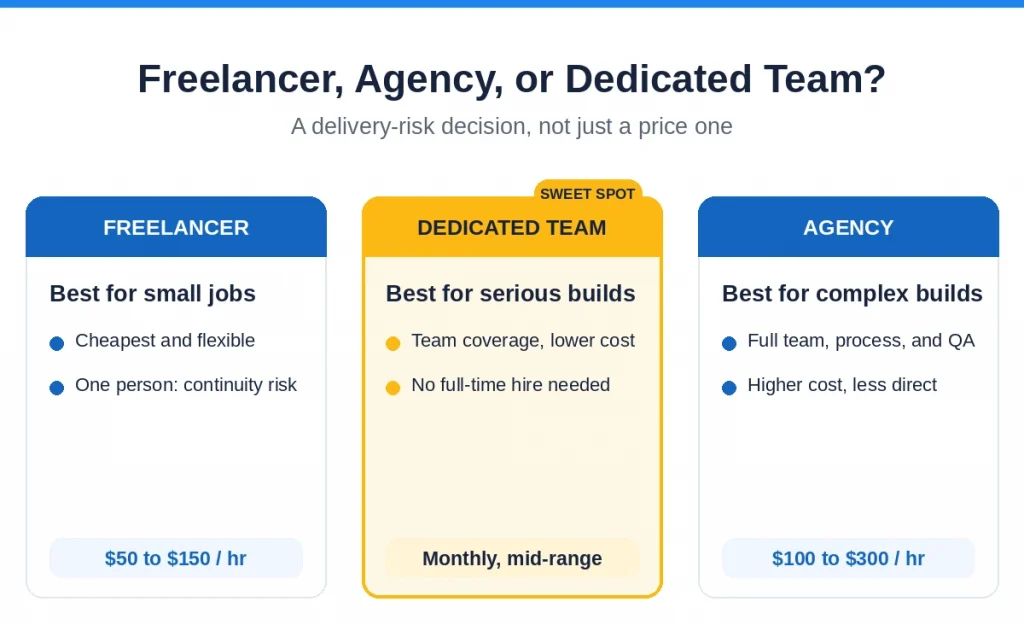
| Freelancer | Agency | Dedicated team | |
|---|---|---|---|
| Best for | Small, well-defined jobs | Complex projects, many skills | Ongoing or evolving builds |
| US cost | $50 to $150/hr, projects under $15k | $100 to $300/hr, $15k to $150k+ | Between the two, monthly |
| Strength | Cheapest, direct, flexible | Full skills, process, QA | Coverage plus lower cost |
| Risk | One person: continuity, gaps | Higher cost, less direct | Depends on the partner |
A freelancer is efficient for a narrow, well-defined task, a single-page site, a fix, ongoing maintenance. The risk is continuity: one person gets sick, goes quiet, or lacks a skill your project needs halfway through. An agency gives you a full team and process, which is right for complex, multi-part builds, but costs more. A senior dedicated team sits in between and is often the sweet spot for a serious build: agency-level coverage at a lower cost, without hiring full-time. Match the option to the delivery risk your project carries, not just the sticker price.
How much do web development services cost in the USA?
Let us put real 2026 numbers on it. US web developer hourly rates run roughly $25 to $50 for junior, $50 to $90 for mid-level, and $90 to $180 or more for senior specialists, with a typical freelance average around $70. The seniority of US web talent is real: the US Bureau of Labor Statistics puts the median annual wage for web developers at about $90,930, so genuinely skilled US developers are not cheap, and a rate far below these bands usually means junior or offshore work.
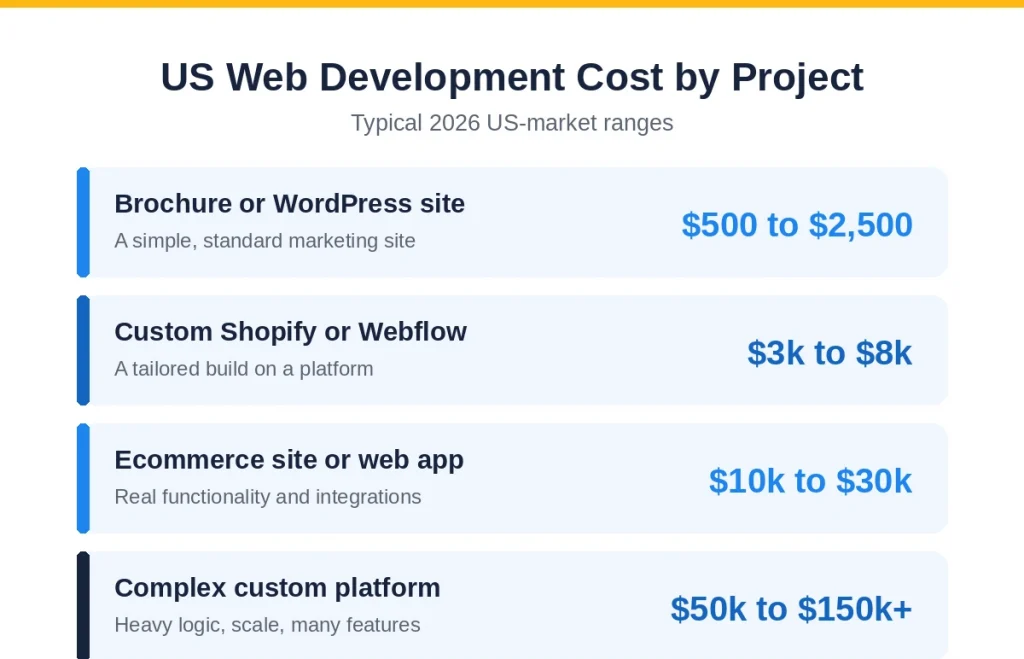
On a project basis, the ranges are wide but predictable by type:
- Simple brochure or WordPress site: about $500 to $2,500.
- Custom Shopify or Webflow build: about $3,000 to $8,000.
- Full ecommerce site or web app: about $10,000 to $30,000, and up.
- Complex, custom platform: $50,000 to $150,000 or more.
Most agencies (around 63 percent) quote projects between $1,000 and $15,000, so if your needs are modest, that is the band to expect. Get itemized quotes and compare what is actually included, because the biggest cost surprises come from scope that was assumed, not stated. Directories like Clutch can help you sanity-check rates and shortlist vetted firms.
Fixed price or hourly?
Both are common, and they suit different situations. Fixed price gives you budget certainty and works when the scope is genuinely locked down, but any change becomes a negotiation, and truly fixed scope is rare in a first build. Hourly, or a monthly retainer, suits work that will evolve and lets you steer as you learn, but it needs a team you trust to be honest with your time. For most web projects, a good middle path is a fixed price for a well-defined first milestone, then a flexible arrangement for the rest. Whatever the model, insist on visibility: regular updates and something working to look at, so you always know where the money is going.
How to find a good web developer (and not get scammed)
The internet is full of horror stories about deposits paid and developers who vanished, so slow down and vet properly. The signals that actually matter:
- Shipped work you can visit. Ask for live sites, ideally similar to yours, and actually use them. Screenshots and mockups prove nothing.
- Real references. Talk to a past client and ask the honest question: what went wrong, and how did they handle it?
- Clear communication. If they are slow, vague, or dodge questions before you have paid, it only gets worse after.
- Sensible process. A good developer asks about your business and pushes back on scope instead of just saying yes to everything.
Protect yourself on payment too. Never pay the whole amount up front; use milestone payments tied to delivered work, and for freelancers, consider an escrow platform that releases funds as stages are completed. A trustworthy provider will expect this and be comfortable with it.
The red flags to walk away from
- A quote dramatically lower than everyone else, which usually means missing scope or a junior team.
- No named developers, or vague answers about who will actually do the work.
- Unclear or missing terms about who owns the code and IP when it is done.
- Pressure for full payment up front, or resistance to milestone or escrow payments.
- Agreeing to your entire feature list on the first call with no questions or pushback.
- No plan or price for support and maintenance after launch.
- Slow, evasive communication before you have even signed.
The questions to ask before you hire
Bring these to any developer or agency you are considering. How they answer tells you almost everything.
- Can I see and use two or three live sites you have built like mine?
- Who exactly will work on this, and how senior are they?
- Who owns the code, the content, and the domain when we are done?
- What is in scope, and what would count as a change?
- How do you handle SEO, performance, security, and mobile responsiveness?
- What are the payment terms, and how do milestones work?
- What happens after launch, and what does maintenance cost?
Custom, template, or a website builder?
Not everyone needs a custom build, and honesty here saves money. A website builder (like Squarespace or Wix) or a template is genuinely fine for a simple site with standard needs, and a good developer will tell you when that is the smart choice rather than upselling you.
Custom development earns its cost when you need a specific workflow, tight branding, real performance, serious SEO, or functionality a template cannot give you. The test: if your site is a digital brochure, a builder or template may be enough; if it is a tool people use or a serious growth asset, custom web development is worth it. Beware anyone who insists on custom for a job a template would do, or on a template for a job that clearly needs custom.
What to put in the contract
A clear contract prevents most disputes. Make sure it covers, in writing: the scope of work and what counts as a change; the timeline and milestones; the payment schedule tied to deliverables; and, most importantly, that you own the source code, the design, the content, and the domain, with no license back to the developer and no lock-in. It should also cover confidentiality, what happens if either side wants out, and the terms for support after launch. The single most expensive omission is ownership: get it stated plainly that everything is yours, because the nightmare is discovering a year later that you cannot move your own website because the code or the accounts were never really in your name.
Timeline: how long should it take?
It depends on scope, but rough expectations help you spot an unrealistic promise. A simple site can ship in a few weeks; many agencies deliver basic sites and MVPs in under four weeks. A custom site or web app takes longer, often a couple of months or more, depending on features and integrations. Be wary of anyone promising a complex custom build in a few days, and equally wary of a simple site that somehow needs six months. A good developer gives you a realistic timeline with milestones, not a single vague date, and keeps you updated against it.
SEO, performance, security, and responsive design
A site is not finished when it looks good; it is finished when it is fast, findable, secure, and works on a phone. These are not optional extras, they are the baseline of competent web development, and you should confirm your developer treats them that way. Responsive design means the site works on every screen size, which matters because most traffic is mobile.
Performance means it loads fast, which affects both users and search ranking. SEO setup means the site is built so search engines can understand and rank it. And security means protecting the site and any user data from the common web threats. Ask specifically how each is handled, and treat a developer who waves these away as a warning sign.
US-based or remote: does location matter?
The keyword says “in USA,” so let us address it honestly. Hiring a US-based developer has real advantages: same time zone, easy communication, and shared context. But location is not the same as quality, and a local shop often carries local overhead you pay for in the rate. A senior remote or offshore team with genuine US time-zone overlap and clear communication frequently delivers the same quality for materially less, with none of the downside as long as the working relationship is tight.
Judge on seniority, shipped work, communication, and ownership terms first; treat location as one factor, not the deciding one. What you actually want is a team that understands US users and is easy to work with, whether they sit in New York or work your hours from elsewhere.
Maintenance, and can they do mobile apps too?
Two loose ends worth tying off before you hire. First, maintenance: a website is not a one-time purchase; it needs updates, security patches, and fixes. Agree up front who handles it and what it costs, because a site nobody maintains slowly breaks. Many businesses keep their developer on a small monthly retainer for exactly this. Second, mobile: if you might need a mobile app later, it helps to hire a partner who also does mobile app development, so your web and app work share a team and a codebase where it makes sense, rather than stitching together two vendors who do not talk to each other.
Web development services in the USA on a small-business budget
A tight budget does not shut you out; it just changes the smart path. If money is limited, be ruthless about scope: build the one version of the site that does the job and nothing more, and add the rest later when it pays for itself. A good developer helps you cut, not upsell. Consider a builder or template for a genuinely simple site, a skilled freelancer for a narrow build, or a senior remote team to get quality at a lower rate than a local agency.
Spend where it counts, mobile-friendliness, speed, and basic SEO, rather than on flourishes users will not notice. The businesses that get the most from web development services in the USA on a small budget are the ones that stay focused and own what they build, so they can grow it in steps.
Managing a web project remotely
Most web work today is done remotely, even with a US team, so managing it well is a skill worth having. Agree on a single point of contact on each side and a regular check-in with something working to look at, not just a status update, because a demo tells you the truth and a written report can hide it.
Write decisions and scope changes down, with their effect on time and cost, so nothing is a surprise at the end. Respond quickly when the team needs a decision, since a stalled answer stalls the build. The projects that go smoothly are rarely the ones with the flashiest developers; they are the ones where the client stayed engaged and the scope stayed clear.
Redesign or rebuild: hiring for an existing site
If you already have a site, the question is whether to improve it or start over. Improve it when the foundations are sound and you mainly need a fresh look, better speed, or new features. Rebuild when the site is slow, insecure, hard to change, or built on something outdated that fights every update. A good developer assesses honestly rather than automatically pushing a full rebuild, because a rebuild is more work and more money. When hiring for a redesign or a legacy update, look specifically for someone comfortable working with existing code and willing to tell you plainly which parts are worth keeping and which are not.
The mistakes to avoid
- Choosing on the lowest quote instead of shipped work and clear ownership.
- Paying the full amount up front instead of using milestones or escrow.
- Leaving code, content, or domain ownership vague or in the developer’s name.
- Hiring custom when a template would do, or a template when you clearly need custom.
- Skipping references and portfolios you can actually visit and use.
- Forgetting to agree who handles maintenance and what it costs after launch.
- Judging a team purely on location instead of seniority and communication.
How to choose: a simple decision path
Strip it to a few questions. What exactly do I need built, and how complex is it? Does that complexity call for a freelancer, an agency, or a dedicated team? Can the people I am considering show me live, similar work and real references? And will the contract give me full ownership with clear scope, milestones, and support? Answer those honestly and the right choice usually becomes obvious. If your project is simple, a good freelancer or a builder may be all you need. If it is a serious, growing web asset, a senior team that gives you ownership and communicates well is worth paying for.
If you want a straight read on what your project needs, what it should cost, and how to build it right, a senior engineer will walk through it with you, no obligation. See how we approach web development, or book a discovery call.
Frequently asked questions
How much do web development services cost in the USA?
US web developer rates run about $25 to $50 an hour for junior, $50 to $90 for mid-level, and $90 to $180 or more for senior. Projects range from roughly $1,000 for a simple site to $150,000 or more for a complex platform, with most agencies quoting between $1,000 and $15,000. Cost tracks scope, complexity, and team seniority.
Should I hire a freelancer or a web development agency?
It is a delivery-risk decision. A freelancer is cheapest and fine for a small, well-defined job, but risky on continuity. An agency or dedicated team gives you a full skill set and process for complex builds at higher cost. Match the choice to how much coordination and fallback the project needs.
What is the difference between a web developer and a web designer?
A web designer shapes how the site looks and how people move through it. A web developer builds it, turning the design into a working site. A full-stack developer does both the front and back end. For a full project delivered end to end, you usually want a team that covers both.
How do I hire a web developer without getting scammed?
Ask for live sites you can use and real references, watch how they communicate before you pay, and never pay the full amount up front. Use milestone payments tied to delivered work, and for freelancers consider an escrow platform. Get code and IP ownership in writing before anyone starts.
How long does it take to build a website?
A simple site can ship in a few weeks, and many agencies deliver basic sites in under four weeks. A custom site or web app takes a couple of months or more, depending on features and integrations. Be wary of anyone promising a complex build in days.
Should I use a custom build or a website builder?
A website builder or template is fine for a simple site with standard needs, and a good developer will say so. Choose custom when you need a specific workflow, tight branding, real performance, serious SEO, or functionality a template cannot provide.
Fixed price or hourly: which costs less?
Fixed price gives budget certainty when scope is locked, but changes become negotiations. Hourly suits work that will evolve and needs a team you trust. A fixed first milestone, then a flexible arrangement, is a good middle path for most projects.
Do I own the website and code after it is built?
You should, if it is in your contract. Insist in writing that you own the source code, design, content, and domain, with no license back to the developer and no lock-in. The worst outcome is being unable to move your own site because ownership was never clearly yours.
Should I hire a US-based or remote web developer?
Location matters less than seniority, shipped work, and communication. US-based means same time zone and shared context but often higher cost. A senior remote team with US time-zone overlap frequently delivers the same quality for less. Judge on the team, not just the flag.
Can a junior developer build my website?
For a simple, standard site, possibly. For anything with custom functionality, performance, security, or SEO needs, junior work often costs more in the long run through rework. Senior involvement gets the foundations right the first time, which is cheaper over the life of the site.
Who should handle website maintenance after launch?
Agree this before you hire. A website needs updates, security patches, and fixes, so it should not be left to nobody. Many businesses keep their developer on a small monthly retainer for maintenance, which is usually cheaper than fixing a neglected site later.
Can web developers help with mobile apps too?
Many can, and it helps to choose a partner who does both web and mobile so the work can share a team and codebase where it makes sense. If a mobile app is on your roadmap, ask about it up front rather than hiring two vendors who do not coordinate.

Ankit Dhimmar is the CTO of Mobilions, leading engineering across custom software, SaaS platforms, and cloud architecture. With over a decade building and scaling production systems, he focuses on the decisions that keep software reliable as it grows. He writes about software architecture, SaaS product engineering, and building systems that last.