
Choosing a custom software development company comes down to one question: will this team ship software that works in production and that you fully own, or will you end up with a demo that stalls and a vendor you cannot leave? Knowing how to choose a custom software development company is less about slick portfolios and more about engineering judgment, honest scoping, security, and who owns the code when the project ends.
This guide covers exactly what to look for: what these companies do, the checks that actually matter, the questions to ask before you sign, the red flags to walk away from, what a fair quote includes, and how to vet a team’s real work. It is written from the side of a company that builds and supports production software, so the advice is about avoiding the failures we see most, not generic tips.
Key Takeaways
- How to choose a custom software development company comes down to engineering judgment, security, communication, honest scoping, and clear ownership of the code and IP.
- Ask who actually writes your code, how they handle security and compliance, and what support looks like after launch.
- A trustworthy company tells you when buying off-the-shelf or a hybrid is the better call, instead of selling you a build by default.
- The biggest red flags are a quote far below everyone else, vague answers on security, and no named engineers or shipped work to show.
- You should own the source code, the IP, and the infrastructure outright, with no lock-in.
What a Custom Software Development Company Actually Does
A custom software development company designs, builds, launches, and maintains software made for one organization’s needs, instead of selling you a packaged product you have to bend your business around. That spans the whole lifecycle: understanding your workflow, architecting the system, building the application and its data layer, integrating it with the tools you already use, and running it in production.
The hard part is rarely writing code. It is building software that stays correct, secure, and maintainable as your business grows, your data accumulates, and your requirements change. The distance between a working demo and a production system is where most projects stall, and it is the clearest thing that separates a strong company from a weak one.
So when you evaluate a company, you are really evaluating one thing: can they close that gap? Real data, authentication, permissions, integrations, security, and years of updates, not a happy-path prototype that looks good in a sales call.
How to Choose a Custom Software Development Company: the Checks That Matter
Here is what to weigh, in rough order of importance. None of it needs a technical background to judge; it needs the right questions and honest answers.
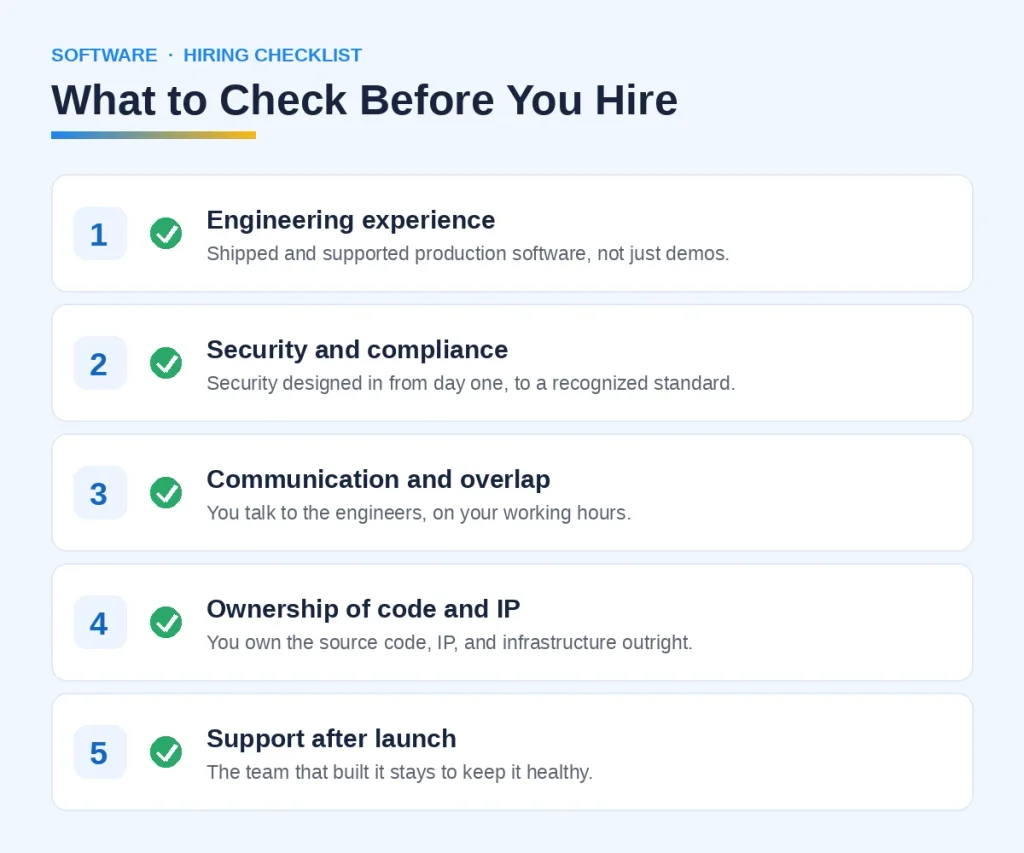
Real engineering experience, not just design
Look for a team that has shipped and supported production software, not just built prototypes or designs. Ask what they have launched, who used it, and what broke after launch. The companies worth hiring talk comfortably about scale, data, and the unglamorous parts: migrations, error handling, and the fix that shipped at 2am.
A security and compliance track record
Security has to be designed in, not bolted on at the end. Ask how they handle authentication, permissions, encryption, and common vulnerabilities, and whether they follow a recognized baseline like the OWASP guidance for application security. For regulated work, they should design to the relevant standard from day one, not retrofit it.
Communication and time-zone overlap
You want to talk to the people writing the code, on a real overlap with your working hours, in the tools your team already uses. A layer of account managers relaying messages is where context and quality quietly leak out. Clear, frequent, honest status beats a polished monthly report.
Ownership of the code and IP
You should own the source code, the IP, the infrastructure, and the documentation outright. If a company keeps your code in a black box, hosts it on accounts you cannot access, or makes leaving hard, that is a structural problem no amount of good work fixes. Get ownership in writing before you start.
Support after launch
Software is never finished at launch. Ask who supports it, on what terms, and whether the engineers who built it stay involved. The team that wrote your system is best placed to keep it healthy, so a company that disappears after delivery is a risk, not a saving.
The Questions to Ask Before You Sign
A short list that separates teams who have shipped production software from teams who have not. Ask these directly, and watch how specifically they answer.
- Who exactly writes my code, and can I speak to them before we start?
- How do you handle security, authentication, and data? For regulated work, how do you design for compliance like SOC 2, HIPAA, or ISO 27001?
- What happens after launch: who supports it, and on what terms?
- Do I own the source code, the IP, and the infrastructure outright?
- Can you show me production software you have shipped, and give me references I can call?
- Where would you tell me not to build custom, and buy an existing product instead?
A team that has done the work answers all six without hedging. A team that has not will be vague on two or three, usually the security question and the one about who actually writes the code.
Red Flags to Walk Away From
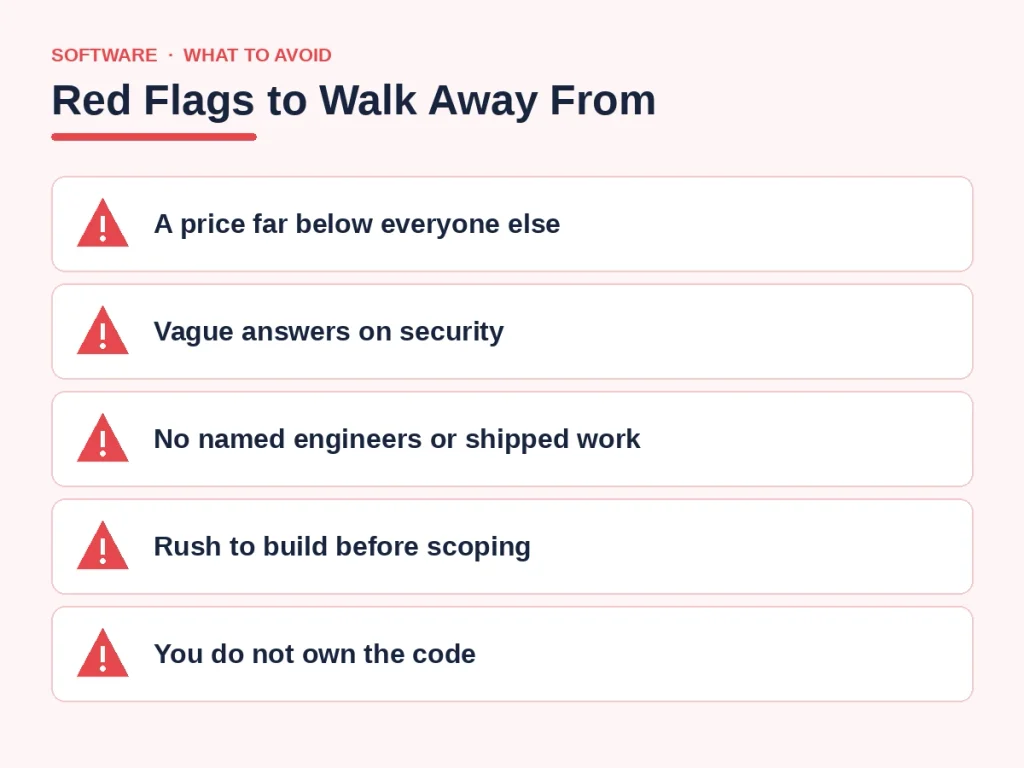
- A quote far below everyone else. It usually means security, compliance, or testing has been left out of the scope, and you pay for it later.
- Vague answers on security, or a promise that compliance is quick and easy. It rarely is.
- No named engineers and no shipped software to show. Case studies you cannot verify are not proof.
- Pressure to start building before the problem is scoped. Good teams scope first, because the early decisions are the cheapest place to get things right.
- Anything that leaves you not owning the code, or dependent on the vendor to keep the software running.
In-House vs Agency vs Freelancers
Part of choosing well is choosing the right kind of team. Hiring in-house gives you control but is slow and expensive to staff, and hard to scale up or down. Individual freelancers are cheap and flexible but carry key-person risk and rarely cover security, testing, and long-term support.
A custom software development company sits in between: a senior team that scopes, builds, launches, and supports the work, with accountability in a contract and the ability to scale the team to the project. For most businesses building something that has to run reliably, that is the balance that holds up. If you need to extend your own team instead, many companies also offer staff augmentation.
What Custom Software Costs, and What a Quote Should Include
Cost depends on scope more than anything else. A focused MVP is far less than a multi-tenant SaaS platform with billing, integrations, and compliance. Be wary of a fixed price quoted before the problem is understood; it is either padded heavily or missing the hard parts.
A real quote accounts for the whole lifecycle, not just screens: scoping and architecture, the build, security, testing and QA, deployment and infrastructure, and support after launch. If a proposal prices only the visible app and skips the integration layer, security, and testing, the number is not real, and the gap shows up as cost and delay later.
Ask for the quote to be broken down by phase, and ask what is explicitly not included. The answer tells you how honestly the team scopes.
How to Vet a Company’s Real Work
Three checks cut through the sales pitch. First, the portfolio: ask to see real, shipped products, and ideally use them. Second, references: talk to a past client about communication, how problems were handled, and whether they would hire the team again. Third, process: ask how they handle code ownership, documentation, and handover, because a company confident in its work makes leaving easy, not hard.
If a company cannot show shipped software, cannot connect you with a reference, or gets cagey about ownership and documentation, treat that as your answer.
How Mobilions Approaches Custom Software
Mobilions is a custom software development company where the same senior engineers who scope your product build it, launch it, and support it, so context is never lost and there are no junior hand-offs. We are deliberate about telling clients when an off-the-shelf product or a hybrid is the smarter call than a custom build, because the goal is the right decision for your business, not the biggest project.
You own the source code, the IP, and the infrastructure throughout, and every case study on our site is real, shipped software you can look at. Since 2016 we have delivered more than 250 projects for over 100 clients across 20-plus countries. If you are weighing a build, a senior engineer will give you an honest assessment of what it takes to ship it, with no obligation.
Choose a Partner Who Will Still Be There After Launch
The right custom software development company will help you make the right build-versus-buy decision, scope the work honestly, ship production software, and leave you with full ownership. Use the questions and checks in this guide before you sign, and walk away from any proposal that hides the hard parts.
Planning a build? Talk to Mobilions for an honest assessment from a senior engineer, or explore our custom software development services.

Tushar Patel is the founder and CEO of Mobilions, an AI-first software engineering company. With over a decade helping businesses build custom software, mobile apps, and AI solutions, he leads strategy and delivery for teams shipping products across 20+ countries. He writes practical, senior-level guides on software development, hiring engineering talent, and scaling products.