Tag: custom software development

  • How to Choose a Custom Software Development Company (2026)

    How to Choose a Custom Software Development Company (2026)

    Choosing a custom software development company comes down to one question: will this team ship software that works in production and that you fully own, or will you end up with a demo that stalls and a vendor you cannot leave? Knowing how to choose a custom software development company is less about slick portfolios and more about engineering judgment, honest scoping, security, and who owns the code when the project ends.

    This guide covers exactly what to look for: what these companies do, the checks that actually matter, the questions to ask before you sign, the red flags to walk away from, what a fair quote includes, and how to vet a team’s real work. It is written from the side of a company that builds and supports production software, so the advice is about avoiding the failures we see most, not generic tips.

    Key Takeaways

    • How to choose a custom software development company comes down to engineering judgment, security, communication, honest scoping, and clear ownership of the code and IP.
    • Ask who actually writes your code, how they handle security and compliance, and what support looks like after launch.
    • A trustworthy company tells you when buying off-the-shelf or a hybrid is the better call, instead of selling you a build by default.
    • The biggest red flags are a quote far below everyone else, vague answers on security, and no named engineers or shipped work to show.
    • You should own the source code, the IP, and the infrastructure outright, with no lock-in.

    What a Custom Software Development Company Actually Does

    A custom software development company designs, builds, launches, and maintains software made for one organization’s needs, instead of selling you a packaged product you have to bend your business around. That spans the whole lifecycle: understanding your workflow, architecting the system, building the application and its data layer, integrating it with the tools you already use, and running it in production.

    The hard part is rarely writing code. It is building software that stays correct, secure, and maintainable as your business grows, your data accumulates, and your requirements change. The distance between a working demo and a production system is where most projects stall, and it is the clearest thing that separates a strong company from a weak one.

    So when you evaluate a company, you are really evaluating one thing: can they close that gap? Real data, authentication, permissions, integrations, security, and years of updates, not a happy-path prototype that looks good in a sales call.

    How to Choose a Custom Software Development Company: the Checks That Matter

    Here is what to weigh, in rough order of importance. None of it needs a technical background to judge; it needs the right questions and honest answers.

    Real engineering experience, not just design

    Look for a team that has shipped and supported production software, not just built prototypes or designs. Ask what they have launched, who used it, and what broke after launch. The companies worth hiring talk comfortably about scale, data, and the unglamorous parts: migrations, error handling, and the fix that shipped at 2am.

    A security and compliance track record

    Security has to be designed in, not bolted on at the end. Ask how they handle authentication, permissions, encryption, and common vulnerabilities, and whether they follow a recognized baseline like the OWASP guidance for application security. For regulated work, they should design to the relevant standard from day one, not retrofit it.

    Communication and time-zone overlap

    You want to talk to the people writing the code, on a real overlap with your working hours, in the tools your team already uses. A layer of account managers relaying messages is where context and quality quietly leak out. Clear, frequent, honest status beats a polished monthly report.

    Ownership of the code and IP

    You should own the source code, the IP, the infrastructure, and the documentation outright. If a company keeps your code in a black box, hosts it on accounts you cannot access, or makes leaving hard, that is a structural problem no amount of good work fixes. Get ownership in writing before you start.

    Support after launch

    Software is never finished at launch. Ask who supports it, on what terms, and whether the engineers who built it stay involved. The team that wrote your system is best placed to keep it healthy, so a company that disappears after delivery is a risk, not a saving.
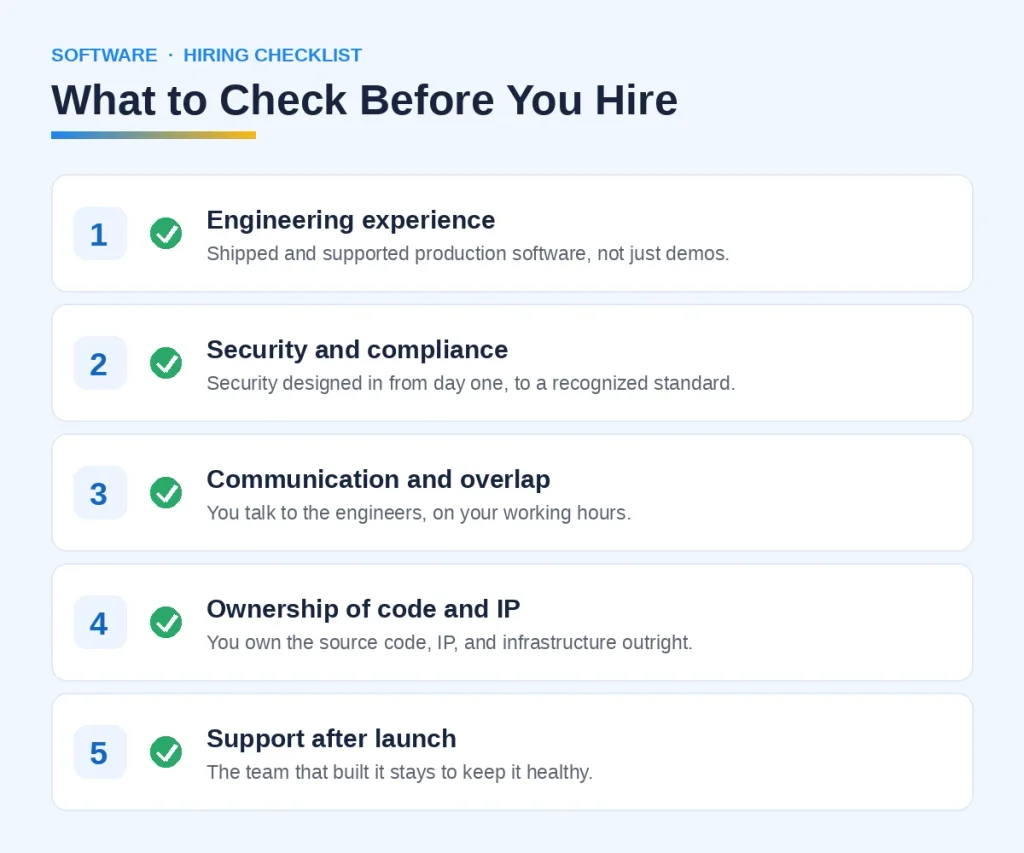
    Checklist for choosing a custom software development company: engineering, security, communication, ownership, support, by Mobilions

    The Questions to Ask Before You Sign

    A short list that separates teams who have shipped production software from teams who have not. Ask these directly, and watch how specifically they answer.

    1. Who exactly writes my code, and can I speak to them before we start?
    2. How do you handle security, authentication, and data? For regulated work, how do you design for compliance like SOC 2, HIPAA, or ISO 27001?
    3. What happens after launch: who supports it, and on what terms?
    4. Do I own the source code, the IP, and the infrastructure outright?
    5. Can you show me production software you have shipped, and give me references I can call?
    6. Where would you tell me not to build custom, and buy an existing product instead?

    A team that has done the work answers all six without hedging. A team that has not will be vague on two or three, usually the security question and the one about who actually writes the code.

    Red Flags to Walk Away From

    • A quote far below everyone else. It usually means security, compliance, or testing has been left out of the scope, and you pay for it later.
    • Vague answers on security, or a promise that compliance is quick and easy. It rarely is.
    • No named engineers and no shipped software to show. Case studies you cannot verify are not proof.
    • Pressure to start building before the problem is scoped. Good teams scope first, because the early decisions are the cheapest place to get things right.
    • Anything that leaves you not owning the code, or dependent on the vendor to keep the software running.
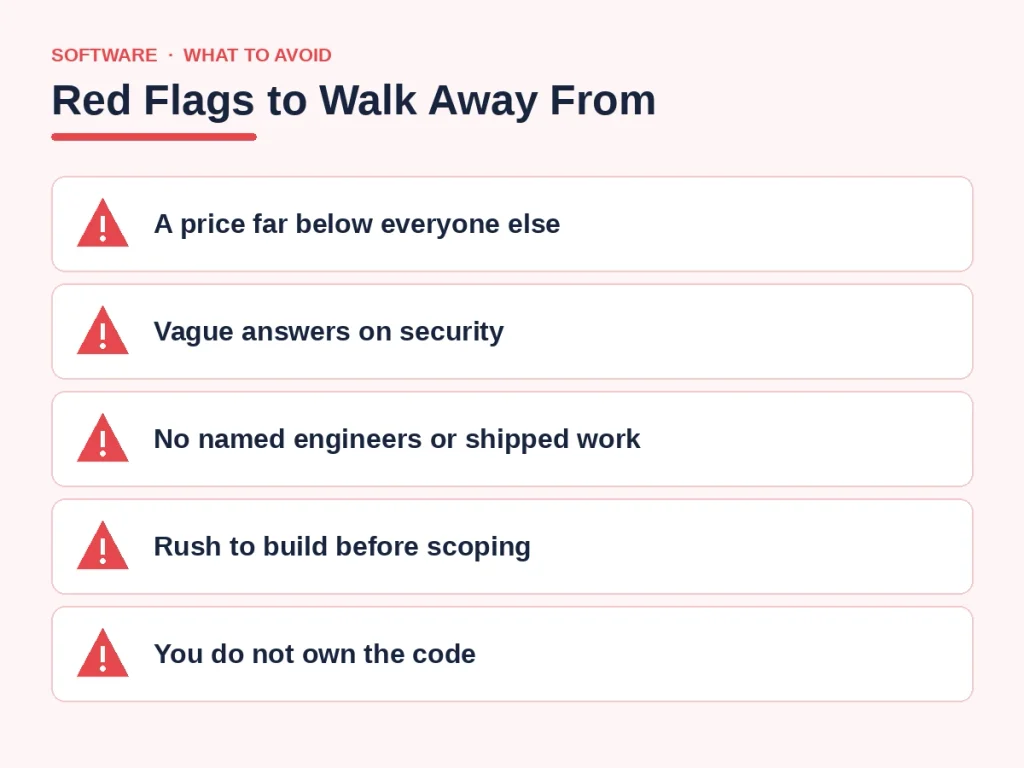
    Five red flags when choosing a custom software development company, by Mobilions

    In-House vs Agency vs Freelancers

    Part of choosing well is choosing the right kind of team. Hiring in-house gives you control but is slow and expensive to staff, and hard to scale up or down. Individual freelancers are cheap and flexible but carry key-person risk and rarely cover security, testing, and long-term support.

    A custom software development company sits in between: a senior team that scopes, builds, launches, and supports the work, with accountability in a contract and the ability to scale the team to the project. For most businesses building something that has to run reliably, that is the balance that holds up. If you need to extend your own team instead, many companies also offer staff augmentation.

    What Custom Software Costs, and What a Quote Should Include

    Cost depends on scope more than anything else. A focused MVP is far less than a multi-tenant SaaS platform with billing, integrations, and compliance. Be wary of a fixed price quoted before the problem is understood; it is either padded heavily or missing the hard parts.

    A real quote accounts for the whole lifecycle, not just screens: scoping and architecture, the build, security, testing and QA, deployment and infrastructure, and support after launch. If a proposal prices only the visible app and skips the integration layer, security, and testing, the number is not real, and the gap shows up as cost and delay later.

    Ask for the quote to be broken down by phase, and ask what is explicitly not included. The answer tells you how honestly the team scopes.

    How to Vet a Company’s Real Work

    Three checks cut through the sales pitch. First, the portfolio: ask to see real, shipped products, and ideally use them. Second, references: talk to a past client about communication, how problems were handled, and whether they would hire the team again. Third, process: ask how they handle code ownership, documentation, and handover, because a company confident in its work makes leaving easy, not hard.

    If a company cannot show shipped software, cannot connect you with a reference, or gets cagey about ownership and documentation, treat that as your answer.

    How Mobilions Approaches Custom Software

    Mobilions is a custom software development company where the same senior engineers who scope your product build it, launch it, and support it, so context is never lost and there are no junior hand-offs. We are deliberate about telling clients when an off-the-shelf product or a hybrid is the smarter call than a custom build, because the goal is the right decision for your business, not the biggest project.

    You own the source code, the IP, and the infrastructure throughout, and every case study on our site is real, shipped software you can look at. Since 2016 we have delivered more than 250 projects for over 100 clients across 20-plus countries. If you are weighing a build, a senior engineer will give you an honest assessment of what it takes to ship it, with no obligation.

    Choose a Partner Who Will Still Be There After Launch

    The right custom software development company will help you make the right build-versus-buy decision, scope the work honestly, ship production software, and leave you with full ownership. Use the questions and checks in this guide before you sign, and walk away from any proposal that hides the hard parts.

    Planning a build? Talk to Mobilions for an honest assessment from a senior engineer, or explore our custom software development services.

  • AI Agents for Workflow Automation: A Practical 2026 Guide

    AI Agents for Workflow Automation: A Practical 2026 Guide

    AI agents for workflow automation are agents that do not just follow a fixed set of steps, they decide what to do next to finish a job. Classic automation runs a rigid if-this-then-that recipe; an AI agent reads the situation, chooses the path, and handles the messy cases a fixed rule would break on. That shift is why automation is suddenly getting smarter, and why so many teams are moving from simple triggers to agents that can actually think through a task.

    This guide is the practical version. It covers what AI agents for workflow automation really are, how they differ from traditional automation, what they are good at, the real returns teams are seeing, the main tools (n8n, Zapier, Make), and the honest question of when an off-the-shelf tool is enough versus when you should build a custom agent. The numbers below are industry figures, not promises, and we flag what is a benchmark versus a guarantee.

    Key takeaways

    • AI agents for workflow automation decide the steps to finish a task, while traditional automation follows fixed rules. Agents handle the messy, variable cases that break a rigid recipe.
    • Adoption is real: a PwC survey found 79 percent of organizations already run AI agents in production, with average workflow-automation ROI around 171 percent.
    • The strongest use cases are repetitive, multi-step, cross-app jobs: lead research and enrichment, support triage, data entry and reconciliation, reporting, and document processing.
    • n8n, Zapier, and Make are the leading platforms. n8n is strongest for AI-agent workflows and self-hosting, Zapier is the fastest for non-technical teams, Make sits in between.
    • Off-the-shelf tools cover a lot, but a custom agent wins when the work touches your private data, complex logic, or systems a platform cannot reach. Many teams use both.

    What are AI agents for workflow automation?

    A workflow automation is a sequence of steps a computer runs for you: when a form is submitted, add a row, send an email, notify a channel. It is fast and reliable, but it only does exactly what you scripted. An AI agent adds judgment on top. Given a goal, it can read inputs, decide which step to take, use tools and apps to act, and adapt when something does not fit the template. In short, traditional automation follows a recipe; an agent can cook without one.

    That is why the phrase AI agents for workflow automation matters. You are not just connecting apps, you are putting a decision-maker inside the flow that can handle the 20 percent of cases a fixed rule cannot. The agent still works through your tools, but it chooses the path rather than replaying a fixed one.

    AI agents vs traditional workflow automation

    The difference is easiest to see side by side.

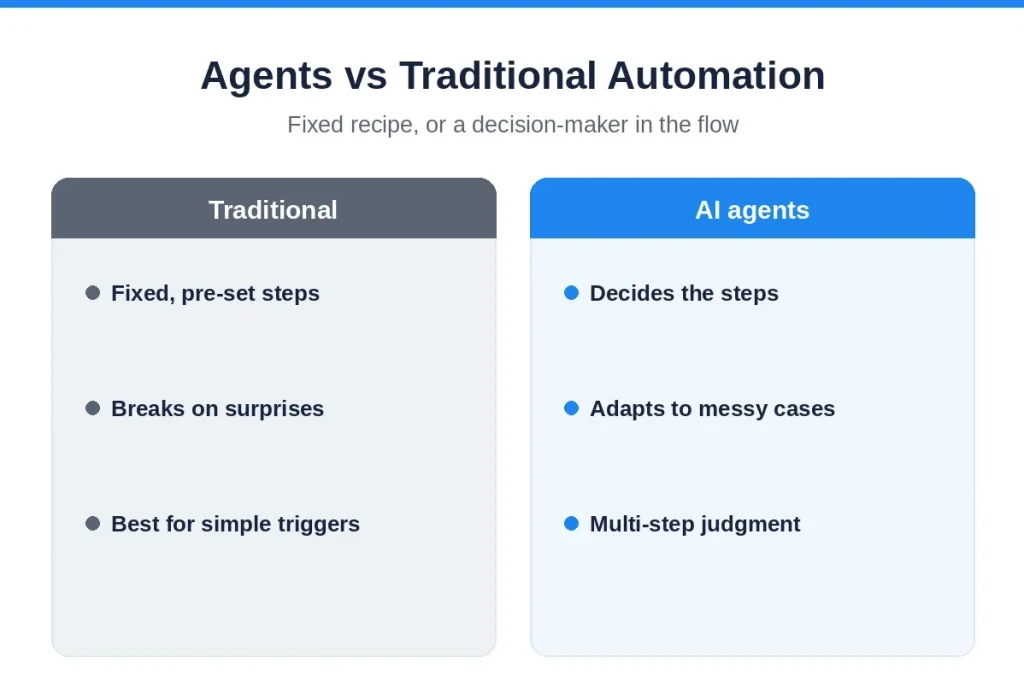
    AI agents vs traditional workflow automation compared, by Mobilions
    Traditional automationAI agents
    How it worksFixed, pre-set stepsDecides steps toward a goal
    Handles variationBreaks on anything unexpectedAdapts to messy, new cases
    Best forSimple, predictable triggersMulti-step, judgment-heavy work
    SetupQuick, rule-basedMore design, but more capable
    RiskDoes the wrong thing silently if inputs changeNeeds guardrails and human checkpoints

    Neither is better in the abstract. A fixed automation is perfect for a simple, predictable task, and cheaper to run. An agent earns its place when the work varies, spans several systems, or needs a decision in the middle. The skill is knowing which one a job actually needs, and a good partner will tell you when the simple option wins.

    What AI agents automate best

    The clearest wins are repetitive, multi-step jobs that cross several apps and need a little judgment. Common examples in 2026:

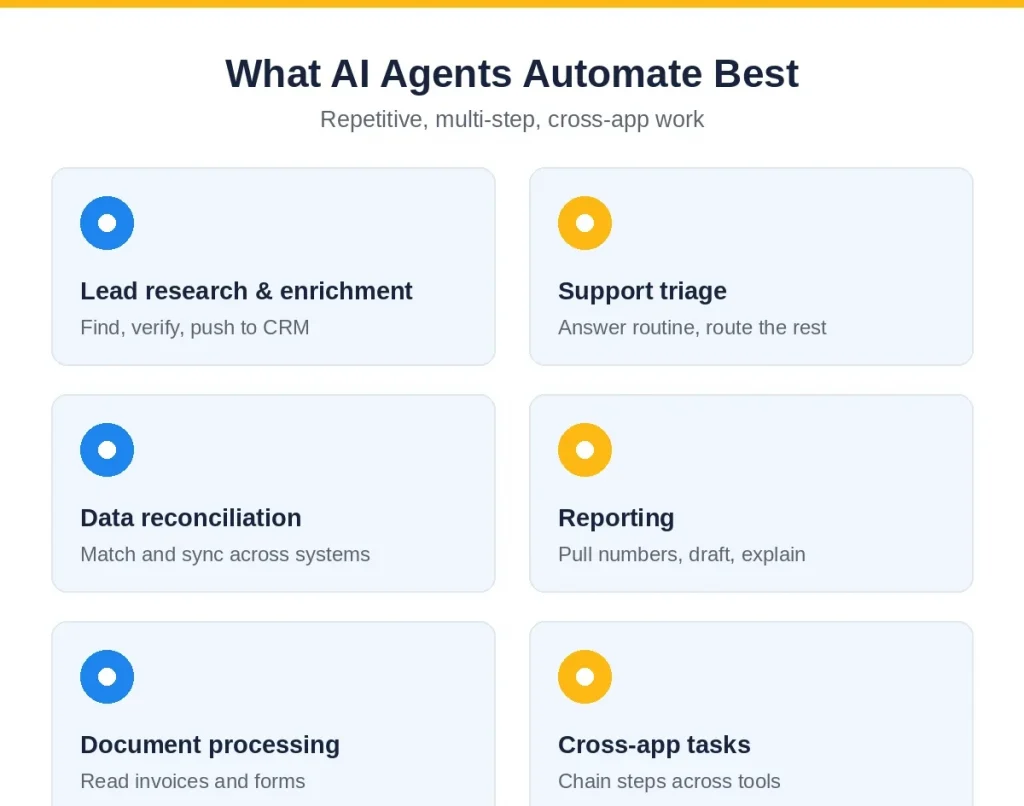
    Six AI agent workflow automation use cases: lead enrichment, support triage, reconciliation, reporting, documents, cross-app tasks, by Mobilions
    • Lead research and enrichment. An agent searches the web, pulls and verifies company data, formats it for your CRM, and posts a summary to Slack, the kind of flow that saves a sales team hours a day.
    • Support triage. Reads incoming tickets, answers the routine ones, and routes the rest to the right person with context attached.
    • Data entry and reconciliation. Moves and matches data across systems, flags mismatches, and keeps records in sync without manual copy-paste.
    • Reporting. Pulls numbers from several tools, drafts the report, and explains what changed, on a schedule.
    • Document processing. Reads invoices, forms, or contracts, extracts the fields that matter, and routes them for approval.
    • Multi-step cross-app tasks. Any job that today needs a person to click through five tools in order is a strong candidate.

    The ROI: what teams are actually seeing

    The adoption numbers are striking. A PwC survey found 79 percent of organizations already run AI agents in production, with average return on workflow automation around 171 percent, and 62 percent of companies reporting returns above 100 percent. Teams implementing automation have reported 30 to 200 percent first-year ROI, and up to 300 percent over the longer term. One widely cited example: a company reclaimed around a million dollars in revenue and saved 282 workdays a year with an automated lead-enrichment workflow.

    Treat these as benchmarks from teams that implemented well, not guarantees. The gains are real when the use case fits and the workflow is built with care, and close to zero when a tool is switched on and left unwatched. The point is that the ceiling is high, which is why adoption is moving so fast. For more on the underlying technology, IBM’s primer on AI agents is a solid, vendor-neutral read.

    The main tools: n8n, Zapier, and Make

    Three platforms dominate AI workflow automation in 2026, and they suit different teams.

    • n8n. The strongest of the three for AI-agent workflows, with native LangChain integration, a large set of AI nodes, persistent memory, and the only self-hosting option for data control. Best when you want power and to own your data. See n8n.
    • Zapier. The fastest path from idea to live automation, rebuilt in 2026 with an AI orchestrator and hundreds of AI actions. Best when your team is non-technical and lives across many SaaS tools.
    • Make. Sits between the two, with a visual builder and good value for moderately complex flows.

    One practical note on cost: billing models differ a lot. For a high-volume workflow, n8n (which bills per execution and can self-host) can be far cheaper than Zapier (which bills per task) at scale. Pick on your team’s skill, your data needs, and your volume, not on the brand.

    Off-the-shelf tools or a custom agent?

    This is the real decision, and it maps onto our two core services. For general, cross-app busywork, an off-the-shelf platform like n8n or Zapier is often the right call, fast, cheap, and good enough. You should build a custom agent when the work touches your private data, depends on logic specific to your business, needs to reach systems a platform cannot, or has to meet compliance and control requirements a shared tool cannot guarantee. When an automated workflow becomes a customer-facing product, iOS app development, Android app development, Flutter development, and React Native development are practical paths; teams that need ongoing delivery can hire dedicated engineers.

    In practice many companies do both: a platform for broad productivity, and a custom build for the core, high-value workflows that are specific to how they operate. Designing that core agent is exactly our agentic AI development work, and wiring it into the systems and logic your business runs on is our custom software development. The honest answer is almost always a mix, and the skill is drawing the line in the right place.

    How to start with AI workflow automation

    Start small and prove it. A few steps keep you out of trouble.

    • Pick one high-pain workflow. Choose a repetitive, multi-step task where a mistake is cheap, and define success in hours saved or errors cut.
    • Keep a human on consequential steps. Let the agent draft, fetch, and prepare, but keep a person approving anything that sends, spends, or changes a record.
    • Use least-privilege access. Give the agent only the access it needs, so a mistake has a small blast radius.
    • Measure, then expand. Compare against your baseline for a few weeks, keep what pays, and add the next workflow once the first proves itself.

    The risks, and where a human stays

    An agent that decides and acts can decide and act wrongly, so guardrails are not optional. Keep a human approving anything consequential, give the agent least-privilege access, log its decisions so failures are traceable, and evaluate it on real cases before you trust it. The teams that get burned are the ones that hand an agent broad access and walk away. Used with care, agents take the busywork and leave the judgment to people, which is exactly the point. For customer-facing workflows, mobile app development services can provide a controlled interface for approvals.

    How Mobilions helps

    We help companies figure out what to automate, whether an off-the-shelf tool is enough, and when a custom agent is worth building, then we build and support it. Our two core services cover both sides of this: agentic AI development for the decision-making agents, and custom software development for the systems and integrations they run on. We also build standard AI automation where a simpler flow is the better fit.

    Mobilions has delivered software and AI since 2016, more than 250 projects for over 100 clients across 20-plus countries, with senior engineers who scope, build, and support the work. If you want a straight read on which workflows to automate and how, book a discovery call.

    Frequently asked questions

    What are AI agents for workflow automation?

    AI agents for workflow automation are agents that decide the steps needed to finish a task, rather than following a fixed script. Given a goal, an agent reads inputs, chooses what to do, uses your apps to act, and adapts to cases a rigid rule would break on, which makes automation smarter and more flexible.

    How are AI agents different from traditional automation?

    Traditional automation follows pre-set, fixed steps and breaks when something unexpected happens. An AI agent decides the steps toward a goal and adapts to variation. Traditional automation is best for simple, predictable triggers; agents are best for multi-step, judgment-heavy work across several apps.

    What is the ROI of AI workflow automation?

    Industry figures are strong: a PwC survey found 79 percent of organizations run AI agents in production with average ROI around 171 percent, and teams report 30 to 200 percent first-year returns, up to 300 percent long term. These are benchmarks from good implementations, not guarantees.

    What tasks can AI agents automate?

    Repetitive, multi-step, cross-app jobs: lead research and enrichment, support ticket triage, data entry and reconciliation, scheduled reporting, document processing like invoices and forms, and any task that today needs a person to click through several tools in order.

    Which is the best AI workflow automation tool, n8n, Zapier, or Make?

    It depends on your team. n8n is strongest for AI-agent workflows and is the only self-hosting option, good for power and data control. Zapier is the fastest for non-technical teams across many SaaS tools. Make sits in between. Choose on skill, data needs, and volume, not brand.

    Is n8n cheaper than Zapier?

    Often, at scale. n8n bills per workflow execution and can be self-hosted, while Zapier bills per task, so for high-volume workflows n8n can cut costs substantially. For low volume or non-technical teams, Zapier’s speed and ease can be worth the higher per-task price.

    Should I use an off-the-shelf tool or build a custom AI agent?

    Use an off-the-shelf tool like n8n or Zapier for general, cross-app busywork where speed matters. Build a custom agent when the work touches private data, needs business-specific logic, must reach systems a platform cannot, or has compliance needs a shared tool cannot meet. Many teams use both.

    Can AI agents replace employees?

    Usually no. Agents take over repetitive, multi-step busywork so people spend time on judgment, relationships, and decisions. The strongest setups keep a human approving anything consequential. The work shifts up the value chain rather than simply disappearing.

    How do I start with AI workflow automation?

    Pick one high-pain, repetitive workflow where mistakes are cheap, keep a human on consequential steps, give the agent least-privilege access, and measure the result against your baseline. Prove it pays, then expand to the next workflow. Do not try to automate everything at once.

    Are AI agents for workflow automation safe?

    They can be, with guardrails. Keep a human approving consequential actions, use least-privilege access so a mistake has a small blast radius, log every decision for traceability, and evaluate the agent on real cases before trusting it. The risk comes from handing broad access and walking away.

    Note: ROI and adoption figures are 2026 industry benchmarks (incl. PwC), not guarantees. Tool details reflect the 2026 market and can change.