
































Agentic AI Development That Reaches Production

Mobilions is an agentic AI development company that builds autonomous, multi-agent systems which plan, use tools, and take real actions in production, not slide-deck demos. Senior engineers own the work end to end, with the governance, evaluation, and human oversight that decide whether agentic AI ships or stalls in a proof of concept.

Part of our AI development services →
famooshedidc-ujoinbeetkoralionstudio-ailokalapptosmartbababanounbasafrdocscannerludusiomaamarmcokieme-by-mindmudeermukaabmy-meeting-cardpaaetpixiprezenceraceboardrecuriciclarioschutzwinkelshishrspendulgetrainaerotrendzfanszatara
Since 2016
250+Projects Delivered
100+Clients Served
20+Countries Reached

What Is Agentic AI?

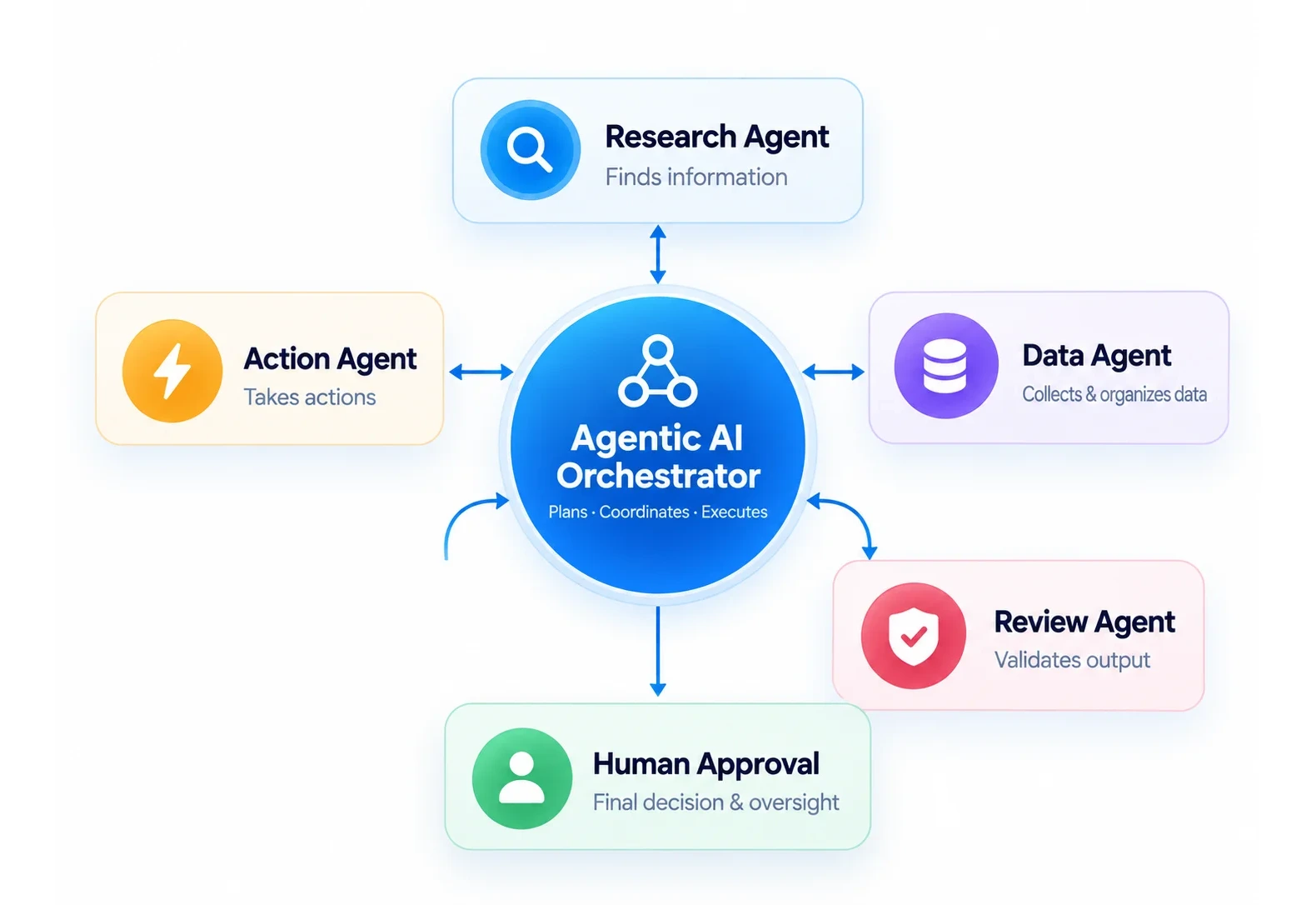
Agentic AI describes software that pursues a goal with limited human steering. Instead of answering a single prompt and stopping, an agentic system plans a sequence of steps, chooses and calls tools, reads and writes to your systems, checks its own results, and adapts when something changes. The model is the engine, but the value lives in the scaffolding around it: the planning loop, the tools, the memory, the guardrails, and the points where a human approves an action before it happens. This is a real step beyond generative AI, which reacts to a prompt and stops. Agentic AI holds a goal and works through it until the goal is met or a human checkpoint is reached.

Agentic AI orchestration diagram showing research, action, data, tool and review agents coordinated by an orchestrator with human approval

Our Agentic AI Development Services

We build the whole system, not just the model call. Six capabilities cover most of what clients need, and most real projects combine several of them. Need a single focused agent instead of a coordinated system? Our AI agent development service shares the same foundations.

Multi-Agent Systems

We design systems where specialized agents cooperate under an orchestrator: a planner breaks the goal into tasks, worker agents each own a capability, and a coordinator routes work. We keep the number of agents as small as the problem allows.

Agentic Workflow Automation

We turn multi-step business processes into agentic workflows that run with minimal human involvement, from intake to action to follow-up. The agents handle the branching and edge cases that break brittle automation, while pausing for approval where you decide.

Retrieval-Grounded Agents

Agents that act on your business need to reason over your data, not a generic model's memory. We ground them in your documents and databases through retrieval, so answers and actions are based on current, cited sources.

Tool Use & System Integration

An agent is only as capable as the tools it can call. We connect agents to your CRM, ERP, ticketing, payments, and internal APIs through well-defined function calling, with strict scoping so an agent does exactly what it is meant to.

Evaluation & Observability

Agentic systems fail in ways a normal app does not: a wrong plan, a bad tool call, a slow drift in quality. We build evaluation suites, tracing, and observability in from the start, so you catch regressions before your users do.

Governance & Human Oversight

The reason most agentic pilots never reach production is trust. We put a control plane around the agents: policies for allowed actions, approvals for anything risky, cost limits, and a full audit trail, so humans stay in control.

How We Build Production Agentic AI

Mobilions builds agentic systems in four disciplined stages, so autonomy stays useful, grounded, and under control in production.

Step 1.

Scope & Design the System

We start with the goal and the workflow, not the model. We map the process, the systems the agents must touch, and the actions that carry risk, then decide how many agents, what each owns, and where humans approve.

Step 2.

Ground & Integrate

We connect the agents to your data through retrieval so they reason over current, correct information, and define and scope every tool, API, and integration with least-privilege permissions.

Step 3.

Govern & Evaluate

We add the control plane: policies, approval steps for consequential actions, rate and cost limits, and validation. Then we build evaluation suites from real cases to measure quality objectively before launch.

Step 4.

Deploy & Operate

We ship into your infrastructure with monitoring, tracing, and cost controls already in place, and you own the code, prompts, and configuration. As your data, tools, and models change, we monitor quality and cost and catch drift.

Is Agentic AI Right for Your Workflow?

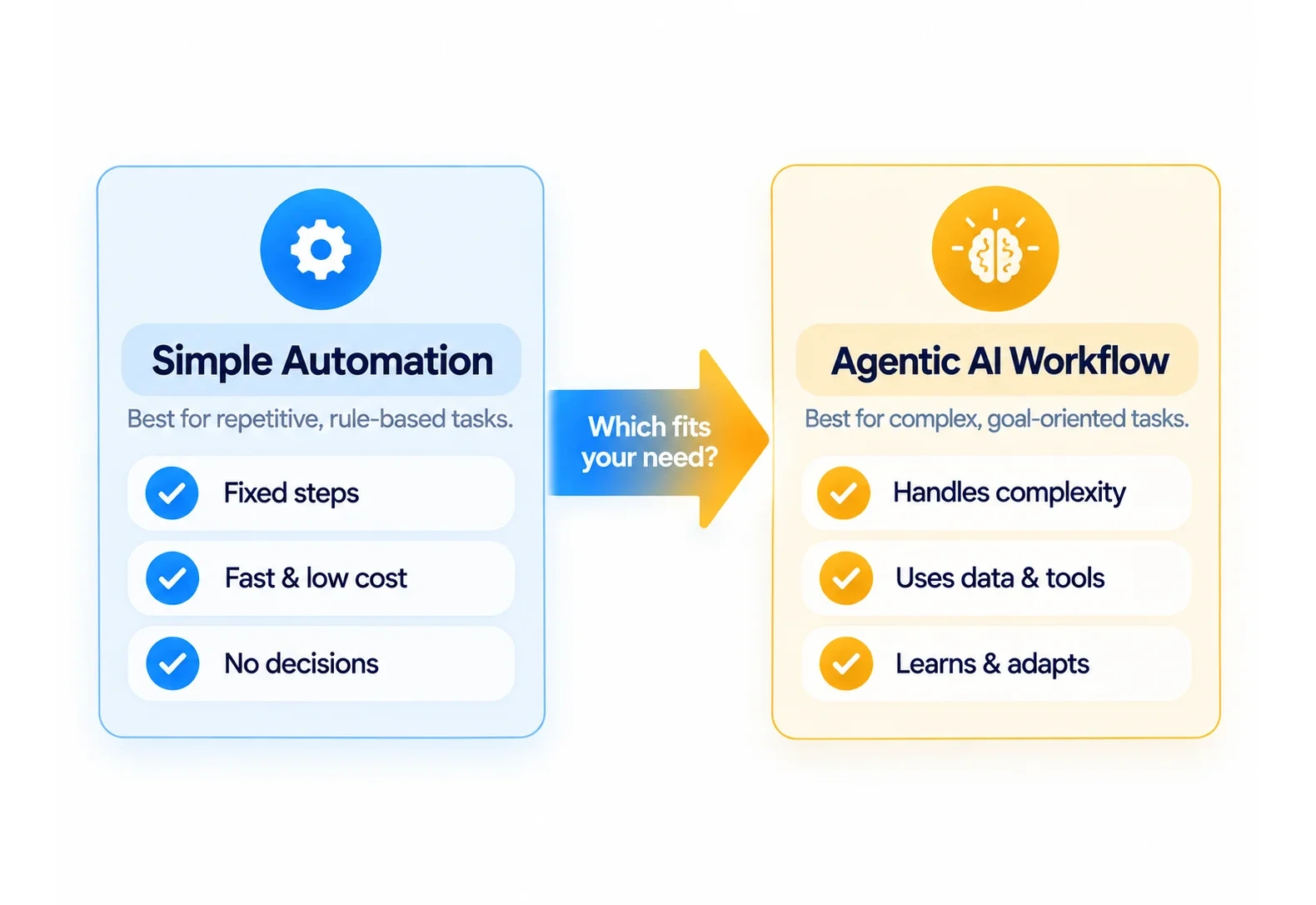
Traditional automation is still the right tool for a large share of processes. If a workflow is stable and every path can be scripted in advance, a deterministic script or an RPA bot is cheaper, faster, and easier to trust than any agent. Agentic AI earns its cost where that breaks down: when a process has too many exceptions to script, when the inputs are messy and unstructured, or when the right next step depends on judgment rather than a fixed rule. The best designs we build are hybrids, with agents for the judgment and plain code for everything that should stay deterministic.

Comparison of simple automation versus an agentic AI workflow for choosing the right approach

Before we build, we check that the workflow is a strong first candidate: genuinely multi-step, currently consuming skilled people's time on repetitive judgment, with accessible data, and gated so a wrong action is caught by a human approval step rather than causing irreversible harm. We steer you away from weak first projects, where a mistake cannot be reviewed or success cannot be measured. Starting with one well-chosen workflow and expanding from there beats a broad rollout that stalls. On cost, most enterprise builds land between roughly 40,000 and 500,000 dollars for the initial system, with regulated domains adding 20 to 35 percent for logging and approvals, and we spell out those drivers before quoting.

Where Agentic AI Helps

Agentic AI earns its cost where work is multi-step, rule-heavy, and currently eats skilled people's time. Four patterns we see repeatedly, including the one where an agent is the wrong answer.

Multi-Step Work Across Systems

When a process pulls data from one system, decides what to do, and acts in another, a fixed script breaks on the exceptions. An agentic system reasons through the variation, calls the right tools in order, and finishes work that used to bounce between people and tabs.

Support, Operations, and Back Office

Ticket triage that pulls real account context and resolves common issues end to end; document-heavy intake, extraction, validation, and routing across systems. This is where agentic AI shows returns first, with a human handling the exceptions the agents escalate. A large share of customer service organizations now plan to apply generative and agentic AI to agent productivity, precisely because this work is high volume, repetitive, and easy to measure, which makes it a safe, high-return first project.

Regulated and High-Stakes Workflows

Finance, healthcare, and other regulated work where agents reconcile, flag, and prepare, but every consequential step pauses for human approval with strict logging and explainability. We build that compliance in from the start rather than bolting it on, which is what turns a pilot into a system you can trust.

Where Agentic AI Is Overkill

If a process is stable and every path can be written down in advance, a deterministic script or RPA bot is cheaper and more reliable than any agent. If the job is a single question and answer, a chatbot fits better than an agentic loop. We will tell you honestly when not to build agents, because autonomy you do not need is added cost and risk. Recommending the simpler tool when it is the right one is how we keep your first agentic project a success rather than a cautionary tale, and it is why the projects we do take on tend to reach production instead of stalling as demos.

Why Mobilions for Agentic AI Development

Clients choose Mobilions because the same senior engineering team that scopes the system also builds, launches, and supports it, with autonomy you can actually trust in production.

01

Governed by Default

Every system ships with a control plane: bounded actions, approvals for consequential steps, cost and rate limits, and full logging. Autonomy is observable and controllable, not a leap of faith. Governance is engineered as part of the product, so you are never choosing between an agent that is useful and one that is safe, you get both.

02

Built for Production, Not Demos

The demo is the easy part. We treat evaluation, observability, and reliability as core, so agentic systems survive thousands of real runs rather than stalling as a pilot. Since 2016 we have delivered 250+ products for 100+ clients across 20+ countries.

03

Senior Engineers, Build to Support

The same senior team that scopes the system builds, launches, and supports it, so there is no handoff and no lost context as real usage reveals edge cases and your needs change. You talk to the engineer building your system, not an account manager relaying messages, which is why decisions get made quickly and honestly rather than filtered through a sales layer.

04

You Own Everything

You keep the source code, the prompts, the orchestration logic, and the configuration, built to run on your infrastructure with no lock-in, so your team can operate and extend it. There is no proprietary wrapper holding your system hostage and nothing trapped with us if you ever bring the work in-house, which is how it should be when you are paying to build a core capability.

What Clients Say

In their own words, Mobilions' clients describe fast delivery, clear communication, and senior, trustworthy engineering.

5.0RATING

Great experience working with this team. They completed the development work quickly and efficiently without wasting time. Communication was clear and consistent, they understood the requirements well, gave smart suggestions, and delivered exactly as discussed. I'd highly recommend them to anyone looking for a reliable, fast, and skilled app development team.


5.0RATING

We worked with Ankit, Mayur, and Tushar to build the first version of Baba Hebrew for iOS and Android, and they delivered super fast. The team was responsive, reliable, and efficient, taking the idea from zero to a working app in record time. I'd recommend them to anyone who wants to get an MVP live quickly.

5.0RATING

Tushar and Ankit did an outstanding job developing our native iOS (Swift) and Android (Kotlin) apps. They were efficient, responsive, and technically strong throughout. Thanks to their work, we launched successfully and gained over 1,000 users in the first 30 days. Highly recommend this team for quality mobile app development.

5.0RATING

It was a wonderful experience working with Tushar, Ankit, and their team. They built a great mobile app for me and truly brought my vision to life. What stood out was not just their technical skill but their attitude: always positive, solution-oriented, and incredibly patient. They went above and beyond at every step, finding creative workarounds and staying committed even when things got challenging. Extremely professional and trustworthy. I would absolutely hire them again.

Frequently Asked Questions

The most common questions buyers ask about agentic AI development, from cost and timelines to safety, ownership, and how it differs from a single agent, answered directly.

An agentic AI development company designs and builds autonomous systems where one or more AI agents plan, use tools, and take actions toward a goal, then runs them reliably in production. That means the orchestration, data grounding, integrations, evaluation, and governance around the model, not just the model call. We build the whole system and hand you full ownership of the code, prompts, and configuration.

A single AI agent handles one narrow job with a few tools. Agentic AI usually means several specialized agents working together under an orchestrator, sharing a plan and passing work between them. If you need one focused agent, our AI agent development service fits better. If you need a coordinated system that runs a multi-step workflow, that is agentic AI development.

Generative AI reacts to a prompt and produces an output, then stops. Agentic AI holds a goal, plans steps, calls tools, checks its own results, and acts until the goal is met or a human checkpoint is reached. Generative AI answers; agentic AI does.

Most enterprise builds land between roughly 40,000 and 500,000 dollars for the initial system, with focused single-workflow tools starting lower and large multi-agent platforms running higher. Running costs, mainly model inference, can add a few thousand to the low tens of thousands per month at scale, and regulated domains add 20 to 35 percent for compliance. We scope before quoting.

A focused, well-scoped agentic workflow can reach production in a few months. Larger multi-agent systems with many integrations and strict compliance take longer. Timelines depend on the number of agents, the systems they must touch, and how much human approval and evaluation the domain requires. We scope in stages, so you see a working version early on a narrow slice and expand from there, rather than waiting on one large delivery at the end.

Yes. A common reason projects stall is that a promising demo has no evaluation, no guardrails, and no observability, so no one can trust it in production. We audit what exists, add the control plane, build an evaluation suite from your real cases, and harden the integrations, then take it to production. You keep full ownership of the code and configuration throughout.

It depends on your needs. Graph-based orchestration like LangGraph suits stateful, auditable production workflows; CrewAI suits fast multi-agent prototyping; the Microsoft Agent Framework suits Azure and .NET shops. We recommend the framework that fits your workflow and infrastructure, and pair any of them with a control plane for governance, because no framework governs risky actions on its own.

We put a control plane around the agents: policies for allowed actions, human approval for anything risky or irreversible, cost and rate limits, and a full audit trail. Humans stay in control of decisions that matter, and the system can show exactly what each agent did and why.

Yes. We ground agents in your documents and databases through retrieval, and connect them to your CRM, ERP, ticketing, payments, and internal APIs through scoped function calling, so agents act on current data within your existing stack.

We build for customer support, operations, sales, finance, software engineering, healthcare, and more. Regulated sectors such as finance and healthcare need extra logging, explainability, and approval steps, which we build in from the start rather than adding later.

Yes. You own the source code, the prompts, and the configuration, with no lock-in. We build it to run on your infrastructure and hand it over so your team can operate and extend it.

We design for cost from day one rather than treating it as a surprise on the monthly bill. That means routing cheaper, faster models to simple steps and reserving frontier models for the hard reasoning, caching where the same work repeats, and setting hard rate and spend limits so a runaway loop stops itself. We also show cost per run in the observability layer, so you can see exactly which steps drive spend and tune them.

Let's build your next big thing

Let's build your next big thing. Share your idea and get a free consultation. We respond within one business day.

250+
Products shipped
100+
Clients served
20+
Countries reached
Call Us (USA)
+1-856-524-5593

Get a Free Quote

A senior engineer replies within one business day · NDA on request · no obligation · you own the code and IP.