




























AR/VR App Development That Delivers Outcomes

Mobilions builds AR/VR app development for real business results: immersive training, product visualization, field and clinical tools, and Apple Vision Pro apps, scoped around the outcome rather than the gadget. Senior engineers own the work end to end, so you own the code and the assets.

Part of our mobile app development services →
famooshedidc-ujoinbeetkoralionstudio-ailokalapptosmartbababanounbasafrdocscannerludusiomaamarmcokieme-by-mindmudeermukaabmy-meeting-cardpaaetpixiprezenceraceboardrecuriciclarioschutzwinkelshishrspendulgetrainaerotrendzfanszatara
Since 2016
250+Projects Delivered
100+Clients Served
20+Countries Reached

What Is AR/VR App Development?

AR/VR app development is building immersive applications that either overlay digital content onto the real world (augmented reality) or place users inside a fully virtual environment (virtual reality). It covers training and simulation, product visualization, hands-free field and clinical work, and spatial apps for Apple Vision Pro. The technology has moved from novelty to real business tool: over 12,000 visionOS apps now exist and enterprise deployments are growing quickly, with companies reporting return on investment within months when they target the right use case.

AR and VR app development for training, visualization, and Vision Pro

At Mobilions, immersive projects start from the outcome, not the headset. We are honest early about where AR/VR pays off, such as training that is risky or expensive in real life, and where a flat screen does the job for less. Spatial design, comfort, and performance are their own engineering discipline, so we prototype the experience before heavy build and optimize so it stays smooth rather than nauseating. We build on Unity, Unreal, or native visionOS, ARKit, and ARCore depending on your users and target devices, and you own the code and the 3D assets throughout.

What We Build

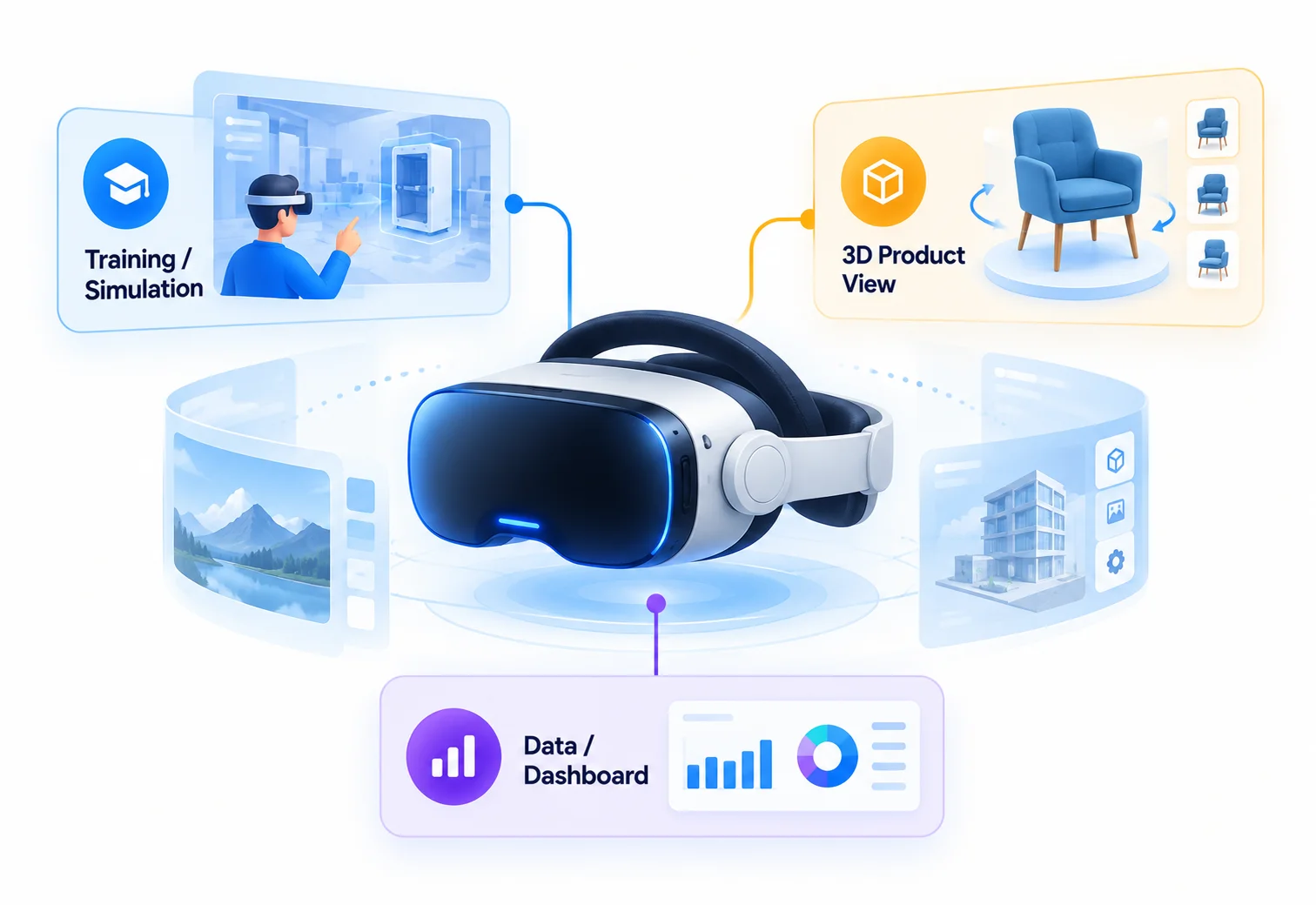
We build immersive experiences that solve real problems, not tech demos. Six capabilities cover most of what clients need, and the mobile side pairs with our mobile app development.

.01

Immersive Training & Simulation

Spatial training environments that let staff practice procedures safely, cutting onboarding time and removing the need for physical prototypes. This is the strongest, clearest-ROI use case for enterprise VR.

.02

Apple Vision Pro & visionOS Apps

Native visionOS apps from windowed 2D tools to fully immersive experiences, built for Apple's spatial platform. We scope the right level of immersion for your budget and outcome rather than over-building.

.03

AR Product & Retail Visualization

Let customers place furniture in a room, try products, or see a 3D model in real space through their phone camera. AR that reduces returns and lifts confidence to buy.

.04

Industrial & Field AR

Hands-free AR for maintenance, assembly, and remote assistance on headsets like Vision Pro and HoloLens, overlaying instructions and expert guidance onto the real task.

.05

Healthcare & Medical XR

Surgical planning, medical training, and therapy applications built with the accuracy and safety the domain demands, under proper compliance and clinical review.

.06

WebAR & Cross-Device

Lightweight AR that runs in the browser with no app install for campaigns and product demos, plus cross-platform builds in Unity so one project targets multiple headsets and phones.

How We Build Production AR/VR Apps

Mobilions builds immersive apps in four disciplined stages, so the experience is usable, comfortable, and tied to a real outcome.

Step 1.

Scope Use Case & ROI

We start with the outcome, not the headset: what task improves, how you will measure it, and which platform fits. We are honest early about where immersive pays off and where a simpler tool wins.

Step 2.

Design the Spatial Experience

We design the interaction, comfort, and flow for 3D space, which is a different discipline from flat screens, prototyping early so we validate the experience before heavy build.

Step 3.

Build on the Right Engine

We build in Unity or Unreal for cross-device 3D, or native visionOS/ARKit and ARCore where the platform demands it, optimizing performance so the experience stays smooth and comfortable.

Step 4.

Test on Device & Deploy

We test on the actual headsets and phones, tune for comfort and performance, and ship with a plan for updates and, for enterprise fleets, device management and support.

Cost, Vision Pro, and the Right Platform

Straight answers on what immersive builds cost, what Apple Vision Pro specifically runs, and how we choose the platform.

What AR/VR app development costs

Cost tracks immersion and 3D complexity. As rough 2026 ranges: a single AR feature starts around 20,000 dollars; most production builds land between 60,000 and 150,000; a full VR training simulation or fully immersive Vision Pro experience runs 200,000 to 500,000 dollars and up. We scope before quoting.

Apple Vision Pro specifically

A windowed 2D visionOS app can start around 40,000 dollars, while a fully immersive Vision Pro experience runs 200,000 to 500,000 or more and takes six to twelve months. Over 12,000 visionOS apps now exist and enterprise deployments are growing fast.

Ongoing enterprise costs

Beyond the build, an enterprise headset fleet adds roughly 35,000 to 65,000 dollars a year in device management, support, and accessory replacement. We factor this into the plan so the total cost of ownership is clear up front.

Which platform

Apple Vision Pro and visionOS for premium spatial apps, Meta Quest for cost-effective VR training, ARKit and ARCore for phone AR, and Unity or Unreal for cross-device 3D. We choose based on your users and outcome, not on what is newest.

Why Mobilions for AR/VR App Development

Clients choose Mobilions because the same senior team that scopes the immersive experience also builds, launches, and supports it, starting from the outcome rather than the gadget.

01

Outcome-First, Not Gimmick-First

We start from the business outcome and tell you honestly when AR/VR is not the right tool, so you invest in immersion only where it pays off.

02

Real Spatial Engineering

3D interaction, comfort, and performance are their own discipline. We design and optimize for space so the experience is smooth and usable, not a nauseating demo.

03

Proven Delivery Since 2016

Since 2016 we have delivered 250+ products for 100+ clients across 20+ countries, so immersive projects get built by a team that ships and supports real products.

04

You Own Everything

You keep the source code, the 3D assets, and the project, with no lock-in, built for your team to operate and extend.

What Clients Say

In their own words, Mobilions' clients describe fast delivery, clear communication, and senior, trustworthy engineering.

★5.0RATING

Great experience working with this team. They completed the development work quickly and efficiently without wasting time. Communication was clear and consistent, they understood the requirements well, gave smart suggestions, and delivered exactly as discussed. I'd highly recommend them to anyone looking for a reliable, fast, and skilled app development team.

★5.0RATING

We worked with Ankit, Mayur, and Tushar to build the first version of Baba Hebrew for iOS and Android, and they delivered super fast. The team was responsive, reliable, and efficient, taking the idea from zero to a working app in record time. I'd recommend them to anyone who wants to get an MVP live quickly.

★5.0RATING

Tushar and Ankit did an outstanding job developing our native iOS (Swift) and Android (Kotlin) apps. They were efficient, responsive, and technically strong throughout. Thanks to their work, we launched successfully and gained over 1,000 users in the first 30 days. Highly recommend this team for quality mobile app development.

★5.0RATING

It was a wonderful experience working with Tushar, Ankit, and their team. They built a great mobile app for me and truly brought my vision to life. What stood out was not just their technical skill but their attitude: always positive, solution-oriented, and incredibly patient. They went above and beyond at every step, finding creative workarounds and staying committed even when things got challenging. Extremely professional and trustworthy. I would absolutely hire them again.

Frequently Asked Questions

The most common questions buyers ask about AR/VR app development, answered directly.

AR/VR app development is building immersive applications that overlay digital content onto the real world (augmented reality) or place users inside a fully virtual environment (virtual reality). It spans training and simulation, product visualization, field and clinical work, and Apple Vision Pro apps, and is built on engines like Unity and Unreal or native platforms like visionOS.

A single AR feature starts around 20,000 dollars, most production builds land between 60,000 and 150,000, and a full VR training simulation or fully immersive Vision Pro experience runs 200,000 to 500,000 dollars and up. Cost tracks the level of immersion and 3D complexity. We scope before quoting.

A windowed 2D visionOS app can start around 40,000 dollars, while a fully immersive Vision Pro experience runs 200,000 to 500,000 or more and takes six to twelve months. We scope the right level of immersion for your outcome and budget rather than over-building.

Training and simulation, product and retail visualization, hands-free field and clinical work, and healthcare applications like surgical planning are the strongest. The common thread is a task that is risky, expensive, or hard to convey in 2D, where immersion creates real, measurable value.

Apple Vision Pro and visionOS, Meta Quest, phone AR via ARKit and ARCore, WebAR in the browser, and cross-device builds in Unity or Unreal. We choose the platform based on your users and outcome, not on what is newest.

It is worth it when a task is risky, costly, or hard to show in 2D and immersion measurably improves it, such as training, complex visualization, or hands-free field work. If a flat screen or normal app does the job, we will tell you AR/VR is not worth the cost and hardware friction.

A focused AR feature can ship in a few months, while a full immersive VR simulation or Vision Pro experience takes six to twelve months. Timelines depend on 3D complexity, the platform, and how much content and interaction the experience needs.

Yes. We build augmented reality that overlays digital content on the real world and virtual reality that places users in a fully digital environment, plus mixed-reality experiences on headsets like Apple Vision Pro. We match the approach to your use case.

Both, chosen on the project. Unity is the pragmatic default for most AR/VR and cross-device work; Unreal suits high-fidelity, graphics-heavy experiences. For Apple's platform we also build native visionOS. We recommend based on your visual needs and target devices.

Yes. You own the source code, the 3D assets, and the project, with no lock-in. We build it for your team to operate and extend, and hand everything over.

Let's build your next big thing

Let's build your next big thing. Share your idea and get a free consultation. We respond within one business day.

250+
Products shipped
100+
Clients served
20+
Countries reached
Call Us (USA)
+1-856-524-5593

Get a Free Quote

A senior engineer replies within one business day · NDA on request · no obligation · you own the code and IP.