Great experience working with this team. They completed the development work quickly and efficiently without wasting time. Communication was clear and consistent, they understood the requirements well, gave smart suggestions, and delivered exactly as discussed. I'd highly recommend them to anyone looking for a reliable, fast, and skilled app development team.
Careslate: A HIPAA-Compliant AI Medical Translation App
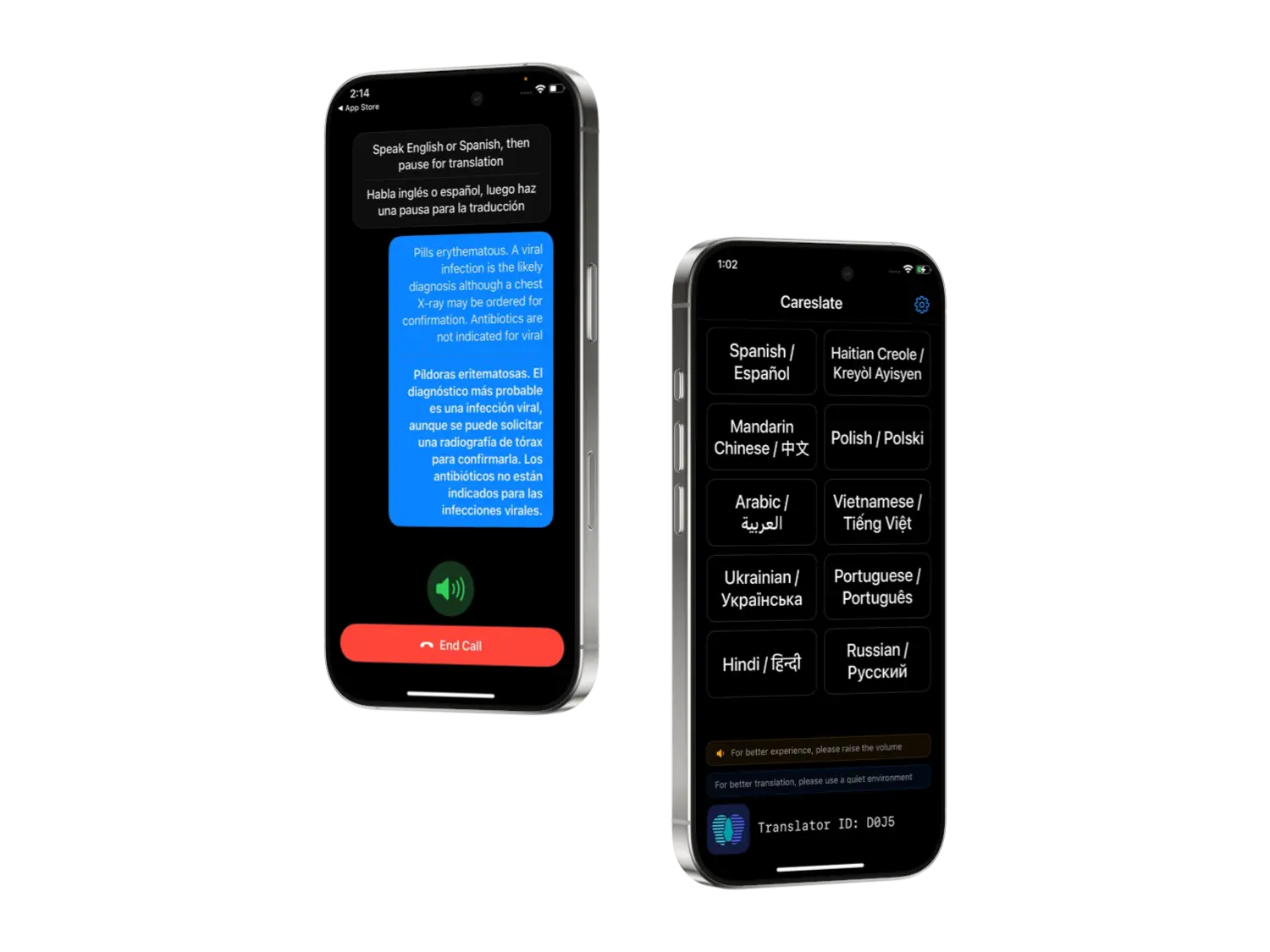
Careslate lets a doctor and patient who do not share a language understand each other in real time through live two-way audio and on-screen subtitles. Mobilions built it on a custom three-stage audio pipeline that cleans audio, constrains the AI, and validates output before a word is shown — with zero patient data stored.

Project Overview
A summary of what Careslate is and what Mobilions engineered.
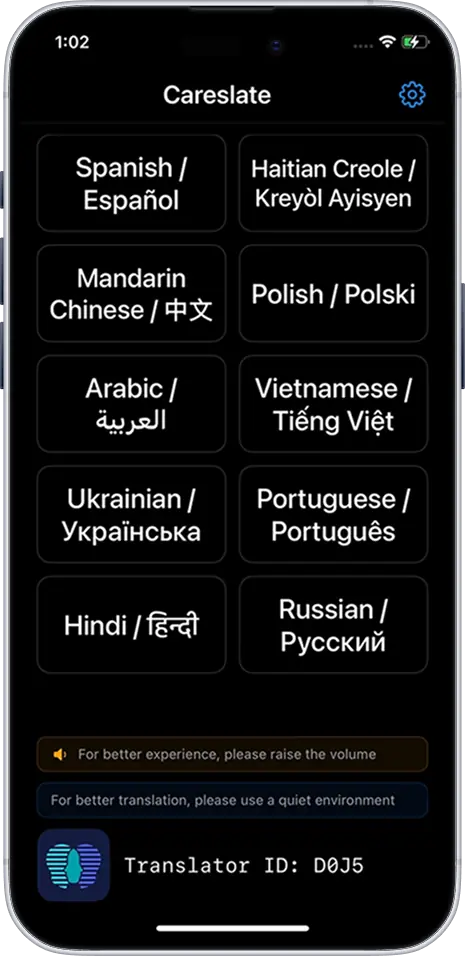
Careslate is a HIPAA-compliant AI translation app that lets a doctor and patient who do not share a language understand each other in real time, through live two-way audio and on-screen subtitles. There is no account, no login and no card: a clinician opens it, picks two languages, and the conversation works, with medical wording kept accurate.
Mobilions built the app on a custom three-stage audio pipeline after finding that a direct audio-in, text-out approach was not dependable enough for medical use. The pipeline cleans the audio, constrains the AI, and checks the output before a single translated word reaches the doctor or patient.
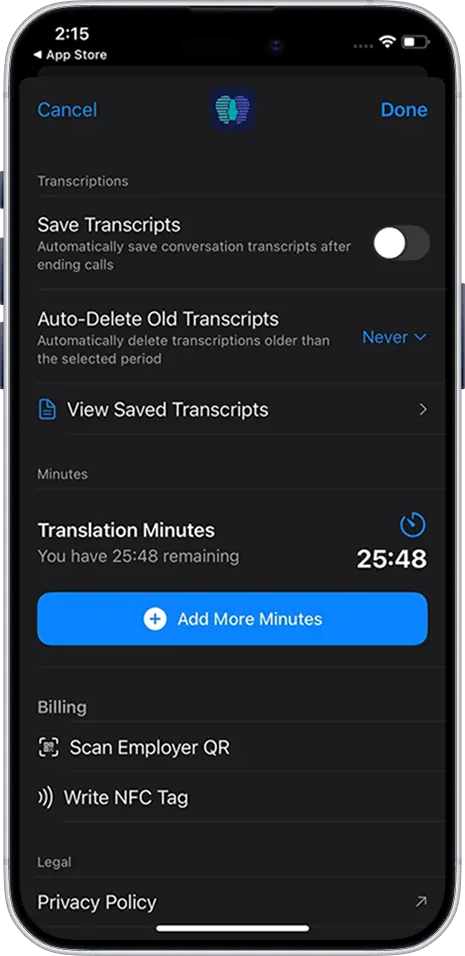
The whole flow is HIPAA-compliant, with no patient data stored at any point. Audio is processed in the moment and never kept as a recording, and the system runs on HIPAA-eligible AWS services with encryption and audit logging.
Client Snapshot
Key facts about the product, platform and market at a glance.
Healthcare
iOS
2026
Information not available in source documents.
Services Delivered
The scope of work Mobilions delivered on Careslate.
- Mobile App Development (native iOS)
- AI & Audio Engineering (real-time translation pipeline)
- Prompt Engineering & Output Validation
- HIPAA Compliance / Privacy Architecture
Technology Stack
The languages, services and tools behind the build.
- Mobile: SwiftUI, AVFoundation
- AI & audio: OpenAI Realtime API, WebSocket
- Pipeline: Three-stage (capture, clean, translate), prompt validation
- Compliance: HIPAA-compliant, no data storage
- Infrastructure: HIPAA-eligible AWS services
The Challenge
The core problems Careslate had to solve in a clinical setting.
Business Challenge
A doctor and patient who do not share a language need to understand each other in a real exam room, where the stakes are medical and a wrong translation is dangerous rather than just annoying. Zero-friction onboarding was a core requirement, because nobody should be filling in a form while a patient waits.
Technical Challenge
On its own, the OpenAI Realtime API gave inconsistent transcriptions during live conversation: audio arrived in fragments, medical terms were misread, and responses lagged behind natural speech. The model could also hallucinate — producing medical advice nobody spoke or inventing terminology. The system also had to translate strictly between the two chosen languages with no cross-interference, and turn translated audio into a smooth chat within seconds without freezing the interface.
Our Approach
How Mobilions moved from discovery to a working clinical pipeline.
Discovery
The team found early that a direct audio-in, text-out approach was not dependable enough for medical use — it looked great in a demo but fell apart against background noise, accents and medical jargon in a real clinic. That finding drove the decision to build a custom three-stage pipeline.
Architecture
A three-stage audio pipeline runs the flow. Stage 1 captures audio from the phone microphone and preprocesses it: noise reduced, volume normalized, speech split at natural phrase boundaries. Stage 2 sends the clean audio to the OpenAI Realtime API under tight prompt constraints to transcribe and translate. Stage 3 validates the output, comparing length ratios and flagging anything off, then pushes passing translations to the chat interface over WebSocket in under three seconds.
Execution
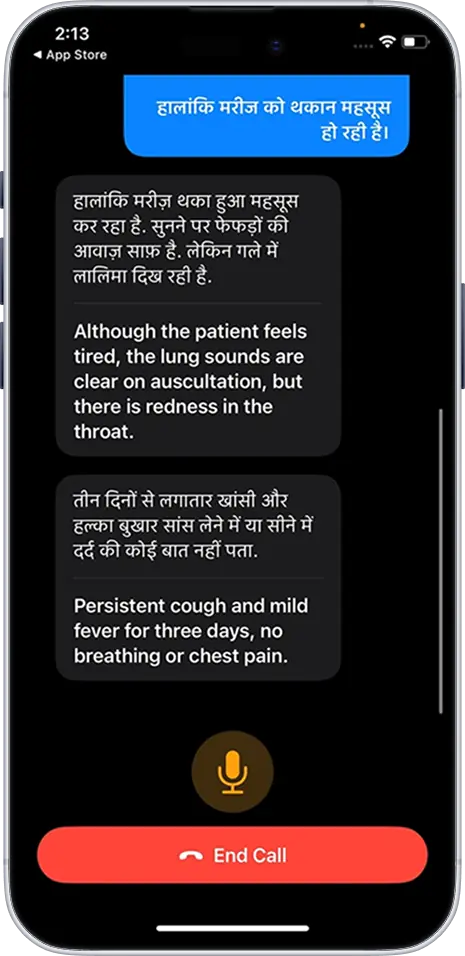
Each session binds to exactly two languages at creation, with the prompt stating the allowed pair explicitly and any non-matching audio filtered out before it reaches the AI. The pipeline connects to the frontend over WebSocket channels, so each translated segment pushes to the client instantly and renders as a chat bubble showing the original transcription and translation side by side — no refreshing or polling.
Engineering Decisions
The deliberate trade-offs that shaped the build.
Build a custom three-stage pipeline instead of direct API output
Because the OpenAI Realtime API alone gave inconsistent live transcription, the team built its own pipeline: capture, then clean and segment, then transcribe and translate. Splitting it into three stages gave control over audio quality, timing and error recovery at every step.
Remove hallucinations with strict prompt engineering and output validation
The system prompt locks the model to translation-only, with explicit instructions never to add advice, context or terminology that was not in the source audio. A validation layer flags any response that strays from expected translation ratios, so nothing invented reaches the doctor or patient.
Language-pair isolation through prompt design and session architecture
Each session binds to exactly two languages at the moment it is created, the prompt states the allowed pair explicitly, and any audio that does not match the source language is filtered out before it reaches the AI, preventing cross-language interference and mid-conversation direction flips.
Technology Considerations
Why the stack was chosen and the trade-offs it carries.
Why These Technologies
SwiftUI runs the native iOS app and AVFoundation handles audio capture. The OpenAI Realtime API powers transcription and translation through the custom three-stage pipeline, and WebSocket delivers translated messages in real time. The entire flow is HIPAA-compliant with no patient data stored at any point.
Tradeoffs
The OpenAI Realtime API is powerful but not production-ready for medical use straight out of the box. A direct approach worked in a demo and then failed against background noise, accents and medical jargon, so the team accepted the added complexity of a three-stage pipeline to gain reliability, with prompt constraints and validation layers carrying the real value.
Scalability Considerations
Careslate supports more than ten major world languages with medical-terminology awareness, and each language pair is checked for clinical accuracy. Selecting two languages locks the session to exactly those two with no interference from a third.
Implementation Highlights
The features that define the Careslate experience.
Live two-way audio translation
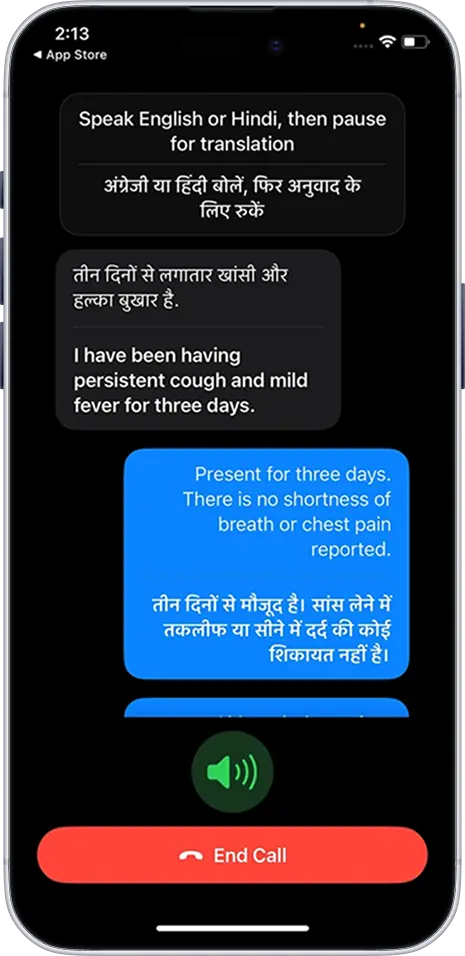
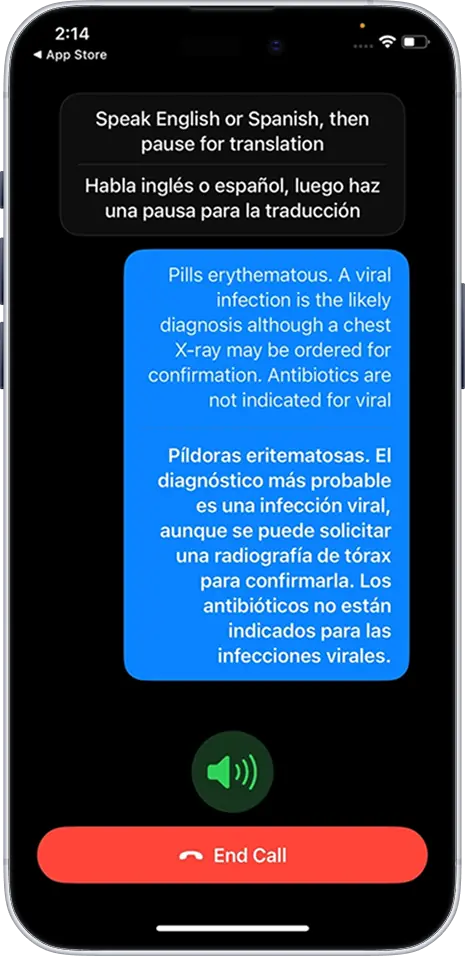
The doctor speaks English and the patient hears Spanish; the patient replies in Spanish and the doctor reads English subtitles. Both sides update live over WebSocket connections, so it feels like a real back-and-forth conversation rather than a turn-by-turn tool.
HIPAA-compliant by design
Audio is processed in the moment and never kept as a recording. No patient health information persists beyond the active session, and the whole thing runs on HIPAA-eligible AWS services with encryption and audit logging, so privacy is built into the architecture.
No hallucinations and no account required
Careful prompt engineering locks the AI into translation-only mode, and the validation layer rejects anything that adds medical advice or context not in the original audio. There are no sign-ups, logins or card details — a clinician opens the app, chooses two languages, and starts translating. A WebSocket chat display shows the original transcription and the translation side by side as conversation bubbles.
Key Engineering Highlights
A closer look at the system underneath the product.
Architecture
A three-stage pipeline (capture and preprocess; transcribe and translate via the OpenAI Realtime API under tight prompt constraints; validate and deliver) with WebSocket delivery to the chat interface.
Data Layer
No patient data is stored at any point. Audio is processed live and never kept as a recording; no patient health information persists beyond the active session.
Performance
From spoken word to translated text in under three seconds. Validated translations are pushed to the chat over WebSocket in under three seconds, keeping the conversation at a natural pace.
Security
HIPAA-compliant by design: the system runs on HIPAA-eligible AWS services with encryption and audit logging, and no patient data is stored.
Information not available in source documents. The source states design goals and capabilities — under-three-second latency, 10+ languages, no account required, HIPAA-compliant — but no post-launch measurable business or usage results.
Gallery
A look at the product across screens.
Ready to build something like Careslate?
If you need a real-time, compliant AI translation or medical app with a reliable pipeline and validated output, let us show you how we would build it.
What Clients Say
Mobilions' clients describe fast delivery, clear communication, and senior, trustworthy engineering—in their own words.
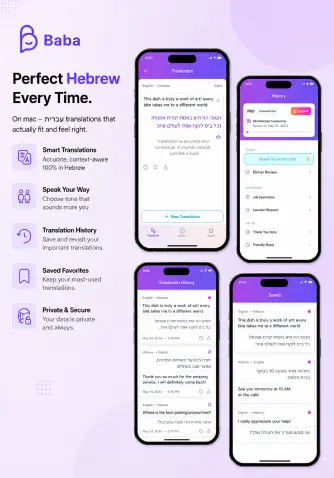
We worked with Ankit, Mayur, and Tushar to build the first version of Baba Hebrew for iOS and Android, and they delivered super fast. The team was responsive, reliable, and efficient, taking the idea from zero to a working app in record time. I'd recommend them to anyone who wants to get an MVP live quickly.
Tushar and Ankit did an outstanding job developing our native iOS (Swift) and Android (Kotlin) apps. They were efficient, responsive, and technically strong throughout. Thanks to their work, we launched successfully and gained over 1,000 users in the first 30 days. Highly recommend this team for quality mobile app development.
It was a wonderful experience working with Tushar, Ankit, and their team. They built a great mobile app for me and truly brought my vision to life. What stood out was not just their technical skill but their attitude: always positive, solution-oriented, and incredibly patient. They went above and beyond at every step, finding creative workarounds and staying committed even when things got challenging. Extremely professional and trustworthy. I would absolutely hire them again.
Great experience working with this team. They completed the development work quickly and efficiently without wasting time. Communication was clear and consistent, they understood the requirements well, gave smart suggestions, and delivered exactly as discussed. I'd highly recommend them to anyone looking for a reliable, fast, and skilled app development team.
We worked with Ankit, Mayur, and Tushar to build the first version of Baba Hebrew for iOS and Android, and they delivered super fast. The team was responsive, reliable, and efficient, taking the idea from zero to a working app in record time. I'd recommend them to anyone who wants to get an MVP live quickly.
Tushar and Ankit did an outstanding job developing our native iOS (Swift) and Android (Kotlin) apps. They were efficient, responsive, and technically strong throughout. Thanks to their work, we launched successfully and gained over 1,000 users in the first 30 days. Highly recommend this team for quality mobile app development.
It was a wonderful experience working with Tushar, Ankit, and their team. They built a great mobile app for me and truly brought my vision to life. What stood out was not just their technical skill but their attitude: always positive, solution-oriented, and incredibly patient. They went above and beyond at every step, finding creative workarounds and staying committed even when things got challenging. Extremely professional and trustworthy. I would absolutely hire them again.
Frequently Asked Questions
Answers to the questions teams ask before building an app like this.
It depends on scope. The cost of a build like this is driven by scope, features, integrations, compliance requirements, team composition, and infrastructure complexity. We provide a fixed estimate after a short discovery call once those are defined.
It can be, when it is built for it. Accuracy comes from more than the model: in Careslate it comes from cleaning the audio first, locking the AI to translation only, and validating every output before it is shown. That combination is what makes it dependable in a real exam room rather than only in a demo.
By designing privacy in from the start. In Careslate, audio is processed live and never stored as a recording, no patient information persists beyond the session, and everything runs on HIPAA-eligible infrastructure with encryption and audit logging. Compliance is built into the architecture, not added at the end.
It is the approach built because direct audio-in, text-out was not reliable enough. Stage one captures and cleans the audio, stage two transcribes and translates it under tight constraints, and stage three validates the result before delivery. Splitting it this way gives control over quality, timing and error recovery at each step.
It is best seen as fast, always-available support rather than a full replacement for a professional interpreter in complex or high-stakes situations. For the many everyday moments where a clinician and patient simply cannot understand each other and no interpreter is on hand, a tool like Careslate bridges the gap safely and instantly.
Through strict prompt engineering and output validation. The system prompt locks the model to translation only and forbids adding advice, context or terminology that was not spoken, and a validation layer rejects any output that strays from expected translation ratios. The goal is a faithful translation and nothing invented.
Careslate supports more than ten major world languages with medical terminology awareness, and each language pair is checked for clinical accuracy. Each session locks to exactly two chosen languages so there is no interference from any third language in the room.
Careslate took around three months from concept to a working HIPAA-compliant app. The timeline depends on the number of languages, the compliance requirements and the depth of the pipeline, and the team works in two-week sprints so progress is visible throughout rather than going quiet until launch.
Let's build your next big thing
Let's build your next big thing. Share your idea and get a free consultation—we respond within one business day.