





























LLM Fine-Tuning Services for Production

Mobilions provides LLM fine-tuning services that produce a custom LLM you can trust in production—curated data, supervised and preference tuning, rigorous evaluation against a real baseline, and private or on-premise deployment when your data demands it. Senior engineers own the work end to end, so you own the data, the weights, and the evaluation harness.

Part of our generative AI development services →
famooshedidc-ujoinbeetkoralionstudio-ailokalapptosmartbababanounbasafrdocscannerludusiomaamarmcokieme-by-mindmudeermukaabmy-meeting-cardpaaetpixiprezenceraceboardrecuriciclarioschutzwinkelshishrspendulgetrainaerotrendzfanszatarafamooshedidc-ujoinbeetkoralionstudio-ailokalapptosmartbababanounbasafrdocscannerludusiomaamarmcokieme-by-mindmudeermukaabmy-meeting-cardpaaetpixiprezenceraceboardrecuriciclarioschutzwinkelshishrspendulgetrainaerotrendzfanszatara
Since 2016
0+Projects Delivered
0+Clients Served
0+Countries Reached

What Is LLM Fine-Tuning?

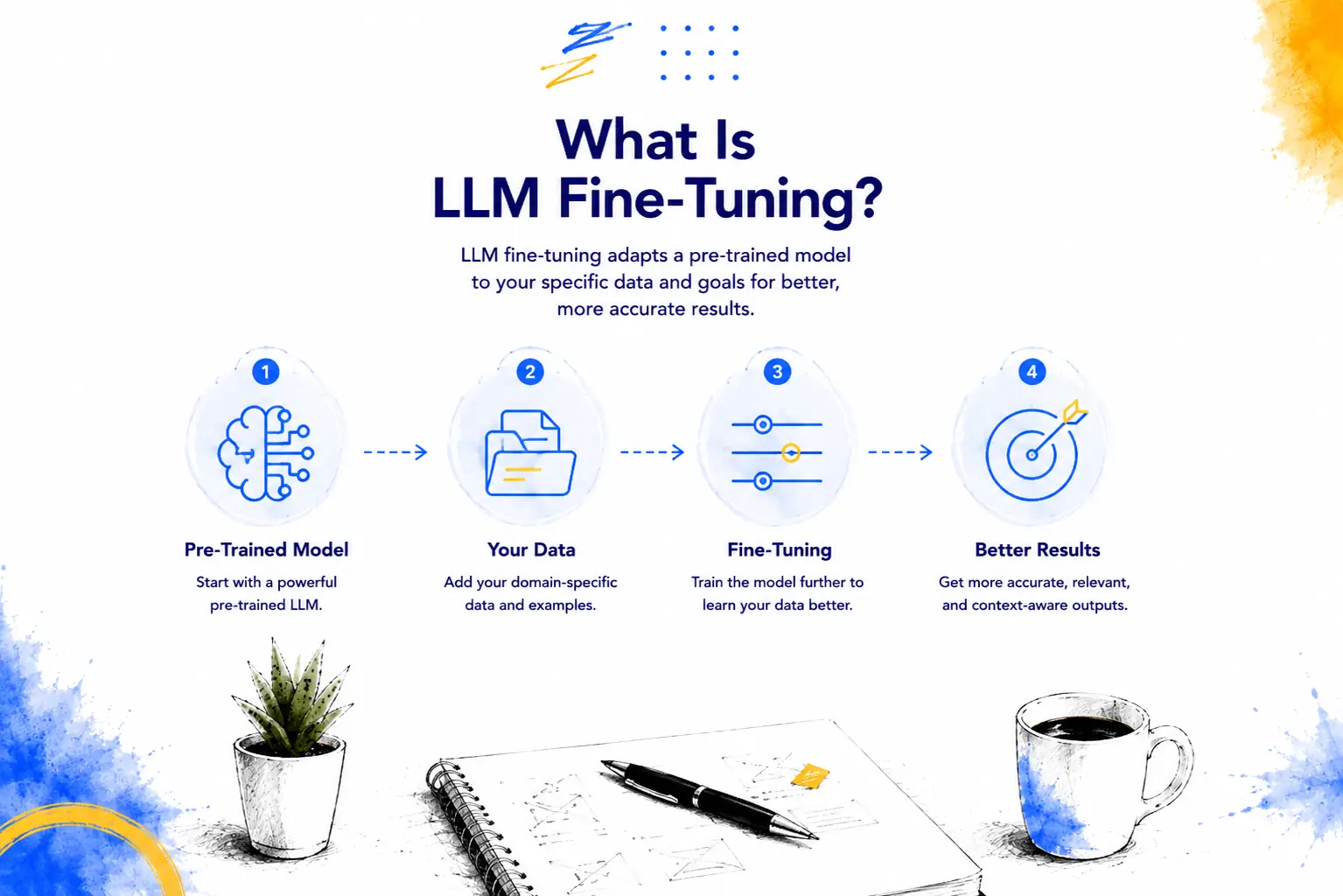
LLM fine-tuning is the process of taking a pre-trained base model and continuing its training on a curated dataset of your own, so the model internalizes your tone, your output format, and the specific task you need it to perform reliably. Instead of steering the model only with instructions at query time, fine-tuning bakes the desired behavior into the model's weights—producing a domain-specific LLM that responds the way you want by default, with less prompting and more consistency. It spans dataset preparation, the training run itself, rigorous evaluation against a held-out test set, and deployment of the resulting custom model into production.

LLM fine-tuning

We are honest about one thing up front: fine-tuning is not always needed, and often it is not the right first move. For most language tasks, grounding the model in your documents with retrieval-augmented generation and engineering disciplined prompts beats fine-tuning on cost, speed, and accuracy—and it updates the moment your data changes, where a fine-tuned model would need retraining. Fine-tuning earns its place when you need a fixed output format the model will not hold reliably through prompting, a specialized tone or voice, a narrow classification or extraction skill, or lower latency and cost from a smaller model taught to do one job well. At Mobilions, we test that case before we train: we compare a fine-tune honestly against a well-grounded, well-prompted baseline, and we only recommend fine-tuning when it genuinely wins for your problem.

What We Build

Mobilions delivers six LLM fine-tuning capabilities, each available on its own or as part of a larger build. Explore each below.

Dataset Preparation & Curation

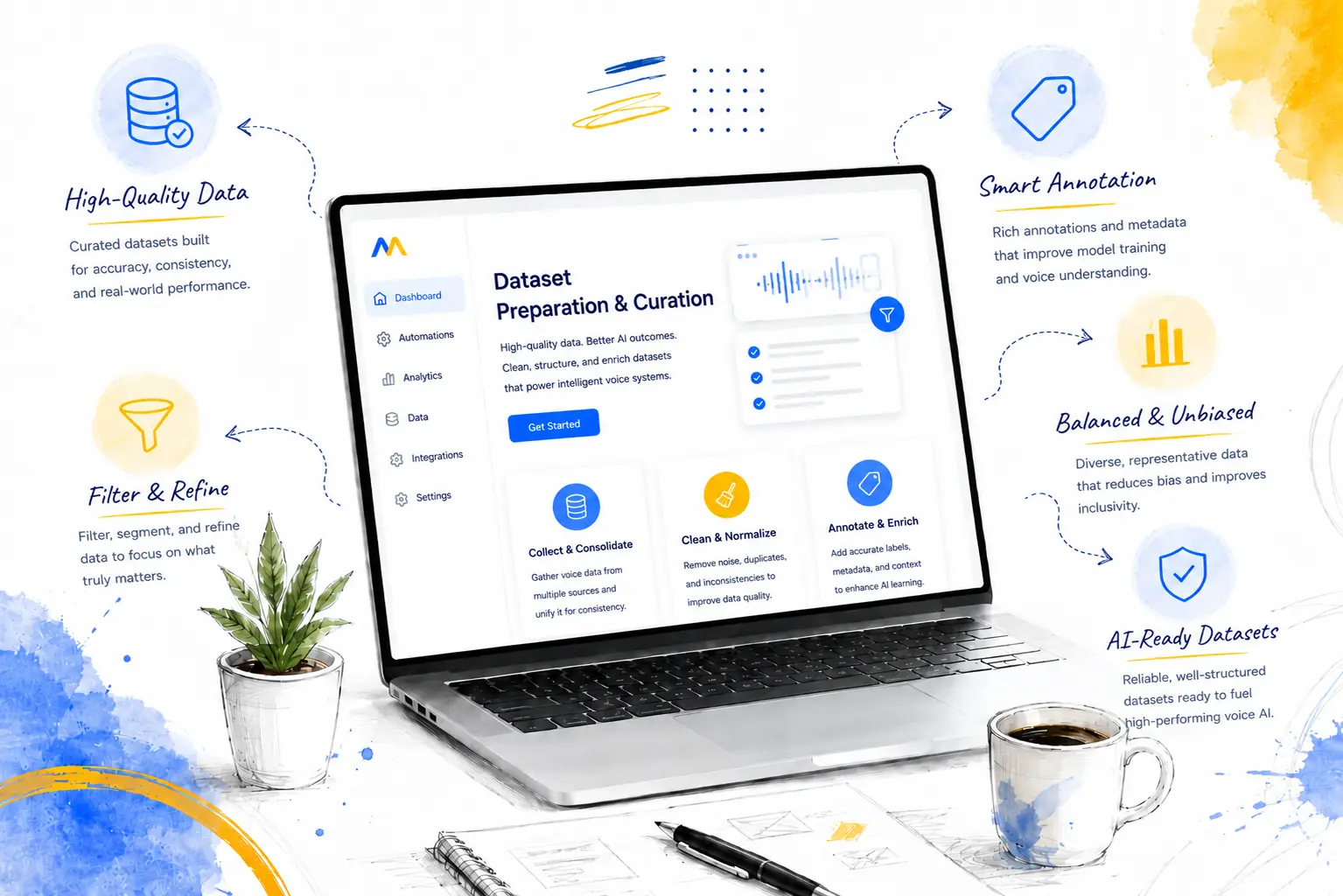
Fine-tuning lives or dies on data, so we treat dataset preparation as the real work. We help you collect, clean, de-duplicate, and label examples; design the input-output format the model will learn; balance and filter for quality; and hold out a representative test set before any training begins. A small, clean, well-curated dataset beats a large noisy one, and the quality of your custom LLM is decided here long before the training run starts.

Dataset Preparation & Curation

Supervised Fine-Tuning

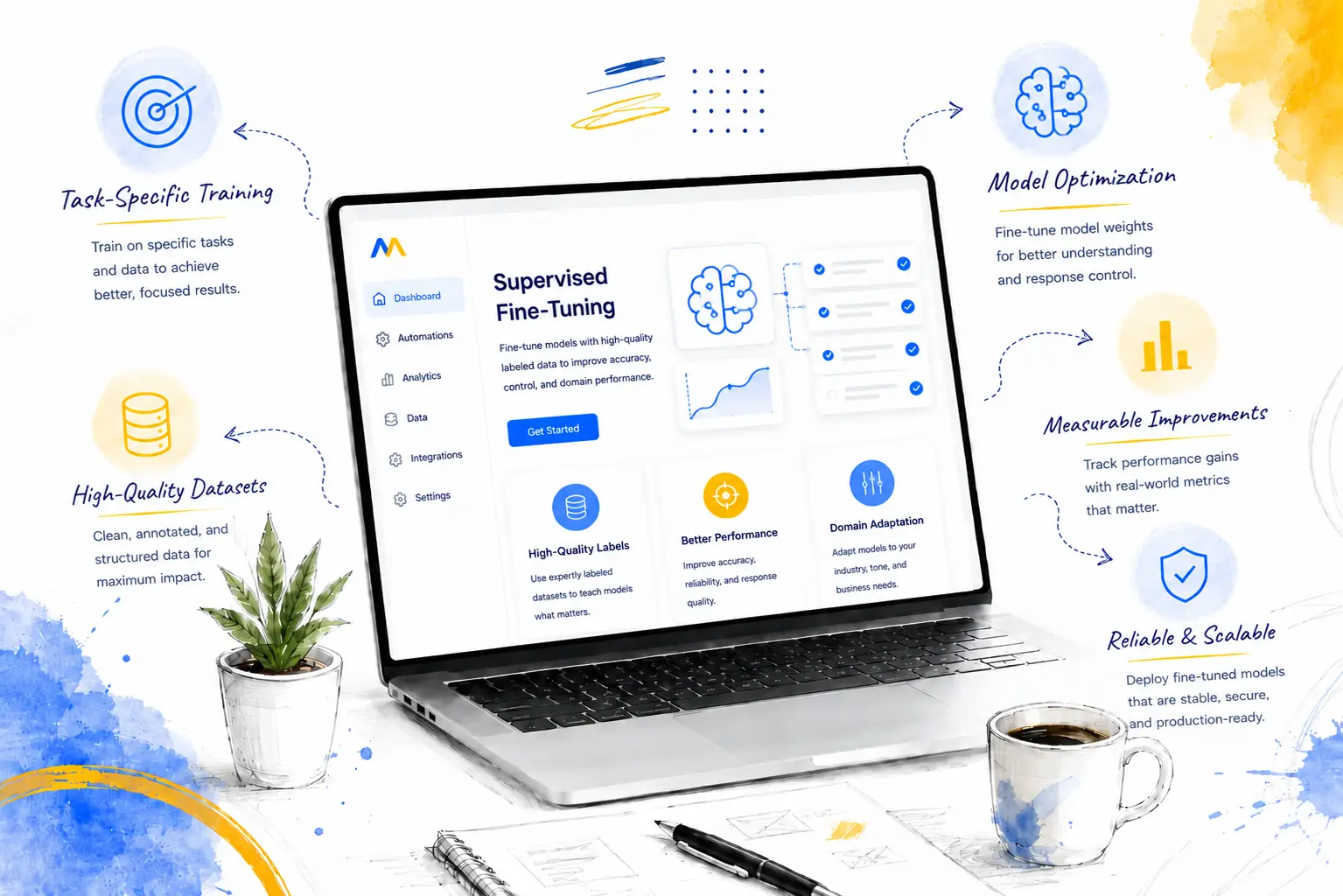
We run supervised fine-tuning—training the base model on your labeled input-output pairs so it learns your task, format, and tone directly from examples. We use parameter-efficient methods such as LoRA where they fit, choose hyperparameters deliberately, and watch for overfitting throughout, so the model generalizes to real inputs rather than memorizing your training set.

Supervised Fine-Tuning

Instruction & Preference Tuning

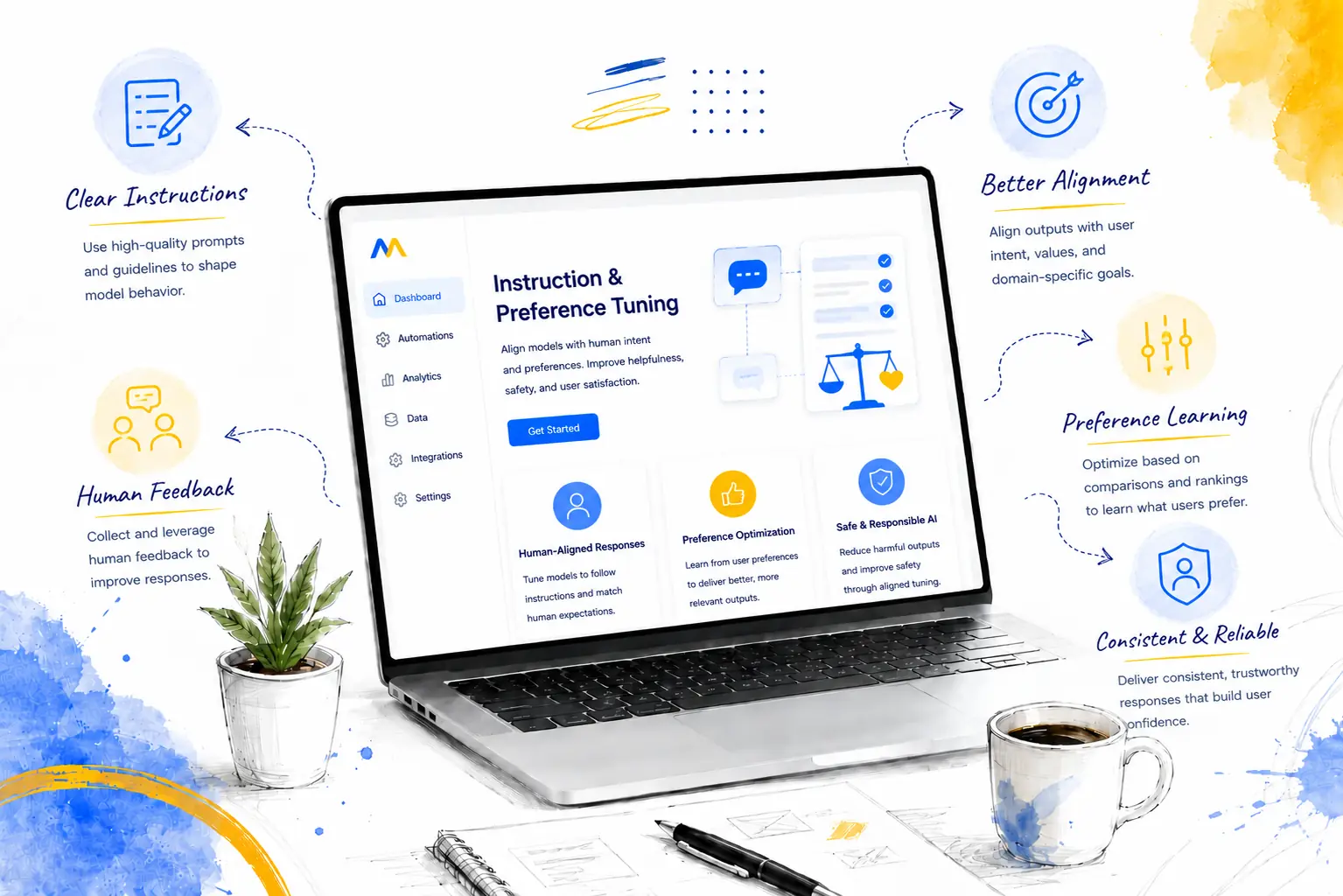
Where behavior matters as much as content, we apply instruction tuning and preference optimization (such as DPO) so the model follows instructions reliably and prefers the kind of answers you actually want. This is how a model learns to be more helpful, more on-brand, and more consistent in style—shaping judgment and behavior, not just surface format.

Instruction & Preference Tuning

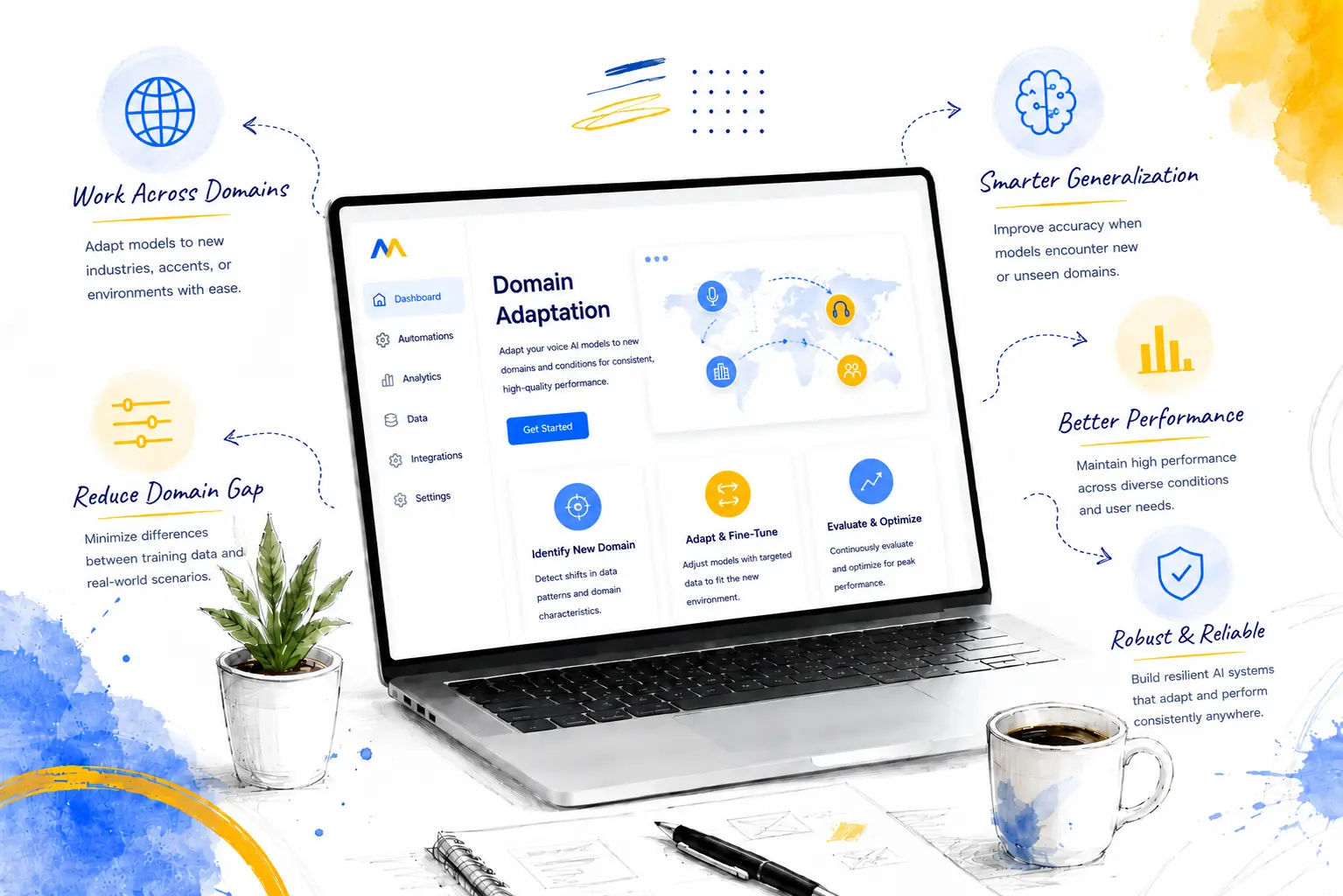
Domain Adaptation

We adapt models to specialized domains—medical, legal, financial, technical, or a particular product vocabulary—so the model understands your terminology and conventions and produces a genuinely domain-specific LLM. We focus adaptation on the language and tasks your domain actually requires, rather than chasing benchmark scores that have nothing to do with your use case.

Domain Adaptation

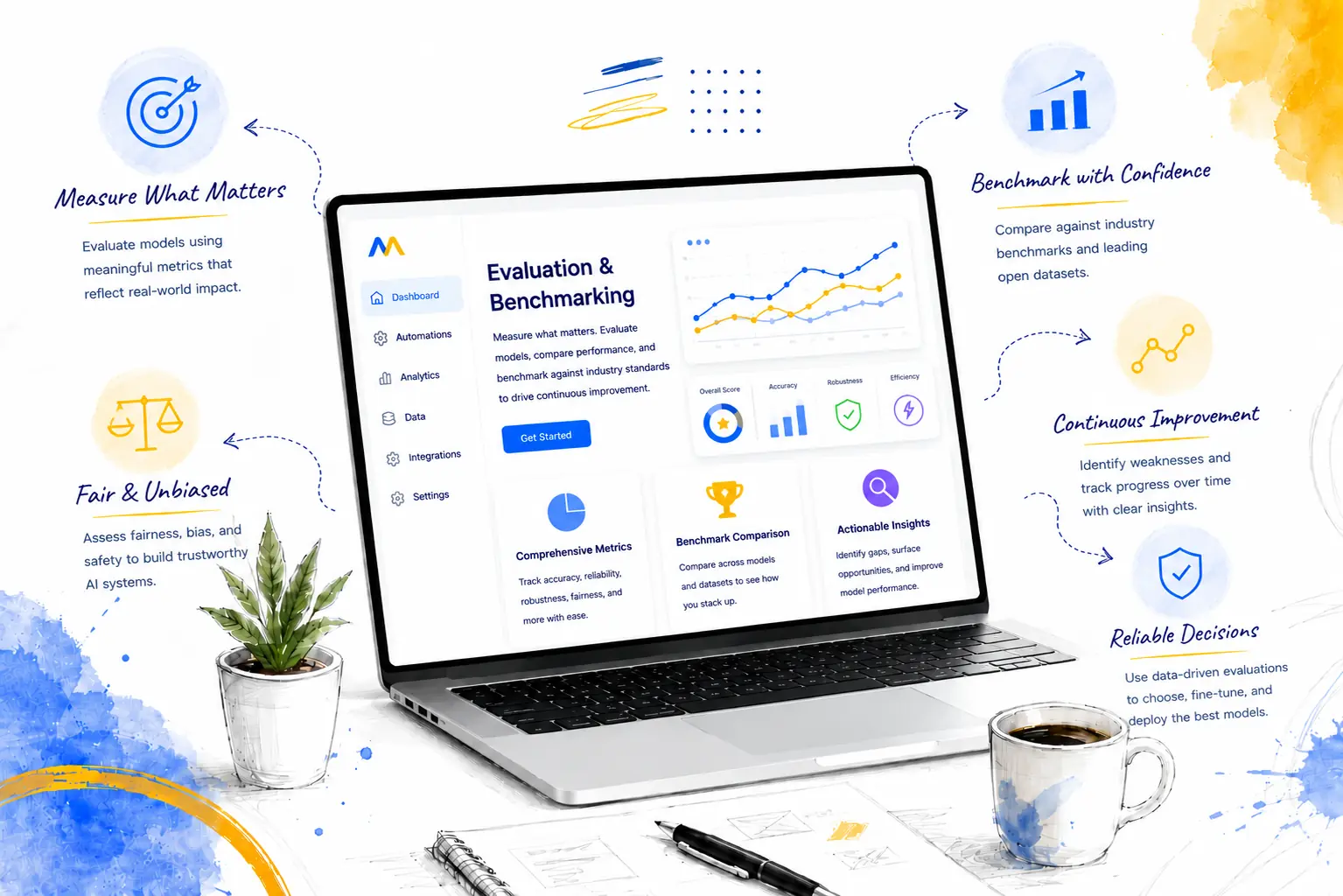
Evaluation & Benchmarking

A fine-tune you cannot measure is a fine-tune you cannot trust, so we build the evaluation harness first. We benchmark the tuned model against a held-out test set and against a grounded, well-prompted baseline—measuring task accuracy, format adherence, tone, and regressions—so you see exactly what fine-tuning bought you and whether it was worth it. We prove the gain with measurement rather than vibes.

Evaluation & Benchmarking

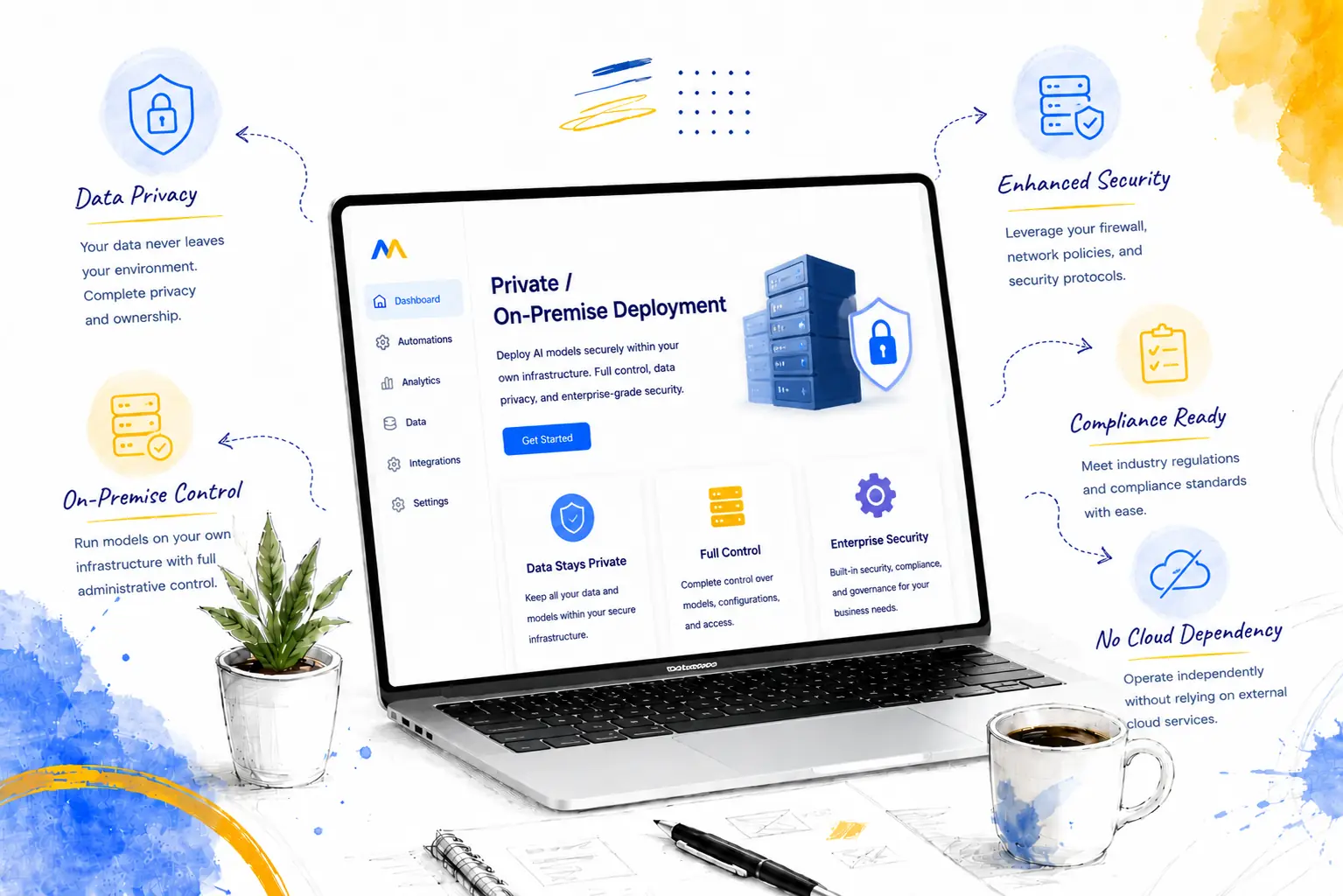
Private / On-Premise Deployment

When data sensitivity or regulation requires it, we deploy your fine-tuned open-source model inside your own environment—private cloud or on-premise—so your training data and your model weights never leave your control. We handle model serving, quantization, scaling, and access control, and map the deployment to your compliance obligations rather than defaulting to a public API.

Private / On-Premise Deployment
Dataset Preparation & CurationSupervised Fine-TuningInstruction & Preference TuningDomain AdaptationEvaluation & BenchmarkingPrivate / On-Premise Deployment
Need broader LLM work? See our LLM development →

Thinking about fine-tuning?

A senior engineer will tell you honestly whether fine-tuning beats RAG and prompting for your task—and what it takes to ship a proven custom model.

Where LLM Fine-Tuning Helps

Fine-tuning pays off where behavior must be baked in—and we will tell you where it does not.

.01

Fixed Formats and Structured Output

When you need the model to return the same structure every time—a strict JSON shape, a specific document layout, a consistent template—prompting alone often drifts. Fine-tuning on examples of the exact format teaches the model to hold it reliably, which is exactly what high-volume, downstream-parsed pipelines need.

.02

Specialized Tone, Voice, and Narrow Skills

When you need a consistent brand voice, a domain register, or a narrow skill like classification or extraction that prompting cannot hold cleanly, fine-tuning bakes that behavior into the model so it shows up by default. A smaller fine-tuned model doing one job well can also be faster and cheaper than a large general model carrying a long prompt.

.03

Domain Language and High-Volume Efficiency

When your domain has dense, specialized vocabulary, or when you run the same task at high volume and want to cut latency and per-call cost, fine-tuning a smaller model on your data can match a larger model's quality on that one task—at a fraction of the runtime cost. The savings compound at scale.

.04

Where Fine-Tuning Is Not the Answer

When you need answers grounded in changing documents with citations, retrieval-augmented generation fits better—you update the index, not the model, and the system stays current without retraining. When disciplined prompting already meets the bar, fine-tuning adds cost and a retraining burden without enough benefit. And when you lack enough clean, representative training examples, fine-tuning has nothing reliable to learn from—better data comes first. We will say so honestly, because training the wrong solution well still wastes your budget.

How We Fine-Tune Production LLMs

Mobilions fine-tunes in four disciplined stages, so the custom model is accurate, proven, and reliable in production.

Step 1.

Decide If Fine-Tuning Is Right

Before any training, we pressure-test the case. We define the task and success metric, build a grounded, well-prompted baseline, and check whether RAG or prompting already clears the bar. We only proceed to fine-tuning when it demonstrably wins for your problem—because the cheapest fine-tune is the one you did not need to run.

Step 2.

Prepare the Data

We collect, clean, de-duplicate, and label your examples; design the input-output format; balance and filter for quality; and split off a representative held-out test set. Dataset quality decides the outcome, so this is where we spend the care—a small, clean, well-curated dataset beats a large noisy one every time.

Step 3.

Fine-Tune & Evaluate

We run supervised and, where it helps, preference tuning—choosing methods such as LoRA and hyperparameters deliberately, and watching for overfitting. Then we evaluate the result against the held-out test set and the baseline, measuring task accuracy, format adherence, tone, and regressions, so the gain from fine-tuning is proven rather than assumed.

Step 4.

Deploy & Monitor

We deploy the fine-tuned model—via a managed API or privately on-premise where sensitivity requires it—and instrument it: logging outputs, tracking quality, latency, and cost, and watching for drift as inputs change. When real usage reveals gaps or the data shifts, we re-curate and re-train. Support terms are agreed explicitly in the engagement.

Industries We Serve

We build voice AI across regulated and high-volume sectors. Explore industry-specific approaches:

Why Mobilions for LLM Fine-Tuning

Clients choose Mobilions because the same senior engineering team that scopes the fine-tune also prepares the data, trains the model, proves it, and supports it—with an honest answer about whether to fine-tune at all.

01

Honest Fine-Tune vs. RAG

We tell you when fine-tuning is the wrong move. We build a grounded, well-prompted baseline first and only fine-tune when it demonstrably wins—so you never pay to train a model you did not need.

02

Evaluated Rigorously

We treat evaluation as the product. Every fine-tune is measured against a held-out test set and a real baseline for accuracy, format, tone, and regressions—so the gain is proven, not assumed.

03

One Team: Data → Train → Deploy

The same team carries your fine-tune across the whole journey—dataset curation, training, evaluation, deployment, and monitoring—so there is no handoff and no loss of context as your data changes.

04

You Own the Models

You keep the training data, the model weights, and the evaluation harness. We build for your team to operate and re-train, with private or on-premise deployment available and no lock-in.

What Clients Say

Mobilions' clients describe fast delivery, clear communication, and senior, trustworthy engineering—in their own words.

5.0RATING

Great experience working with this team. They completed the development work quickly and efficiently without wasting time. Communication was clear and consistent, they understood the requirements well, gave smart suggestions, and delivered exactly as discussed. I'd highly recommend them to anyone looking for a reliable, fast, and skilled app development team.


5.0RATING

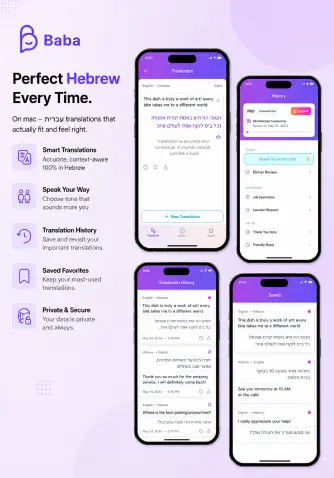
We worked with Ankit, Mayur, and Tushar to build the first version of Baba Hebrew for iOS and Android, and they delivered super fast. The team was responsive, reliable, and efficient, taking the idea from zero to a working app in record time. I'd recommend them to anyone who wants to get an MVP live quickly.

5.0RATING

Tushar and Ankit did an outstanding job developing our native iOS (Swift) and Android (Kotlin) apps. They were efficient, responsive, and technically strong throughout. Thanks to their work, we launched successfully and gained over 1,000 users in the first 30 days. Highly recommend this team for quality mobile app development.

5.0RATING

It was a wonderful experience working with Tushar, Ankit, and their team. They built a great mobile app for me and truly brought my vision to life. What stood out was not just their technical skill but their attitude: always positive, solution-oriented, and incredibly patient. They went above and beyond at every step, finding creative workarounds and staying committed even when things got challenging. Extremely professional and trustworthy. I would absolutely hire them again.

5.0RATING

Great experience working with this team. They completed the development work quickly and efficiently without wasting time. Communication was clear and consistent, they understood the requirements well, gave smart suggestions, and delivered exactly as discussed. I'd highly recommend them to anyone looking for a reliable, fast, and skilled app development team.
5.0RATING

We worked with Ankit, Mayur, and Tushar to build the first version of Baba Hebrew for iOS and Android, and they delivered super fast. The team was responsive, reliable, and efficient, taking the idea from zero to a working app in record time. I'd recommend them to anyone who wants to get an MVP live quickly.

5.0RATING

Tushar and Ankit did an outstanding job developing our native iOS (Swift) and Android (Kotlin) apps. They were efficient, responsive, and technically strong throughout. Thanks to their work, we launched successfully and gained over 1,000 users in the first 30 days. Highly recommend this team for quality mobile app development.

5.0RATING

It was a wonderful experience working with Tushar, Ankit, and their team. They built a great mobile app for me and truly brought my vision to life. What stood out was not just their technical skill but their attitude: always positive, solution-oriented, and incredibly patient. They went above and beyond at every step, finding creative workarounds and staying committed even when things got challenging. Extremely professional and trustworthy. I would absolutely hire them again.

Frequently Asked Questions

The most common questions buyers ask about LLM fine-tuning—answered directly.

LLM fine-tuning is the process of adapting a pre-trained base model on a curated dataset of your own, so the model internalizes your tone, output format, and task and produces them by default—with less prompting and more consistency. Instead of steering the model only with instructions at query time, fine-tuning bakes the desired behavior into the model's weights, producing a custom, domain-specific LLM. It spans dataset preparation, the training run, evaluation against a held-out test set, and deployment into production.

Prompting steers a base model with instructions at query time; RAG grounds answers in retrieved documents so the system stays current and cites sources; fine-tuning bakes new behavior, format, or skill into the model's weights through training. Prompting and RAG fit most tasks and update instantly when your data changes; fine-tuning fits when you need a fixed format, a specialized tone, or a narrow skill that prompting cannot hold reliably. Often grounding with RAG and disciplined prompting wins—and many systems combine all three. We recommend the approach that actually fits.

Less than most people expect, but it must be clean and representative. Many useful fine-tunes—format, tone, or a narrow task—work with a few hundred to a few thousand high-quality examples, because a small, well-curated dataset beats a large noisy one. The real requirement is that your examples accurately represent the inputs and outputs you want in production. In a short scoping call we will tell you honestly whether you have enough data, or whether data collection comes first.

We fine-tune frontier models from providers such as OpenAI and Anthropic where managed fine-tuning fits, and open-source models such as Llama and Mistral where you need a private, owned model you can deploy on-premise. We choose the base model on evidence for your task and constraints—size, latency, cost, and deployment requirements—rather than defaulting to one vendor.

We build the evaluation harness before training. We hold out a representative test set and benchmark the tuned model against it and against a grounded, well-prompted baseline—measuring task accuracy, format adherence, tone, and any regressions—so you see exactly what fine-tuning bought you. We prove the gain with measurement, and we keep monitoring quality on live traffic after deployment rather than assuming the model stays good.

Yes. When you fine-tune an open-source model, we can deploy it inside your own private cloud or on-premise environment, so your training data and model weights never leave your control. We handle model serving, quantization, scaling, and access control, and map the deployment to your compliance obligations—rather than defaulting to a public API endpoint.

The main risks are overfitting (the model memorizes your training set instead of generalizing), regressions (it gets better at your task but worse at others), and drift (its inputs change over time and quality decays). We manage these with held-out evaluation, parameter-efficient methods, deliberate hyperparameters, regression checks against a baseline, and post-deployment monitoring—and when data shifts, we re-curate and re-train rather than letting quality quietly erode.

Cost depends on scope: the state of your data, how much curation it needs, the base model, the training method, and whether you need private deployment. A focused fine-tune on a clean, ready dataset is modest; a project that includes data collection, domain adaptation, and on-premise serving costs more. Crucially, we often find fine-tuning is not the cheapest path—and we will tell you if RAG or prompting gets you there for less. The fastest way to a real number is a short scoping call—Get a Project Estimate.

Timeline depends mostly on data readiness. With a clean, curated dataset, a focused fine-tune and its evaluation can reach a proven result in a couple of weeks; projects that require significant data collection, domain adaptation, or private on-premise deployment take longer. We front-load the decision and the dataset work because that is where the time and the quality actually live—not in the training run itself.

You do. You keep the training data, the model weights, and the evaluation harness, with no lock-in. We handle data with least-privilege access, sign an NDA on request, and for sensitive or regulated work offer private and on-premise deployment so your data never leaves your environment. For fintech and healthcare, security and compliance are designed into the pipeline from the start.

Let's build your next big thing

Let's build your next big thing. Share your idea and get a free consultation—we respond within one business day.

0+
Products shipped
0+
Clients served
0+
Countries reached
Call Us (USA)
+1-856-524-5593

Get a Free Quote

A senior engineer replies within one business day · NDA on request · no obligation · you own the code and IP.