Most guides on food delivery app development are really just cost calculators wearing a guide’s clothing. They give you a price range, a feature checklist, and a tech-stack table, and they stop exactly where the hard part begins. Having built and shipped mobile apps for years, I can tell you the menu screen and the checkout flow are the easy 40 percent. The other 60 percent, the part that decides whether your app actually works at dinner rush, is real-time logistics: matching an order to the right driver, tracking that driver live on a map, and keeping a customer, a restaurant, and a courier in sync at the same second.
Here is the honest version up front. A food delivery app is not one app, it is three: a customer app, a restaurant app, and a driver app, all talking to a backend that has to make dispatch decisions in real time. The market is large and still growing, so the opportunity is real, but the projects that fail almost never fail on the customer-facing screens. They fail on the logistics engine underneath. This guide covers the whole thing, from business model and features to the real-time architecture, cost, and the mistakes that quietly sink these builds.
Key takeaways
If you only have a minute, these are the points that matter most about food delivery app development.
You are building three apps, not one. A customer app, a restaurant app, and a driver app, coordinated by a backend that dispatches orders and tracks drivers live. Budgeting for one and discovering you need three is the classic first mistake.
The real difficulty is real-time logistics, not the UI. Driver matching, live GPS tracking, and keeping three parties in sync are where the engineering effort and the risk concentrate.
Cost scales with logistics, not screens. A basic build runs about $30,000 to $60,000, a serious real-time platform with a full driver-dispatch system runs $150,000 to $300,000 or more, and the difference is almost entirely the logistics engine.
The market is big and still growing. The online food delivery market was about $288.8 billion in 2024 and is projected to reach roughly $505.5 billion by 2030, growing at about 9.4 percent a year, so the opportunity is real if you build the hard parts properly.
Is building a food delivery app still worth it in 2026?
Short answer: yes, if you have a real angle, because the category is still growing rather than saturating. According to Grand View Research, the global online food delivery market was worth about $288.8 billion in 2024, is projected to reach roughly $355.6 billion in 2026, and about $505.5 billion by 2030, growing at a compound annual rate of around 9.4 percent. The United States market is growing slightly faster than the global average at about 9.6 percent a year. Broader market forecasts from sources like Statista point the same direction.
The shape of the market matters as much as the size. Platform-to-consumer delivery, the aggregator model where an app connects diners to many restaurants, held about 71 percent of the market in 2024. Online payment made up about 67 percent of transactions. Asia Pacific was the largest region at roughly 41.6 percent, with North America at about 27 percent. The practical read for a new entrant is that the giant horizontal aggregator space is crowded, so the realistic openings are vertical or local: a specific cuisine, a specific city, a restaurant chain’s own branded app, or a hyper-local neighborhood service where the incumbents are weak. You do not beat the incumbents on breadth. You beat them on focus.
What are the types of food delivery apps and business models?
Before scoping features, decide which model you are building, because it changes everything downstream, especially whether you own delivery logistics or not.
The aggregator model lists many restaurants and passes orders to them, while the restaurants handle their own delivery. It is the lightest to build because you do not run a driver fleet, but it is the most crowded. The order plus delivery model, which is what most people picture, controls the logistics with its own driver network, which is far more powerful and far more complex to build. The direct-to-consumer model is a single restaurant or chain’s own branded app that bypasses the aggregators to avoid their commissions, which is often the smartest first build for an established brand. Cloud kitchen models run delivery-only kitchens with no dine-in. Subscription models add recurring fees for free delivery or perks. Hyper-local models focus on a tight neighborhood radius.
| Model | You own delivery? | Best fit | Build complexity |
| Aggregator | No | Marketplace connecting many restaurants | Lower |
| Order + delivery | Yes | A platform that controls the full experience | High |
| Direct-to-consumer | Sometimes | An established restaurant or chain avoiding commissions | Medium |
| Cloud kitchen | Yes | Delivery-only brands | Medium to high |
| Hyper-local | Usually | A focused neighborhood service | Medium |
The single most important line in that table is the “you own delivery” column. The moment the answer is yes, you are building a real-time logistics system, and your cost and timeline roughly double. Decide this before you write a line of code.
What features does a food delivery app actually need?
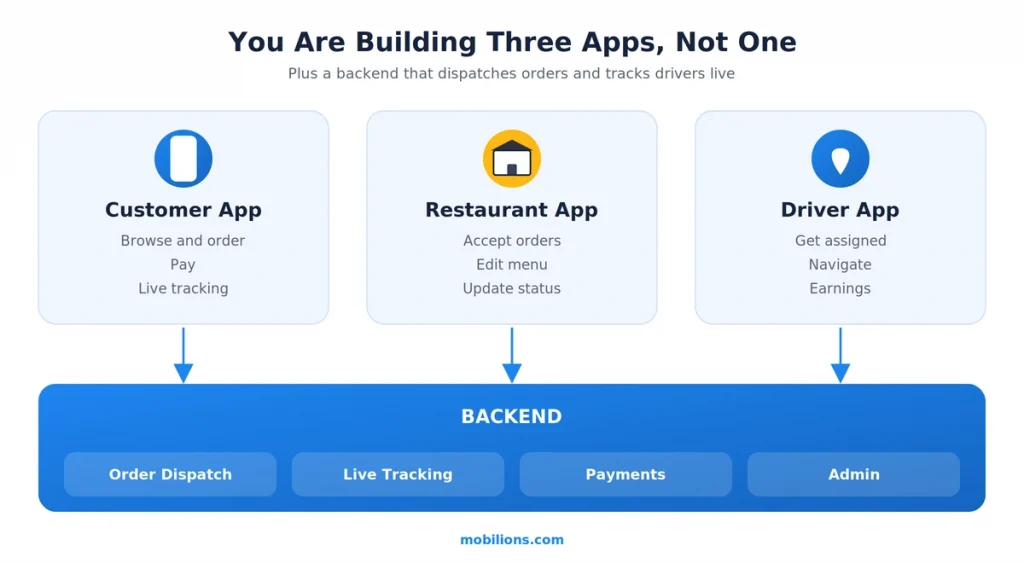
Because you are building three apps, the feature list splits three ways. Here is the realistic minimum for a delivery-owning platform, not a bloated wishlist.
The customer app needs registration and login, restaurant and menu browsing with search and filters, a cart and checkout, multiple payment options including cards, wallets, and cash on delivery, live order tracking on a map, an estimated delivery time, ratings and reviews, order history and reordering, and push notifications for each status change.
The restaurant app needs incoming order management with accept, reject, and modify, menu and availability editing so an item can be marked sold out instantly, order-status updates, basic sales analytics, and notifications. Getting this app right is underrated. A slow or confusing restaurant app is where delivery times quietly balloon.
The driver app needs availability toggling, real-time order assignment based on location, turn-by-turn navigation, order-status updates from pickup to delivery, an earnings view, and in-app communication with the customer and restaurant.
| App | Core job | A few must-have features |
| Customer | Order and track | Browse, cart, pay, live tracking, reorder |
| Restaurant | Accept and prepare | Order queue, menu editing, status updates, analytics |
| Driver | Pick up and deliver | Availability, live assignment, navigation, earnings |
Plus an admin dashboard behind all three, where you manage restaurants, drivers, commissions, disputes, and promotions. Teams routinely forget to budget for the admin panel, then discover on launch week that they have no way to actually run the marketplace.
The hard part: real-time logistics and live tracking
This is the section most guides skip, and it is the one that actually determines whether your app succeeds. A food delivery platform is a three-sided marketplace, and its backend has to satisfy three competing goals at once: get the customer their food fast, keep the driver’s route efficient, and fit the restaurant’s prep time. Optimizing any one of those in isolation is easy. Doing all three together, live, is the real engineering problem, as this breakdown of DoorDash’s real-time logistics lays out well.
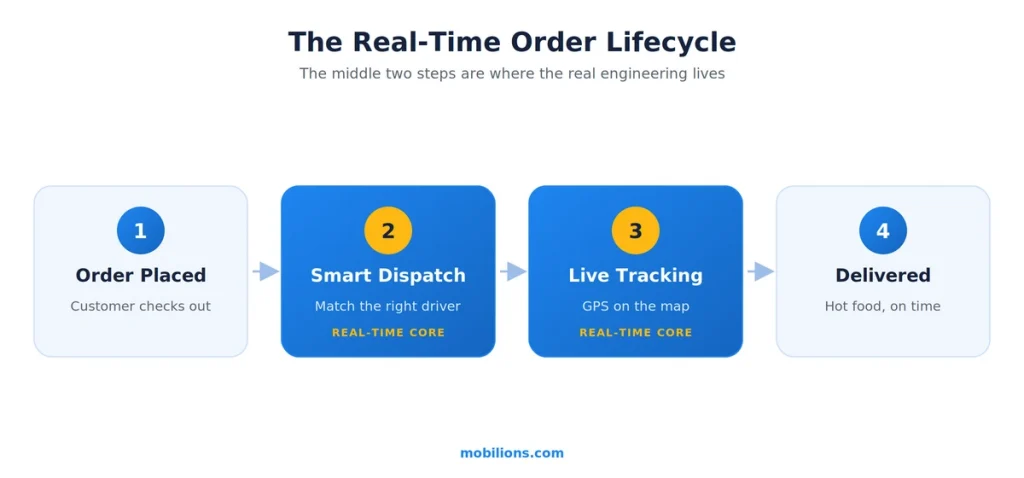
Order dispatch is the heart of it. When an order comes in, the system has to pick the right driver, not just the nearest one. A good dispatcher weighs driver proximity to the restaurant, the estimated delivery time, driver availability and history, and often a machine-learning prediction of whether a given driver will even accept the offer. At scale, the map is split into geographic zones so the matching problem stays small enough to solve in real time rather than searching every driver in the city for every order.
Live tracking is the other half. The driver app streams GPS location, and the customer app shows it moving on a map. The right way to do this is a push-based connection using WebSockets or gRPC, not the app polling a server every few seconds, because polling is both laggy and expensive at scale. Large platforms pipe those location updates through streaming infrastructure such as Apache Kafka, cache hot routes in Redis, and compute estimated arrival times by blending live position with historical traffic and the restaurant’s prep time.
You do not need DoorDash’s scale on day one, but you do need to choose an architecture on day one that will not have to be thrown away at ten thousand orders a day. This is exactly where a food delivery build stops being a mobile project and becomes a custom software and systems project, and where scoping the backend as an afterthought goes wrong.
The part that breaks naive systems is demand volatility. Order volume is not steady. It spikes hard at lunch and dinner and collapses in between, and a dispatcher that works fine at noon can fall apart at 7 pm when a surge of orders hits a limited pool of available drivers. Mature platforms handle this by forecasting demand with time-series models and pre-positioning drivers before the rush rather than reacting to it, and by letting dynamic pricing rise to pull more drivers online when demand outstrips supply.
You do not need any of that at launch, but you do need to know it is coming, because the difference between a demo that works and a product that survives dinner rush is almost entirely about how it behaves under load. Estimated arrival times are the visible symptom here: a customer forgives a slightly slow delivery far more readily than an ETA that keeps sliding, so getting ETA accuracy right under load is as much a trust feature as a technical one.
What is the right tech stack for a food delivery app?
The stack follows from the requirements above, especially the real-time ones. On mobile, you can go native with Swift and Kotlin or cross-platform with React Native or Flutter, and for most food delivery apps cross-platform is the sensible default, which I will come back to below. On the backend, Node.js and Python are both common and both fine; the more important choice is designing it as independently scalable services, since your dispatch, tracking, and payment systems have very different load patterns. For data, a relational database such as PostgreSQL handles orders and users, while Redis caches routes and sessions and something like Kafka moves the real-time event stream.
The integrations are where the real-time magic lives. Mapping, routing, and ETAs typically run on the Google Maps Platform or a comparable provider. Payments run through a provider like Stripe so you never touch raw card data yourself. Notifications and in-app messaging often run through a service like Twilio or Firebase.
| Layer | Common choice | Why |
| Mobile | React Native / Flutter (or native Swift/Kotlin) | One team ships customer, restaurant, and driver apps |
| Backend | Node.js or Python, as scalable services | Dispatch, tracking, and payments scale differently |
| Data | PostgreSQL + Redis + Kafka | Orders, caching, and the real-time event stream |
| Maps and ETA | Google Maps Platform | Routing, navigation, live tracking |
| Payments | Stripe or similar | Secure, compliant, no raw card handling |
How much does food delivery app development cost?
Cost scales with logistics complexity far more than with screen count. Based on industry ranges and what real builds actually run, here is the honest picture.
| Tier | What you get | Cost | Timeline |
| Basic | Aggregator or single-restaurant app, no owned delivery | $30,000 to $60,000 | 3 to 6 months |
| Mid-range | Customer + restaurant + basic driver app, some real-time tracking | $60,000 to $150,000 | 6 to 9 months |
| Advanced | Full three-app platform with real dispatch and live logistics | $150,000 to $300,000+ | 9 to 12 months |
| Enterprise | High-scale, multi-city, ML dispatch, surge pricing | $300,000+ | 12+ months |
Notice that the jump from basic to advanced is not about more screens. It is almost entirely the logistics engine: dispatch, live tracking, and the driver app. Budget for ongoing cost too. Maps, cloud infrastructure, payment fees, and notifications are real per-order operating costs, and maintenance typically runs 15 to 25 percent of the build cost each year.
Native or cross-platform for a food delivery app?
As a mobile engineer who has shipped both, my default recommendation for food delivery is cross-platform with React Native or Flutter, and the reason is specific to this product. You are building three apps, and cross-platform lets one team ship all three to both iOS and Android without triple the work. The business logic in these apps, ordering, status updates, tracking display, is well within what cross-platform handles cleanly.
The one place I would consider native is the driver app, because it runs continuous background GPS and navigation for hours, and battery and background-location behavior is where native APIs still give you more control. A common and sensible pattern is cross-platform for the customer and restaurant apps, where iteration speed matters most, and a harder look at native for the driver app if battery drain becomes a real complaint. If you want the deeper version of this tradeoff, our mobile app development team makes this call on every build, and it is the same reasoning behind our enterprise mobile app work.
How do food delivery apps make money?
Revenue usually comes from several streams at once, not one. Restaurant commissions on each order are the largest for most aggregators, often in the 15 to 30 percent range, which is also exactly why so many restaurants want their own app. Customer delivery fees, often variable by distance and demand, are the second. Subscription plans that offer free or reduced delivery smooth revenue and improve retention, and they tend to be the strongest lever for repeat ordering because they change the customer’s default.
Featured listings and in-app advertising let restaurants pay for visibility. Surge or dynamic pricing during peak demand adds margin, though it has to be handled carefully so it propagates correctly in real time and does not anger customers. For a direct-to-consumer restaurant app, the model is simpler and often more attractive: you are not earning commissions, you are avoiding paying them to an aggregator, which for a chain doing real volume can be worth more than any single revenue stream a marketplace could add.
A real-world scenario
To make this concrete, picture a regional restaurant chain with fifteen locations that is tired of paying 20 to 30 percent commissions to the big aggregators. They want their own branded app.
A systematic reading of this guide sorts their build quickly. Their model is direct-to-consumer, so they do not need a giant restaurant-onboarding marketplace, which cuts scope and cost. They do own delivery within their own radius, so they still need a real driver app and live tracking, which keeps them in the mid-range tier rather than the basic one. They choose cross-platform for the customer app to launch on both platforms fast, and they scope the backend as proper services from day one because they know order volume spikes hard at dinner.
They skip surge pricing and machine-learning dispatch at launch because at fifteen locations a simpler proximity-based dispatcher is plenty, and they add complexity only if scale demands it. The result is a focused build that avoids both traps: it is not a toy that cannot track a driver, and it is not an over-engineered DoorDash clone they do not need.
Common mistakes and myths
A few errors sink food delivery builds more often than any technical problem.
The biggest myth is that a food delivery app is one app. It is three, plus an admin panel, and budgeting for one is how projects run out of money at 60 percent done.
The second mistake is treating real-time logistics as a feature to add later. Live tracking and dispatch are architectural decisions that shape the whole backend. Bolt them on after the fact and you usually rebuild the backend.
The third is underestimating the restaurant and driver apps because they are not customer-facing. A clunky restaurant app inflates delivery times, and a battery-draining driver app makes couriers quit. These two apps are where operational quality actually lives.
The fourth is copying an incumbent’s full feature set. You do not need surge pricing, machine-learning dispatch, and a national restaurant marketplace to launch. You need the smallest system that reliably gets hot food to a customer, and you earn the complex features later.
The honest caveat worth stating plainly: this is one of the harder consumer app categories to build well, precisely because of the real-time, three-sided nature. That is not a reason to avoid it. It is a reason to scope the logistics honestly and resist the temptation to treat it as a simple ordering app with a map bolted on.
Why Mobilions
Mobilions has been building custom software, mobile apps, and AI solutions since 2016. We have delivered more than 250 projects for over 100 clients across 20-plus countries, which means we have built the kind of three-app, real-time, logistics-heavy systems this guide describes, not just written about them.
When we scope a food delivery build, we treat the driver-dispatch and live-tracking backend as the core of the project rather than an add-on, and we pair the mobile app development with the backend and systems work rather than handing it off. If you are planning a food delivery app and want to pressure-test the model and the logistics before committing a budget, or you need to hire mobile developers who have shipped real-time apps, that is the conversation we have with founders and brands every week.
Summary
Food delivery app development in 2026 is a real opportunity in a market still growing toward roughly $505.5 billion by 2030, but it is not a simple ordering app. You are building three coordinated apps, a customer app, a restaurant app, and a driver app, on top of a backend whose real job is real-time logistics: matching orders to drivers, tracking them live, and keeping three parties in sync. Decide your business model first, because owning delivery roughly doubles the work. Scope the logistics engine as the core, not an afterthought.
Choose cross-platform for speed with a native option for the driver app, and budget honestly, from about $30,000 for a basic build to $150,000 and well beyond for a real logistics platform. Get the hard part right and the rest of the app is the easy part.
Frequently asked questions
How much does it cost to develop a food delivery app?
It depends mostly on whether you own delivery logistics. A basic aggregator or single-restaurant app runs about $30,000 to $60,000, a mid-range build with a real driver app and tracking runs $60,000 to $150,000, and a full real-time logistics platform runs $150,000 to $300,000 or more. Maintenance adds 15 to 25 percent yearly.
How long does it take to build a food delivery app?
Roughly 3 to 6 months for a basic build, 6 to 9 months for a mid-range three-app platform, and 9 to 12 months or more for an advanced platform with real dispatch and live logistics. The timeline scales with the logistics engine far more than with the number of screens you design.
Is it still profitable to build a food delivery app in 2026?
Yes, if you have a focused angle. The market is still growing near 9.4 percent a year toward roughly $505.5 billion by 2030, but the broad aggregator space is crowded. The realistic openings are vertical or local: a specific cuisine, a city, a restaurant chain’s own app, or a hyper-local service.
What features are essential for a food delivery app?
Across three apps: customers need browsing, cart, payments, live tracking, and reordering; restaurants need order management, menu editing, and status updates; drivers need availability, live order assignment, navigation, and earnings. Behind them all sits an admin dashboard to manage restaurants, drivers, commissions, and disputes, which teams routinely forget to budget for.
How do food delivery apps track drivers in real time?
The driver app streams its GPS location over a push-based connection using WebSockets or gRPC rather than polling, and the customer app renders it live on a map. At scale, those updates flow through streaming infrastructure like Apache Kafka, with routes cached in Redis and ETAs computed from live position plus traffic and prep time.
Should a food delivery app be native or cross-platform?
Cross-platform with React Native or Flutter is the sensible default, because you are building three apps and one team can ship them all to iOS and Android. The exception worth considering is native for the driver app, since continuous background GPS and navigation is where native APIs give more control over battery behavior.
What is the best tech stack for a food delivery app?
Cross-platform mobile with React Native or Flutter, a backend of independently scalable services in Node.js or Python, PostgreSQL plus Redis plus Kafka for data and real-time events, the Google Maps Platform for routing and tracking, and Stripe or a similar provider for secure payments. The real-time requirements drive the choices.
What are the different food delivery business models?
The main ones are the aggregator model where you list many restaurants and they deliver, order plus delivery where you own the fleet, direct-to-consumer for one brand’s own app, cloud kitchens that are delivery-only, subscription, and hyper-local. Whether you own delivery is the single decision that most affects cost and complexity.
What is the hardest part of building a food delivery app?
Real-time logistics: dispatching each order to the right driver, tracking that driver live, and coordinating the customer, restaurant, and driver at the same moment. The customer-facing screens are the easy part. The dispatch and tracking backend is where the engineering effort and the risk actually concentrate.
How much does it cost to build an app like Uber Eats or DoorDash?
A true DoorDash-style platform, with a full driver fleet, machine-learning dispatch, surge pricing, and multi-city scale, starts around $150,000 to $300,000 and runs well past that at enterprise scale. Most new entrants do not need that on day one. A focused MVP in one city or vertical costs far less and validates the model first.
Should I build a custom food delivery app or use a white-label clone?
A white-label clone is cheaper and faster to launch, which suits a simple, standard offering. A custom build costs more but lets you own the code, tune the logistics engine, and differentiate, which matters because dispatch and tracking quality is where these apps win or lose. Clones usually struggle exactly where the hard real-time work lives.
Do I need my own delivery drivers to launch a food delivery app?
No. An aggregator or direct-to-consumer app can pass orders to restaurants that deliver themselves, or plug into a third-party delivery service through its API. You only build a driver app and dispatch system when you own the fleet, which is the choice that roughly doubles cost and timeline, so decide it deliberately and early.
How do you keep payments secure in a food delivery app?
Route payments through a provider like Stripe so you never store raw card data yourself, which keeps you PCI compliant by design. Support cards, wallets, and cash on delivery, encrypt data in transit and at rest, and add tokenization plus fraud checks. Never build your own card-handling layer when a trusted provider already exists.
How can a food delivery app reduce delivery times?
Mostly through better dispatch, not faster driving. Assign each order to the best-placed driver rather than the nearest, split the map into zones so matching stays fast, batch nearby orders, and pre-position drivers before the lunch and dinner rush. Accurate ETAs that do not keep sliding matter as much to trust as raw speed.
What is an MVP for a food delivery app, and where should I start?
Start with one model, one area, and the smallest system that reliably gets hot food to a customer. For most, that is a customer app, a simple restaurant app, basic driver assignment, and live tracking, skipping surge pricing and machine-learning dispatch. Prove demand in a focused market before adding the complex logistics features.
What are the most common mistakes in food delivery app development?
Budgeting for one app when you need three plus an admin panel, treating real-time logistics as a feature to bolt on later, underestimating the restaurant and driver apps because they are not customer-facing, and copying an incumbent’s full feature set instead of shipping the smallest system that reliably delivers hot food.

Dhaval Patel is a Senior Mobile Developer at Mobilions with deep, hands-on experience shipping Android, iOS, and cross-platform apps. He has helped build products used by teams across 20+ countries. He writes practical guides on mobile app development, app performance, and the real-world trade-offs of building for phones and tablets.