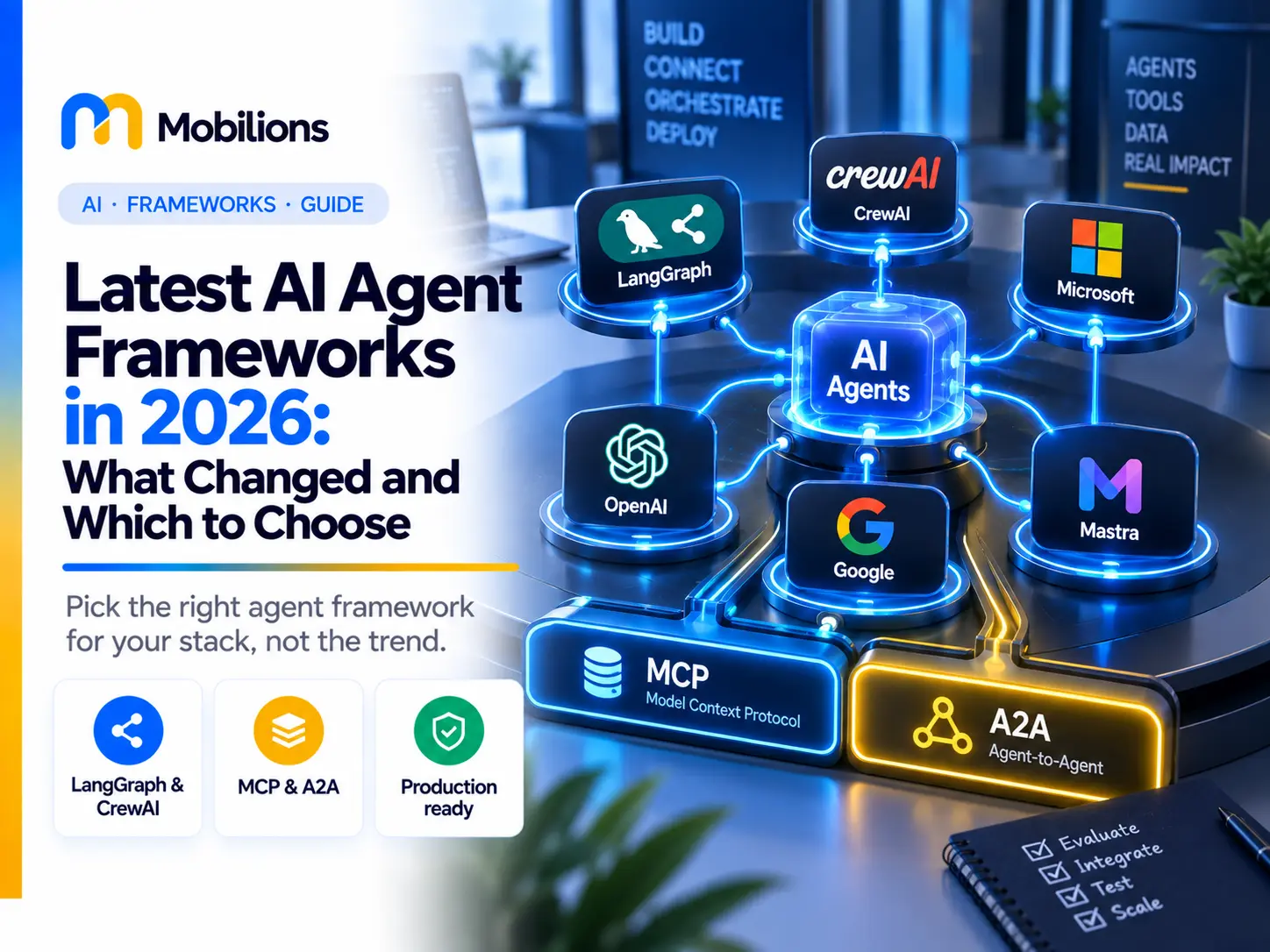
Among the latest AI agent frameworks 2026, there is no single best one, there is a best one for your situation. LangGraph leads for production, stateful agents; CrewAI is fastest for role-based multi-agent prototypes; the new Microsoft Agent Framework is the unified successor to AutoGen for Microsoft stacks; OpenAI’s Agents SDK is simplest if you are all-in on OpenAI; and Google’s ADK suits Gemini-first teams. The bigger shift is underneath the frameworks: the MCP standard now connects agents to tools everywhere, and no-code platforms like n8n let non-developers build real agents. Pick the framework that matches your stack, your team’s skill, and whether you need production reliability or a quick prototype.
The latest AI agent frameworks 2026 landscape brought bigger shifts than any single new feature, and it now moves fast enough that a guide written six months ago is already wrong in places. Frameworks that were the obvious choice last year are in maintenance mode now, new standards have quietly become universal, and a wave of no-code tools has made “which framework” a question even non-developers have to answer.
This guide cuts through it. It covers what actually changed in 2026, the frameworks that matter and what each is genuinely best at, the protocols that now sit underneath all of them, the no-code route for non-technical teams, and a straight decision guide for choosing. We build production agents at Mobilions across these frameworks, so this is a practitioner’s view, not a leaderboard. Where a framework is overhyped or fading, this guide says so. A framework runs the agent, but the data, retrieval, and governance around it belong to a broader AI fabric architecture.
Latest AI Agent Frameworks 2026: What Actually Changed
A few shifts define the latest AI agent frameworks 2026, and they matter more than any single framework’s new features.
AutoGen faded, Microsoft consolidated. AutoGen, one of the early multi-agent favorites, is now in maintenance mode: no new features, community-managed. Microsoft folded its agent work into a single Microsoft Agent Framework, the unified successor to AutoGen and Semantic Kernel, with graph-based workflows, responsible-AI guardrails through Azure AI Foundry, and both Python and .NET runtimes. If you were on AutoGen, this is where the road now leads.
MCP became the universal standard. The Model Context Protocol (MCP), which standardizes how an agent connects to tools and data, went from a promising idea to something every major lab and IDE ships: Claude, OpenAI, Google’s Gemini and Vertex AI, Cursor, Windsurf, JetBrains, and more. This is the biggest quiet change of the year, because it means tool integration is no longer framework-specific glue, it is a shared standard.
Protocols split into two jobs. Alongside MCP (agent to tools), the A2A protocol emerged for agent-to-agent coordination. The clean way to remember it: MCP gives your agent hands, A2A gives your agents colleagues.
No-code got real. Platforms like n8n, with over a thousand integration nodes and now MCP support, made it genuinely possible for non-developers to build working agents, not toys. The “do I even need a framework” question is now a legitimate one for many teams.
With that context, here are the frameworks themselves.
The main AI agent frameworks in 2026
There is no universal winner among the latest AI agent frameworks 2026, because each optimizes for something different. Here is what each is genuinely best at.
LangGraph (LangChain)
LangGraph is the most battle-tested choice for production, stateful agents that need tight control. It models an agent as a directed graph with conditional edges, which gives you precise control over flow, plus built-in checkpointing with time-travel debugging, so you can inspect and rewind an agent’s state. It is model-agnostic, pairs with LangSmith for enterprise-grade observability and evaluation, and now has Deep Agents for long-running workflows. The trade-off is a steeper learning curve. If you are shipping a serious agent to production, this is usually the default.
CrewAI
CrewAI has the lowest barrier to entry. It uses a role-based mental model (you define agents as roles working in a crew), and you can be running in about twenty lines. It is model-agnostic and ideal for getting a team-based, multi-agent prototype working quickly. It is the framework to reach for when you want to prove an idea fast, and many teams keep it for production too once it fits.
Microsoft Agent Framework
The new unified framework for the Microsoft stack, replacing AutoGen and Semantic Kernel. It offers graph-based workflows, responsible-AI guardrails via Azure AI Foundry, and both Python and .NET runtimes at 1.0 general availability. If your organization already runs on Azure and Microsoft tooling, this is the natural home.
OpenAI Agents SDK
The simplest path if you are committed to OpenAI models. It uses explicit handoffs between agents and context variables for state (ephemeral by default). The limitation is the flip side of its simplicity: it is restricted to OpenAI models, so it is a poor fit if you want model flexibility.
Google ADK
Google’s Agent Development Kit organizes agents into a hierarchical tree and is optimized for Gemini, though it supports other models. It is the sensible choice for Gemini-first and Google Cloud teams.
Mastra
Mastra is TypeScript-native, which makes it the natural fit for JavaScript and TypeScript teams building AI into web applications rather than working in Python. It handles persistent memory and long-running operations, so it is a real production option, not just a convenience.
Framework comparison at a glance
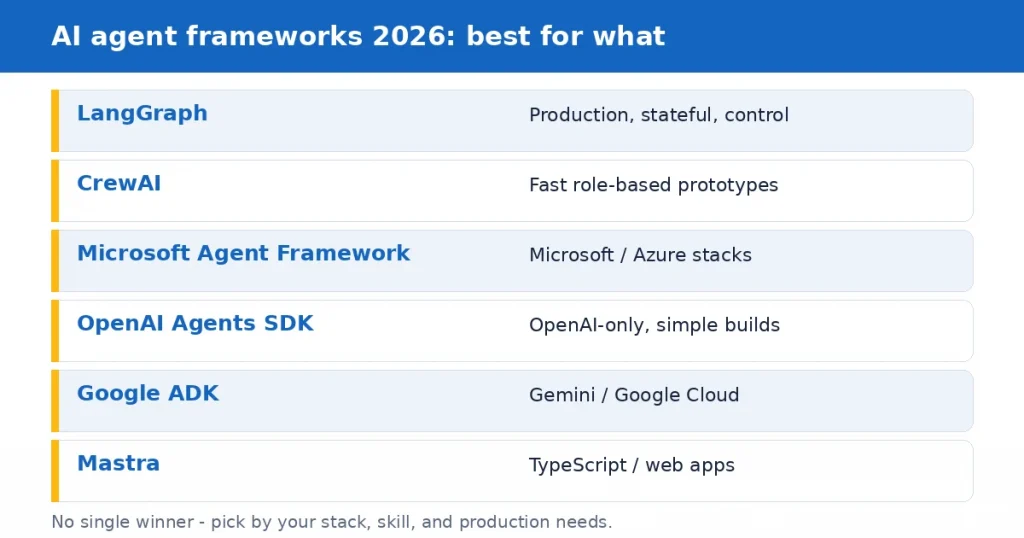
| Framework | Best for | Model support | Learning curve |
| LangGraph | Production, stateful, control | Any | Higher |
| CrewAI | Fast role-based prototypes | Any | Low |
| Microsoft Agent Framework | Microsoft / Azure stacks | Any (Azure-centric) | Medium |
| OpenAI Agents SDK | OpenAI-only, simple builds | OpenAI only | Low |
| Google ADK | Gemini / Google Cloud | Gemini-first, others | Medium |
| Mastra | TypeScript / web apps | Any | Medium |
The honest summary: LangGraph for production control, CrewAI for speed, Microsoft or Google or OpenAI if you are committed to their ecosystem, and Mastra if you live in TypeScript.
The protocols that now sit underneath everything
In 2026 the frameworks matter less than they used to, because two standards do a lot of the heavy lifting no matter which framework you pick.
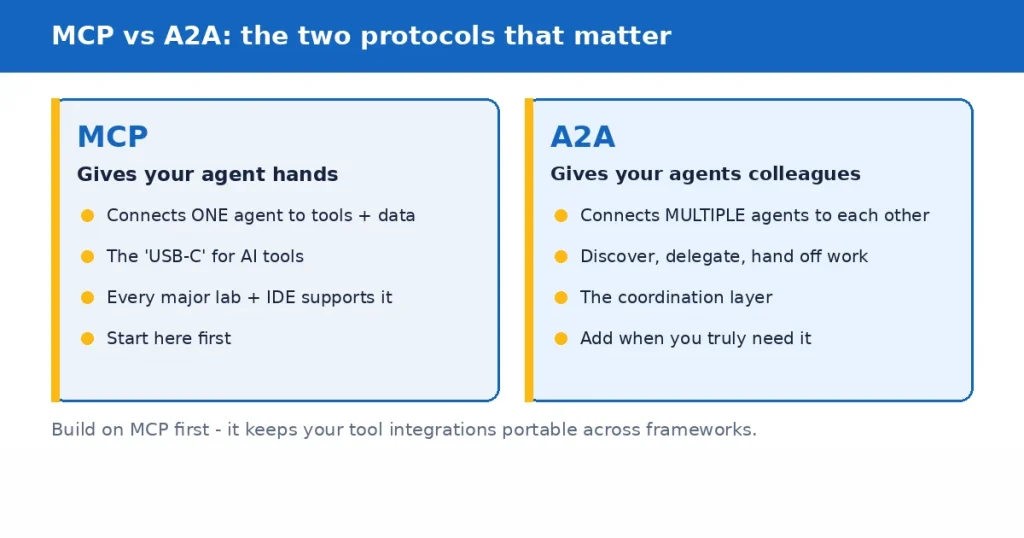
MCP (Model Context Protocol) standardizes how a single agent connects to tools and data. It is the USB-C port for AI: one interface that lets any agent plug into any tool. Because every major lab and IDE now supports it, building integrations is increasingly a matter of using a standard rather than writing custom connectors. If you are starting today, MCP is the first thing to adopt.
A2A (Agent-to-Agent Protocol) standardizes how multiple agents discover each other, delegate tasks, and pass work back and forth. It is the coordination layer for multi-agent systems. Most teams need MCP first and reach for A2A only when they genuinely have multiple agents that must collaborate.
The practical takeaway: choose a framework, but build on MCP, because it keeps your tool integrations portable across frameworks and future changes.
The no-code and low-code route
Not every agent needs a framework and an engineering team. Low-code platforms like n8n are event-driven tools that expose HTTP, conditional routing, and AI nodes without custom agent code, and with over a thousand integration nodes plus MCP support, they can build genuinely useful agents. This substantially lowers the barrier for non-technical teams.
The honest guidance: for standard, well-defined workflows, a no-code platform may be the right answer and can save you a large custom build. Reach for a code framework when your agent is unusual, needs deep custom logic, has to integrate in ways the platform cannot, or must run at a scale and reliability the no-code tool was not built for. Starting no-code to prove value, then moving to a framework if you outgrow it, is a perfectly sensible path.
How to choose your framework
Cut through the options with a few questions rather than chasing whichever framework is trending.
Start with your ecosystem: if you are deep in Azure, Microsoft Agent Framework; all-in on OpenAI, the OpenAI Agents SDK; Gemini and Google Cloud, ADK. If you want model flexibility, LangGraph or CrewAI. Then your team’s skill and speed: CrewAI or a no-code platform for the fastest start, LangGraph when you need production control and can absorb the learning curve, Mastra if your team is TypeScript. Then production versus prototype: for anything that has to run reliably with state, monitoring, and long workflows, favor LangGraph, Mastra, or CrewAI with proper observability; for a quick proof, almost anything works. Finally, whether you even need to build: try no-code first for standard tasks.
Whatever you pick, build on MCP so your tool integrations stay portable, and choose based on your problem, not on which framework got the most stars this quarter.
How long it takes to get productive
A fair question before you commit: how long until your team is actually building. With a no-code platform, a non-developer can have a working flow the same day. With CrewAI, a developer can get a role-based prototype running in an afternoon, because the mental model is simple and it takes about twenty lines to start. LangGraph asks for more up front, usually a week or two to get comfortable with graphs, state, and checkpointing, but it pays that back on complex production systems.
The Microsoft, Google, and OpenAI SDKs sit in between and are fastest if you already work in that ecosystem. The point is to be honest about the learning curve when you choose: a framework your team can actually use beats a more powerful one they fight.
What if my framework gets abandoned
This is a real worry, and AutoGen going into maintenance mode this year shows it is not hypothetical. Two things reduce the risk. First, favor frameworks with large, active communities and clear backing (LangGraph, CrewAI, the big-lab frameworks), because they are the least likely to be dropped and the easiest to hire for. Second, and more importantly, build on standards like MCP and keep your business logic and prompts separate from framework-specific code.
When most of your value lives in your data, your tools (behind MCP), and your prompts rather than in one framework’s syntax, migrating to another framework is a manageable job rather than a rewrite. Lock-in comes from tangling your logic into a framework, not from choosing one.
Common mistakes when choosing a framework
A few patterns trip teams up. Chasing the trendiest framework instead of the one that fits your stack and skill leads to fighting the tool. Reaching for a heavy multi-agent framework when a single simple agent, or even a no-code flow, would do adds complexity you pay for forever. Ignoring observability and evaluation until something breaks in production is a classic, because an agent you cannot monitor is one you cannot trust. And betting everything on one framework’s proprietary features, rather than standards like MCP, is how you end up locked in. The fix for all of these is the same: match the tool to the problem, keep your logic portable, and build in monitoring from the start.
How Mobilions helps
We build production AI agents across these frameworks, and we have shipped AI since 2016. For teams choosing, we do the honest version: we recommend the framework that fits your stack, skill, and reliability needs rather than the one that is trending, and sometimes that recommendation is a no-code platform and no framework at all. We build on MCP so your integrations stay portable, design in observability and evaluation from the start, and hand you full ownership of the code. When AutoGen went into maintenance mode, the teams who had kept their logic portable barely noticed, and that is how we build.
What we will not do is push a heavier framework than your problem needs, because the whole point of this guide is that the right choice is the one that fits, not the most impressive one.
The bottom line
The latest AI agent frameworks 2026 have a clear shape once you stop looking for a single winner. LangGraph for production control, CrewAI for fast prototypes, Microsoft or Google or OpenAI if you live in their ecosystem, Mastra for TypeScript, and no-code for standard workflows. Underneath all of them, MCP has become the standard worth building on, and A2A waits for when you truly need agents to coordinate.
The durable advice outlasts any framework: choose based on your stack, your team, and whether you need production reliability or speed; build on open standards so you are not locked in; keep your real value in your data, tools, and prompts rather than one framework’s syntax; and add monitoring from day one. Do that, and it barely matters which framework wins the next quarter, because your agent will keep running and you will be able to move if you need to.
If you are choosing a framework for a real agent and want a straight recommendation for your stack and use case, that is exactly the conversation our senior engineers have with teams every week.
Book a discovery call and get an honest assessment, no obligation. You can also explore our AI agent development services.
Key takeaways
- There is no single best AI agent framework in 2026, only the best fit for your stack, skill, and reliability needs.
- LangGraph leads for production and control; CrewAI for fast role-based prototypes; Microsoft Agent Framework, OpenAI Agents SDK, and Google ADK for their ecosystems; Mastra for TypeScript.
- AutoGen is now in maintenance mode; Microsoft Agent Framework is its successor.
- MCP became the universal standard for connecting agents to tools; A2A handles agent-to-agent coordination. Build on MCP first.
- No-code platforms like n8n can build real agents and may replace a custom build for standard workflows.
- Reduce abandonment and lock-in risk by favoring well-backed frameworks and keeping your logic and tools portable behind standards.
- Choose by matching the tool to the problem, keep logic portable, and build in observability from the start.
Frequently asked questions
What are the best AI agent frameworks in 2026?
The leading options are LangGraph (production, stateful control), CrewAI (fast role-based prototypes), the Microsoft Agent Framework (Microsoft and Azure stacks), OpenAI Agents SDK (OpenAI-only, simple), Google ADK (Gemini and Google Cloud), and Mastra (TypeScript). There is no single winner; the best one depends on your stack, skill, and whether you need production reliability or speed.
Which AI agent framework should I choose?
Start with your ecosystem (Azure, OpenAI, or Google point to their frameworks; model flexibility points to LangGraph or CrewAI), then your team’s skill and speed (CrewAI or no-code for fast starts, LangGraph for production control, Mastra for TypeScript), then whether you need production reliability or a quick prototype. Whatever you pick, build on MCP so integrations stay portable.
Is LangGraph or CrewAI better?
Neither is universally better. LangGraph is the more battle-tested choice for production, stateful agents that need control, with checkpointing and strong observability, at the cost of a steeper learning curve. CrewAI has the lowest barrier to entry and is ideal for getting a role-based multi-agent prototype running quickly. Many teams prototype in CrewAI and move to LangGraph for demanding production systems.
Is AutoGen still worth using in 2026?
AutoGen is now in maintenance mode, meaning no new features and community management. For new projects, the Microsoft Agent Framework is its unified successor, combining AutoGen and Semantic Kernel with graph workflows and Azure AI Foundry guardrails. Existing AutoGen projects still work, but new builds should start on the successor or another active framework.
What is MCP and why does it matter?
MCP, the Model Context Protocol, is a standard that lets any AI agent connect to tools and data through one universal interface, often called the USB-C of AI. It matters because every major lab and IDE now supports it, so tool integration is a shared standard rather than framework-specific glue. Building on MCP keeps your integrations portable across frameworks.
What is the difference between MCP and A2A?
MCP connects a single agent to tools and data, giving your agent hands. A2A connects multiple agents to each other so they can discover, delegate, and coordinate, giving your agents colleagues. Most teams adopt MCP first and only need A2A when they genuinely run multiple agents that must collaborate.
Can I build an AI agent without coding?
Yes. Low-code platforms like n8n expose AI nodes, routing, and over a thousand integrations without custom agent code, and now support MCP, so non-developers can build genuinely useful agents. For standard workflows this may be all you need; reach for a code framework when the agent is unusual, needs deep custom logic, or must run at a scale the no-code tool was not built for.
Which AI agent framework is best for beginners?
CrewAI has the lowest learning curve among code frameworks, with a role-based model you can start with in about twenty lines. For non-developers, a no-code platform like n8n is often the easiest entry point. Both let you prove an idea quickly before committing to a heavier, production-grade framework.
What happens if my AI agent framework gets abandoned?
It is a real risk, as AutoGen going into maintenance mode showed. Reduce it by favoring frameworks with large, active communities and clear backing, and, more importantly, by building on standards like MCP and keeping your prompts and business logic separate from framework-specific code. When your value lives in your data, tools, and prompts, migrating frameworks is a manageable job rather than a rewrite.
Are AI agent frameworks model-agnostic?
Some are, some are not. LangGraph, CrewAI, and Mastra are model-agnostic, so you can switch model providers. The OpenAI Agents SDK is restricted to OpenAI models, and Google ADK is optimized for Gemini while supporting others. If model flexibility matters to you, favor a model-agnostic framework.
Do I need a framework at all for a simple agent?
Often no. For a single, standard workflow, a no-code platform or even a direct model integration can be simpler and cheaper than a full framework. Frameworks earn their weight when you need multi-step orchestration, persistent state, multiple agents, or production-grade reliability and monitoring. Match the tool to the problem rather than defaulting to a framework.
Does Mobilions build agents on these frameworks?
Yes. We build production AI agents across LangGraph, CrewAI, and the major frameworks, and we recommend the one that fits your stack and use case rather than the trendiest. We build on MCP so your integrations stay portable, design in observability from the start, and hand you full ownership of the code. Book a discovery call for a straight recommendation.

Mayank Makwana is an AI Solution Architect and Full Stack Developer at Mobilions, where he designs and ships production AI systems — grounded, governed, and owned by the client. He specializes in LLM applications, retrieval-augmented generation (RAG), and AI agents, and also builds modern web applications. He writes senior-level guides on AI architecture, applied machine learning, and web engineering.