Every SaaS founder reaches the same fork in the road, usually sooner than they planned. You can hire an engineer, bring in an agency, or lean harder on an AI coding tool and delay the headcount question for another quarter.
The saas startup hire vs outsource vs ai decision turns up at almost every stage of a company. Pre-seed founders want to ship a first version without burning runway. Seed-stage teams debate whether their fourth engineer should be a full-time hire or a contractor. Funded teams quietly wonder whether a Cursor or Copilot seat can cover a role they have not posted yet.
Here is the short answer, because you are probably reading this in the middle of the decision. All three paths are legitimate, and they solve different problems.
The honest cost gap between them is 5 to 10 times, not 20 percent. AI tools change the productivity math for whichever path you choose, but they do not remove the need to make the choice. Everything below is the reasoning and the numbers behind that one paragraph.
Key takeaways
If you only have a minute, these are the points that matter most about the saas startup hire vs outsource vs ai decision.
- The cost gap is large, not marginal. Hiring in-house runs roughly $190,000 to $290,000 a year fully loaded. Outsourcing runs $15 to $150 an hour depending on region and model. AI tooling runs $20 to $60 per seat a month.
- Staff augmentation, dedicated teams, and project outsourcing are three different arrangements, not synonyms. The wrong model for your stage is riskier than the wrong vendor.
- AI adoption is high but trust is falling. 84 percent of developers use or plan to use AI tools per Stack Overflow, yet 45.7 percent actively distrust its accuracy.
- AI-assisted solo building is right before you validate demand. It becomes the wrong call once the product is customer-facing and needs to scale securely.
- It is rarely one path for the whole company. The winning pattern is the right path for each piece of work, matched to how core, how bounded, and how validated it is.
What does hire vs outsource vs AI actually mean for a SaaS startup?
Before you can choose, it helps to be precise about what each path really is, because the words get used loosely.
Hiring in-house means putting a salaried engineer on your own team, under your own management, building your product as their full-time job. You own the recruiting, the ramp-up, the retention risk, and the long-term knowledge that stays inside your company.
Outsourcing means paying an external company to deliver working software. That could be a feature, a module, or an entire product build. The outside company manages its own people and is accountable for the result. You are buying an outcome, not a headcount.
AI-assisted development means using tools like GitHub Copilot, Cursor, or Claude Code to write, review, or refactor code faster. A human still directs the work, reviews the output, and owns the architecture. That human can be yours, a contractor’s, or an agency’s.
There is a fourth term worth knowing, because people confuse it with outsourcing constantly. Staff augmentation means you bring in external engineers who work inside your team, under your management. It is a hybrid of hiring and outsourcing, and it changes both the cost and the risk profile.
In practice, the saas startup hire vs outsource vs ai choice usually shows up as one of four situations. A technical co-founder codes a first version alone with an AI assistant. A seed-stage team brings on a nearshore partner to build one well-defined module.
A newly funded company hires its first two or three in-house engineers to own the core product. Or, most often, some blend of all three runs at once as the product matures.
None of these paths are mutually exclusive. Plenty of the SaaS teams we have worked with run all three together: a small in-house core, an outsourced partner for a bounded module, and AI tools speeding up both.
What does each path actually cost in 2026?
This is where most comparisons of the saas startup hire vs outsource vs ai decision go vague. Here is the real range, fully loaded, not just the sticker price.
In-house hiring. A base salary is roughly half the real story. Once you add payroll taxes, benefits, equipment, recruiting, and the ramp time before someone is fully productive, a senior US engineer costs around $190,000 to $250,000 a year fully loaded.
The true first-year cost, including recruiting and onboarding, often reaches $205,000 to $290,000. Industry salary research puts the average base near $129,000, then notes that benefits, taxes, and overhead typically inflate the total employee cost by 100 to 170 percent, landing in a similar range for a senior hire.
Outsourcing. Rates vary enormously by region and engagement model. Offshore teams, such as India-based partners, commonly run $15 to $30 an hour. Nearshore Latin American teams run $30 to $60 an hour, and US-based contract engineers run $90 to $150 an hour.
A typical outsourced MVP build lands between $60,000 and $130,000 for a nearshore partner, and between $150,000 and $350,000 or more for a US agency, depending on scope.
AI-assisted tooling. This is the cheapest line item by far. Individual AI coding seats typically run $20 to $60 per developer a month, which is a rounding error next to either path above.
The catch is that an AI tool has no accountability, no architectural judgment, and no ability to own a roadmap. It multiplies whatever human capacity you already have. It does not replace it.
| Path | Typical Cost | What You Are Actually Buying |
|---|---|---|
| In-house hire (senior, US, fully loaded) | About $190K to $290K a year | Full-time ownership, institutional knowledge, direct management |
| Outsourced build (nearshore) | About $60K to $130K a project, or $30 to $60 an hour | An external team accountable for a defined outcome |
| Outsourced build (US agency) | About $150K to $350K a project, or $90 to $150 an hour | The same, at a domestic quality and communication premium |
| AI-assisted tooling (per seat) | About $20 to $60 a month | A productivity multiplier, not a substitute for judgment or ownership |
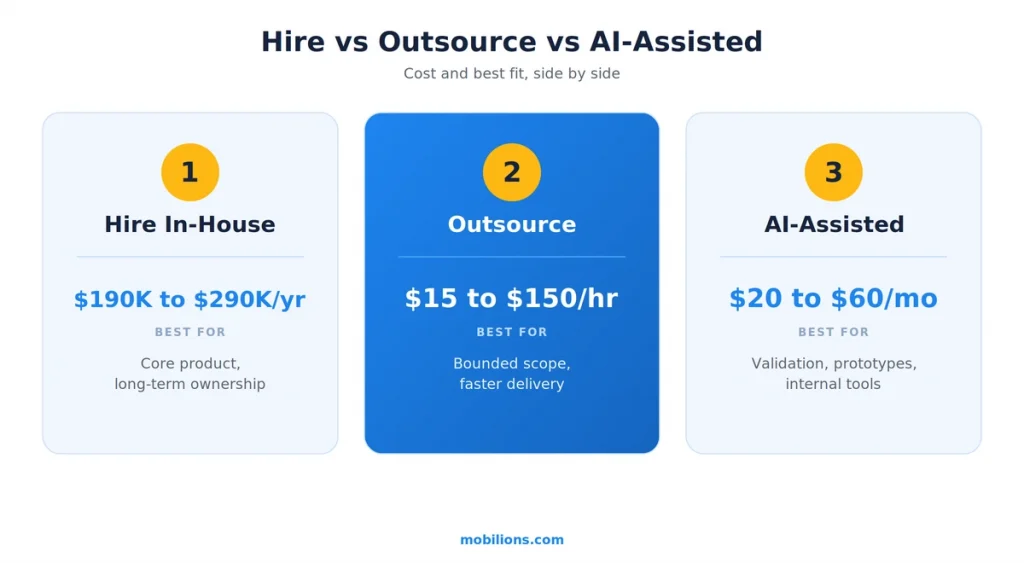
Here is why this matters more than a simple search for the cheapest option. AI tooling now costs so little next to headcount or outsourcing spend that it is rarely the deciding factor. The real decision is still hire versus outsource. AI just makes whichever one you pick faster.
Staff augmentation, outsourcing, or a dedicated team: what is the real difference?
This is the distinction that trips up most first-time SaaS founders, because outsourcing gets used as a catch-all for three genuinely different arrangements.
Staff augmentation. The external engineer works inside your team and takes direction from your own managers day to day. You are responsible for the outcome. The augmentation partner is responsible for supplying qualified people.
Project-based outsourcing. You hand a scoped deliverable to an external company, and they manage the work from start to finish. You are buying an outcome. They own the process and the accountability for hitting it.
A dedicated development team. This sits between the two. It is a stable group of external engineers who work only on your product over time. You give more oversight than pure project outsourcing, but carry less day-to-day management than staff augmentation.
| Model | Who Manages Daily Work | Who Is Accountable for the Result | Best Fit |
|---|---|---|---|
| Staff augmentation | You | You | Short, bounded gaps where you already have strong internal leads |
| Dedicated team | Shared | Mostly the vendor, with your product input | An ongoing roadmap without full in-house hiring |
| Project outsourcing | The vendor | The vendor | A defined deliverable with clear scope and an end date |
If you already have a technical co-founder or a strong lead who can direct daily work, staff augmentation is usually the cheapest way to add capacity. If you do not have that internal capacity yet, project outsourcing or a dedicated team shifts more of the delivery risk onto the vendor. You pay a real premium for that risk transfer, and it is often worth it.
Outsourcing SaaS development: when it makes sense
Outsourcing SaaS development means bringing in an outside engineering team to build or extend your product instead of hiring in-house. It works best when you need to move fast, lack a specific skill, or want senior engineers without the cost of full-time hires. The trade-off is picking a partner who ships to production and hands you full ownership.
Can AI actually replace your development team in 2026?
I build production AI systems for a living, so here is the answer I will actually stand behind rather than the one that makes a better headline. Not yet, and the data backs that up more clearly than the hype suggests.
Start with adoption, because it is genuinely high. Stack Overflow’s 2025 Developer Survey found that 84 percent of professional developers are using or planning to use AI tools, with just over half using them daily. That is real, broad adoption, not a niche experiment.
The tools themselves have gotten good at specific jobs. GitHub Copilot and Cursor are strongest at autocomplete and boilerplate, such as scaffolding a CRUD endpoint, writing a test skeleton, or converting a function from one language to another. Claude Code and similar agentic tools go further, handling multi-file changes across a codebase.
In our own work building production systems, none of them replace the step where a senior engineer decides what the system should do and why. They replace typing, not judgment.
Adoption is not the same as trust, though, and the same survey shows trust moving in the opposite direction from the headlines. Favorable sentiment toward AI tools fell to 61 percent, down from over 70 percent the previous year. On raw accuracy, 45.7 percent of developers actively distrust AI output, versus 29.6 percent who somewhat trust it.
Where developers say they will not hand work to AI is the more telling data point. Per the same survey, 75.8 percent will not use it for deployment and monitoring, 69.2 percent will not use it for project planning, and 58.7 percent will not use it for code review.
That is precisely the judgment-heavy work that separates a shipped product from a pile of generated code. The most common complaint, cited by 66 percent of developers, is AI output that is almost right but not quite. Plausible-looking code that takes longer to debug than it would have taken to write.
The productivity data tells a similarly two-sided story. Developers report saving real time, with estimates from GitHub and academic studies putting time savings on coding and documentation tasks at 30 to 60 percent.
But the quality picture is mixed. GitHub Copilot’s own data shows only about 46 percent of suggestions get completed, and roughly 30 percent actually get accepted. Google’s DORA research found a 7.2 percent decrease in delivery stability even as raw speed improved, which means teams shipped faster and broke more. Code-analytics firm GitClear measured roughly four times more duplicated code in AI-assisted codebases, a leading indicator of technical debt that shows up eighteen months later, not eighteen days later.
Security is the sharpest edge of this. Independent research has found that 48 percent of AI-generated code samples contain at least one security vulnerability, and a Black Duck audit flagged 40 percent of programs written with GitHub Copilot for insecure patterns. That is not a reason to avoid AI tools. It is a reason every team using them needs a human doing real security review rather than a rubber stamp.
So what does all of this mean for your decision? AI tools are a genuine multiplier on whichever team you choose. They measurably speed up boilerplate, tests, and documentation.
They are not yet a substitute for the architectural judgment, security review, and production ownership that a hire or an outsourced team provides. That is the same reason our own AI development work always pairs AI-assisted coding with senior engineering review before anything reaches a customer.
The tools make the first draft fast. The review is what makes it safe to ship. If your plan is AI instead of a team, the data says that plan has a gap. If your plan is AI and a team, whether hired, outsourced, or a mix, the data actively supports it.
When hiring in-house is the right call
Hire in-house when the thing you are building is the durable competitive advantage. That means the core product logic, the data model, and the parts of the system that will still matter in three years.
In-house makes the most sense once you are past initial validation and into a phase where institutional knowledge compounds. Think of the fourth or fifth engineer who needs deep context on why the system is shaped the way it is, not just the ability to ship a ticket.
It is also the right call when you need someone who can push back on product decisions with real ownership. An outsourced partner can execute a well-specified brief exceptionally well, but they are structurally less positioned to tell you the brief itself is wrong. Full-time engineers who live with the consequences tend to raise that flag earlier.
The tradeoff is time and cost. Hiring well takes months, not weeks, and the fully loaded cost of a senior in-house hire is the highest of the three paths. Use our custom software development team as a sounding board if you are unsure whether a piece of scope is core enough to justify a hire, versus building it externally first and bringing it in-house later.
When outsourcing makes more sense
Outsourcing wins when you need production-grade work delivered against a clear scope, faster than you could hire for it, without the long-term overhead of a full-time role. It is the right tool for a bounded module such as a payments integration, a redesign, or a migration, where the requirements are knowable in advance and the work has a natural end date.
It is also the more honest choice before product-market fit, when you genuinely do not know if a role will still be needed in six months. Paying a premium for flexibility is cheaper than a bad hire followed by a severance conversation.
The real skill in outsourcing well is picking the right model for your stage. Choose staff augmentation if you already have a strong internal lead directing the work. Choose a dedicated team if you have an ongoing roadmap but no in-house capacity yet, and choose project-based outsourcing for a single, well-specified deliverable. Getting that model wrong is a bigger risk than picking the wrong vendor.
When AI-assisted building is genuinely enough for now
There is a real, narrow window where AI-assisted building alone is the right call. It is the pre-validation stage, when you are testing whether an idea deserves a team at all.
A technical founder using Cursor or Claude Code to build a scrappy first version, validate demand, and get real user feedback before committing real payroll is making a good decision, not cutting a corner.
The same is true for genuinely bounded, low-stakes internal tooling, such as an admin dashboard, a one-off data migration script, or a prototype for a sales demo. The failure modes above, including security gaps, technical debt, and brittle architecture, matter far less when the blast radius is small and the code is not customer-facing.
Where this stops working is the moment the thing you built becomes customer-facing infrastructure that needs to scale, stay secure, and evolve for years. At that point you need the judgment layer, in-house or outsourced, that AI tools are not yet a substitute for.
Where each path actually fails
Every path in the saas startup hire vs outsource vs ai decision has a real, measurable failure rate. The honest version of this guide includes them.
Outsourcing fails more often than most founders expect. DemandSage research puts the failure rate of outsourcing relationships at 20 to 25 percent within two years.
Deloitte’s analysis of why engagements fail points less to vendor competence and more to process. In failed engagements, 55 percent lacked proper benefit tracking, 53 percent suffered from inadequate change management, and 47 percent had poor integration between the vendor and the client’s own team. Engagements with a clearly defined sourcing strategy succeeded 57 percent of the time. The difference is usually preparation on the client side, not vendor quality.
In-house hiring fails in quieter, slower ways. A bad senior hire can cost six figures and eighteen months before the mismatch becomes undeniable. Small teams also carry serious key-person risk when critical system knowledge lives in one person’s head.
AI-only building fails in the ways the previous section covered in detail. You get technical debt from duplicated code, a measurable drop in delivery stability even as raw speed improves, and security vulnerabilities that do not surface until an audit or an incident forces the issue.
| Path | Primary Failure Mode | Real-World Rate |
|---|---|---|
| Outsourcing | Poor sourcing strategy, weak vendor integration | 20 to 25 percent fail within 2 years |
| In-house hiring | Bad senior hire, key-person risk | Six-figure cost, about 12 to 18 months to detect |
| AI-only building | Technical debt, security gaps, no ownership | 48 percent of AI-generated code has at least 1 vulnerability |
So how do you actually decide? A simple framework
Strip away the frameworks and the saas startup hire vs outsource vs ai decision comes down to three questions, asked in order.
First, is this core to your product’s long-term advantage? If yes, lean in-house, eventually, even if not on day one. The parts of the system that define why customers pick you over a competitor are the parts worth owning directly.
Second, do you know the scope well enough to hand it to someone else? If yes, and it is bounded, then outsourcing or staff augmentation is faster and cheaper than hiring. If the scope is genuinely unknown, that is a sign you are not ready to outsource it yet. Vague scope is how engagements end up in the 20 to 25 percent that fail.
Third, are you still validating whether this needs a team at all? If yes, AI-assisted building by a technical founder or a single contractor is the right-sized answer. Do not hire or outsource before you know what you are building.
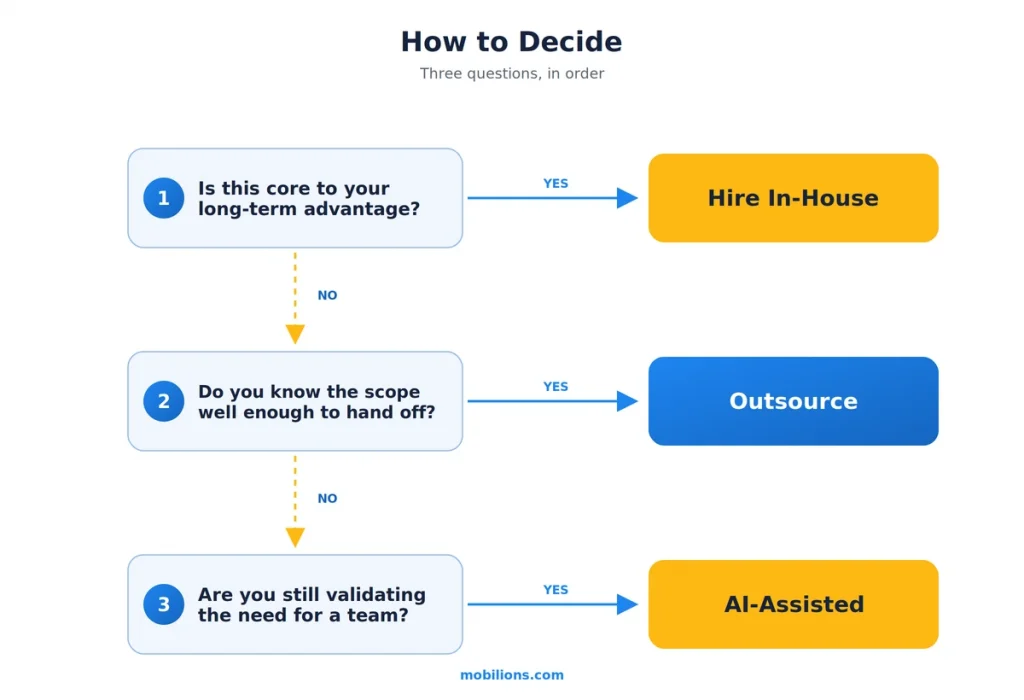
That is the whole saas startup hire vs outsource vs ai decision in three questions. Whichever path you pick, use AI tools to make that team faster, not as a reason to skip having one. There is also a middle path many founders miss. You can bring in a fractional CTO to own the technical decisions part-time, then let an outsourced team or your own juniors build under that senior direction. It gives you the judgment layer without a full-time salary, and it often de-risks all three paths at once.
A real-world scenario
Picture a seed-stage SaaS company with a technical co-founder and $1.2 million in the bank. They have a working prototype, their first ten paying customers, and a roadmap with three big items: a billing overhaul, a mobile app, and a core analytics engine that is quickly becoming the reason customers stay.
A systematic reading of the three questions above sorts this quickly. The analytics engine is core to their long-term advantage, so it goes in-house, and their next hire is a senior engineer to own it.
The billing overhaul is bounded and well understood, with clear requirements and a natural end date, so it goes to an outsourced partner or staff augmentation while the founder keeps directing the analytics work. The mobile app is still unproven, so a contractor builds a lean first version with heavy AI assistance to test demand before anyone commits a full-time role.
That is the pattern in practice. It is rarely one path for the whole company. It is the right path for each piece of work, matched to how core, how bounded, and how validated that piece is.
Common mistakes to avoid
A few errors show up again and again in the saas startup hire vs outsource vs ai decision, and all of them are avoidable.
The first is hiring too early. Bringing on a full-time engineer before you know what you are building locks in cost and slows you down at exactly the stage when speed and flexibility matter most.
The second is outsourcing work you cannot specify. If you cannot write the requirements down clearly enough for a stranger to build the right thing, handing it to a vendor does not remove that problem. It hides it until the invoice and the wrong feature both arrive.
The third is treating AI as a headcount replacement rather than a multiplier. The data on security gaps and technical debt is clear. AI accelerates a team; it does not replace the judgment a team provides.
The fourth is confusing cheaper per hour with cheaper overall. Offshore rates look dramatically lower on a spreadsheet, but ramp time, communication overhead, and the long-term value of knowledge staying in-house all change the real total.
Why Mobilions
Mobilions has been building custom software, mobile apps, and AI solutions since 2016. We have delivered more than 250 projects for over 100 clients across 20-plus countries, which means we have watched the saas startup hire vs outsource vs ai decision play out at every stage, from first prototype to funded scale-up.
When we take on custom software development or staff augmentation work, we pair it with senior engineering review rather than treating any single tool or model as a silver bullet. If you are weighing hire versus outsource versus AI for a specific piece of your roadmap, that is the conversation we have with founders every week.
Frequently asked questions
Should a SaaS startup hire, outsource, or use AI to build its product?
Use all three, matched to the work. Use AI to prototype fast and multiply your team, outsource well-scoped or non-core features to move quickly, and hire in-house for the core product logic that becomes your long-term advantage. The mistake is treating it as one permanent choice instead of a mix that shifts as you grow.
Should a SaaS startup outsource its software development?
Yes, for bounded, well-scoped work, especially before product-market fit when you do not yet know if a role should be permanent. Outsourcing is the wrong call for the core logic that defines your long-term advantage, which is worth hiring for. A simple test: if you can write the requirements clearly enough for a stranger to build it correctly, it is usually safe to outsource.
When should a startup hire its first in-house engineer?
Once you are past initial validation and the work involves core product logic that must compound over time. Hiring too early, before you know what you are building, is a common and expensive mistake. Outsourcing or AI-assisted building is usually the better fit at that earlier, pre-validation stage.
Do you need a CTO, or can you outsource everything?
You can outsource the building, but someone on your side has to own the technical direction. Early on that can be a technical co-founder or a fractional or advisory CTO rather than a full-time hire. What you cannot outsource is the judgment about architecture, security, and what to build. Handing that entirely to a vendor is how startups lose control of their own product.
How many developers do you actually need to build a SaaS?
Fewer than most founders expect. A first version often needs one or two strong full-stack engineers, or a small outsourced team, plus AI to speed up routine work. You scale the team with validated demand, not ambition. Hiring a large team before product-market fit is one of the most common and expensive startup mistakes.
Is it cheaper to hire in-house or outsource development?
Outsourcing is almost always cheaper per hour. Offshore rates run $15 to $60 an hour, versus a fully loaded in-house senior engineer at roughly $190,000 to $290,000 a year. But cheaper per hour and cheaper overall differ once you count ramp time, communication overhead, and the long-term value of keeping core knowledge in-house.
How much does it cost to outsource software development?
Typical rates run $15 to $30 an hour for offshore teams, $30 to $60 for nearshore, and $90 to $150 for US-based contractors. A full MVP build usually lands between $60,000 for nearshore work and $350,000 or more for a US agency, depending on scope and complexity.
How much does it cost to hire an in-house developer in the US?
A senior US software engineer’s fully loaded cost, salary plus benefits, taxes, and overhead, typically runs $190,000 to $250,000 a year. Counting recruiting and ramp time, the true first-year cost reaches $205,000 to $290,000, which is why early-stage teams often start with outsourcing or AI.
What are the hidden costs of outsourcing development?
Beyond the quoted hourly rate, the real costs are management time, communication overhead across time zones, rework from unclear requirements, onboarding and knowledge transfer, and rebuilding poor-quality code later. These are why outsourcing sometimes feels more expensive than hiring. You control them with clear specs, active management, and owning the code from day one.
Can AI replace a software development team in 2026?
Not yet. Adoption is high, around 84 percent of developers use or plan to use AI tools per Stack Overflow, but the same survey found trust in AI accuracy falling. Most teams will not hand AI the judgment-heavy work like architecture, deployment, and code review. AI is a strong multiplier on a team, not a replacement for one.
Can AI build a SaaS product on its own?
It can build a prototype or a simple internal tool, but not a production SaaS that must scale securely. AI accelerates coding, yet it still needs a human to own architecture, security, data design, and the judgment calls that decide whether the product survives real users. Treat AI as a fast builder under human ownership, not an autonomous one.
Is AI-assisted development enough to skip hiring developers entirely?
For pre-validation prototypes and internal tools, often yes. For anything customer-facing that must scale securely over time, no. AI-generated code still carries security gaps and technical debt, so a human owner, in-house or outsourced, is a requirement rather than a nice-to-have once real users and data are involved.
What is the difference between staff augmentation and outsourcing?
Staff augmentation adds external engineers to your team under your own day-to-day management, so you own the outcome. Outsourcing hands a scoped deliverable to a vendor who manages the work and owns the result. Pick staff augmentation when you have strong internal leads to direct the work, and outsourcing when you want a whole piece delivered.
Is it better to hire a freelancer or an agency for a startup?
A freelancer is cheaper and fine for a single, well-defined task or a short gap. An agency costs more but brings a managed team, process, and continuity, which matters for anything larger than one person can own. For a startup building its first real product, an agency or a dedicated team usually beats juggling several freelancers.
What percentage of software outsourcing relationships fail?
Around 20 to 25 percent fail within two years, according to research cited by DemandSage. The leading causes are usually client-side process failures, such as unclear scope, missing benefit tracking, and weak change management, more often than vendor incompetence. Clear requirements and active management prevent most failures.

Mayank Makwana is an AI Solution Architect and Full Stack Developer at Mobilions, where he designs and ships production AI systems — grounded, governed, and owned by the client. He specializes in LLM applications, retrieval-augmented generation (RAG), and AI agents, and also builds modern web applications. He writes senior-level guides on AI architecture, applied machine learning, and web engineering.