To choose an AI agent development company, judge four things above all: whether they have shipped real agents in production (not demos), whether they scope honestly and push back on your idea, whether you keep full ownership of the code and IP, and whether they have a real plan for monitoring and maintenance after launch. Cost matters, but the cheapest quote is usually the most expensive choice once you count rework. A production agent typically runs $15,000 to $75,000 and a few weeks to a couple of months, so the decision is worth getting right.
Knowing how to choose an AI agent development company is now a real business skill, because everyone is racing to build AI agents and a whole industry has appeared overnight to build them for you. Some of these companies are excellent. Many are a landing page, a few prompts, and a lot of confidence. Telling them apart before you sign is the difference between an agent that runs reliably in production and an expensive demo that falls over the first time a real user does something unexpected.
This guide is the filter. It walks through how to evaluate an AI agent development company, which hiring model fits your project, what it should cost, the exact questions to ask, and the red flags that should end the conversation. We build production AI agents at Mobilions, so this is written from the inside, including the parts that make some vendors uncomfortable. Where the honest answer is to hire someone else, or to buy an off-the-shelf tool instead of hiring anyone, this guide says so.
How to choose an AI agent development company: the short version
If you only remember one thing about how to choose an AI agent development company, make it this: pick the team that has shipped real agents in production and is honest about what your project needs. The rest of this guide breaks that down into what to look for, which hiring model fits, what it costs, the questions to ask, and the red flags to avoid. Work through it in order and you will filter out the demo shops quickly.
First, decide what you actually need
Before you evaluate a single company, get clear on the job. The word agent covers a huge range (see IBM’s overview of AI agents), and the right partner for one is the wrong partner for another.
A simple, single-task agent (say, one that drafts replies or routes tickets) is a small, fast build. A production agent that plans, calls several tools, and pulls from your data is a real engineering project. A multi-agent system that runs autonomously across your business, with monitoring and compliance, is a serious undertaking. If you do not know which of these you need, that is fine, and it is actually a useful test: a good company will help you figure it out and will happily tell you if your idea is smaller (or larger) than you think. A company that agrees enthusiastically to whatever you say, without asking what problem you are solving, is optimizing for the invoice.
There is also a real chance you do not need a development company at all. For common, standard workflows, a no-code agent platform or an existing tool may solve your problem for a fraction of the cost.
A trustworthy partner will tell you that too. If the first thing a vendor does is insist you need a big custom build, be skeptical.
The hiring models: freelancer, agency, or in-house
There are three ways to get an AI agent built, and each fits a different situation.
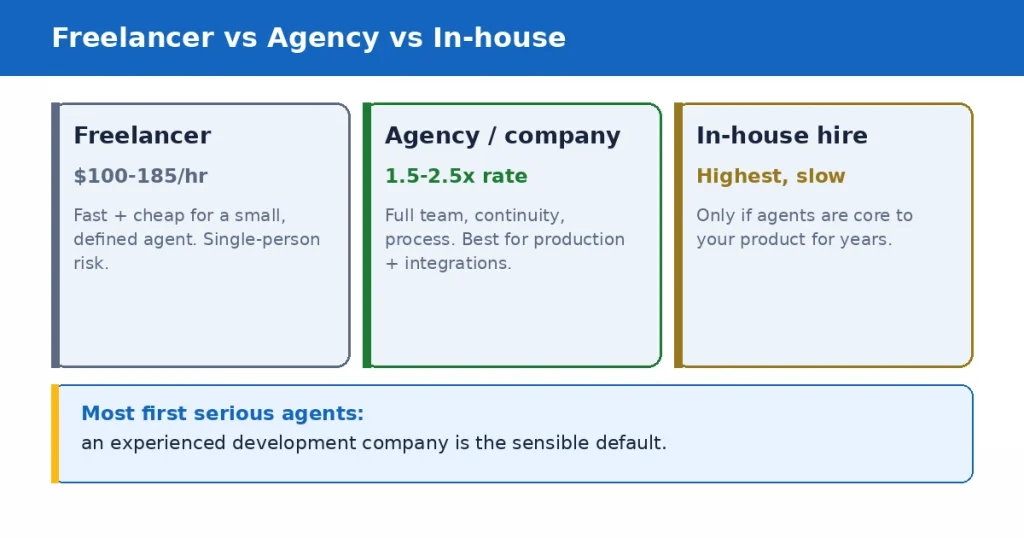
A freelancer is one independent developer. Freelance AI agent developers commonly charge $100 to $185 an hour, and more for top specialists, though rates range widely. A good freelancer is fast and cost-effective for a small, well-defined agent, and platforms like Upwork list many, though vetting is on you. The risk is single-person dependency: if they get busy, sick, or vanish, your project stalls, and one person rarely covers engineering, data, security, and design all at once.
An agency or development company is a coordinated team. Agencies typically charge 1.5 to 2.5 times an individual rate because of overhead and coordination, but you get a team that covers the whole build, continuity if one person is out, and usually a real process for scoping, testing, and support. This is the right fit for anything production-grade or anything that has to integrate with your systems and keep running.
An in-house hire makes sense only when AI agents are core to your product and you will keep building them for years. Hiring senior AI engineers is slow and expensive, and for a single project it is almost never worth it. Most companies are better served by a partner for the build and, if needed, a smaller in-house team to own it later.
For most businesses building their first serious agent, an experienced development company is the sensible default: enough capability to ship something that works, without the cost and delay of hiring a permanent team.
What separates a good AI agent development company
When you work out how to choose an AI agent development company, here is what actually matters when you evaluate one. These are the signals that predict whether your agent will work in production, in rough order of importance.
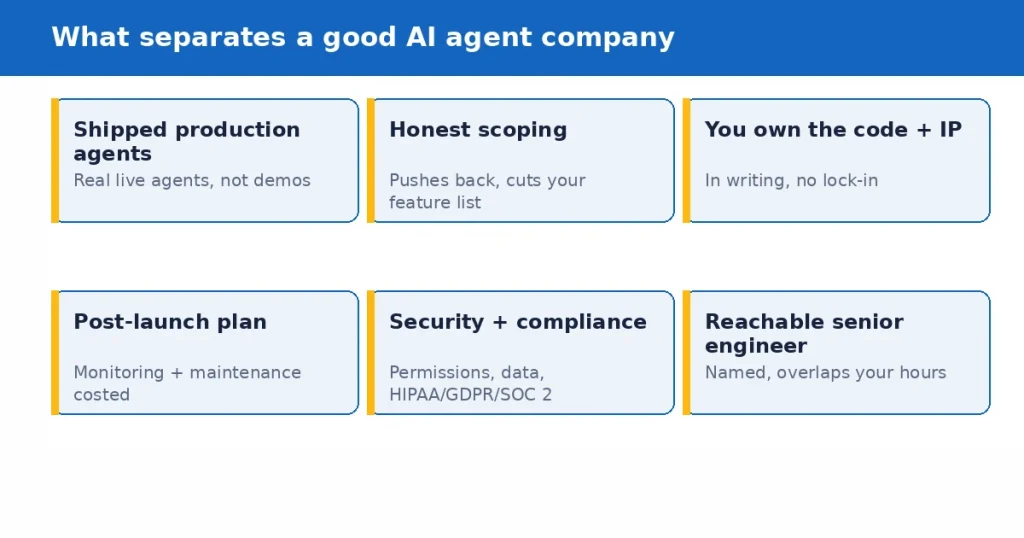
Shipped agents in production. The single strongest signal is real, live agents they have built, ideally ones you can see or that they can describe in detail. Building a demo is easy in 2026. Making an agent reliable when real users hit it, when a tool call fails, when the input is messy, is the actual engineering, and only teams who have done it before know where the traps are. Ask for specifics, not a logo wall.
Honest scoping. The best companies argue with your feature list. They propose the smallest version that proves value, tell you what to cut, and are upfront about what AI is bad at. A partner who promises everything works flawlessly is either inexperienced or not being straight with you, because everyone who has shipped agents knows they need guardrails, evaluation, and human oversight.
Clear ownership. In writing, you own the source code, the IP, and the documentation. Some vendors keep you dependent by holding the code or building on a proprietary layer you cannot leave. Walk away from anyone vague about this. You should be able to take everything and move to another team if you ever need to.
A real plan for after launch. An agent is not done at launch. Models drift, your data changes, tools update, and edge cases appear. Ask what monitoring, evaluation, and maintenance look like, and what they cost. A company with no answer for month three is planning to disappear after the invoice clears.
Security and compliance fluency. Agents that can take actions and touch data widen your risk. A serious partner talks naturally about permissions, data handling, and, if you are regulated, HIPAA, GDPR, or SOC 2. If security only comes up when you raise it, that tells you where it sits on their priority list.
Communication that fits your schedule. Most failed builds are a communication failure long before they are an engineering one. You want a named senior engineer you can reach, working hours that overlap yours, and updates you do not have to chase.
Questions to ask before you hire
A short, pointed set of questions separates real teams from confident ones. Ask these, and listen for specific answers rather than reassurance.
- Can you show me an AI agent you have built that runs in production, and describe how it handles failures?
- Who specifically will build this, and can I talk to that senior engineer before we start?
- How do you decide the smallest version worth building first?
- Do I own the code, the IP, and the documentation, in writing?
- How do you handle guardrails, testing, and evaluation so the agent behaves reliably?
- What does monitoring and maintenance look like after launch, and what does it cost?
- How will this integrate with the systems we already run?
- How do you handle data security and, if relevant, our compliance requirements?
The pattern to watch for: good teams answer with concrete detail and are comfortable saying what they will not do. Weak teams answer with enthusiasm and generalities.
Red flags that should end the conversation
Some signals are reliable enough to walk away on.
A quote far below everyone else usually means missing scope, and the work reappears later as change requests or a rebuild. No named engineers, just a promise of our team, is how a senior pitch becomes a junior build. Vague or missing code-ownership terms are a plan to lock you in. Agreeing to your entire feature list on the first call with no pushback means no one is protecting your budget.
No answer for what happens after launch means they are optimizing for handover, not for your agent still working next year. Guarantees of perfect accuracy or fully autonomous with no oversight are a sign they have not actually shipped agents, because anyone who has knows better. And slow, hard-to-reach communication during the sales phase, when they are trying to win you, only gets worse once the contract is signed.
What AI agent development costs in 2026
Costs vary widely because agents do, so treat any number before a scoping conversation as a rough range. Based on current market data, here is a realistic frame.
A prototype or proof of concept commonly runs $10,000 to $30,000 over about four to six weeks. A minimum viable product runs roughly $20,000 to $60,000 over six to ten weeks. A production agent with retrieval and several integrations typically lands between $15,000 and $75,000 over four to eight weeks. A multi-agent enterprise system with monitoring, evaluation, and compliance can run $75,000 to $250,000 and up. A single, simple workflow agent can be much less, sometimes low four figures shipping in a week or two.
The cost drivers are consistent: complexity (single task versus multi-agent coordination), the number of systems it integrates with, how autonomous it is, and any compliance requirements. The mistake to avoid is choosing on price alone. A cheap agent built without guardrails or testing is not a saving, it is a deferred bill, because you pay again to fix what it does wrong in production.
Custom build vs plug-and-play
Not every business needs a custom-built agent. For standard, common tasks, a no-code platform or an existing product may do the job well and cheaply, and a good company will point you there rather than sell you a build you do not need.
Custom development earns its cost when your workflow is unusual, when the agent must integrate deeply with your own systems, when data or compliance rules out a hosted tool, or when the agent is central enough to your business that owning it matters. The honest way to decide is to try the off-the-shelf option first for anything standard, and reserve custom work for the parts where nothing off the shelf fits. A partner willing to recommend buying over building, when buying is right, is usually one worth building with when building is right.
How to reduce your risk before committing
You do not have to bet the whole project on one decision. A few moves lower the risk.
Start small: a paid discovery or a scoped prototype tells you more about how a company works than any sales call. Check references and ask them the pointed questions (was it delivered, did it work in production, how was support). Read the contract for ownership, and for what happens if the relationship ends. And insist on a real plan for testing and monitoring before launch, not as an afterthought. A company that welcomes a small first engagement, rather than pushing for the full contract immediately, is showing you it is confident in the work.
How Mobilions approaches AI agent projects
We build production AI, including agents, and have shipped AI since 2016. For companies choosing a partner, we do the honest version of this work. We scope first and tell you if your idea is smaller than you think, or if an off-the-shelf tool would serve you better than hiring us. Senior engineers build the agent with guardrails, evaluation, and monitoring designed in, not bolted on. You keep full ownership of the code, IP, and documentation. And we plan for life after launch, because an agent that is never maintained slowly stops working.
What we will not do is promise flawless autonomy or sell you a bigger build than your problem needs. The whole point of this guide is that the right partner is the honest one, and we try to be the company we are describing.
The bottom line
Learning how to choose an AI agent development company comes down to a simple test underneath all the criteria: is this a team that has actually shipped agents that work, and are they honest with you about what your project really needs. Everything else, the cost, the model, the questions, the red flags, is a way of getting to that answer before you sign.
So look for shipped production work, insist on honest scoping and clear ownership, demand a real plan for after launch, and be suspicious of anyone who promises perfection or quotes far below the market. Start with a small engagement, check references, and read the contract. Do that, and you will filter out the demo shops and land with a partner who builds you an agent that runs, rather than one that impresses in a meeting and breaks in production.
If you are weighing AI agent development companies and want a straight read on what your project actually needs, and an honest answer on build versus buy, that is exactly the conversation our senior engineers have with businesses every week.
Book a discovery call and get an honest assessment, no obligation. You can also explore our AI agent development services.
Key takeaways
- Judge a company on shipped production agents, honest scoping, clear code and IP ownership, and a real post-launch plan, in that order.
- Pick the model to fit the job: a freelancer for a small, defined agent; a development company for anything production-grade; in-house only if agents are core to your product for years.
- Ask pointed questions and listen for specific answers, not reassurance. Good teams are comfortable saying what they will not do.
- Walk away from suspiciously low quotes, no named engineers, vague ownership terms, no post-launch plan, and promises of flawless autonomy.
- Expect $15,000 to $75,000 and a few weeks to a couple of months for a production agent; more for enterprise, less for a single simple workflow.
- Try off-the-shelf for standard tasks; reserve custom development for unusual, deeply integrated, or business-critical agents.
- Lower risk with a small paid first engagement, reference checks, and a contract that is clear on ownership.
Frequently asked questions
How do I choose an AI agent development company?
Judge four things above all: whether they have shipped real agents in production, whether they scope honestly and push back on your idea, whether you keep full ownership of the code and IP, and whether they have a real plan for monitoring and maintenance after launch. Then check references, ask pointed questions, and start with a small engagement rather than the full contract.
How much does it cost to hire an AI agent development company?
It varies with complexity. A prototype commonly runs $10,000 to $30,000, an MVP $20,000 to $60,000, and a production agent with integrations $15,000 to $75,000. Enterprise multi-agent systems run $75,000 to $250,000 and up. Agencies typically charge 1.5 to 2.5 times an individual freelancer rate, but include a full team and support.
Should I hire a freelancer or an agency for AI agent development?
A freelancer is cost-effective and fast for a small, well-defined agent, but you carry single-person risk. An agency or development company is the better fit for anything production-grade or that must integrate with your systems and keep running, because you get a full team, continuity, and a real process for testing and support.
What questions should I ask an AI development company before hiring?
Ask to see a production agent they built and how it handles failures, who specifically will build yours, how they decide the smallest version to build first, whether you own the code and IP, how they handle guardrails and testing, what maintenance costs after launch, and how they handle integration and security. Listen for specific answers, not reassurance.
What are the red flags when hiring an AI agent developer?
A quote far below everyone else, no named engineers, vague or missing code-ownership terms, agreeing to your full feature list with no pushback, no plan for after launch, guarantees of perfect accuracy or fully autonomous with no oversight, and slow communication during the sales phase.
How long does it take to build an AI agent?
A simple single-workflow agent can ship in one to two weeks. A prototype takes about four to six weeks, an MVP six to ten weeks, and a production agent with integrations roughly four to eight weeks. Enterprise multi-agent systems take longer. Compliance and integrations drive the timeline more than the agent logic itself.
Do I need a custom AI agent or can I use an off-the-shelf tool?
For standard, common tasks, an off-the-shelf or no-code platform may solve your problem cheaply, and a good company will tell you so. Choose custom development when your workflow is unusual, when the agent must integrate deeply with your systems, when compliance rules out a hosted tool, or when the agent is central to your business.
What skills should an AI agent development company have?
Look for LLM and agent engineering, retrieval and data pipelines, integration with real systems, guardrails and evaluation, and security and compliance experience, plus the product sense to scope the right thing. A single skill set is rarely enough, which is one reason a coordinated team often beats a lone developer for production work.
How do I know if an AI developer is actually good?
The clearest sign is shipped agents that run in production, described in specific detail, including how they handle failures. Beyond that, good developers scope honestly, explain trade-offs, care about testing and monitoring, and are comfortable telling you what not to build. Reference checks and a small paid trial confirm it.
Who owns the code when I hire an AI agent development company?
You should, in writing. A trustworthy partner gives you full ownership of the source code, IP, and documentation, with no lock-in, so you can move to another team if you ever need to. If a vendor is vague about ownership or builds on a proprietary layer you cannot leave, treat that as a serious red flag.
How do I reduce risk when hiring an AI development company?
Start with a small paid discovery or scoped prototype instead of committing to the full project, check references with pointed questions about delivery and support, read the contract for ownership and exit terms, and insist on a testing and monitoring plan before launch. A company comfortable with a small first step is showing confidence in its work.
Does Mobilions build AI agents?
Yes. We build production AI agents with guardrails, evaluation, and monitoring designed in, and we have shipped AI since 2016. We scope honestly, tell you when an off-the-shelf tool is the better choice, and hand you full ownership of the code and IP. You can book a discovery call for a straight assessment of what your project needs.

Mayank Makwana is an AI Solution Architect and Full Stack Developer at Mobilions, where he designs and ships production AI systems — grounded, governed, and owned by the client. He specializes in LLM applications, retrieval-augmented generation (RAG), and AI agents, and also builds modern web applications. He writes senior-level guides on AI architecture, applied machine learning, and web engineering.