Real estate app development is how brokerages, property managers, and PropTech founders turn a phone into the place a deal actually happens, from the first search to the signed lease. Buyers now start on a screen, expect instant pricing and a virtual tour, and lose patience with anything slower. This guide walks through what it costs, which features matter, how MLS and IDX data fits in, how long a build takes, and the decisions that separate an app that ships from one that stalls.
We build mobile products for a living, so the advice here is what we would tell a founder or broker sitting across the table, including the parts where the honest answer is “you do not need that yet.”
Why real estate app development is worth it in 2026
The market has moved onto the phone and it is not moving back. The global PropTech market reached about 54.66 billion dollars in 2026 and is on track to pass 185 billion by 2034, and in JLL’s 2025 technology survey, 88 percent of real estate investors had already started piloting AI, on average across five use cases at once.
For Millennials and Gen Z, the property search begins on a phone. They expect instant pricing, virtual tours, digital mortgage tools, and smart-home data as standard, not as extras. A brokerage or platform without a fast, modern app is quietly handing those buyers to one that has it.
That does not mean everyone needs a custom app. It means the ones who compete on speed, listings, and experience increasingly do, and the gap between a good app and a slow website keeps widening.
What a real estate app actually does
“Real estate app” covers several very different products, and knowing which one you are building is the first real decision. The three most common shapes:
A listing and search marketplace, like a smaller Zillow or Realtor.com, where buyers and renters browse properties, save searches, and contact agents. A brokerage or agent app, branded to one firm, that shows its listings, captures leads, and helps agents work in the field. A property management app, where owners and managers track units, tenants, leases, rent payments, and maintenance requests.
Each serves a different user and needs a different core. A marketplace lives or dies on listing data and search. A management app lives on payments, documents, and tenant communication. Building the wrong one first is the most expensive mistake in this space, so we scope the product around who uses it and what job they are doing before writing any code.
Must-have features for real estate app development
Features drive both value and cost, so the goal is the smallest set that solves the real job, not the longest list. The core features most real estate apps genuinely need:
Property listings and search. Rich listings with photos, video, price, and location, plus fast filtering by price, beds, type, and neighborhood. This is the heart of a buyer-facing app and where most of the engineering attention goes.
Saved searches and alerts. Buyers set criteria once and get an email or push notification the moment a matching property appears. In a fast market this single feature drives more engagement than almost anything else.
Maps and location. Map-based browsing, commute and neighborhood context, and pins that make a list of addresses feel like a place. Mapping APIs handle most of the heavy lifting here.
Agent contact and lead capture. A clean path from “I like this” to “talk to a person,” with the lead landing in a CRM rather than a lost inbox. For brokerages, this is the feature that pays for the app.
Virtual tours and media. 3D tours, interactive floor plans, and video walkthroughs are now standard expectations, not premium add-ons. They reduce wasted physical visits and keep serious buyers engaged.
A dashboard. An agent, seller, or property-manager view to manage listings, leads, or units in one place, tuned to who is actually logging in every day.
Payments (for management apps). Rent collection, deposits, and fees through a secure payment gateway, with clear records for both tenant and owner.
Advanced features like AI valuation, in-app mortgage tools, and e-signature closing are real differentiators, and we cover them below. The discipline is shipping the core first and adding those once the app has real users.
MLS and IDX integration in real estate app development
If your app shows live listings in the United States, MLS and IDX integration is usually the single biggest technical and cost decision, so it deserves its own section.
The MLS (Multiple Listing Service) is the database of listings brokers share in a region. IDX (Internet Data Exchange) is the rule set and feed that lets you display those listings on your own site or app. Pulling live listing data means licensing the feed, mapping its fields to your data model, and building sync logic that keeps everything current as listings change, sell, or expire.
That work is not trivial. MLS/IDX integration commonly adds roughly 15,000 to 35,000 dollars to a project, and a single full MLS integration can run 20,000 to 60,000 dollars once licensing, data mapping, and sync are done properly. There are hundreds of MLSs in the US, each with its own feed and rules, so covering multiple regions multiplies the effort.
Two practical points save real money here. First, start with the MLS regions you actually operate in, not the whole country. Second, follow the data standards from the Real Estate Standards Organization, whose RESO Web API is the modern way MLS data is exchanged and what most current feeds use. Building to that standard from day one avoids expensive rework later.
How much does real estate app development cost in 2026?
Cost tracks scope far more than it tracks any agency’s rate card, so treat every headline number as a range until your features are scoped. As rough 2026 figures:
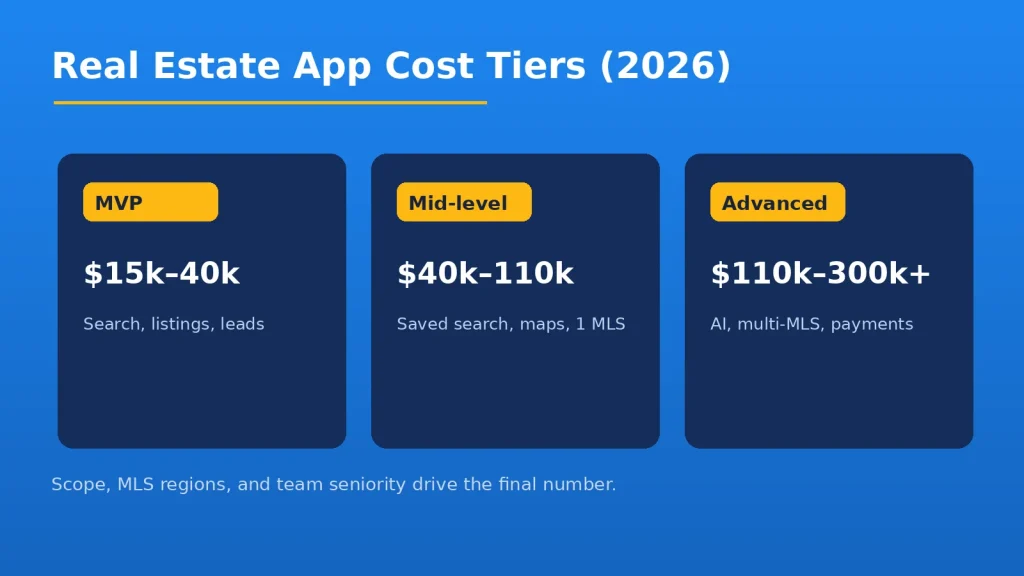
A basic MVP with core search, listings, and lead capture runs about 15,000 to 40,000 dollars. A mid-level app with saved searches, dashboards, maps, and one MLS feed lands around 40,000 to 110,000 dollars. An advanced platform with AI features, multi-MLS aggregation, payments, and deep integrations runs 110,000 to 300,000 dollars and up.
For production-grade products built in the US with senior teams, real ranges are higher: an MVP often lands at 80,000 to 180,000 dollars, and a full v1 platform at 180,000 to 450,000 dollars. A white-label app you customize rather than build from scratch can start around 20,000 to 80,000 dollars, and a national multi-MLS marketplace can reach 1.5 million dollars or more.
The biggest cost levers are the number of MLS regions, whether you build native or cross-platform, the depth of payments and compliance, and how senior the team is. For a broader view of how mobile budgets are set, see our guide to mobile app development cost.
How long does real estate app development take?
Timeline follows scope the same way cost does. A typical real estate app runs about 4 to 9 months from discovery to launch. A simpler build using an API-only IDX feed can ship in 1 to 3 months, while a multi-MLS aggregation platform with AI-native features can stretch to 9 to 12 months.
The variables that move the timeline are the number of MLS integrations, payment and compliance requirements, how much custom design you want, and how quickly decisions and feedback move on your side. A good partner ships in stages, so you see a working app on a narrow slice early and expand from there, rather than waiting many months for one large release.
We usually recommend launching a focused MVP, getting it in front of real agents or buyers, and letting their behavior guide the next features. It is cheaper to learn from a live app than to guess in a requirements document.
The real estate app development process, step by step
A well-run real estate app development project moves through seven clear stages, and knowing them helps you spot a partner who skips the important early work.
1. Discovery and scoping. We define who uses the app, which regions and MLS feeds matter, and what the first version must do. This is where most budget is saved or wasted, so it comes before any design or code.
2. UX and design. We map the core flows, search, listing detail, lead capture, dashboard, and design screens around how agents and buyers actually behave in the field, not around a feature list.
3. Architecture and data model. We decide native versus cross-platform, plan the listing and user data model, and design MLS/IDX sync so the app stays fast and current as data changes.
4. Development. Senior engineers build the app in short cycles, so you see working screens early rather than waiting months for one big reveal. Integrations like maps, payments, and feeds are wired in with clear contracts.
5. Testing. We test on real devices, real network conditions, and real MLS data, because a listing app that is slow or wrong on a phone loses trust instantly. Security testing matters here for any app holding financial or tenant data.
6. Launch. We ship to the App Store and Google Play, handle their review requirements, and roll out to real users. A focused MVP launch beats a delayed everything-at-once release.
7. Maintenance and iteration. The app is not done at launch. OS updates, MLS feed changes, and real user behavior all demand ongoing care, so support and a roadmap are agreed up front rather than as an afterthought.
A team that races past discovery and testing to start coding is optimizing for its invoice, not your outcome. The early and late stages are exactly where real estate apps succeed or quietly fail.
The 2026 trends worth building for
A few trends have moved from “nice to have” to something buyers now expect, and they are worth designing for even in an MVP roadmap.
AI property valuation. Automated Valuation Models give instant, data-driven price estimates from comparable sales, market trends, and neighborhood data. In 2026 these are evolving into “living valuations” that adjust as the market moves, and buyers increasingly expect an instant number rather than “contact us for pricing.”
Immersive virtual tours. Photos alone no longer cut it. 3D tours, interactive floor plans, and AR/VR walkthroughs let buyers explore a property from the couch, which filters out weak leads and keeps serious ones engaged.
Digital mortgage and closing. Payment gateways, mortgage calculators, e-signatures, and online notarization inside the app shorten closing times and keep the buyer in your product instead of bouncing to a bank’s site. Even a simple in-app mortgage calculator meaningfully lifts engagement.
Smart-home and neighborhood data. Buyers, especially younger ones, want context: schools, commute, walkability, and smart-home details surfaced right on the listing.
None of these need to be in version one, but the ones you plan to add should shape how the app is architected now, so adding them later is an upgrade rather than a rebuild.
Native or cross-platform for a real estate app?
Most real estate apps do not need two separate native codebases, and this choice has a real effect on budget and timeline. Cross-platform frameworks like React Native or Flutter let you ship to both iOS and Android from one codebase, which lowers cost and speeds delivery, and they handle listings, search, maps, and dashboards comfortably.
Native iOS and Android make sense when you need maximum performance, heavy AR/VR tours, or deep device features, and can support two codebases. For most brokerages and PropTech MVPs, cross-platform is the pragmatic starting point, and you can go native later for a specific feature if the product demands it.
The right call depends on your users, budget, and roadmap, and a good partner explains the trade-off rather than defaulting to whatever they staff. If you are weighing it up, our mobile app development team scopes this with you before anything is built.
Common real estate app development mistakes to avoid
The failures in this space tend to repeat, and most are avoidable with honest scoping up front.
Building for the whole country’s MLS data on day one, when you operate in two regions, burns budget you could spend on the actual product. Cramming every feature into version one delays launch and hides which features users truly want. Ignoring data security when the app holds tenant and financial information invites a breach you pay to fix twice. Treating the app as done at launch, with no plan or budget for maintenance and OS updates, guarantees it degrades within a year.
The pattern behind all of these is skipping the scoping conversation. A short, honest discovery that pins down who uses the app, which regions matter, and what the first version must do prevents most expensive mistakes before a line of code is written.
How to choose a real estate app development partner
The team you pick matters more than any single feature, so judge them the way you would judge a contractor building your house. Ask who exactly will write your code and how senior they are, because a senior pitch that turns into a junior build is the most common bait-and-switch in app development.
Ask for shipped work in real estate or a similar data-heavy domain, ideally apps you can download and use today. Confirm you will own the source code, the IP, and the app store listings in writing, with no lock-in. Get a clear answer on MLS/IDX experience, since that is where inexperienced teams underestimate the work. And ask what maintenance and support cost after launch, because a team with no answer there is planning to disappear after the invoice clears.
Third-party reviews on independent platforms and reference calls with past clients tell you more than any sales deck. When you are ready to staff a build, you can also hire mobile developers who already work with maps, payments, and listing data to extend your own team.
Frequently asked questions
How much does it really cost to build a real estate app?
A basic MVP runs about 15,000 to 40,000 dollars, a mid-level app 40,000 to 110,000 dollars, and an advanced platform 110,000 to 300,000 dollars or more. Production-grade US builds start higher, often 80,000 to 180,000 dollars for an MVP. The biggest cost drivers are MLS integration, payments, and how senior the team is, so scope the features before trusting any single number.
What features should my real estate app have first?
Start with property listings and search, saved searches with alerts, map-based browsing, agent contact and lead capture, and a simple dashboard. For property management apps, add rent payments and tenant communication. AI valuation, virtual tours, and mortgage tools are strong differentiators, but ship the core first and add them once you have real users.
Do I need MLS or IDX integration, and what does it cost?
If your app shows live US listings, yes. MLS/IDX integration means licensing a listing feed, mapping its data, and keeping it in sync, which commonly adds 15,000 to 35,000 dollars, and a single full MLS integration can reach 20,000 to 60,000 dollars. Start with the regions you actually operate in and build to the RESO data standard to avoid rework.
How long does it take to develop a real estate app?
About 4 to 9 months from discovery to launch for a typical app. A simpler build on an API-only IDX feed can ship in 1 to 3 months, while a large multi-MLS platform with AI features can take 9 to 12 months. Launching a focused MVP first and expanding from there is usually faster and cheaper than one big release.
Should I build a real estate app without being a developer?
You do not need to be a developer, but you do need a technical partner. No-code tools can validate a simple idea, but they hit limits fast on MLS data, payments, and scale. For anything you plan to grow, a senior development team that scopes honestly and hands you full ownership is the safer path than trying to assemble it yourself.
Native or cross-platform, which is better for a real estate app?
Cross-platform frameworks like React Native or Flutter suit most real estate apps, cost less, and ship to iOS and Android from one codebase. Native makes sense when you need maximum performance or heavy AR/VR tours. For most brokerages and PropTech MVPs, cross-platform is the pragmatic starting point.
Should my real estate app have AI or machine learning features?
AI valuation, smart search, and lead scoring are genuinely useful in 2026 and increasingly expected by buyers. They are worth planning for, but they are not where you start. Ship a fast, reliable core app first, then add AI features once you have data and users, so the AI improves a working product rather than propping up an unfinished one.
How do I make money with a real estate app?
Common models include agent or brokerage subscriptions, per-listing or featured-listing fees, lead-generation fees paid by agents, transaction or referral fees, and premium tools for power users. Property management apps often charge a per-unit monthly fee. Pick the model that fits your users before you build, because it shapes the product.
What security do real estate apps need?
Any app holding tenant, buyer, or financial data needs encryption in transit and at rest, secure authentication, least-privilege access to sensitive records, and secure payment handling through a compliant gateway. For apps that touch payments or personal financial data, security and compliance should be designed into the architecture from the start, not added later.
Should I use existing real estate software or build custom?
Off-the-shelf software is cheaper and faster when your needs are standard, and white-label apps sit in between at roughly 20,000 to 80,000 dollars. Build custom when your workflow, branding, or data needs are specific enough that existing tools force awkward compromises. The honest answer is often to start with something proven and build custom only where it creates real advantage.
Build a real estate app that ships
Real estate app development rewards focus: the right product shape, a lean first version, the MLS regions you actually serve, and a partner who tells you what to cut. Get those right and the app becomes the place your deals happen, rather than another project that stalls in scope.
Planning a real estate app? Talk to Mobilions. A senior engineer will scope it with you, give you an honest cost and timeline, and recommend the smallest version that proves the idea. Book a discovery call or explore our mobile app development services.

Dhaval Patel is a Senior Mobile Developer at Mobilions with deep, hands-on experience shipping Android, iOS, and cross-platform apps. He has helped build products used by teams across 20+ countries. He writes practical guides on mobile app development, app performance, and the real-world trade-offs of building for phones and tablets.