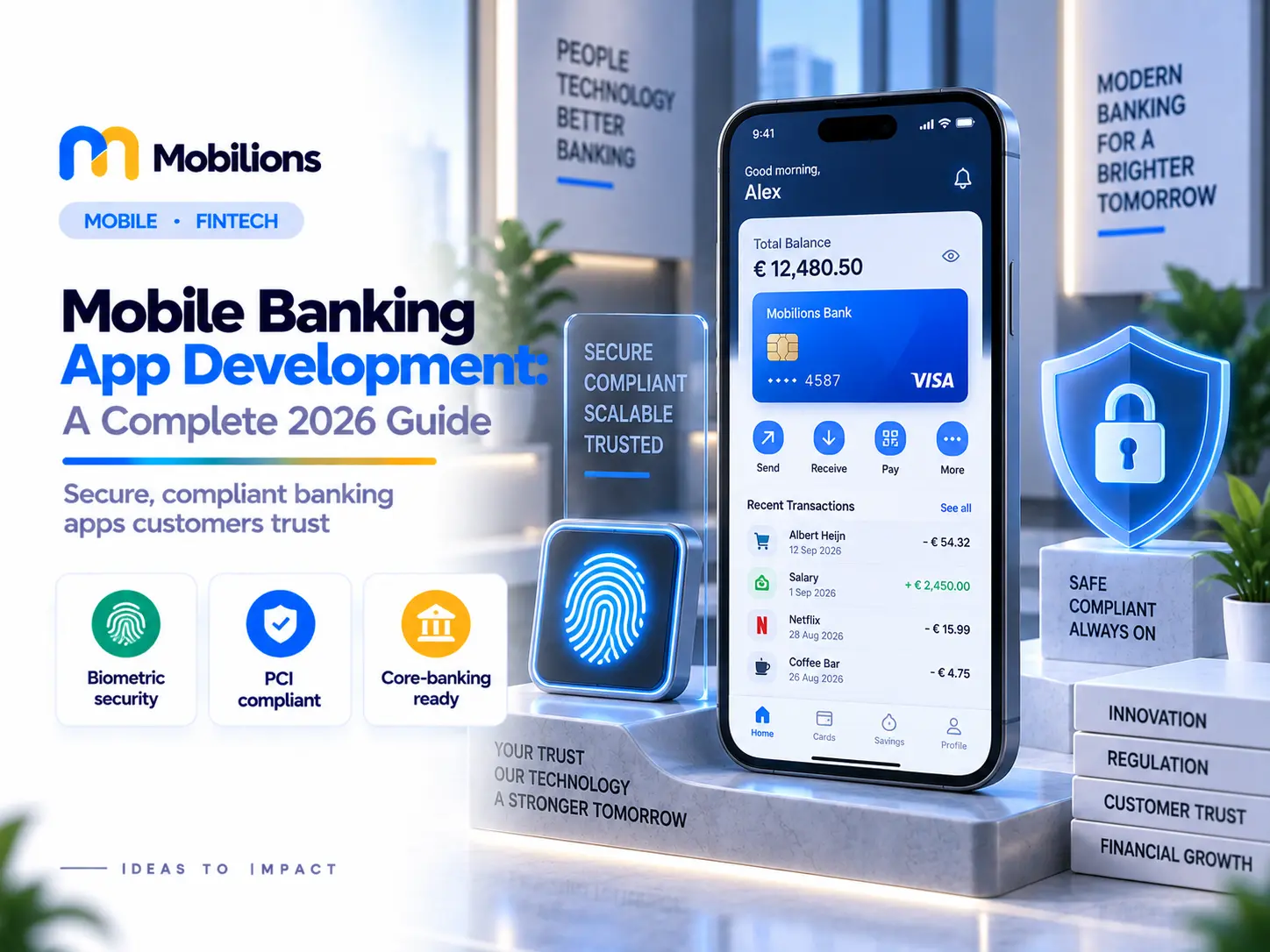
Mobile banking app development is one of the few software projects where a single security gap can end the business, not just the product. That is what makes it different from an ordinary app: the users are trusting you with their money, and the regulators are watching how you handle it. Get it right and you have a product people open every day; get it wrong and you have a breach, a fine, and a headline.
This guide walks through what mobile banking app development actually involves in 2026, from the features that keep users, to the security and compliance you cannot skip, to what it costs, how long it takes, and how to choose who builds it. It is written from the perspective of engineers who ship and support production financial software, not from a sales deck.
What is mobile banking app development?
Mobile banking app development is the process of designing, building, securing, and maintaining a mobile application that lets customers manage money: check balances, move funds, pay bills, and control cards, all connected to a core banking system in real time.
The app is the visible part, but most of the real work is invisible: the integration with core banking, the security layer, the compliance controls, and the fraud detection that runs behind every tap. A banking app that only looks good is a demo. A banking app that stays accurate, secure, and compliant under real traffic is a product.
That distinction shapes every decision in this guide. In consumer apps you optimize for delight; in mobile banking app development you optimize for trust, and trust is earned in the parts users never see.
What features should a mobile banking app include?
Features fall into three layers: the basics users expect, the ones that drive retention, and the security features that make the rest safe to ship.
The basics are table stakes: account overview and balances, transaction history, fund transfers, bill payments, and card management. If any of these is slow or confusing, users go back to the website, and you have lost the point of the app.
The retention drivers are what separate a banking app people tolerate from one they rely on. The highest-impact ones in 2026 are biometric login, real-time transaction alerts with instant card controls, instant peer-to-peer payments, AI-powered spending insights, and fast in-app support. These are the features that turn an account into a habit.
The third layer is security, and it is not optional in a banking context. A complete stack includes biometric authentication, multi-factor authentication for high-risk actions, end-to-end encryption, AI-powered fraud detection with real-time alerts, instant card freeze and unfreeze, and behavioral biometrics for continuous session checks. We will come back to this, because it is where the budget and the risk concentrate.
The trap is treating features as a checklist. The right feature set depends on who your customers are and what they actually do with their money, which is why good mobile banking app development starts with the customer, not the feature list.
Security and compliance: the non-negotiables
In banking, security and compliance are the product, not a phase you add at the end. This is the single most important thing to understand before you budget or plan.
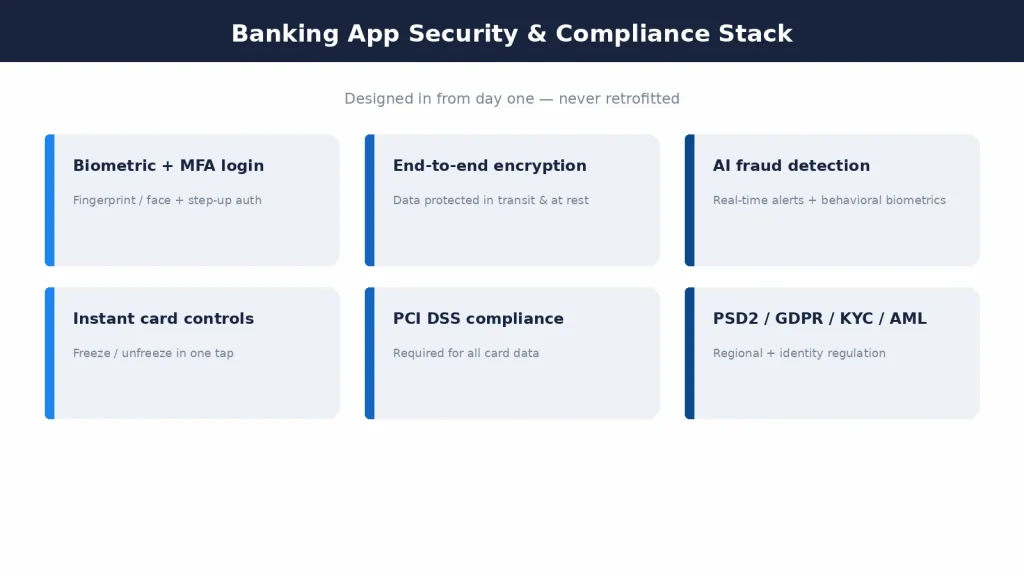
Security cannot be retrofitted. Security added at the end of development is harder to get right and far more expensive to fix. It has to be designed into the architecture from the first commit. In practice, security work alone can consume roughly a fifth of the budget before a single customer-facing feature is built, and that is money well spent rather than overhead.
The security layer includes encryption of data in transit and at rest, secure authentication (biometric plus MFA), certificate pinning, jailbreak and root detection, secure local storage, and real-time fraud monitoring. Aligning the build to a recognized standard such as the OWASP Mobile Application Security project turns “we think it is secure” into something you can actually verify.
Compliance is a legal gate, not a nice-to-have. A banking app has to satisfy PCI DSS for card data, plus regional rules like PSD2 in Europe, GDPR for personal data, and KYC and AML for identity and anti-fraud. This regulatory work typically adds $30,000 to $100,000 to a project and, like security, cannot be bolted on afterward. Anything that touches card data must follow the PCI Security Standards Council requirements from day one.
Biometric authentication deserves special mention because users now expect it and it is central to both security and experience. Building it against an open standard like the FIDO Alliance specifications keeps it interoperable and future-proof rather than tied to one vendor.
The honest summary: if a vendor quotes mobile banking app development without a detailed security and compliance plan, they have not scoped the hard part, and the number will move once reality arrives.
How much does mobile banking app development cost in 2026?
Cost scales with security, compliance, and integration depth far more than with the number of screens. With that framing, 2026 numbers fall into clear bands.
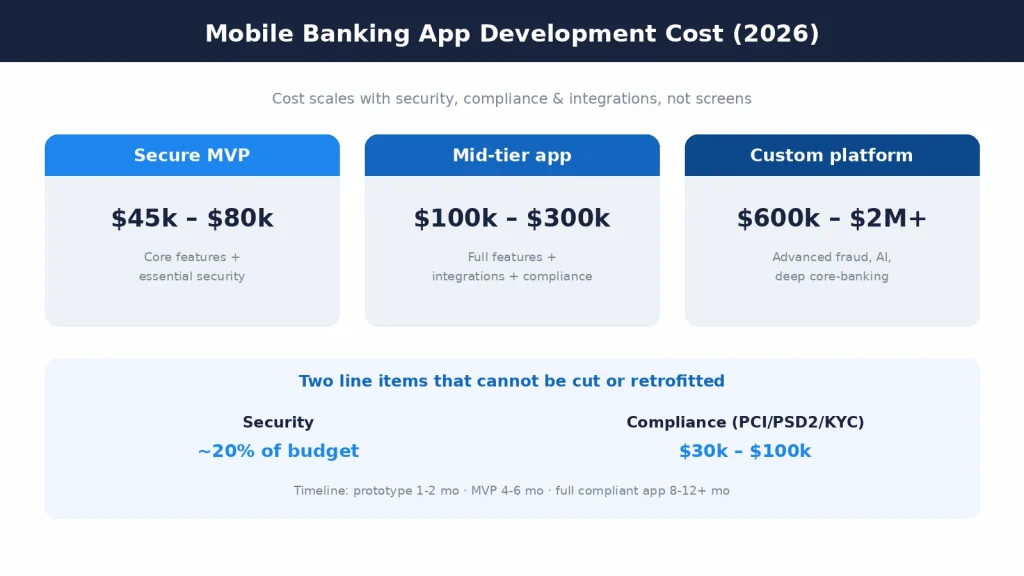
A basic MVP, with core banking features and essential security, starts around $45,000 to $80,000. A mid-tier app, with the full retention feature set, multiple integrations, and complete compliance, runs roughly $100,000 to $300,000. A full-scale custom digital banking platform, built from scratch with advanced fraud, AI features, and deep core-banking integration, runs $600,000 and can pass $1,000,000 to $2,000,000 for the largest programs.
Inside those totals, three line items dominate: security (around a fifth of the budget), regulatory compliance ($30,000 to $100,000), and integrations with core banking and payment systems. None of these are safe places to cut, because they are exactly what makes the app usable and legal.
The most useful thing you can do for your budget is scope the compliance and integrations early. That is where mobile banking app development costs are made or blown, and an honest partner will tell you which cost band your requirements fall into before you commit rather than discovering it mid-build.
How long does it take to build a mobile banking app?
Timelines track complexity, not ambition. A clickable prototype can be ready in one to two months. A production MVP typically takes four to six months. A full-featured, fully compliant banking app usually runs eight to twelve months or more, and a large in-house custom platform can stretch to eighteen months and beyond.
The parts that extend timelines are rarely the screens. They are the security hardening, the compliance certification, the core-banking integration, and the testing that a financial app demands before it can touch real money. Rushing these is how projects fail, so a realistic schedule builds them in rather than treating them as a final sprint.
A good partner defines milestones in discovery so you have an honest schedule before building starts, and ships in visible iterations rather than disappearing into a long black box.
Native or cross-platform for a banking app?
This is one of the most common questions in mobile banking app development, and the answer depends on your priorities.
Cross-platform frameworks like React Native and Flutter let you build for iOS and Android from one codebase, which roughly halves build and maintenance cost and speeds up delivery. For most banking apps, where the feature set is shared across platforms, this is the pragmatic default in 2026.
Native development, with Swift for iOS and Kotlin for Android, is worth it when you need the deepest device-level security features, the highest performance, or platform-specific capabilities that a cross-platform layer cannot reach cleanly. Some banks choose native specifically for the tightest control over security primitives.
Mobile banking app development The honest guidance is that cross-platform is the right call for the majority of banking apps, and native is the right call when security depth or performance genuinely demands it. A good team recommends based on your requirements, not on what it prefers to build.
The mobile banking app development process
Building a banking app is a staged exercise, and the order matters because each stage de-risks the next.
Discovery and compliance scoping comes first: map the features, the core-banking integration, the regulatory regime, and the security requirements. This is where the true scope, and the honest cost, becomes visible.
Design follows, turning real customer workflows into an interface that is fast and trustworthy, because in banking, a confusing screen erodes the trust the whole product depends on. Then development builds the app, the backend, the integration layer, and the security controls in parallel, with security written in rather than bolted on.
Security testing and compliance certification is a dedicated phase, not an afterthought: penetration testing, code review, and the audits required to satisfy PCI DSS and regional regulators. Finally, deployment and ongoing support: launch, monitor, and maintain, because a banking app is a living product that must stay patched and compliant for years.
The team behind a banking app
A serious mobile banking app development effort needs more than app developers. It needs mobile engineers for iOS and Android, backend engineers for the integration and API layer, a security specialist who owns encryption and threat modeling, a compliance lead who knows PCI DSS and regional rules, a UX designer who understands financial workflows, and QA engineers who test against real-world attack scenarios.
You rarely need all of these full-time from day one, which is why many banks and fintechs work with an experienced custom software development partner who brings the security and compliance expertise that is hardest to hire, or hire mobile developers to extend an existing team. The point is that a banking app is a multi-disciplinary build, and treating it as just “an app” is how the security and compliance gaps appear. The teams that ship successful banking apps staff for the invisible work first, because that is where the product actually lives.
Integrations a banking app needs
An app is only as useful as what it connects to. Mobile banking app development almost always involves several integrations, and each one is a place where reliability and security are won or lost.
The core banking system is the foundation: the app reads and writes real account data through it, usually via a secure API layer rather than talking to it directly. Payment processing and card networks handle transactions and card controls. KYC and identity providers handle onboarding and verification. And increasingly, open banking APIs connect the app to other financial institutions for account aggregation and payments.
Each integration carries its own security and compliance weight, which is why the integration layer, not the UI, is usually where most of the real engineering time goes.
Why banking apps fail, and how to avoid it
Most banking-app trouble is predictable, and nearly all of it traces back to underestimating the hard parts.
The first mistake is treating security and compliance as a later phase. Retrofitting encryption, fraud detection, and PCI controls into a finished app costs far more than building them in, and it often forces a redesign. Security scoped late is security done twice.
The second is pricing screens instead of integrations and compliance. The visible app is the cheap part; the core-banking integration, the security layer, and the regulatory work are where the effort and the budget live. A quote that ignores them will be wrong.
The third is neglecting the boring reliability work, offline handling, error states, and performance under load, in a product where a failed transaction is not a minor bug but a broken trust. The fourth is shipping and stopping: a banking app needs continuous maintenance to stay patched, compliant, and ahead of new fraud patterns.
How to choose a mobile banking app development company
The right partner talks about your security, compliance, and integrations before it talks about screens. That is the fastest signal that they have built financial software before.
Look for real experience with core-banking integration, a documented security and compliance track record, and a support model that lasts beyond launch. Ask how they handle PCI DSS and fraud detection, and how they test against real attack scenarios, because a team that has shipped banking apps will have clear answers.
Be cautious of quotes that price only the visible app, and of anyone who promises a fully compliant banking app on a consumer-app budget and timeline. Ownership matters too: you should own the code, the infrastructure, and the roadmap, with no lock-in.
What customers expect from a banking app in 2026
Customer expectations have moved, and mobile banking app development has to move with them or the app feels dated on launch day.
The clearest shift is toward intelligence. Users now expect AI-powered spending insights, categorized transactions, and proactive alerts that tell them something useful before they ask. A banking app that only shows a list of transactions feels like a statement; one that explains where the money went feels like a tool.
Personalization and speed are the next expectations. People want biometric login that just works, instant P2P payments, real-time notifications, and card controls they can act on in one tap, like freezing a lost card immediately. Every extra second or step in these core flows is a reason to abandon the app.
Open banking is reshaping the baseline too. Customers increasingly expect to see and move money across institutions from one app, which means open banking API strategy is now part of serious banking-app planning rather than a future nice-to-have. Accessibility and multi-language support round out the modern baseline, because a banking app that excludes users is both a business miss and, in many regions, a compliance one.
The takeaway is that the bar for a competitive banking app keeps rising, and the apps that win treat these expectations as core scope rather than a later upgrade.
A quick example: what a banking build looks like
Consider a regional bank that wants a modern app for its retail customers. It needs balances and transactions, transfers and bill pay, card controls, biometric login, real-time fraud alerts, and integration with its existing core banking system, all under PCI DSS and local regulation.
The scope decisions follow directly. Cross-platform on React Native to serve iOS and Android cost-effectively. A secure API layer between the app and the core banking system so the app never touches it directly. Biometric authentication and MFA built against open standards. Encryption everywhere, fraud monitoring in real time, and a compliance workstream running in parallel from day one.
Notice what drove every decision above: not the number of screens, but the systems the app had to connect to and the rules it had to satisfy. Change the core banking platform or the regulatory regime and the estimate changes with it. The screens were the fastest part to build and the least important to the outcome.
On these requirements the project lands in the mid-to-upper cost band, and the integration, security, and compliance work, not the screen count, is what sets the price and the timeline. That is mobile banking app development in one concrete picture: the app is the easy part, and the trust underneath it is the real product.
Frequently asked questions
What is mobile banking app development?
Mobile banking app development is the process of designing, building, securing, and maintaining a mobile app that lets customers manage money, connected in real time to a core banking system, and built to meet strict security and regulatory requirements like PCI DSS.
How much does it cost to build a mobile banking app in 2026?
A basic secure MVP starts around $45,000 to $80,000, a mid-tier app with full features and compliance runs about $100,000 to $300,000, and a full custom digital banking platform runs $600,000 and up. Security takes roughly a fifth of the budget and compliance adds $30,000 to $100,000.
How long does it take to develop a mobile banking app?
A prototype takes one to two months, a production MVP four to six months, and a full-featured compliant app eight to twelve months or more. Security hardening, compliance certification, and core-banking integration are what extend the timeline.
How secure are mobile banking apps?
Well-built banking apps are very secure because security is engineered in: biometric authentication, multi-factor authentication, end-to-end encryption, certificate pinning, jailbreak and root detection, and real-time fraud monitoring. The risk comes from apps where security was added late rather than designed in.
What features should a mobile banking app have?
Core features are balances, transaction history, transfers, bill pay, and card management. High-retention features are biometric login, real-time transaction alerts with card controls, instant P2P payments, AI spending insights, and in-app support, all wrapped in a strong security layer.
What compliance does a banking app need?
Typically PCI DSS for card data, plus regional rules such as PSD2 in Europe, GDPR for personal data, and KYC and AML for identity and anti-fraud. Compliance adds $30,000 to $100,000 and must be built in from the start, not retrofitted.
Should a banking app be native or cross-platform?
Cross-platform with React Native or Flutter is the pragmatic default for most banking apps because one codebase for iOS and Android roughly halves cost. Native is worth it when you need the deepest device-level security or maximum performance.
How do you choose a mobile banking app development company?
Choose one that scopes your security, compliance, and core-banking integration before pricing screens, has documented financial-software experience, tests against real attack scenarios, supports the app beyond launch, and hands you full ownership of the code and infrastructure.
Build a banking app your customers can trust
Mobile banking app development succeeds or fails on the parts users never see: the security, the compliance, and the integrations. If you are scoping a banking app and want an honest read on cost, timeline, and what production really requires, talk to Mobilions. Senior engineers who build fintech and mobile apps scope it, build it, secure it, and support it in production, with the security and compliance planned from the first day rather than discovered on the last.

Dhaval Patel is a Senior Mobile Developer at Mobilions with deep, hands-on experience shipping Android, iOS, and cross-platform apps. He has helped build products used by teams across 20+ countries. He writes practical guides on mobile app development, app performance, and the real-world trade-offs of building for phones and tablets.