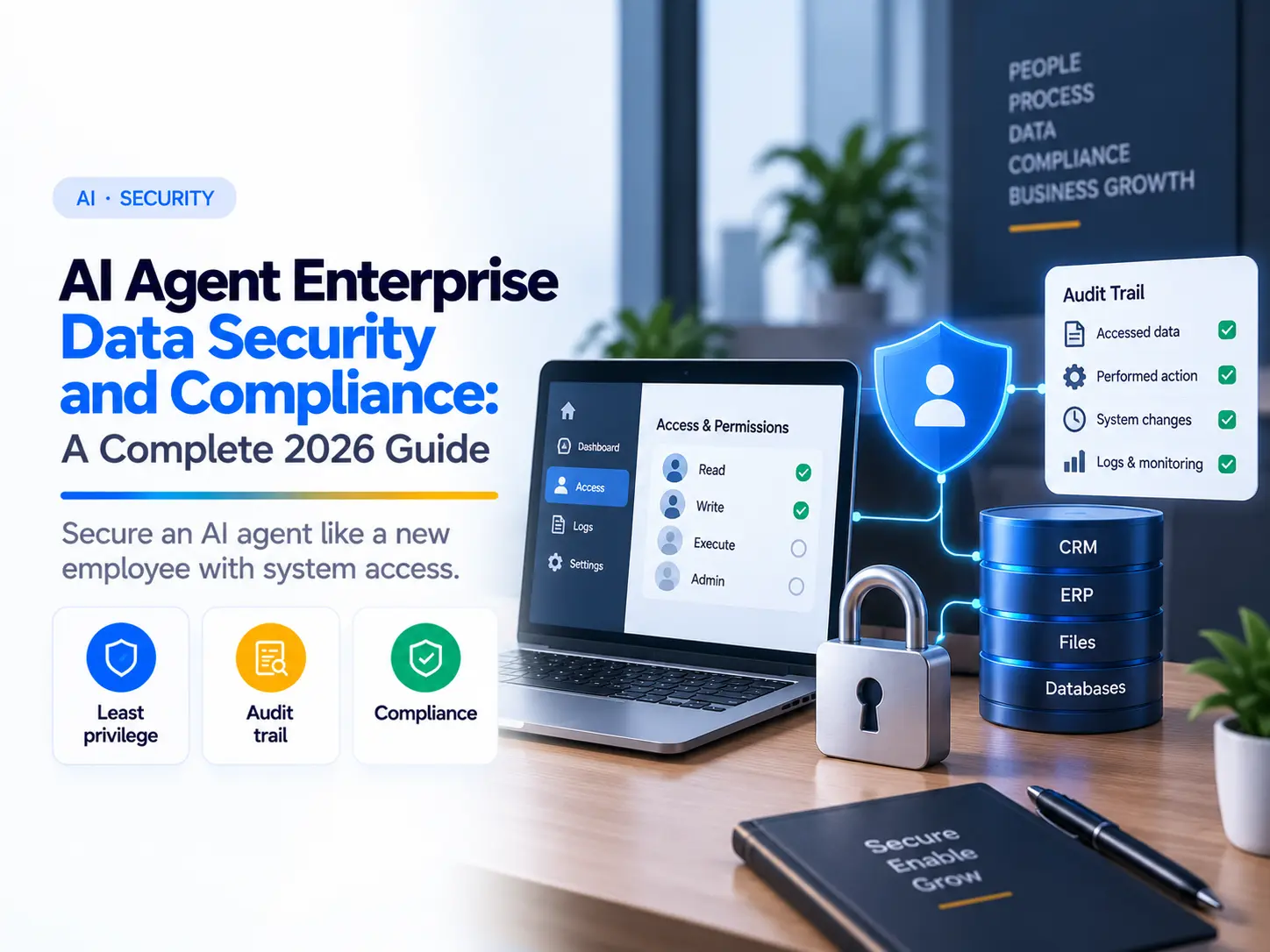
AI agent enterprise data security compliance is the set of controls that keep an autonomous AI agent from leaking data, taking unauthorized actions, or breaking regulations while it works inside your business. It is different from ordinary software security because an agent does not just read data, it acts: it has permissions, calls tools, and makes decisions.
The essentials are least-privilege access, full audit logging of every action, human approval for high-risk steps, defense against prompt injection, and mapping the agent to the frameworks that apply to you (GDPR, SOC 2, ISO 27001, and the EU AI Act, whose high-risk rules take effect on 2 August 2026). Treat the agent as a powerful new employee with system access, and secure it like one.
Getting AI agent enterprise data security compliance right is now the hard part of deploying agents, not building them. The models are capable enough. The blocker in most enterprises is proving that an autonomous system with access to customer data, internal tools, and the ability to act will not leak, break a rule, or do something no one authorized. That is a fair concern, and it has real answers.
This guide is the practical version for teams actually deploying agents. It covers why agent security is different, what compliance actually involves, the specific risks that matter in 2026, how to handle permissions and audit trails, which regulations apply, how to evaluate a vendor, and a concrete checklist to secure an enterprise agent. We build production AI agents at Mobilions, and security and compliance are where most of the engineering effort goes, so this is a practitioner’s view rather than a policy summary.
Why AI agent security is different from normal software security
The instinct is to treat an AI agent like any other software vendor or SaaS tool. That instinct undersells the problem, and the difference is the whole reason this is hard.
Ordinary software follows fixed rules. It does exactly what it was coded to do, and you secure it by controlling its inputs and its access. An AI agent is different in three ways. It acts, calling tools, sending messages, changing records, not just returning information. It has agency, choosing what to do next based on a goal rather than a script, which means its exact behaviour is not fully predictable in advance. And it is manipulable through language, because the same natural-language interface that makes it useful can be hijacked by carefully crafted text.
Put those together and an agent is less like a database and more like a new employee who is fast, tireless, literal, and occasionally gullible, and who has been handed system access on day one. You would not give a new hire unlimited access to everything and no oversight. The same logic, applied rigorously, is what agent security is.
AI agent enterprise data security compliance: what it actually covers
It helps to define the scope plainly, because the phrase covers several distinct jobs. Strong AI agent enterprise data security compliance rests on a few pillars, and a gap in any one is where incidents come from.
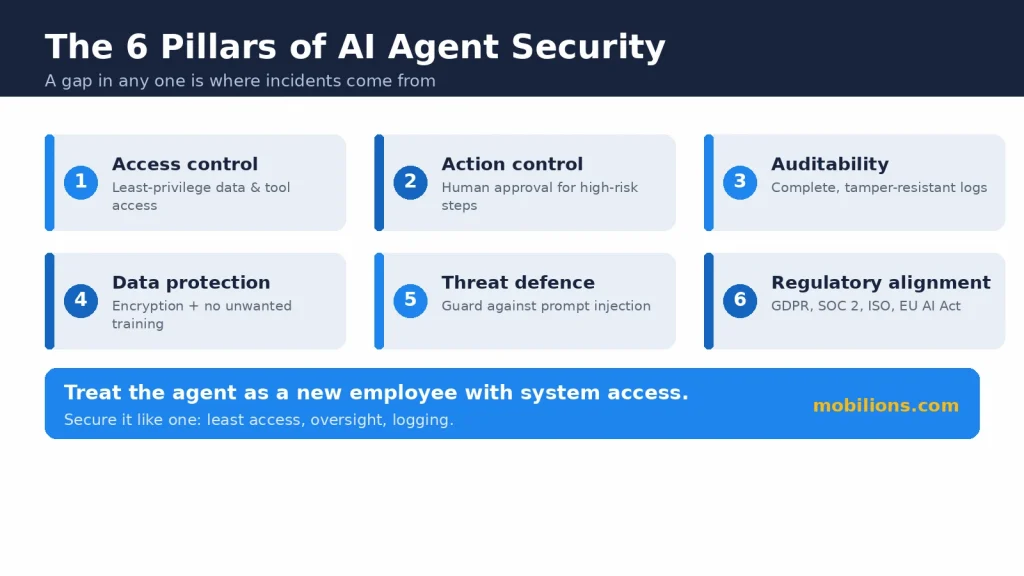
Access control: exactly what data and tools the agent can reach, kept to the minimum it needs. Action control: which operations it can perform on its own, and which require a human to approve. Auditability: a complete, tamper-resistant log of everything the agent did, so you can review, investigate, and prove what happened. Data protection: encryption, control over whether your data trains anyone’s model, and clean deletion when you stop. Threat defence: protection against prompt injection and manipulation. And regulatory alignment: mapping all of the above to the laws and standards that apply to your business.
Miss access control and the agent can reach too much. Miss auditability and you cannot prove compliance or investigate an incident. Miss threat defence and an attacker turns the agent’s power against you. AI agent enterprise data security compliance is getting all six right together, not picking the easy ones.
The core risks in 2026
The threats are not hypothetical any more, so it is worth being specific about what actually goes wrong.
Prompt injection. This is the big one. An attacker hides instructions in content the agent reads, an email, a web page, a document, and the agent follows them, exfiltrating data or taking actions it should not. OWASP ranks prompt injection as the number one risk for LLM applications, and its 2026 reporting notes there is no complete fix even with frontier models, which is why defence in depth is the only credible strategy. Real, high-severity vulnerabilities in mainstream AI coding and assistant tools through 2025 and 2026 show this is being exploited in production, not just in labs.
Excessive agency and over-permissioning. An agent given more access or autonomy than it needs is a large blast radius waiting for a trigger. The danger is simple: excessive agency is only a threat if someone can hijack it, and prompt injection is exactly how they do. The fix is least privilege, giving the agent the narrowest access and the fewest autonomous powers that still let it do its job.
Data leakage. An agent with broad read access can surface sensitive data to the wrong user, include it in an output, or send it somewhere it should not go, often without any malicious attacker involved, just a poorly scoped permission.Enforcing this consistently is the job of a fabric architecture for AI systems, which centralizes access and audit across every model and agent
Unauthorized actions. Because agents act, an error or a manipulation can turn into a real-world consequence: a wrong record changed, a message sent, a payment attempted. This is why high-risk actions need a human in the loop.
Unwanted training on your data. If your data flows to a vendor’s model and is used for training, it can effectively leak into a system you do not control. Knowing, and contractually controlling, whether your data trains anyone’s model is a core compliance question.
Weak oversight. The quiet risk is simply not watching. One 2026 industry survey found only a minority of organizations monitor their AI activity end to end, which means most would not notice a problem until after it caused damage.
Permissions and access control: the foundation
If you fix only one thing, fix this, because most agent incidents trace back to an agent that could reach or do too much.
The governing principle is least privilege: the agent gets the minimum data access and the fewest tool permissions it needs for its specific job, and nothing more. A support agent that answers order questions needs read access to orders, not write access to the finance system. Access should be role-based and scoped, ideally with the agent holding its own identity and permissions rather than borrowing a human’s or a shared admin account, so its actions are attributable and its access is independently controllable.
A common and important question: should an AI agent have the same access as the employee who runs it? The answer is no. An agent operates faster, at scale, and can be manipulated in ways a person cannot, so it should usually have narrower access than a human doing the same role, with the riskiest capabilities removed entirely or gated behind human approval. Give it employee-level access to everything and you have created an employee who never sleeps, can be tricked with a paragraph of text, and touches your whole system.
Audit trails and monitoring
You cannot secure or prove compliance for something you cannot see, so logging is not optional.
Every meaningful action an agent takes, what it accessed, what it decided, what it did, should be recorded in a complete, time-stamped, tamper-resistant log. Good audit trails do three jobs: they let you investigate when something looks wrong, they let you prove to auditors and regulators what the agent did and did not do, and they let you improve the system by seeing how it actually behaves. Pair the logs with active monitoring and alerting, so unusual behaviour, a spike in data access, an unexpected action, surfaces in near real time rather than in a post-incident review.
How often should you review? Continuously through automated monitoring, with scheduled human reviews for high-stakes agents. The regulatory direction is the same: the EU AI Act’s high-risk rules require automatic logging and human oversight, so building this in now is also future-proofing.
Which regulations actually apply
Compliance is not one rule; it is a stack, and which parts apply depends on your data and industry. The main pieces in 2026:
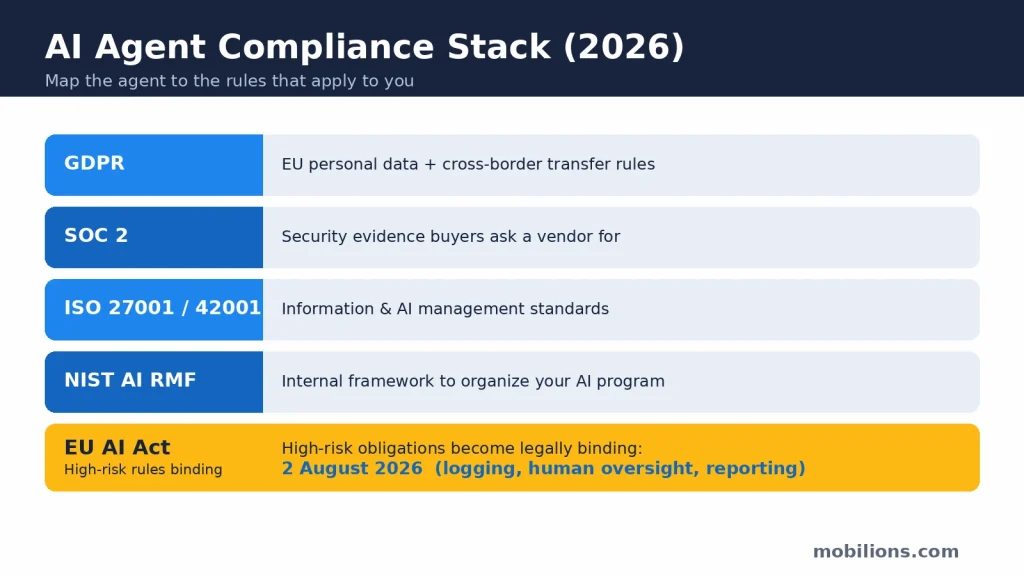
GDPR governs personal data of EU residents, including a hard rule on international transfers (Chapter V) that is triggered every time data crosses a border, which is easy to do accidentally through an AI API. SOC 2 (AICPA) is the external evidence most enterprise buyers ask a vendor for, covering security, availability, and confidentiality controls. ISO 27001 and the AI-specific ISO/IEC 42001 are the international management-system standards. the NIST AI Risk Management Framework is the voluntary framework most enterprises use internally to organize their AI program.
And the EU AI Act is the big regulatory shift: its obligations for high-risk AI, including incident reporting, log retention, human oversight, and impact assessments, become legally binding on 2 August 2026, as the regulation sets out. In practice, agent governance leans on SOC 2, GDPR, and ISO 27001 for evidence, while NIST AI RMF and the EU AI Act shape the internal program. You do not need all of them; you need the ones that match your customers, data, and jurisdictions, mapped deliberately.
How to evaluate an AI agent vendor
If you are buying rather than building, the vendor’s security is your security, so evaluate it properly rather than trusting a marketing page.
Ask for concrete evidence, not assurances. A current SOC 2 Type II report and ISO 27001 certification are table stakes for enterprise use. Ask directly whether your data is used to train their models (the answer should be no, in writing), where your data is stored and processed (for data-residency compliance), what audit logs you get access to, and how they defend against prompt injection. Push on the security agreement: it should cover data ownership, breach notification, deletion on offboarding, and liability. Watch for red flags, vague answers about data use, no independent certifications, no audit access, or an unwillingness to put commitments in the contract.
Is SOC 2 alone enough? It is necessary but not sufficient. SOC 2 tells you the vendor has security controls; it does not tell you the agent is scoped to least privilege in your environment, or how it handles your specific regulatory obligations. Treat SOC 2 as a floor, not a finish line.
Build vs buy, from a security angle
The build-or-buy decision looks different through a security lens, and it is worth weighing deliberately.
Buying a mature agent platform means inheriting a vendor’s security investment, certifications, and patch cadence, which is real value, at the cost of trusting their controls, their data handling, and their prompt-injection defences, and accepting the residency and training-data terms they offer. Building (or having a partner build) a custom agent means the data stays in your environment and under your controls, permissions and logging are exactly what you specify, and there is no third-party training-data question, at the cost of owning the security engineering yourself.
For agents that touch highly sensitive or heavily regulated data, the control of a custom build often wins; for lower-risk, standard workflows, a well-certified vendor is usually the faster, sensible path. Either way, the security requirements are the same, only who implements them changes.
Data lifecycle: encryption, training, and offboarding
Security does not end at access; it follows the data through its whole life with the agent.
Encrypt sensitive data in transit and at rest, and consider what the agent actually needs to see, sometimes it can work on masked or tokenized data rather than the raw records. Control training use contractually and technically, so your data is not absorbed into a model you do not govern. And plan offboarding before you need it: when you stop using an agent or vendor, you should be able to confirm your data is deleted, exports are handled, and access is revoked, cleanly and verifiably. The question “what happens to my data if I stop using this agent” should have a clear answer before you start, not after.
Incident response and liability
Even well-secured systems fail sometimes, so plan for it, because improvising during an incident is how a contained problem becomes a reportable breach.
Have an incident-response plan that treats the agent as a first-class system: how you detect a problem, how you contain it (including the ability to quickly restrict or shut down the agent’s access), how you investigate using the audit trail, and how you meet notification obligations. Liability is a genuinely unsettled area, when an agent takes a harmful unauthorized action, responsibility can sit with the deploying company, the vendor, or both, depending on the contract and the regulation, which is exactly why the security agreement and the human-approval gates matter.
Some enterprises are now looking at insurance for AI-related risk, though coverage is still maturing. The practical protection is the same as the prevention: least privilege, human approval on high-risk actions, and complete logs.
A practical checklist to secure an enterprise AI agent
Pulling it together, here is the short version of AI agent enterprise data security compliance you can actually work from.
Scope the agent to least-privilege data and tool access. Give it its own identity, not a shared or human account. Require human approval for high-risk or irreversible actions. Log every action to a complete, tamper-resistant audit trail, and monitor it actively. Defend against prompt injection with input and output filtering and defence in depth, and test adversarially.
Encrypt sensitive data and control whether it trains any model. Map the agent to your applicable frameworks (GDPR, SOC 2, ISO 27001, NIST AI RMF, EU AI Act) and keep the evidence. Vet vendors for certifications, data-use terms, residency, and audit access. And plan incident response and clean offboarding before launch, not after. Do these, and you have covered the ground that almost every incident comes from.
How Mobilions helps
We build production AI agents for enterprises, and security and compliance are the core of how we build, not an afterthought bolted on at the end. We scope agents to least privilege by default, give each agent its own identity and complete audit logging, gate high-risk actions behind human approval, and design in defences against prompt injection rather than assuming the model will protect itself.
We keep your data in your environment where the sensitivity calls for it, control training use, and map the build to the frameworks you answer to, GDPR, SOC 2, ISO 27001, NIST AI RMF, and the EU AI Act, so the agent is defensible to your security team and your auditors. You own the code, the data, and the logs.
What we will not do is ship an over-permissioned agent with no audit trail to hit a deadline, because that is precisely the agent that becomes an incident.
The bottom line
AI agent enterprise data security compliance is now the deciding factor in whether an agent reaches production, and it is a solvable engineering problem, not a reason to avoid agents. The mindset that works is to treat the agent as a powerful new employee with system access: give it the least access it needs, require approval for the risky moves, log everything, defend the language interface it runs on, and map it to the rules that apply to you.
The threats are real, prompt injection has no complete fix, over-permissioned agents have a large blast radius, and regulation is tightening with the EU AI Act’s high-risk rules landing in August 2026. But every one of them has a known control, and together they are a checklist, not a mystery. Get the controls right and you can deploy agents that are genuinely useful and genuinely safe. Skip them and you are one crafted paragraph away from an incident.
If you want a straight assessment of how to secure a specific agent for your data and your regulators, that is exactly the conversation our senior engineers have with enterprise teams every week.
Book a discovery call for an honest review, no obligation. You can also explore our AI agent development services and how we approach applied AI.
Key takeaways
- AI agent security is different from ordinary software security because agents act, choose, and can be manipulated through language; treat an agent as a powerful new employee with system access.
- AI agent enterprise data security compliance rests on six pillars: access control, action control, auditability, data protection, threat defence, and regulatory alignment.
- Prompt injection is the top risk (OWASP LLM01) and has no complete fix, so defence in depth is the only credible strategy.
- Least privilege is the foundation: give the agent the narrowest data and tool access, its own identity, and human approval for high-risk actions. It should have less access than the employee who runs it.
- Log every action to a complete, tamper-resistant audit trail and monitor it actively; most organizations still do not monitor AI end to end.
- Map the agent to the frameworks that apply, GDPR, SOC 2, ISO 27001, NIST AI RMF, and the EU AI Act, whose high-risk rules take effect 2 August 2026.
- Vet vendors for SOC 2, data-use and residency terms, and audit access; SOC 2 is a floor, not a finish line. Plan encryption, training-data control, incident response, and clean offboarding before launch.
Frequently asked questions
What is AI agent enterprise data security compliance?
It is the set of controls that keep an autonomous AI agent from leaking data, taking unauthorized actions, or breaking regulations while it operates inside a business. It spans least-privilege access, human approval for risky actions, complete audit logging, defence against prompt injection, data protection, and mapping the agent to applicable laws and standards like GDPR, SOC 2, and the EU AI Act. In short, it is securing and governing an agent that can act, not just read.
Why is securing an AI agent harder than securing normal software?
Because an agent acts rather than just returning information, chooses its next step based on a goal rather than a fixed script, and can be manipulated through the same natural-language interface that makes it useful. That combination means its behaviour is not fully predictable and its access can be turned against you, so it needs the kind of oversight you would give a new employee with system access, not the kind you give a static tool.
What is prompt injection and why does it matter so much?
Prompt injection is when an attacker hides instructions in content the agent reads, an email, a document, a web page, and the agent follows them, leaking data or taking unauthorized actions. OWASP ranks it the number one risk for LLM applications, and there is no complete fix even with the best current models. It matters because it is the main way an attacker hijacks an agent’s permissions, which is why least privilege and human approval on risky actions are essential.
Should my AI agent have the same access as my employees?
No. An agent works faster, at scale, and can be manipulated in ways a person cannot, so it should usually have narrower access than a human in the same role, with the riskiest capabilities removed or gated behind human approval. Giving an agent full employee-level access creates a system that never sleeps, can be tricked with text, and touches everything, which is a large and unnecessary blast radius.
How do I prevent an AI agent from leaking company data?
Scope its data access to the minimum it needs (least privilege), give it its own identity so access is controllable and attributable, filter its inputs and outputs, encrypt sensitive data, control whether your data trains any model, and log every action so you can detect and investigate leaks. Most leakage comes from over-broad permissions rather than sophisticated attacks, so tight scoping is the highest-value control.
Which regulations apply to enterprise AI agents?
It depends on your data and industry, but the common stack is GDPR (EU personal data, including cross-border transfer rules), SOC 2 (the security evidence buyers ask for), ISO 27001 and ISO/IEC 42001 (management-system standards), NIST AI RMF (internal program framework), and the EU AI Act, whose high-risk obligations become binding on 2 August 2026. Map the ones that match your customers, data, and jurisdictions rather than trying to satisfy all of them.
Is SOC 2 compliance enough for an AI agent vendor?
It is necessary but not sufficient. SOC 2 shows a vendor has security controls, but it does not tell you the agent is scoped to least privilege in your environment, whether your data trains their model, where it is stored, or how they defend against prompt injection. Treat SOC 2 as a floor and ask specifically about data use, residency, audit access, and injection defence on top of it.
How do I audit what my AI agent is doing?
Log every meaningful action, what it accessed, decided, and did, to a complete, time-stamped, tamper-resistant trail, and pair it with active monitoring that alerts on unusual behaviour. Review continuously through automated monitoring and schedule human reviews for high-stakes agents. Good logs let you investigate incidents, prove compliance to auditors, and improve the system, and the EU AI Act will require this kind of logging for high-risk AI anyway.
Should I build or buy an AI agent for security reasons?
Buying gives you a vendor’s security investment and certifications but means trusting their controls, data handling, and terms. Building or having a partner build keeps data in your environment with permissions and logging exactly as you specify and no third-party training question, at the cost of owning the security work. For highly sensitive or regulated data, the control of a custom build often wins; for standard, lower-risk workflows, a well-certified vendor is usually the faster path.
What happens to my data if I stop using an AI agent?
That should be settled before you start. A proper agreement specifies that on offboarding your data is deleted, exports are provided, and access is revoked, verifiably. If a vendor cannot clearly explain deletion and offboarding, treat it as a red flag, because unclear data handling at the end often signals unclear handling throughout.
Does Mobilions build secure, compliant AI agents?
Yes. We build production agents with least-privilege access, per-agent identity, complete audit logging, human approval on high-risk actions, and designed-in defences against prompt injection, mapped to the frameworks you answer to, GDPR, SOC 2, ISO 27001, NIST AI RMF, and the EU AI Act. You own the code, data, and logs. Book a discovery call for a straight assessment of how to secure an agent for your data and regulators.

Mayank Makwana is an AI Solution Architect and Full Stack Developer at Mobilions, where he designs and ships production AI systems — grounded, governed, and owned by the client. He specializes in LLM applications, retrieval-augmented generation (RAG), and AI agents, and also builds modern web applications. He writes senior-level guides on AI architecture, applied machine learning, and web engineering.