Vibe coding gets you a working app in an afternoon. It rarely gets you an app that survives real users. The demo logs in, saves data, looks clean, and then the first hundred people show up and the cracks appear: leaked data, a login anyone can bypass, a screen that takes nine seconds to load.
That gap is predictable. Vibe-coded apps tend to break in the same six places, every time, because the AI optimized for a demo that runs, not a product that holds. The good news is that each of those six failures has a known fix. This guide walks through all six, in the order they usually bite, with the exact thing to change.
None of this means vibe coding is bad. It is a real shift, and it is here to stay. It just needs a second pass before you put real people and real data behind it.
Key takeaways
- Vibe coded apps almost always break in the same six areas: database access, exposed secrets, input validation, performance, missing tests and error handling, and architecture.
- The root cause is not weak AI. These tools are built to produce a demo that works, so they skip the hardening that production needs.
- Security is the one that hurts most. Veracode found that 45% of AI-generated code samples failed security tests, and cross-site scripting slipped through 86% of the time.
- Most vibe-coded apps can be fixed in place. A full rebuild is only needed when the data model itself is wrong.
- Before launch, check five things: row level security, secret keys, payments, a real login test, and one outside security review.
What vibe coding actually is
Andrej Karpathy coined the term in February 2025, describing a way of building where you describe what you want in plain English and let the model write the code, to the point where you can almost forget the code exists. Collins Dictionary liked the idea enough to name “vibe coding” its Word of the Year 2025.
It is not a fringe habit either. In Y Combinator’s Winter 2025 batch, a quarter of the startups had codebases that were about 95% AI-generated, according to partner Jared Friedman. These are technical founders choosing speed. Tools like Lovable, Bolt, Cursor, Replit, and v0 turn a prompt into a running app in minutes.
So the trend is real and the output is real. The problem starts when a prototype gets promoted to production without anyone hardening it first. Here is where that goes wrong.
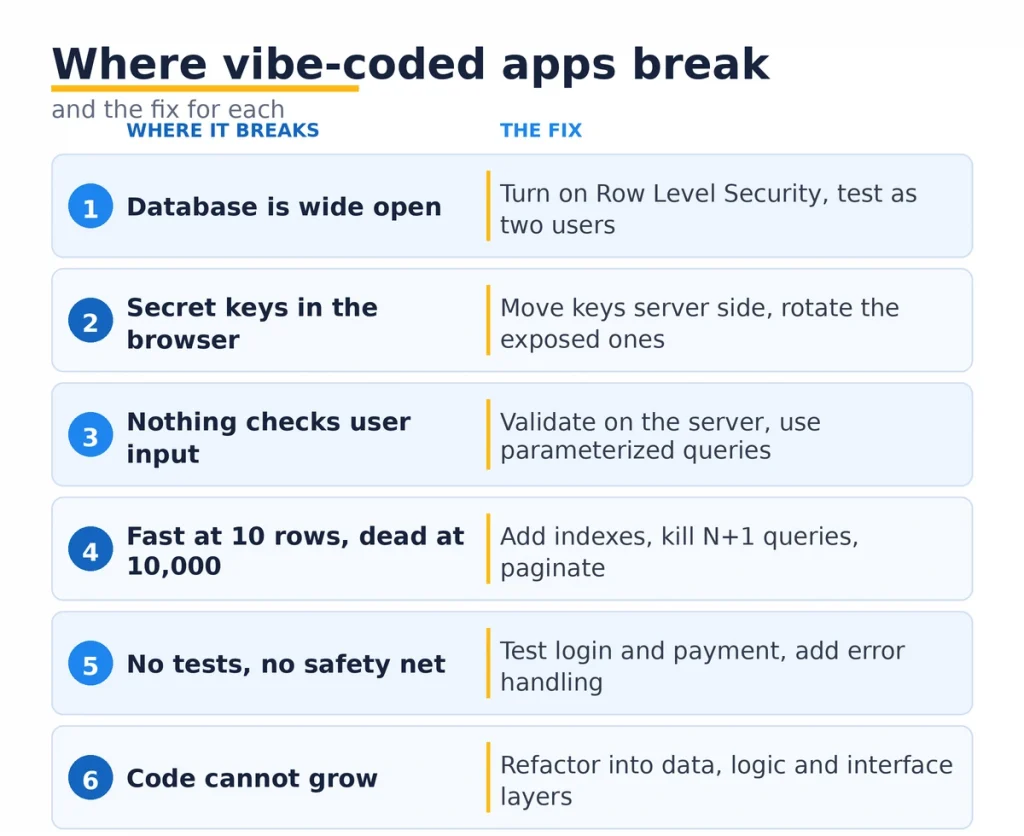
1. Your database is wide open
This is the vibe coding failure we see most at Mobilions, and it is the one that leaks data.
Tools that wire up Supabase or Firebase create the tables and get your app reading and writing fast. What they usually skip is Row Level Security, the rule layer that decides who can see which rows. With it off, every signed-in user can read every other user’s records, and often anyone with your public key can read the whole table from a browser.
You can check this in about a minute. Open your Supabase project, go to the Authentication or Policies tab, and look at each table. No policies listed means the table is open.
How to fix it. Turn Row Level Security on for every table that holds real data. Write a policy so a user can only touch their own rows, usually by matching the row’s user id to auth.uid(). Then test it as two different accounts and confirm neither can see the other’s data. This one change closes the most common vibe coding data leak.
2. Your secret keys are sitting in the browser
The second break is secrets baked into the frontend. To make the demo work end to end, AI tools often hardcode API keys for Stripe, OpenAI, your database, or a third-party service straight into the client code.
Anything in the frontend is public. A curious user opens developer tools, reads the bundle, and there is your key. Bots scan public code for exposed keys around the clock, so this is not a maybe.
How to fix it. Treat every key that shipped in the frontend as already leaked and rotate it. Move secret keys to the server side, into environment variables or a secrets manager, and call the paid service through your own backend endpoint. The browser should never see a secret key again. Publishable keys meant for the client are fine to leave, but know the difference before you ship.
3. Nothing checks what users type
Vibe-coded apps trust their inputs. The form works when you type a normal name, so it looks done. It is not.
This is where the security numbers get loud. Veracode’s 2025 report tested more than 100 AI models across four languages and found 45% of the code samples failed security tests by introducing an OWASP Top 10 vulnerability. Cross-site scripting alone got through in 86% of the relevant cases. Newer, smarter models did not do any better on security.
Cross-site scripting and SQL injection both come from the same habit: taking whatever a user submits and using it directly, in a page or a database query, without cleaning it first.
How to fix it. Validate and sanitize every input on the server, not just in the browser. Use parameterized queries so user text can never run as a command. Escape anything you render back onto a page. The OWASP Top 10 is the checklist to run against here, and it is free.
4. It works at ten rows and dies at ten thousand
Performance is the quiet one. The app feels instant in the demo because the demo has twelve rows. Real usage brings ten thousand, and the same screen now crawls.
Three patterns cause most of it. Missing database indexes, so every lookup scans the whole table. N+1 queries, where loading a list fires one more query per item instead of one query total. And selecting entire tables when the screen needs ten rows.
How to fix it. Add indexes on the columns you filter and sort by. Replace N+1 loops with a single joined query or a batched load. Paginate long lists and select only the columns you use. None of this is exotic, and it usually turns a nine-second screen into a fast one without touching the design.
5. There are no tests and no safety net
Ask an AI agent to add a feature and it will happily rewrite code that already worked. Without tests, nobody notices until a user does. This is the complaint behind every “the agent broke my login” post.
Two things are missing at once. Tests, so a change that breaks checkout gets caught before it ships. And error handling, so when something does fail, the user sees a clear message instead of a blank white screen while your app silently loses their data.
How to fix it. Add tests around the flows that matter most first: signup, login, payment, anything that touches money or accounts. Wrap risky operations in real error handling with fallbacks and clear messages. Add basic logging so you find out about failures before your users email you.
A little test coverage on the critical paths is what turns a scary codebase into one you can change with confidence. This is the core of proper software testing, and it is worth doing early.
6. The code cannot grow
The last break shows up later, when you try to add the third or fourth big feature and everything slows to a crawl. The app was generated as one tangled piece, so every change risks breaking two things you did not touch.
Vibe coding is great at a first version and weak at structure. There is no clear separation between the screens, the business logic, and the data. Feature five takes a week because the AI has to reason about the whole app at once, and so do you.
How to fix it. Refactor into clear layers as soon as the app is worth keeping: a data layer, a logic layer, and the interface. Pull shared logic out of the screens. You do not need a rewrite for this. You need someone to draw the boundaries the AI never did, so the next ten features do not each cost a week.
Why this keeps happening
It is tempting to blame the tools, but that misses the point. Lovable, Bolt, Cursor, and the rest are doing exactly what they promise: turn an idea into a running app fast. Hardening is a different job, and they were never asked to do it.
The mistake is human. A prototype gets users, the users make it feel real, and nobody stops to ask whether the thing was ever built to carry real data. Speed to a demo and readiness for production are two separate milestones. Vibe coding nails the first and skips the second, and the skip is invisible until it is not.
Treated as a prototyping method, vibe coding is one of the better things to happen to software in years. Treated as a finished product, it is a data breach with a nice landing page.
What a cleanup actually looks like
A founder came to us with a Bolt-built scheduling app. Real customers, real bookings, growing fast. Then two users reported seeing each other’s client lists.
It was Row Level Security, off on every table. Anyone logged in could read every booking in the system. We turned on policies, rotated the Stripe and database keys that were sitting in the frontend, added indexes to the two tables that were timing out, and wrote tests around booking and payment.
Four days of work. No rebuild, because the data model was sound. The app the founder already had was fine. It just needed the second pass that vibe coding does not include.
That is the usual shape with vibe coding. Most vibe-coded apps do not need to be thrown away. They need someone to walk the same six places and close each one.
Five checks before you launch a vibe-coded app
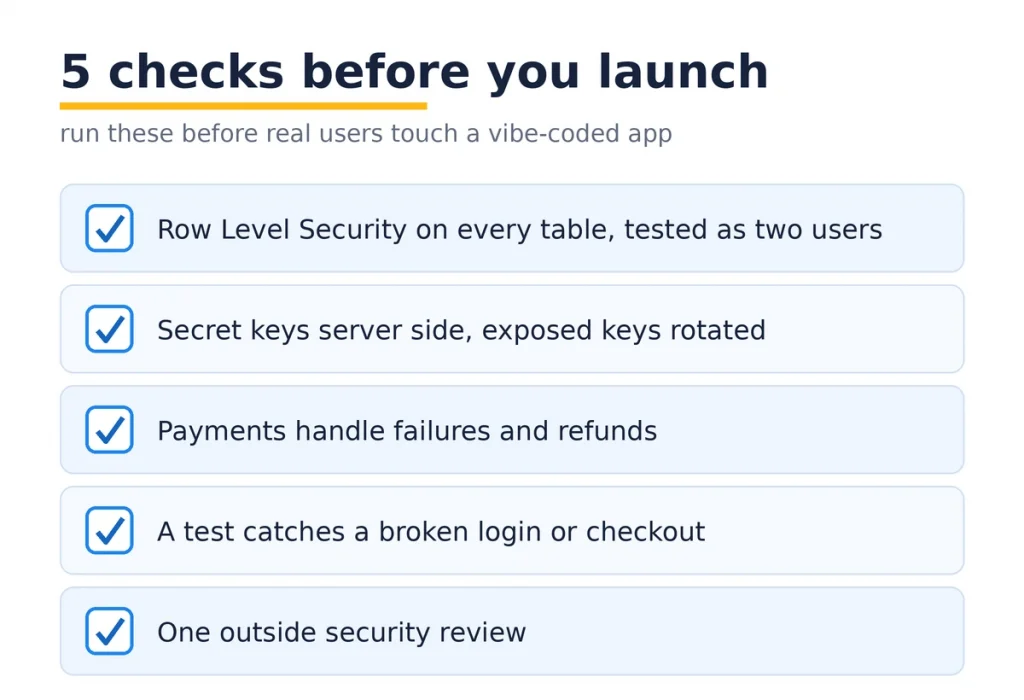
If you are about to put a vibe-coded app in front of real users, run these first:
- Is Row Level Security on for every table with real data, tested as two different users?
- Are all secret keys on the server, with anything that shipped in the frontend rotated?
- Do payments handle failures and refunds, not just the happy path?
- Would a test catch a broken login or checkout before your users do?
- Has anyone outside the build looked at it for security?
Any “no” on that list is a reason to pause. These five catch the worst of the vibe coding failures, and the first four you can often handle yourself. The fifth is where an outside set of eyes pays for itself.
Where Mobilions fits
We have been building and fixing software since 2016: 250+ projects for 100+ clients across 20+ countries. A growing share of that work now is exactly this, taking an app that started with vibe coding and getting it ready for real users.
Our AI code cleanup service walks all six of the places above, closes the security holes first, then the performance and structure problems, and leaves you with the app you thought you had.
If you are not sure whether yours needs a light pass or a deeper rebuild, that is the kind of call a fractional CTO makes well, and it is usually cheaper to ask early than to find out from a user.
If you would rather build the next version properly from the start, our approach to custom AI software development keeps the speed of AI without the six breaks.
FAQ
What is vibe coding?
Vibe coding means building software by describing what you want in plain language and letting an AI model write the code, often without reviewing it line by line. Andrej Karpathy coined the term in early 2025, and Collins Dictionary named it Word of the Year 2025.
Is vibe coding good or bad?
It is genuinely good for prototypes, internal tools, and testing an idea fast. It becomes risky when a prototype ships to real users with real data, because the AI skips the security and structure that production needs. The method is fine. Shipping it unchecked is the problem.
Can vibe coding build a real production app?
Yes, but not on its own. A vibe-coded app can become production ready after a hardening pass that adds database security, moves secret keys to the server, validates inputs, fixes performance, and adds tests. The build is a strong first draft, not the finished product.
Why do vibe-coded apps break in production?
They break because the tools optimize for a working demo, not a hardened product. The common failures are open database access, exposed API keys, no input validation, missing indexes, no tests, and tangled structure. Each is predictable and fixable.
Is AI-generated code secure?
Often not by default. Veracode’s 2025 study found 45% of AI-generated code samples introduced an OWASP Top 10 vulnerability, with cross-site scripting slipping through 86% of the time. AI code needs a security review before it goes live, the same as any code.
How do I know if my vibe-coded app is safe to launch?
Check five things: row level security on every table, secret keys kept server side, payments that handle failures and refunds, tests around login and checkout, and one outside security review. If any answer is no, pause and fix it first.
How much does it cost to fix a vibe-coded app?
It depends on how deep the problems go, but most cleanups are far cheaper than a rebuild. A typical security and performance pass on a sound app runs a few days of work. A rebuild is only needed when the data model itself is wrong.
Should I rebuild or fix my vibe-coded app?
Fix it if the data model is sound and the problems are security, performance, and structure, which is the common case. Rebuild only when the core data design is wrong in a way that every feature depends on. Most vibe-coded apps do not need a rebuild.
What are the most common vibe coding mistakes?
Leaving Row Level Security off, hardcoding API keys in the frontend, trusting user input without validation, skipping database indexes, and shipping with no tests. All five are common, and all five are quick to fix once you know to look.
Is vibe coding good for MVPs?
It is one of the fastest ways to build an MVP and validate an idea. Just treat the result as a prototype. Before you take payments or store personal data, run the six-point hardening pass so the MVP does not become a liability.
Can vibe coders build complex applications?
Vibe coding handles a first version of most apps well. Complexity is where it strains, because the generated code lacks the structure needed to add features safely. Complex apps usually need an engineer to set the architecture the AI never did.
Vibe coding vs traditional coding, which is better?
They are better at different jobs. Vibe coding wins on speed to a first version. Traditional engineering wins on security, scale, and long-term maintenance. The strongest teams use vibe coding to move fast, then apply real engineering before real users arrive.
What tools are used for vibe coding?
The common ones are Lovable, Bolt, Cursor, Replit, and v0, plus general assistants like ChatGPT and Claude. They differ in polish, but they share the same blind spot: they produce a working demo and leave production hardening to you.
Do real companies actually use vibe coding?
Yes. A quarter of Y Combinator’s Winter 2025 startups had codebases that were about 95% AI-generated. The difference between the ones that scale and the ones that stall is whether they hardened the code before growth, not whether they used AI to write it.
How do I make my vibe-coded app secure?
Start with the highest-impact fixes: turn on Row Level Security, move secret keys off the frontend and rotate the exposed ones, validate every input on the server, and run your code against the OWASP Top 10. Then add tests around login and payment.
How long does it take to make a vibe-coded app production ready?
For a sound app with the usual issues, a focused hardening pass is often a few days to two weeks. Apps with deeper data-model problems take longer. The security fixes come first because they carry the most risk.
Can I scale a vibe-coded app?
Not until the performance and structure breaks are fixed. Missing indexes, N+1 queries, and tangled code all cap how far an app can grow. Once those are addressed, a vibe-coded app can scale like any other well-built product.
The next step
Vibe coding is not going anywhere, and it should not. It is the fastest way to turn an idea into something you can click. Just remember that a running demo and a launch-ready product are two different things, separated by the six places above.
If you already have a vibe-coded app with users on it, start with the five-point launch check today. Fix what you can, and get an outside review on the rest before the numbers grow.
If you want that review from a team that does it most weeks, tell us what you built and we will point you at the shortest fix. Finding a leak yourself is a Tuesday. Finding out from a customer is a very different day.

Mayank Makwana is an AI Solution Architect and Full Stack Developer at Mobilions, where he designs and ships production AI systems — grounded, governed, and owned by the client. He specializes in LLM applications, retrieval-augmented generation (RAG), and AI agents, and also builds modern web applications. He writes senior-level guides on AI architecture, applied machine learning, and web engineering.