AI agents for healthcare are software agents that take over the repetitive, admin-heavy work around care, booking appointments, handling intake, drafting clinical notes, chasing billing, so staff spend less time on paperwork and more on patients. The important part is what they are not: they are not a replacement for a clinician’s judgment, and they only belong in healthcare when they are built to protect patient data. That second point, compliance, is where most of the real work and most of the cost sits.
If you have asked how. tobuild AI agents for healthcare and what it takes, this. guide is thestraight version. It covers what these agents actually do, how to build one step by step, what HIPAA compliance really means in practice, what it. costs in2026, and where a human has to stay in. the loop. Mobilionshas shipped healthcare software, including a privacy-first medical translation app, so this is from building the real thing, not a demo.
Key takeaways
- AI agents for healthcare are strongest at admin work: scheduling, intake, clinical notes, billing, and follow-up. Gartner expects agentic AI to cut administrative processing costs by up to 30 percent.
- They do not diagnose or decide care on their own. A clinician stays in the loop for anything that touches a medical decision.
- Compliance is the hard part. A healthcare agent must keep patient data (PHI) in HIPAA-eligible infrastructure, under a signed Business Associate Agreement, with encryption, audit logs, and minimum-necessary access.
- Cost tracks compliance and integration more than the AI. A single-workflow agent runs about 35,000 to 70,000 dollars; a multi-location production system 70,000 to 150,000 and up.
- The two biggest cost and time drivers are compliance engineering and connecting to your EHR and scheduling systems.
What AI agents for healthcare actually do
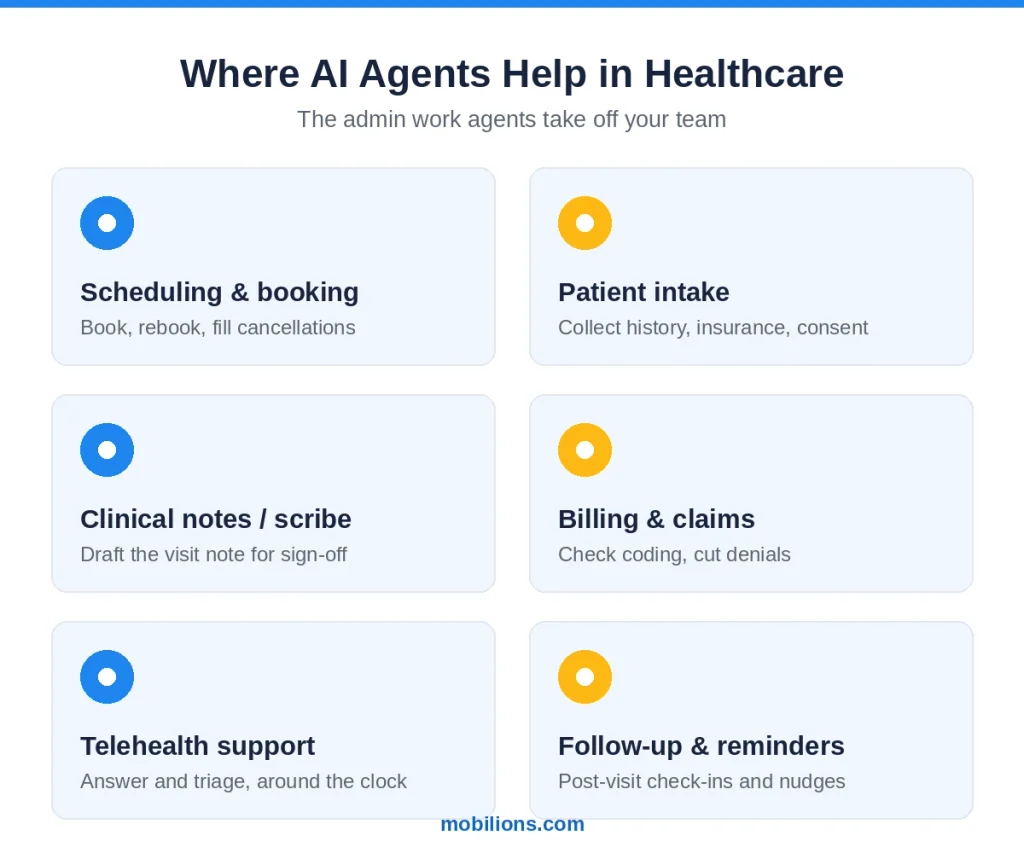
The clearest wins for AI agents for healthcare in 2026 are administrative, not clinical. These are the use cases moving from pilot to production across practices and hospital systems.
- Patient scheduling and booking. Agents book, reschedule, and fill cancellations across your calendar, and cut phone-tag for the front desk.
- Intake and onboarding. AI intake assistants collect history, insurance, and consent before the visit, so the first few minutes are care, not forms.
- Clinical notes and scribing. Ambient AI scribes draft the visit note from the conversation, which the clinician reviews and signs. This is one of the biggest time-savers.
- Billing and revenue cycle. Agents check coding, flag errors before claims go out, and chase the status of unpaid claims, reducing denials and manual follow-up.
- Telehealth and patient support. Support agents answer common questions, triage messages, and route the ones that need a human, around the clock.
- Follow-up and care coordination. Agents send reminders, check in after a visit, and coordinate multi-step admin across systems, with audit trails and human checkpoints.
Notice the pattern: these free clinicians from paperwork rather than make medical calls. That is the line that keeps healthcare AI safe and useful, and it shapes everything in our AI agent development services for the sector.
How to build an AI agent for healthcare, step by step
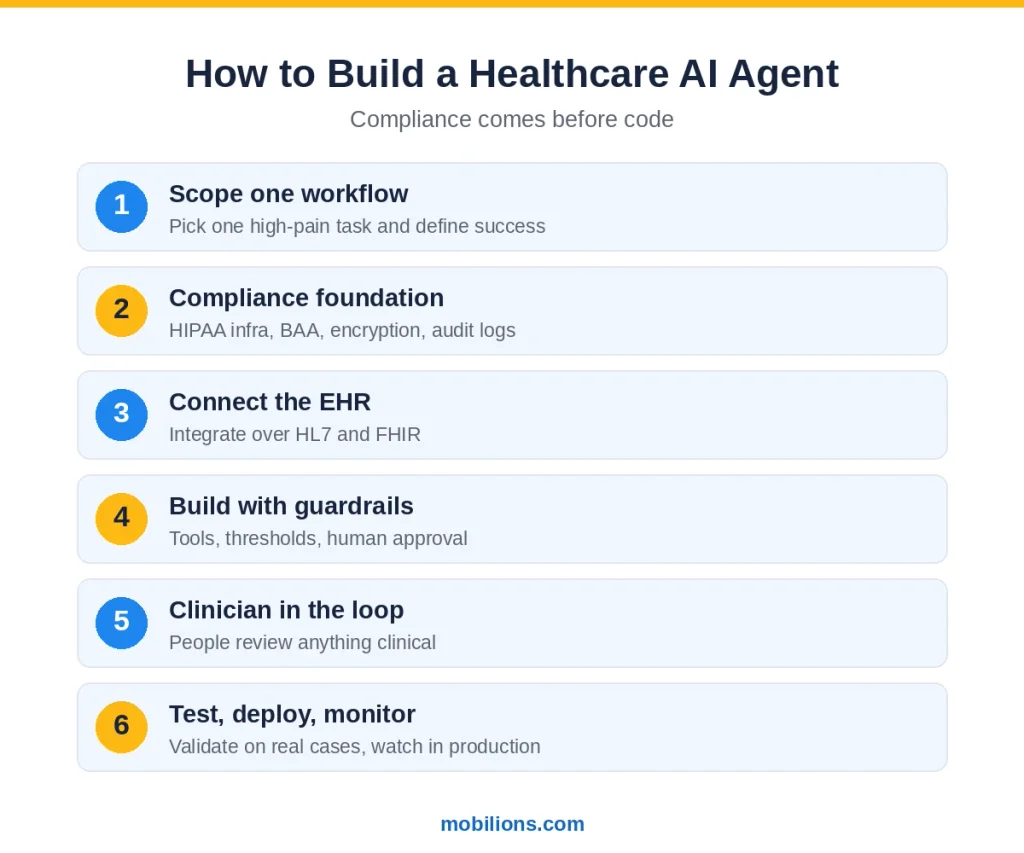
This is the part people really want when they ask how to build AI agents for healthcare. The order matters, because in healthcare compliance comes before code, not after.
1. Scope one workflow and the outcome. Pick a single, high-pain task (scheduling, intake, or notes) and define what success looks like in hours saved or errors cut. Do not try to automate the whole practice at once.
2. Lay the compliance foundation first. Decide where patient data will live (HIPAA-eligible infrastructure), get a Business Associate Agreement in place with every vendor that touches PHI, and set encryption, access control, and audit logging as the base, not an add-on.
3. Connect to your EHR and systems. Integrate with your electronic health record and scheduling, usually over standards like HL7 and FHIR. This is the slow, unglamorous part, and the one that most often blows up naive timelines.
4. Build the agent with guardrails. Wire the agent to its tools and data, add confidence thresholds, and make it ask for human approval on anything consequential. Retrieval keeps answers grounded in your real policies and records.
5. Keep a clinician in the loop. Any output that touches a medical decision gets reviewed by a person. The agent drafts and proposes; the clinician decides and signs.
6. Test, validate, deploy, and monitor. Evaluate the agent on real cases before launch, roll out to a small group first, and monitor accuracy and safety in production, because an agent that is quietly wrong is worse than none.
HIPAA and compliance: what makes a healthcare AI agent legal
A healthcare agent is only safe to use if it is compliant, and HIPAA is the baseline in the United States. Compliance is not a checkbox at the end; it is how the thing is built. In practice it means protected health information stays in HIPAA-eligible infrastructure, every vendor touching that data signs a Business Associate Agreement, data is encrypted in transit and at rest, access is minimum-necessary, and every action is logged for audit.
One rule to carry into any vendor conversation: if a provider of AI agents for healthcare will not sign a BAA, walk away. That single question filters out most tools that are not actually built for healthcare. For the technical standards behind records exchange, HL7 FHIR is the common language your agent will speak to the EHR.
How much do AI agents for healthcare cost in 2026?
Cost tracks compliance and integration far more than the AI model. Here are the rough 2026 ranges.
| Scope | Typical 2026 cost | What you get |
|---|---|---|
| Proof of concept | 8,000 to 20,000 | One workflow proven on sample data, no live PHI |
| Single-workflow agent | 35,000 to 70,000 | Scheduling or intake for one practice, compliant and live |
| Multi-workflow production | 70,000 to 150,000 | Multiple workflows, multi-location, full compliance tooling |
| Enterprise / complex | 150,000 to 350,000+ | Hospital-scale, deep EHR integration, governance |
For AI agents for healthcare, the two biggest cost drivers are compliance engineering and EHR or scheduling integration, not the agent itself. Budget for running costs too: model usage, hosting in compliant infrastructure, and ongoing maintenance, usually 15 to 30 percent of the build per year. A small practice can still start: scope one workflow, prove it, and expand.
Timeline: how long it takes
For AI agents for healthcare, the build moves slower than other software, mostly because of compliance and EHR access. As a guide: a proof of concept in about 3 to 6 weeks, a single compliant workflow in 2 to 4 months, a multi-workflow production system in 4 to 8 months, and hospital-scale work in 8 to 12 months or more. The agent is rarely the bottleneck; data access, integration, and validation are.
The risks, and where a human must stay
For AI agents for healthcare, a balanced view means naming the limits. AI agents can be confidently wrong, so nothing that affects diagnosis, treatment, or a clinical decision should run without a clinician reviewing it. Accountability stays with the provider, not the software, which is exactly why human-in-the-loop is a design requirement in healthcare, not a nicety. Patient data carries real risk if mishandled, so security and consent are not optional. Used inside those lines, for admin and drafting with a person signing off, agents are safe and genuinely useful. Pushed past them, they are a liability.
How to choose a healthcare AI partner
When choosing a provider of AI agents for healthcare, look for a team that will sign a BAA without hesitation, has actually shipped healthcare software, designs compliance and human oversight in from the start, and is honest about what should stay with a clinician. Be wary of anyone who promises diagnosis-grade AI with no human in the loop, cannot explain where PHI lives, or treats HIPAA as paperwork to handle later.
How Mobilions builds healthcare AI
We build healthcare software the way the domain demands: compliance first, clinician in the loop, and honest about where an agent helps versus where it does not belong. We have shipped real healthcare products, including Careslate, a privacy-first medical translation app for real-time, two-way clinical conversations, so we build for the accuracy and data care the sector requires, not a generic chatbot.
Mobilions has delivered software and AI since 2016, more than 250 projects for over 100 clients across 20-plus countries, and the same senior engineers scope, build, and support the system. See our healthcare software work and AI agent development services, or book a discovery call to talk through one workflow.
Frequently asked questions
What are AI agents for healthcare?
AI agents for healthcare are software agents that handle admin-heavy tasks around care, such as scheduling, patient intake, clinical note drafting, billing, and follow-up. They act across your systems with guardrails and human oversight. They support staff and clinicians; they do not replace clinical judgment.
Will AI replace doctors?
No. The strong, safe use of AI in healthcare is administrative and supportive, not diagnostic. Agents take paperwork and routine tasks off clinicians so they spend more time with patients. Any output touching a medical decision is reviewed and signed by a clinician, who remains accountable.
Are AI agents for healthcare HIPAA compliant?
They can be, when built correctly. That means protected health information stays in HIPAA-eligible infrastructure, every vendor touching it signs a Business Associate Agreement, data is encrypted, access is minimum-necessary, and actions are logged. If a vendor will not sign a BAA, the tool is not safe for healthcare.
How much does a healthcare AI agent cost in 2026?
A proof of concept runs about 8,000 to 20,000 dollars, a single compliant workflow 35,000 to 70,000, and a multi-location production system 70,000 to 150,000, with enterprise builds higher. Compliance engineering and EHR integration are the main cost drivers, not the AI model.
How long does it take to build one?
Roughly 3 to 6 weeks for a proof of concept, 2 to 4 months for a single compliant workflow, and 4 to 8 months for a multi-workflow production system. Healthcare is slower than other software because of compliance and EHR access, not the agent itself.
Do AI agents connect to our EHR?
Yes, that is central to the build. Agents integrate with your electronic health record and scheduling systems, usually over standards like HL7 and FHIR. This integration is the slow, important part of the project and a major driver of cost and timeline.
How do AI agents protect patient data?
Through HIPAA-eligible infrastructure, a signed Business Associate Agreement, encryption in transit and at rest, minimum-necessary access, and full audit logging. For regulated data, security and consent are designed in from the start, and sensitive actions require human approval.
Can small practices afford AI agents?
Yes, by starting small. Scope one high-pain workflow, such as scheduling or intake, prove it saves time, and expand from there. You do not need a hospital budget; you need focus on the task that costs your team the most hours.
What tasks can AI agents automate in a medical practice?
Scheduling and rebooking, patient intake and consent, drafting clinical notes from visits, billing and claim checks, answering routine patient questions, appointment reminders, and post-visit follow-up. The common thread is repetitive admin work, not clinical decisions.
What happens if the AI gets something wrong?
That is why healthcare agents keep a human in the loop. The agent drafts or proposes; a clinician reviews and decides on anything clinical, and accountability stays with the provider. Good builds also add confidence thresholds, evaluation, and monitoring to catch errors before they reach a patient.

Mayank Makwana is an AI Solution Architect and Full Stack Developer at Mobilions, where he designs and ships production AI systems — grounded, governed, and owned by the client. He specializes in LLM applications, retrieval-augmented generation (RAG), and AI agents, and also builds modern web applications. He writes senior-level guides on AI architecture, applied machine learning, and web engineering.