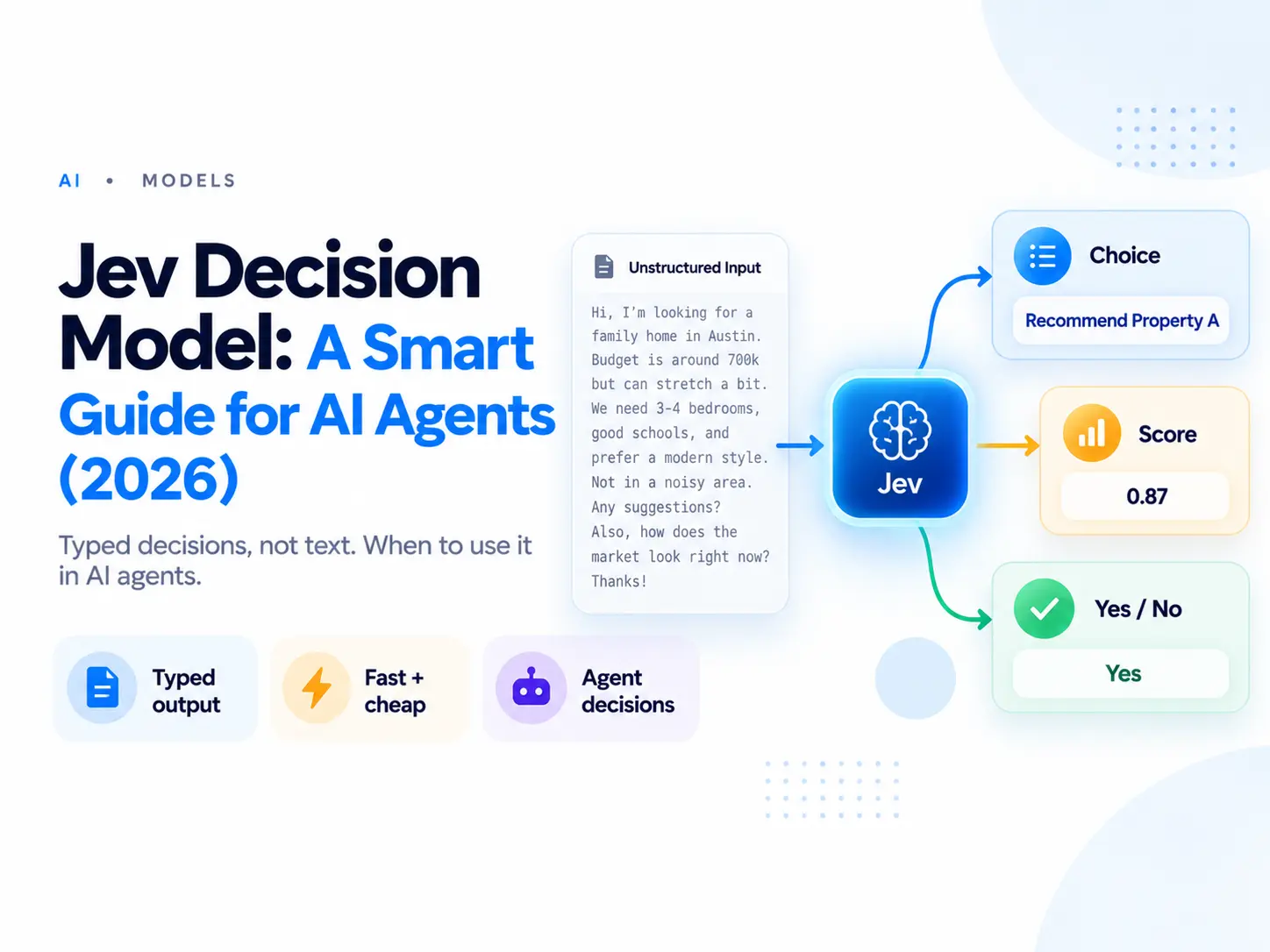
The Jev decision model is one of the more interesting AI launches of 2026, because it does something most models do not: instead of writing text, it returns a typed decision with a confidence score. For teams building AI agents and automation, that difference is not a gimmick. It points at a real gap in how agents make the small, fast choices that a large language model is slow and expensive to make. This guide explains what Jev is, how a decision model differs from an LLM, when to reach for one, and how to add a decision layer to your own agents.
We build AI agents and automation for a living, so the goal here is practical: not hype, just where a model like Jev genuinely helps and where it does not.
What is the Jev decision model?
Jev is the first model from TypeSafe AI, a San Francisco lab that emerged from stealth on September 15, 2026 with a 40 million dollar seed round led by DCVC. It was founded by Diogo Almeida, a co-author of the InstructGPT research that led to ChatGPT. TypeSafe calls Jev a “System One” model, a nod to fast, intuitive decision-making rather than slow, deliberate reasoning.
The core idea is simple. You send Jev a state, some text or JSON describing a situation, plus a set of questions, each with the allowed answers defined in advance. Jev returns one of those answers for every question, in parallel, with a calibrated probability attached. The questions come in three shapes: a Choice (pick one of several options), a Score (a number in a range), and a yes/no probability.
Because the answer space is enumerated in the request, the model cannot invent an option, return malformed output, or produce a type error. That type guarantee is built into the model, not bolted on as a post-processing layer over a text generator. Jev is called through its own evaluate endpoint rather than the chat-completions endpoint you use for an LLM.
How the Jev decision model differs from an LLM
The clearest way to understand a decision model is by contrast with a large language model, because they are built for different jobs.
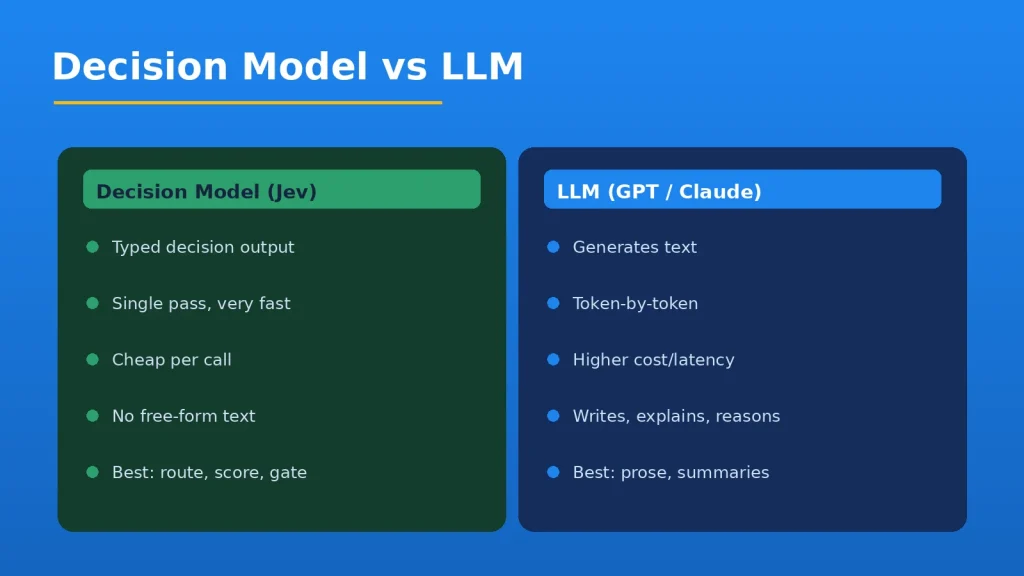
An LLM generates text token by token, one after another, which is why it can write prose, explain reasoning, and hold a conversation, and also why it can be slow, expensive, and occasionally produce an answer outside the format you wanted. A decision model like Jev skips that token-by-token generation entirely. It produces the decision in a single pass using a non-autoregressive architecture and a parallel sampler, trained with a method TypeSafe calls Reinforcement Learning for Calibrated Decisions.
The practical result is speed and cost. TypeSafe reports latency of roughly 70 to 500 milliseconds and, on classification tasks, claims up to 200 times faster inference and 400 times lower cost than a comparable LLM, with pricing of 0.042 dollars per million input tokens and output tokens free. Those are vendor figures on specific benchmarks, so treat them as a direction rather than a promise, but the architecture genuinely is built to make cheap, fast, structured decisions rather than to write.
The trade you make is real: you give up free-form text generation. If you need a summary, a drafted reply, or an explanation, you still need an LLM. Jev is for the decision, not the prose.
When to use a decision model instead of an LLM
The useful heuristic is “complicated input, simple output.” If your task takes messy, unstructured input and needs to end in a small, defined answer that code will act on, a decision model is a strong fit. If it needs to end in generated language, an LLM is still the right tool.
Reach for a decision model like Jev when you can define the answer space in advance and the result will be reused, ranked, routed, or blocked by your code. Classifying a support ticket, scoring a lead, deciding which queue handles a request, or judging whether an action is safe are all “complicated input, simple output” problems.
Stay with an LLM when the product needs prose: a written summary, a customer reply, a code explanation, or open-ended reasoning. Many real systems use both, with a fast decision model gating and routing work and an LLM generating text only when a decision says it is needed. That pairing is where this gets interesting for agents.
Using a decision model in AI agents and automation
This is where a decision model earns its place, because AI agents make a lot of small decisions, and paying for an LLM call on each one is slow and expensive. A cheap, fast, calibrated decision changes what is feasible.
Tool gating and safety checks. Before an agent runs a command or calls a tool, a decision model can return proceed, review, or block based on the command and its context. Because the check is cheap, you can run it on every action rather than sampling, which is exactly the kind of guardrail our AI agent development work depends on.
Routing. A decision model can classify an incoming request by intent or complexity and route it to the right agent, queue, or model, sending easy cases to a cheap path and hard ones to a stronger one.
Classification and extraction at scale. Tagging documents, scoring leads, and categorizing messages are high-volume, judgment-light tasks that fit a decision model well and pair naturally with our AI automation services.
Verification and confidence gating. Because every answer carries a calibrated probability, you can send low-confidence cases to a human and let high-confidence ones run automatically, which is the backbone of good human-in-the-loop design.
In an agentic AI system, the pattern is a decision layer that makes the fast, structured calls and an LLM that handles the language. The decision model keeps the agent fast and bounded; the LLM handles the parts that need words.
How to add a decision layer to your agents
Adding a decision layer is an architecture change, not a rewrite, and it follows a clear path.
Start by listing the small decisions your agent already makes with an LLM or brittle rules: route this, allow that, score this, is this safe. Each of those is a candidate for a decision model. Define the answer space for each as an explicit schema, since that enumeration is what makes the output safe and the model fast.
Then measure. Run the decision model against your real cases, compare its accuracy and calibration to your current LLM or rules, and keep it only where it wins on cost, speed, and quality together. Set a confidence threshold so uncertain cases fall back to an LLM or a human. The result is an agent that spends LLM budget only where language is genuinely needed, and makes everything else cheaply.
Because Jev is in early access and this class of model is new, we treat it as one option in a decision layer rather than a lock-in. The right design keeps the decision layer swappable, so you can move between providers as this space matures.
Jev versus function calling and JSON mode
A fair question is why you would use a separate decision model at all, when modern LLMs already offer structured output through function calling, JSON mode, and constrained decoding. The distinction is worth understanding, because it decides whether Jev is solving a problem you actually have.
Function calling and JSON mode make an LLM return structured data, but the structure is enforced on top of a text generator that is still running its slow, token-by-token process underneath. You get a schema-shaped answer, but you pay LLM latency and cost for it, and the guarantee is a wrapper around a model that was built to write. A decision model like Jev is the opposite: the typed output is the model’s native behavior, and there is no text-generation step to pay for. That is where the speed and cost gap comes from.
The practical rule is about volume and simplicity. If you make a structured decision occasionally, inside a workflow that already uses an LLM for language, function calling on that LLM is simpler and avoids adding a second model. If you make the same small decision thousands of times, on a hot path where latency and cost matter, a dedicated decision model can be the better tool, because you are not paying a generative model to do a job it is over-engineered for.
This is also why decision models fit agents so well. An agent that checks safety, routes work, or scores options on every step is exactly the high-volume, simple-output pattern where paying full LLM cost per call adds up fast. For a one-off classification, reach for what you already have. For a decision the agent makes constantly, a decision layer starts to pay for itself.
Limitations and honest caveats
A decision model is not a general-purpose upgrade, and pretending otherwise wastes budget. Jev cannot write, explain, or reason in prose, so any product that needs generated language still needs an LLM. It is only as good as the schema you define; a poorly framed question gives a confident but useless answer.
It is also very new. Jev launched in early access in September 2026, so the tooling, benchmarks, and best practices are still forming, and the headline speed and cost figures are vendor claims on specific tasks. Security researchers have already shown that, like any model taking untrusted input, a typed decision model can be steered by prompt-injection-style attacks, so the surrounding guardrails still matter. None of that makes it a bad choice; it makes it a choice to adopt deliberately, measured on your own data, with a fallback in place.
Why work with Mobilions on decision models
Adopting a new model class well is an engineering judgment call, and that is exactly where we help. We build AI agents and automation that reach production, so we can tell you honestly where a decision model like Jev pays off, where an LLM is still the right tool, and where plain rules beat both.
Senior engineers scope the decision layer with you, benchmark it on your real cases, wire in confidence thresholds and human review, and keep the design swappable so you are not locked to one early-access provider. You own the code, the prompts, and the architecture throughout. If you want to explore where a decision layer fits your product, our LLM development and agent teams can scope it with you, and you can also hire AI developers to extend your own team.
Frequently asked questions
What is the Jev decision model?
Jev is the first model from TypeSafe AI, a “System One” model that returns typed decisions with calibrated confidence instead of text. You give it a situation and a set of questions with defined answers, and it returns a choice, a score, or a yes/no probability for each, in parallel. It is built for decisions software will act on, not for chat.
How is Jev different from an LLM like GPT?
An LLM generates text token by token, which lets it write and reason but makes it slower and pricier. Jev skips text generation and produces a structured decision in a single pass, so it is fast and cheap, and it cannot return output outside the schema you define. The trade is that Jev cannot write prose, so you still need an LLM for language.
When should I use a decision model instead of an LLM?
Use a decision model when the task is “complicated input, simple output”: messy input that ends in a defined answer your code will act on, such as routing, classification, scoring, or safety checks. Use an LLM when you need generated language, like a summary or a reply. Many systems use both, with a decision model gating and routing and an LLM generating text.
How does Jev help AI agents?
Agents make many small decisions, and an LLM call for each is slow and expensive. A cheap, fast decision model can gate tool calls (proceed, review, block), route requests, classify inputs, and confidence-gate results on every step, which keeps the agent fast, bounded, and safer. The LLM then handles only the parts that need words.
How much does Jev cost and how fast is it?
TypeSafe lists pricing at 0.042 dollars per million input tokens with output tokens free, and reports latency of roughly 70 to 500 milliseconds. On classification tasks it claims up to 200 times faster inference and 400 times lower cost than a comparable LLM. These are vendor figures on specific benchmarks, so validate them on your own tasks before committing.
Can Jev replace our LLM?
No, and it is not meant to. Jev handles typed decisions; it cannot generate text, explain, or reason in prose. The realistic pattern is a decision layer alongside an LLM, where the decision model makes fast structured calls and the LLM handles language. Replacing an LLM entirely only works if your product never needs generated words.
Is a decision model like Jev safe to use in production?
It can be, with the same discipline any model needs: measure accuracy and calibration on your real data, set confidence thresholds so uncertain cases fall back to a human or an LLM, and keep guardrails around untrusted input, since prompt-injection-style attacks can still steer a typed model. Because Jev is in early access, we recommend a swappable design and a fallback rather than a hard dependency.
What is a “System One” model?
The name refers to fast, intuitive decision-making, as opposed to slow, deliberate reasoning. A System One model like Jev is optimized to return a quick, calibrated decision in a single pass, rather than to think step by step in text like a reasoning LLM. It is a different tool for a different job, not a smarter chatbot.
Do we own what you build with a decision model?
Yes. When Mobilions builds a decision layer or agent for you, you own the source code, the prompts, the schemas, and the architecture, with no lock-in. We design the decision layer to be swappable between providers, which matters especially with an early-access model, so you are never trapped on one vendor.
Should we adopt Jev now or wait?
It depends on your use case. If you have high-volume, well-defined decisions where speed and cost matter, a controlled pilot on your real data is worth running now, with a fallback in place. If your needs are mostly language generation, there is less urgency. We help teams pilot it deliberately, measure it honestly, and adopt only where it clearly wins.
A quick checklist before you pilot a decision model
If you want to test whether a decision model like Jev belongs in your stack, a short, disciplined pilot answers the question faster than a debate. Pick one high-volume decision your system already makes, not five. Write down the answer space as an explicit schema, because if you cannot enumerate the answers, the task is probably not a fit.
Assemble a real test set from your own data, with the correct answer labelled, and score the decision model on accuracy and calibration against your current LLM or rules. Compare all three dimensions together, cost, speed, and quality, rather than being swayed by any single headline number. Set a confidence threshold and confirm that low-confidence cases fall back cleanly to a human or an LLM.
Finally, keep the integration swappable behind a small interface, so that adopting an early-access model is a reversible experiment, not a dependency you cannot unwind. Run the pilot for a defined window, read the numbers, and expand only where the model clearly wins. That is how you get the upside of a new model class without betting the product on it.
The takeaway
The Jev decision model is a useful reminder that not every AI problem is a text problem. For the fast, structured decisions inside AI agents and automation, a typed decision model can be dramatically cheaper and faster than an LLM, as long as you use it for the decision and keep an LLM for the words. Adopt it deliberately, measure it on your own data, and keep the design swappable.
Exploring a decision layer for your agents? Talk to Mobilions. A senior engineer will tell you where a decision model like Jev fits, where an LLM is still right, and how to build it so you own it. Book a discovery call or explore our AI agent development services.

Mayank Makwana is an AI Solution Architect and Full Stack Developer at Mobilions, where he designs and ships production AI systems — grounded, governed, and owned by the client. He specializes in LLM applications, retrieval-augmented generation (RAG), and AI agents, and also builds modern web applications. He writes senior-level guides on AI architecture, applied machine learning, and web engineering.