The best multi-agent AI frameworks in 2026 are LangGraph for production control, CrewAI for fast role-based prototypes, and AutoGen or its successor the Microsoft Agent Framework for conversation-heavy workflows. That is the short answer. The honest one is that there is no single best framework, only the right one for your team, your language, and how much control you need, and this guide is about picking that.
A multi-agent framework is the software that lets several AI agents work together, one planning while others handle focused parts, and coordinate without stepping on each other. It is a different question from which single-agent framework to use, which we cover in our guide to AI agent frameworks. Here the focus is coordination: what the leading multi-agent AI frameworks are good at, where each falls down, and how to choose without a costly rewrite six months in.
Key takeaways
- There is no single best multi-agent framework. LangGraph wins on production control, CrewAI on speed to a first demo, AutoGen and the Microsoft Agent Framework on conversation-heavy work.
- LangGraph gives you an explicit state graph with checkpoints, streaming, and human-in-the-loop steps, which is why production teams pick it, at the cost of the steepest learning curve.
- CrewAI gets a role-based multi-agent system running in under 20 lines of Python, so many teams prototype on CrewAI and move to LangGraph when reliability becomes the bottleneck.
- Pick on your real constraints: language, team skill, how much control and auditability you need, and whether this is a prototype or a production system.
- Most problems do not need multiple agents. A single agent or a fixed workflow is often cheaper, faster, and easier to trust. Reach for multi-agent only when one agent genuinely cannot do the job.
What is a multi-agent AI framework?
A multi-agent AI framework is a toolkit for building systems where several agents, each with its own role and tools, coordinate to finish a task. One agent might plan, another research, another write, and another check the work, passing control between them. The framework handles the hard parts: how agents talk to each other, who does what, shared state and memory, and recovery when a step fails.
This is a level up from a single agent. A single-agent framework runs one agent in a loop; a multi-agent framework orchestrates many. If you are choosing between single-agent tools or just getting started, read our broader guide to AI agent frameworks first, then come back here when you know you need coordination between agents.
The best multi-agent AI frameworks in 2026 at a glance
Here are the leading options and what each is actually best at, before the detail.

| Framework | Best for | Language | Learning curve |
|---|---|---|---|
| LangGraph | Production control, auditability, state | Python, JS | Steep |
| CrewAI | Fast role-based prototypes | Python | Gentle |
| AutoGen / MS Agent Framework | Conversation-heavy, offline quality work | Python, .NET | Medium |
| OpenAI Agents SDK | Teams already on OpenAI, simple handoffs | Python, JS | Gentle |
LangGraph: most control for production
LangGraph is a low-level orchestration framework for stateful, multi-actor agents. You define an explicit state graph, with checkpointing, streaming, and human-in-the-loop steps built in. That graph model maps cleanly to what production teams need: audit trails, rollback points, and durable state you can inspect. It reached version 1.0 in late 2025 and tends to show the lowest latency and token use in benchmarks.
The trade is the learning curve, which is the steepest of the group. LangGraph asks you to think in graphs and state, not quick scripts. For a serious production system where reliability and auditability matter, that effort pays off. See the official LangGraph site for current docs.
CrewAI: fastest path to a working prototype
CrewAI is built around Crews and Flows and is independent of LangChain. Its strength is developer experience: you can stand up a role-based multi-agent system in under 20 lines of Python, which is why it is the go-to for a fast demo. It has a large, active community (around 47,000 GitHub stars) and is approachable for people who are not agent specialists.
The common pattern in 2026 is to prototype on CrewAI, prove the idea, then migrate to LangGraph when reliability and control become the bottleneck. That is a reasonable path, not a failure, as long as you plan for it. The CrewAI site has quickstarts to try it.
AutoGen and the Microsoft Agent Framework
AutoGen pioneered multi-agent conversation patterns, where agents talk to each other to solve a problem. In 2026 the original AutoGen is in maintenance mode: the Microsoft Agent Framework is its production successor, while AG2 continues the legacy style. AutoGen and its line excel at offline, quality-sensitive workflows where thoroughness matters more than speed, and are less suited to high-volume, real-time use like live customer support, where cost climbs.
OpenAI Agents SDK and other options
If your stack is already on OpenAI, the OpenAI Agents SDK offers a simpler way to build agents with clean handoffs between them, with a gentle learning curve. Beyond these four, worth a look depending on your needs: LlamaIndex for retrieval-heavy agents, Semantic Kernel for .NET shops, and Mastra for TypeScript-native teams. The field moves fast, so judge any framework by its last few months of activity, not a blog from a year ago.
How to choose the right multi-agent framework
Ignore the leaderboard and match the framework to your real constraints. A few questions settle most decisions.
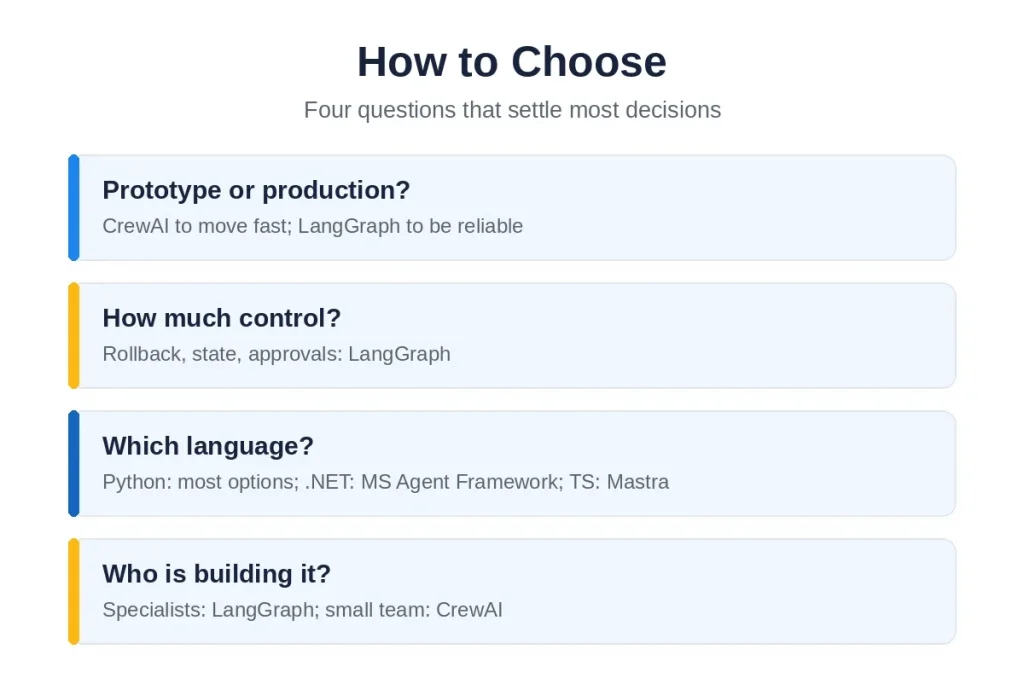
- Prototype or production? CrewAI or the OpenAI Agents SDK to move fast and learn. LangGraph when it has to be reliable, auditable, and durable.
- How much control do you need? If you need rollback points, inspectable state, and human approval steps, LangGraph is built for that. If you need a quick role-based crew, CrewAI.
- What language is your team in? Python has the most options. For .NET, look at the Microsoft Agent Framework or Semantic Kernel. For TypeScript, Mastra.
- Who is building it? Specialists can take on LangGraph from day one. A small or non-specialist team gets to value faster on CrewAI.
A practical rule many teams follow, and one Anthropic also recommends, is to start with the simplest setup that works and add complexity only when it earns its place. Multi-agent is complexity, so make it justify itself.
Do you even need multiple agents?
This is the question most framework comparisons skip, so here it is plainly. Multiple agents add real cost: more moving parts, more ways to fail, harder debugging, and higher token bills. A lot of problems labelled multi-agent are solved better by one capable agent, or by a fixed workflow with a model filling in steps. Reach for multi-agent only when the work genuinely splits into distinct roles that benefit from running and reasoning separately. If a single agent does the job, use a single agent. We tell clients this before any framework talk.
Common mistakes when choosing a framework
- Picking by GitHub stars instead of fit. The popular framework is not automatically right for your language, team, or control needs.
- Building multi-agent when one agent would do, and paying for the complexity with no benefit.
- Prototyping on the wrong tool and getting stuck. If you know it must be production-grade, factor in the move to a control-first framework early.
- Ignoring evaluation. Whatever the framework, you need a way to measure whether the agents are actually right, or you are shipping confident guesses.
- Chasing the newest release. The field churns; stability and your team’s ability to maintain it matter more than being first on a new framework.
How Mobilions builds multi-agent systems
We start from the outcome, not the framework. The first question is whether the problem needs multiple agents at all, and we are honest when a single agent or a workflow is the better call. When multi-agent is right, we choose the framework on your constraints, language, control needs, and whether it is headed for production, and we build in evaluation and human checkpoints from the start so you can trust what ships.
Mobilions has built software and AI since 2016, with more than 250 projects delivered for over 100 clients across 20-plus countries, and the same senior engineers scope, build, and support the system. If you are weighing a multi-agent build, our AI agent development services and broader agentic AI development cover it end to end. Tell us the task and we will tell you straight whether multi-agent is the right shape, or book a discovery call.
Frequently asked questions
What is the best multi-agent AI framework in 2026?
There is no single best one. LangGraph is best for production systems that need control and auditability, CrewAI for fast role-based prototypes, and AutoGen or the Microsoft Agent Framework for conversation-heavy, quality-sensitive work. The right choice depends on your language, team, and whether it is a prototype or production.
What is the difference between LangGraph and CrewAI?
LangGraph is a low-level, control-first framework with an explicit state graph, checkpoints, and human-in-the-loop steps, best for reliable production systems but with a steep learning curve. CrewAI is higher-level and fast to start, standing up a role-based crew in under 20 lines, best for prototypes. Many teams prototype on CrewAI and move to LangGraph for production.
Is AutoGen still a good choice in 2026?
The original AutoGen is in maintenance mode in 2026. Microsoft Agent Framework is its production successor, and AG2 continues the legacy style. The line is strong for offline, quality-sensitive workflows but costly for high-volume real-time use like live support. For new production work, consider the Microsoft Agent Framework or LangGraph.
Do I need coding skills to build multi-agent systems?
For the leading frameworks like LangGraph and CrewAI, yes, they are code-first (mostly Python). There are no-code and low-code agent builders for simpler cases, but they trade control and flexibility for ease. For a production multi-agent system, you will want developers or a development partner.
Which multi-agent framework is best for production?
LangGraph is the common choice for production because its state graph gives audit trails, rollback points, durable state, and human approval steps. The Microsoft Agent Framework is a strong option for .NET and enterprise stacks. The key is control, observability, and evaluation, not just how fast you can demo.
How much does it cost to build a multi-agent system?
It tracks complexity more than the framework. A prototype can start around 10,000 to 30,000 dollars, a production system with integrations commonly runs 40,000 to 150,000, and large multi-agent platforms go higher. Running costs (model API, hosting) and maintenance are ongoing, so budget for operation, not just the build.
Can I use more than one framework together?
Sometimes, but be careful. Mixing frameworks adds complexity and failure points. A more common and safer pattern is to prototype in one (such as CrewAI) and move to another for production (such as LangGraph), rather than running both in one system. Only combine them when there is a clear, specific reason.
Which framework has the best performance?
In published benchmarks LangGraph tends to show the lowest latency and token use, partly because its graph model is efficient. That said, performance depends heavily on how you design the agents, the model you use, and your prompts, so treat benchmarks as a guide, not a guarantee.
Are open-source multi-agent frameworks safe for business use?
They can be, with the right engineering. LangGraph, CrewAI, and AutoGen are open source and widely used in production. Safety comes from how you build: least-privilege access to your systems, encrypted data handling, audit logs, human approval on consequential steps, and real evaluation. The framework is the start, not the whole security story.
How do I choose a framework for my team size?
Small or non-specialist teams get to value fastest on CrewAI or the OpenAI Agents SDK. Larger teams, or any team building a serious production system, are usually better served by LangGraph’s control, despite the steeper curve. Match the tool to who will build and maintain it, not to what is trending.

Mayank Makwana is an AI Solution Architect and Full Stack Developer at Mobilions, where he designs and ships production AI systems — grounded, governed, and owned by the client. He specializes in LLM applications, retrieval-augmented generation (RAG), and AI agents, and also builds modern web applications. He writes senior-level guides on AI architecture, applied machine learning, and web engineering.