This mobile app development guide walks you through everything that actually matters before you build an app in 2026: what mobile app development involves, the types of apps you can build, the step-by-step process, real cost and timeline ranges, the native versus cross-platform decision, and how to choose a team you can trust. It is written for founders and business owners, not engineers, so you can make confident decisions without a technical background.
We build and ship mobile apps for a living, so the advice here is what we would tell a friend planning an app, including the parts where the honest answer is “you do not need that yet.”
What is mobile app development?
Mobile app development is the process of building software that runs on phones and tablets, from the first idea through design, engineering, testing, launch on the App Store and Google Play, and the ongoing support that keeps it working as iOS and Android change. It covers the app people tap on, the backend and databases behind it, and the integrations that connect it to payments, maps, notifications, and other systems.
The visible app is only part of the work. Most of the engineering effort goes into the parts users never see: the backend, the data model, security, and the integrations that make the app actually useful. A good build treats all of that as one system rather than bolting pieces together, which is what separates an app that scales from one that breaks the moment real users arrive.
Types of mobile apps you can build
The first real decision is what kind of app to build, because it shapes cost, timeline, and performance. There are four main routes.
Native apps are built specifically for one platform, using Swift for iOS app development and Kotlin for Android app development. They give the best performance and the deepest access to device features, at the cost of maintaining two separate codebases.
Cross-platform apps are built once and run on both iOS and Android from a single codebase, using frameworks like React Native or Flutter. In 2026 this is the default choice for most apps, because the cost and speed advantages are large and the old performance penalty has largely disappeared.
Hybrid apps wrap web code in a native shell. They are cheap and fast to build but feel less polished, so they suit simple internal tools more than consumer products.
Progressive web apps (PWAs) run in the browser with no app-store install. They are a low-cost way to reach users quickly, though they cannot use every device feature a real app can.
For most startups and businesses, cross-platform is the smartest starting point. Roughly 80 percent of new mobile apps fit the cross-platform sweet spot, and you can still go native later for a specific feature if the product demands it.
The mobile app development process, step by step
A well-run build moves through seven clear stages. Knowing them helps you spot a partner who skips the important early work.
1. Discovery and strategy. Define the goal, the users, the core features, and the platform. This is where scope is set and money is saved. Discovery and design together usually take four to eight weeks before any code is written.
2. UX and UI design. Map the user flows and design the screens around how people actually behave, not around a feature list. Good design here prevents expensive rework later.
3. Architecture and planning. Decide native or cross-platform, design the backend and data model, and plan the integrations. This is the blueprint the whole build follows.
4. Development. Senior engineers build the app in short cycles, so you see working screens early rather than waiting months for one big reveal. Frontend, backend, and integrations come together here.
5. Testing and QA. Test on real devices, real OS versions, and real network conditions, not just simulators. This is where the difference between a smooth app and a one-star review actually lives.
6. Launch. Submit to the App Store and Google Play, handle their review requirements, and roll out to real users. A focused first release beats a delayed everything-at-once launch.
7. Maintenance and updates. An app is not done at launch. OS updates, bug fixes, and new features are ongoing, and budgeting for them is part of doing it right. For a deeper look at the phases, see our guide on the 7 stages of app development.
How much does mobile app development cost in 2026?
Cost tracks scope far more than any agency’s rate card, so treat every headline number as a range until your features are scoped. As rough 2026 figures:
A simple app with basic features runs about 25,000 to 60,000 dollars for a single platform, or 35,000 to 80,000 dollars for a cross-platform build. A mid-complexity app with user accounts, payments, and integrations lands in the mid five figures to low six figures. A complex or enterprise app with custom backends, AI features, and strict compliance runs well into six figures. For serious US-facing products, plan on roughly 80,000 to 350,000 dollars for a first public release.
Two numbers people forget: maintenance typically costs 15 to 25 percent of the build cost per year to keep the app alive, and the biggest cost lever is usually who builds it, not the design. For a fuller breakdown, see our guide on mobile app development cost.
How long does it take to build a mobile app?
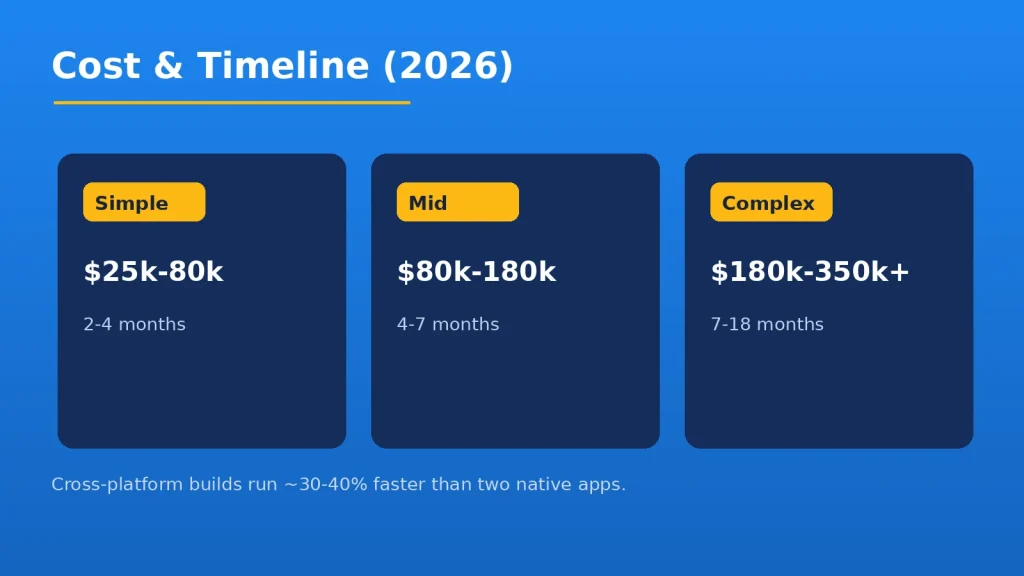
Timeline follows scope the same way cost does. A simple app usually takes two to four months, a moderate app four to seven months, and a complex app seven to eighteen months. Discovery and design alone take four to eight weeks before development starts.
Cross-platform development cuts timelines by roughly 30 to 40 percent compared with building two native apps, thanks to code reuse. The other big variable is your side: how quickly decisions and feedback move. A good partner ships in stages so you see a working app early and expand from there.
Native vs cross-platform: which should you choose?
This choice has the biggest effect on cost and timeline, so it deserves a clear answer. Cross-platform is 30 to 40 percent cheaper for a content-heavy app and 10 to 20 percent cheaper for a feature-heavy app once you add platform-specific polish and testing on both platforms. For a system-feature-heavy flagship, the saving can shrink to zero, because you end up writing native modules for most features anyway.
The practical rule for 2026: start cross-platform unless you have a specific reason not to. Go native when you need maximum performance, the newest platform features on day one, or heavy device-specific integration. A good partner recommends based on your product and budget and explains the reasoning, rather than defaulting to whatever they staff. Our mobile app development team scopes this with you before anything is built.
The tech stack behind a modern app
You do not need to master the stack, but knowing the pieces helps you ask better questions. A typical 2026 app uses React Native or Flutter for cross-platform, or Swift and Kotlin for native. The backend runs on Node, Python, or similar, with a cloud database and cloud hosting on AWS, Azure, or Google Cloud. Around that sit integrations for payments, maps, push notifications, analytics, and increasingly AI features.
What matters is not the specific tools but that the team chooses them on evidence for your product, and that you own the code, the accounts, and the app-store listings at the end. Anything less is a lock-in you will pay for later.
Mobile app trends worth building for in 2026
A few shifts are worth designing for, even if they are not all in your first version. AI features are becoming standard, from smart search and personalization to in-app assistants. Cross-platform has become the default rather than the compromise. Faster, phased launches are winning over big-bang releases, because getting a focused app in front of real users beats guessing in a requirements document.
Two more shifts are worth noting. Privacy and platform rules keep tightening, so apps that handle data cleanly and ask for permissions honestly avoid painful app-store rejections and user distrust. And wearables, voice, and connected devices are widening what a “mobile” app touches, so it is worth designing your architecture to extend beyond the phone if that is on your roadmap.
The common thread is speed and focus. The teams that win ship a lean, well-built first version, learn from real usage, and expand, rather than spending a year building everything before launch.
In-house, outsource, or a development partner?
Once you know what you want to build, the next question is who builds it. Hiring an in-house team gives you full control and works well when the app is your core product and you can afford senior salaries plus the months it takes to recruit. Outsourcing to freelancers is the cheapest route and fine for small, well-defined pieces, but it gets risky for a whole product because coordination, quality, and continuity fall on you.
A development partner sits in between: a senior team that scopes, builds, launches, and supports the app end to end, without the cost and delay of building an internal team from scratch. For most founders and businesses this is the pragmatic choice for a first product, because you get experienced engineers and a repeatable process immediately, then bring the work in-house later if it makes sense. If you are weighing these options, our guide on hiring versus outsourcing for a startup breaks down the trade-offs in detail.
Whichever route you pick, the same non-negotiables apply: senior people actually doing the work, clear ownership of the code, honest scoping, and a real plan for maintenance. Those matter more than the label on the arrangement.
Mobile app development by industry
Different industries put different demands on a build, and knowing yours helps you scope realistically. Fintech and banking apps live or die on security and compliance, with encryption, fraud checks, and strict data handling built in from the start. Healthcare apps need HIPAA-aware design, secure records, and often integration with clinical systems. E-commerce and retail apps center on fast catalogs, payments, and a checkout that does not lose the sale. Logistics and field apps need to work offline and sync when a connection returns. Fitness, sports, and social apps compete on engagement, so notifications, real-time features, and smooth performance matter most.
The lesson is that “a mobile app” is never generic. The right partner has shipped in your space, so they already know the traps: the app-store rules, the compliance edges, and the integrations that always break. Domain experience is one of the biggest predictors of a smooth build, which is why it belongs on your checklist alongside cost and timeline.
Common mobile app development mistakes to avoid
The failures in this space tend to repeat, and most are avoidable with honest scoping up front. The most expensive mistake is building everything before launch instead of shipping a focused first version, which delays feedback and hides which features users truly want. A close second is skipping discovery and testing to start coding sooner, which trades a few early weeks for months of rework later.
Other common traps: choosing a vendor on price alone, when a suspiciously low quote almost always means missing scope that reappears as change requests; ignoring maintenance, so the app degrades within a year of launch; unclear ownership, where the code or store listings stay trapped with the vendor; and no real device testing, so the app that looked fine in a demo falls apart on the phones your users actually carry. This mobile app development guide keeps coming back to the same theme because it is the one that matters: focus, honesty about scope, and a team that plans for the day after launch, not just the invoice.
How to choose a mobile app development partner
The team you pick matters more than any single feature. Ask who exactly will write your code and how senior they are, because a senior pitch that turns into a junior build is the most common bait-and-switch in this industry.
Ask for live apps you can download, ideally in your space, and read their reviews. Confirm in writing that you own the source code, the IP, and the app-store listings, with no lock-in. Get a clear answer on what maintenance and support cost after launch, because a team with no answer there is planning to disappear after the invoice clears. Third-party reviews and reference calls tell you more than any sales deck. When you are ready to staff a build, you can also hire mobile developers to extend your own team.
Frequently asked questions
How much does it cost to develop a mobile app?
A simple app runs about 25,000 to 60,000 dollars for one platform or 35,000 to 80,000 for cross-platform, a mid-complexity app lands in the mid five to low six figures, and a complex or enterprise app runs well into six figures. Serious US products often cost 80,000 to 350,000 dollars for a first release. Budget another 15 to 25 percent of build cost per year for maintenance.
How long does it take to build a mobile app?
A simple app usually takes two to four months, a moderate app four to seven months, and a complex app seven to eighteen months. Discovery and design alone take four to eight weeks before development begins. Cross-platform builds are about 30 to 40 percent faster than building two native apps.
Should I build a native or cross-platform app?
Cross-platform (React Native or Flutter) is the right default for most apps in 2026: it is cheaper, faster, and the performance gap has largely closed. Choose native (Swift or Kotlin) when you need maximum performance, the newest platform features immediately, or heavy device-specific integration. A good partner recommends based on your product and explains why.
What are the stages of mobile app development?
The seven stages are discovery and strategy, UX and UI design, architecture and planning, development, testing and QA, launch on the app stores, and ongoing maintenance. Skipping discovery and testing is where most failed apps go wrong, so a good process treats those as core, not optional.
Do I need separate apps for iOS and Android?
Not necessarily. Native development means two separate codebases (one each for iOS and Android), while cross-platform frameworks build both from a single codebase, which lowers cost and speeds delivery. Most businesses start cross-platform and only go native for a specific feature if the product truly needs it.
How do I turn my app idea into a real product?
Start with a discovery phase that defines the goal, users, and core features, then design and build a focused first version (an MVP) rather than everything at once. Launch it, learn from real users, and expand. The fastest path is a senior team that scopes honestly and ships in stages, so you see progress early.
What is an MVP and do I need one?
An MVP (minimum viable product) is a first version with only the core features needed to prove the idea and get real users. Yes, most apps should start here: it is cheaper, faster, and it tells you what users actually want before you invest in the full build. You expand from a working MVP rather than guessing up front.
How do I keep my app secure?
Any app handling user or payment data needs encryption in transit and at rest, secure authentication, least-privilege access to sensitive data, and secure payment handling through a compliant gateway. For regulated apps like fintech or healthcare, security and compliance should be designed into the architecture from the start, not added later.
What happens after my app launches?
Launch is the start, not the end. Apps need ongoing maintenance for OS updates, bug fixes, security, and new features, typically 15 to 25 percent of build cost per year. Plan and budget for it up front, and make sure your team has a clear support plan, because an unmaintained app degrades within a year.
Do I own the app and the code?
You should. Insist in writing that you own the source code, the IP, and the app-store listings, with no proprietary lock-in. This is standard for good teams and a red flag when it is missing, because it protects your product if you ever change partners.
Build your mobile app the right way
Mobile app development rewards focus: the right app type, a lean first version, a clear process, and a partner who tells you what to cut. Get those right and your app becomes a real product rather than a project that stalls in scope.
Planning a mobile app? Talk to Mobilions. A senior engineer will scope it with you, recommend the right platform, and give you an honest cost and timeline. Book a discovery call or explore our mobile app development services.

Dhaval Patel is a Senior Mobile Developer at Mobilions with deep, hands-on experience shipping Android, iOS, and cross-platform apps. He has helped build products used by teams across 20+ countries. He writes practical guides on mobile app development, app performance, and the real-world trade-offs of building for phones and tablets.