Healthcare mobile app development is the process of building iOS or Android apps that handle patient or clinical data, which means HIPAA compliance, strong security, and often EHR integration are part of the job from day one, not features you bolt on later. A basic HIPAA-ready MVP typically starts around $60,000 and ships in about four to six months. The cost and timeline track compliance, the integrations you need, and whether your app is a wellness tool or a regulated medical device.
Most healthcare apps do not fail because the idea was wrong. They fail because the team treated a medical app like a regular app, and then hit compliance, security, and integration walls halfway through the build. By then the budget is spent and the timeline is gone.
This guide is written to keep you out of that hole. It covers what healthcare mobile app development actually involves in 2026, what it costs, how long it takes, where HIPAA and the FDA fit in, and how to choose a team that has shipped this kind of app before. We have built and shipped mobile health products since 2016, including medical translation and nutrition platforms where a wrong answer carries real consequences, so the advice here is what we would tell a founder over a call.
Key takeaways
- Healthcare app development means compliance and security are part of the build from day one, not add-ons.
- Know early whether your app is a wellness product or an FDA-regulated medical device. The line is narrower than most founders expect.
- HIPAA in practice means AES-256 at rest, TLS 1.2 or higher in transit, MFA, audit logs, and signed BAAs with every vendor.
- A HIPAA-ready MVP starts around $60,000 and ships in four to six months. EHR integration adds the most to both cost and timeline.
- Choose a team with shipped healthcare apps, compliance fluency, named senior engineers, and clear code ownership.
What healthcare mobile app development actually means
A healthcare app is any mobile app that touches health data or clinical workflows. That covers a lot of ground: a patient booking a telehealth visit, a nurse checking a chart at the bedside, someone logging blood sugar, a therapist running a session. What ties them together is the data. The moment your app stores, moves, or displays information that can identify a person and their health, you are in regulated territory, and the rules shape every decision after that.
This is the part founders underestimate. In a normal app, security and privacy are good practice. In a healthcare app, they are the product. Encryption, access control, audit logs, and consent are not features you add if there is time. They are the foundation the rest of the app sits on.
Health app vs medical app: the line that changes everything
Not every health app is a medical device, and the difference decides how heavy your build is. A wellness app that tracks steps, logs meals, or reminds you to take medication is usually a general wellness product with a lighter regulatory load. An app that diagnoses, treats, or drives a clinical decision can be a medical device that the FDA regulates as Software as a Medical Device (SaMD).
The FDA draws the line at intended use. A blood pressure app that just displays your readings usually sits in enforcement discretion. Add a feature that interprets those readings and says you may have hypertension and should ask about medication, and you have crossed into regulated territory.
That distinction is set out in the FDA’s guidance on device software functions and mobile medical applications. Check the current version before you finalise your feature list, because the boundary has moved more than once and it moves in the direction of more scrutiny, not less. Decide which side you are on before you build. It changes your timeline, your budget, and your legal exposure.
HIPAA compliance: what it really requires
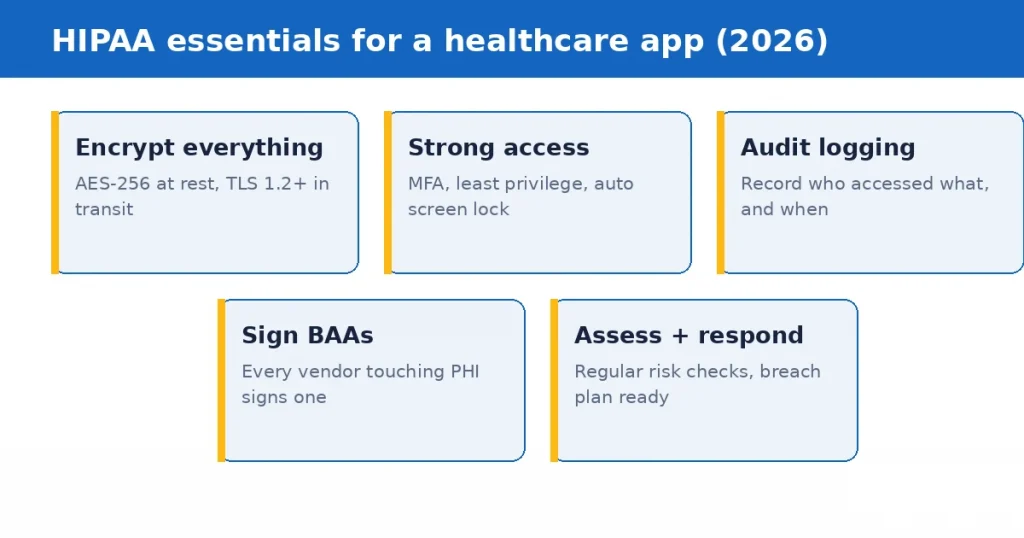
If your app handles protected health information for anyone in the US, HIPAA applies. It is not a certificate you buy or a checkbox at the end. It is a set of safeguards baked into how the app is built, hosted, and run. Here is what that means in practice.
- Encryption everywhere. Protected health information must be encrypted at rest and in transit. The working standard is AES-256 for stored data and TLS 1.2 or higher for data moving across the network.
- Strong access control. Every user gets the minimum access they need, with multi-factor authentication, automatic screen lock, and session timeouts. On mobile specifically, that includes blocking screenshots on iOS and screen recording on Android so health data does not leak out the side door.
- Audit logging. The system records who accessed what and when, so a breach can be investigated and access can be proven.
- A Business Associate Agreement (BAA). Every vendor that touches the data, your cloud host, your video provider, your analytics, must sign a BAA. Using a service that will not sign one is a compliance gap by itself.
- Risk assessments and breach response. HIPAA expects regular security risk assessments and a real plan for breach notification.
The Security Rule has been under active revision, and the direction of travel is toward making encryption and multi-factor authentication mandatory rather than addressable, with tighter breach timelines. Build to the stricter bar now. It is cheaper than retrofitting when a rule finalises, and none of it is wasted work even if the timeline slips.
Founder note
HIPAA compliance is not the whole app, it is a property of the app. It adds meaningfully to the base build cost, but retrofitting it into a non-compliant app later costs far more and sometimes means rebuilding. Start compliant.
iOS vs Android: which platform first
You do not have to pick one forever, but for an MVP, building one platform well beats building two platforms poorly. The right first choice depends on who your users are.
If your users are patients in the US, iOS often makes sense first, since iPhone holds a large share of the US consumer market and Apple’s health frameworks are mature. If your app is for clinicians or serves a broad or global population, Android may matter more because of device range. If your budget is tight and you want both from day one, cross-platform is the practical answer, which brings us to the next decision.
Native or cross-platform
Cross-platform frameworks like Flutter and React Native let you build one codebase for both iOS and Android, which lowers cost and speeds up delivery. For most healthcare apps, that is the right call.
You reach for native when you need heavy device-specific performance, deep integration with Apple HealthKit or Google Health Connect, or tight control over hardware like Bluetooth medical devices. Continuous glucose monitors, connected inhalers, and anything with a real-time data stream from a device tend to push you native, or at least native for that one module.
A good team helps you decide based on your product, not on what they prefer to build. If a team recommends the same stack for every client regardless of the brief, that tells you something.
We work across Flutter app development and React Native app development as well as native iOS and Android, and the choice genuinely changes per project.
Core features of a healthcare app
The exact feature set depends on whether your app is patient-facing, provider-facing, or both. These are the building blocks most healthcare apps draw from.
- Secure sign-in and identity: MFA, biometric login, role-based access.
- Patient profiles and health records, with consent controls.
- Appointment booking and reminders.
- Telehealth: encrypted video, chat, and file sharing.
- Tracking and monitoring: medication, symptoms, vitals, often synced from wearables.
- Notifications that respect privacy, with no health details on a lock screen.
- EHR integration, so the app talks to the systems clinicians already use.
The trap is trying to ship all of this at once. The apps that succeed launch with the two or three features that solve the core problem, prove people use them, and add the rest based on real feedback.
What to cut from version one
This is the conversation we have with almost every healthcare founder, and it saves more money than any other decision in the project.
Cut multi-role from the first release. Building for patients and clinicians and administrators at once triples your permission model, your testing surface, and your compliance review. Pick the role that proves the product and build only for them.
Cut EHR integration if you can prove value without it. It is the single biggest cost and schedule driver. Plenty of products validate with manual data entry or a simple export first, then integrate once a health system has actually committed.
Cut native wearable integration. Apple HealthKit and Google Health Connect sound cheap because the SDKs are free. The cost is in the edge cases: missing data, duplicate readings, timezone drift, and users who revoke permission halfway through a study. Add it when the core loop works.
Cut offline mode unless clinicians in the field are your users. Offline-first is a genuine engineering commitment involving conflict resolution and sync logic. It is worth it for a community health worker in a low-connectivity area. It is not worth it for an urban telehealth app.
Do not cut audit logging, access control, or encryption. These are the things founders try to defer and they are the things you cannot add cleanly later. Every retrofit we have done started as a deferral.
The pattern across the healthcare products we have shipped is the same: the launch feature set is smaller than the founder first imagined, and the compliance foundation is deeper. That combination ships. The reverse does not.
EHR integration: the part that quietly drives cost
If your app needs to read or write clinical data, it has to connect to electronic health record systems like Epic or Cerner. This is where a lot of healthcare budgets get their surprise.
Modern EHRs expose FHIR-compliant APIs, the current healthcare data standard, which makes standard integrations relatively clean. Older systems that rely on HL7 v2 messaging or custom interface engines are a heavier lift.
Three things drive the difference in effort:
Which standard the system speaks. A FHIR API with good documentation is a different project from an HL7 v2 feed arriving over a legacy interface engine.
Read or write. Reading patient data is far simpler than writing back into a clinical record. Write-back triggers a much heavier review process on the health system’s side, and their timeline is not yours to control.
Whose sandbox you get. Some health systems have a working developer sandbox and a defined app review process. Others have a committee and a six-week wait for a call. This is often the real schedule risk and it has nothing to do with your code.
If EHR integration is in your plan, scope it early and start the conversation with the health system before you start building. Budget and schedule both move more on this than on almost anything else.
How much does healthcare app development cost in 2026
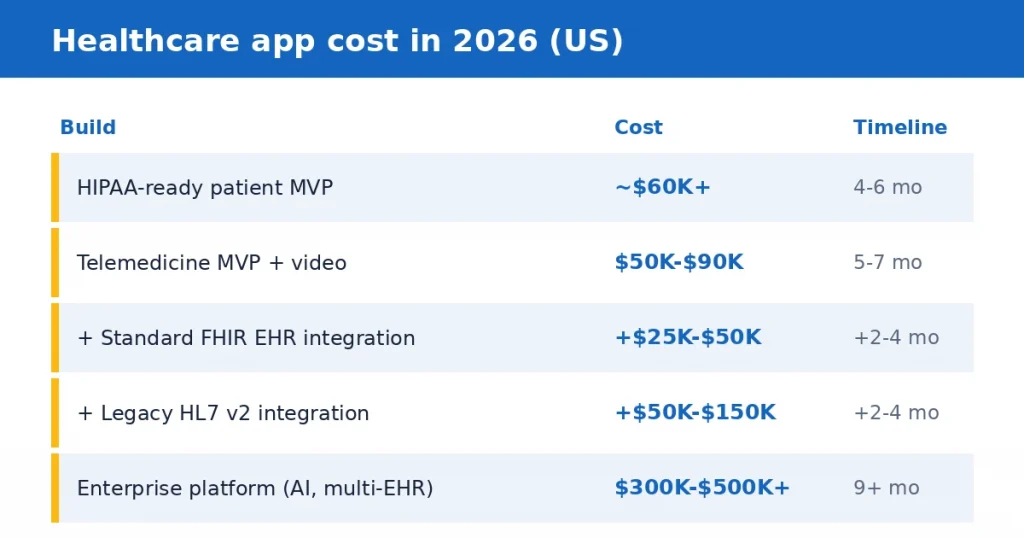
There is no single price, because a wellness tracker and a telemedicine platform with EHR write-back are completely different products. The ranges below reflect what we see when scoping healthcare builds for the US market. Treat them as a starting frame, not a quote. We scope your specific app before giving a real number.
| App type | Typical cost (US, 2026) | Rough timeline |
| HIPAA-ready patient MVP | Around $60,000 and up | 4 to 6 months |
| Telemedicine MVP (portals, encrypted video, booking) | $50,000 to $90,000 | 5 to 7 months |
| Real-time video infrastructure (add-on) | $15,000 to $40,000 | Included above |
| Standard FHIR EHR integration | Add $25,000 to $50,000 | Add 2 to 4 months |
| Legacy HL7 v2 integration | Add $50,000 to $150,000 | Add 2 to 4 months |
| Enterprise platform (AI, multi-EHR, multi-platform) | $300,000 to $500,000 and up | 9 months and up |
Compliance work is not a line item you can remove. It runs through security engineering, documentation, audit logging, vendor agreements, and testing, and it is a meaningful share of any healthcare build.
Why healthcare apps cost more than regular apps
The extra cost is not padding. It buys encryption and security engineering, compliance work and documentation, audit logging, signed vendor agreements, careful testing against real clinical workflows, and integrations that have to be exact because a wrong record is a patient safety issue.
A consumer photo app can ship a bug and patch it Tuesday. A medication app cannot.
How long does it take
A focused HIPAA-ready MVP usually ships in about four to six months. Add telehealth video and you are closer to five to seven. Add EHR integration and you add two to four months on top.
The timeline is driven less by screen count and more by compliance, integrations, and testing. There is also a category of delay that is not yours to control: health system review cycles, app store review for medical claims, and legal sign-off on your privacy policy and consent flows. Build slack for those into the plan rather than discovering them in month five.
How to choose a healthcare app development company
This is a specialist build, and general app teams get healthcare wrong in expensive ways. Here is how to tell a team that has shipped medical apps from one that will learn on your budget.
- Shipped healthcare work. Ask for live health apps they have built, ideally in your space. Compliance experience shows up in the details they mention without being asked.
- Compliance fluency. They should talk about HIPAA, BAAs, encryption, and the health app versus medical device line naturally, and tell you early if you are heading toward FDA territory.
- Named senior engineers. You want senior people on your project, not a pitch team that hands the build to juniors. Ask who writes your code and whether you can interview them.
- Clear ownership. In writing, you own the source code, the IP, and the app store listings, with no lock-in.
- A real post-launch plan. Healthcare apps need ongoing maintenance, security patching, and OS updates. A team with no answer for month twelve is planning to disappear.
Questions worth asking on the first call
Five questions that separate teams quickly:
- Which of your healthcare apps is live right now, and can I download it?
- Who signs the BAA, you or the client, and which vendors in your usual stack will sign one?
- Based on what I have described, do you think this is a medical device? Why?
- What would you cut from my first version, and what would you refuse to cut?
- Who exactly writes the code, and can I speak to them before we sign?
A team that has done this work answers all five without hedging. A team that has not will be vague on two or three, usually the medical device question and the one about who writes the code.
Red flags to walk away from
- A quote far below everyone else, which usually means compliance is missing from the scope.
- Vague answers on HIPAA, or a promise that compliance is easy.
- No named engineers and no shipped healthcare apps to show.
- Fuzzy code-ownership terms.
If you are weighing an in-house hire against an agency, our hire mobile developers page covers the engagement models, and the honest answer is that healthcare is one of the areas where prior domain experience matters more than raw headcount.
How we approach healthcare apps at Mobilions
We build healthcare apps compliant from the first commit, not compliant-later. That means encryption, access control, and audit logging in the foundation, signed BAAs with every vendor in the stack, and an honest early read on whether your app is a wellness product or heading toward SaMD. Senior engineers scope, build, and support the product, and you own the code, the IP, and the documentation throughout.
We have shipped mobile health products since 2016. Careslate is a HIPAA-compliant AI medical translation app with live two-way audio built on a custom three-stage pipeline, used in clinical settings where a mistranslation has consequences. JoinBeet is a personalised medical nutrition platform with meal matching, wearable sync, and role-based admin access.
Both are on our healthcare software development page alongside how we approach the sector, and the mobile side of that work sits under mobile app development.
Ready to scope your healthcare app?
Tell us what you want to build and who it is for. A senior engineer will give you an honest read on cost, timeline, and the compliance path, including the parts you can cut from the first version. Book a discovery call.
Frequently asked questions
How much does it cost to build a healthcare app?
In the US in 2026, a HIPAA-ready patient MVP typically starts around $60,000, a telemedicine MVP runs $50,000 to $90,000, and enterprise platforms with AI and EHR integration reach $300,000 to $500,000 or more. The number tracks scope, integrations, and whether the app is regulated. Compliance work is a meaningful share of any healthcare build and cannot be removed from the scope.
How long does it take to develop a healthcare app?
A focused HIPAA-ready MVP usually ships in about four to six months. Telehealth video pushes that to five to seven months, and EHR integration adds another two to four months. Compliance and testing drive the timeline more than the number of screens, and health system review cycles can add delay you do not control.
What is HIPAA compliance for a mobile app?
It is a set of safeguards for protected health information: AES-256 encryption at rest, TLS 1.2 or higher in transit, multi-factor authentication, access controls, audit logging, and signed Business Associate Agreements with every vendor that touches the data. It is built into the app, not added at the end.
Does my healthcare app need FDA approval?
Only if it functions as a medical device, meaning it diagnoses, treats, or drives a clinical decision. Wellness trackers and appointment apps usually do not. Apps that interpret data and make clinical claims can be regulated as Software as a Medical Device. The line is narrow, so get an assessment early rather than after the build.
What is the difference between a health app and a medical app?
A health or wellness app tracks or supports general wellbeing, like steps, meals, or reminders, with a lighter regulatory load. A medical app diagnoses, treats, or informs a clinical decision and can be an FDA-regulated medical device. Intended use decides which one you are building, not the feature list on its own.
Should I build for iOS or Android first?
If your users are US patients, iOS is often a strong first choice. If you serve clinicians or a broad or global audience, Android may matter more. If you want both on a tight budget, a cross-platform build with Flutter or React Native is usually the practical answer.
How much does HIPAA compliance add to the cost?
It is not a separate line you can price and remove. Compliance runs through security engineering, audit logging, documentation, vendor agreements, and testing, so it raises the cost of the whole build rather than sitting beside it. Retrofitting compliance into an app built without it costs far more, so it is cheaper to start compliant.
What is EHR integration and why does it cost so much?
EHR integration connects your app to systems like Epic or Cerner so it can read or write clinical data. A modern FHIR integration commonly adds $25,000 to $50,000, while legacy HL7 v2 integration can add $50,000 to $150,000 and two to four months. Writing back into a clinical record is significantly harder than reading, and health system review timelines are not yours to control.
Can I build a healthcare app without technical skills?
Yes, most healthcare app founders are not engineers. You bring the clinical or business insight and partner with a team that handles the build and compliance. What matters is choosing a team that has shipped healthcare apps and can guide you through HIPAA and the medical device question.
What features should my healthcare app include?
Start with secure sign-in, patient profiles with consent, and the two or three features that solve your core problem, whether that is booking, telehealth video, or tracking. Add EHR integration, wearables, and extra features later based on real user feedback, not all at once.
How do I make sure my healthcare app is secure?
Encrypt data at rest and in transit, enforce MFA and least-privilege access, log every access, block screenshots and screen recording of health data, sign BAAs with all vendors, run regular security risk assessments, and test against real clinical workflows before launch.
Does Mobilions build healthcare apps?
Yes. We build HIPAA-compliant iOS, Android, and cross-platform healthcare apps, and have shipped mobile health products since 2016, including a medical translation app for clinical settings and a nutrition platform with wearable sync. We build compliant from day one and hand you full ownership of the code and IP.

Dhaval Patel is a Senior Mobile Developer at Mobilions with deep, hands-on experience shipping Android, iOS, and cross-platform apps. He has helped build products used by teams across 20+ countries. He writes practical guides on mobile app development, app performance, and the real-world trade-offs of building for phones and tablets.