Tag: mvp development

  • Healthtech MVP Development: How to Build a Compliant MVP Without Overbuilding

    Healthtech MVP Development: How to Build a Compliant MVP Without Overbuilding

    Most healthtech startups do not die from a bad idea. They die from a good idea built too big. The founder raises a seed round, spends nine months and most of the money building a full platform, and runs out of runway before a single clinician or patient has used the thing for real. Healthtech startup MVP development is the fix for that pattern. It is the discipline of building the smallest honest version that proves your idea works and keeps patient data safe, and nothing more, until the market tells you what to build next. Done well, healthtech MVP development is less about writing code and more about restraint.

    The safe part is what makes healthcare different. In most industries you can ship fast, cut a few corners on security, and tidy up later. In healthcare the corner you cut is someone’s medical record, and the rules do not care that you are small. A data breach during your MVP carries the same legal weight as one at a company with millions of users. So the goal is not only to build less. It is to build less while getting the few things that matter exactly right.

    We have built medical software since 2016, including JoinBeet, a nutrition platform that syncs with wearables, and Careslate, a translation tool used in clinical settings. This guide is the long version of the advice we give founders on the first call: what an MVP really is, what compliance actually costs you, how to decide what to cut, and the specific mistakes that quietly drain a seed round.

    Key takeaways

    • An MVP is the smallest compliant version that proves one core loop. If your description has several “ands,” you are describing a full product, not an MVP.
    • In the US, a healthcare MVP from an experienced team usually runs $100,000 to $400,000, and HIPAA work adds roughly 40 to 80 percent over a comparable consumer app.
    • Most properly scoped healthcare MVPs take three to six months. A quote of a few weeks almost always means compliance was left out of the plan.
    • Build compliance in from sprint one: encryption, role-based access, multi-factor login, audit logs, and a signed BAA with every vendor that touches patient data. Retrofitting later costs three to five times more.
    • Cut everything that is not the core loop, validate with real clinicians before building, and keep full ownership of your code and IP.

    MVP, prototype, or full product? Know what you are building

    These three words get used as if they mean the same thing, and the confusion is expensive. A prototype is a clickable mockup. It shows how the app looks and moves, has no real backend, and stores no real data. You build it in days to test an idea with users, not to launch. An MVP is a working product with the single core feature that delivers value, built properly enough to put in front of real patients or providers, with real compliance behind it. A full product is the whole vision: the roadmap, the integrations, the polish, the second and third user types.

    Founders who ask for an MVP but describe a full product are the ones who blow the budget, and it happens on almost every first call. Here is the quick test we use out loud: read your feature list back. If it has more than one “and” in it, you are probably describing a full product. “Patients log symptoms and providers review them” is an MVP. “Patients log symptoms and providers review them and there is a billing module and a pharmacy integration and a family portal” is a two-year platform wearing an MVP costume.

    The reason this matters so much in healthcare is that every extra feature is not just extra build time. It is extra data, extra access paths, extra compliance surface, and extra ways to leak something you should not. In consumer software, scope creep costs money. In healthtech, it costs money and risk.

    Why healthcare MVPs cost more than regular apps

    Take any app idea, add the words “for patients,” and the price roughly doubles. The real cost of healthtech MVP development is not agencies padding the invoice. It is where the work actually goes.

    • Compliance is architecture, not a feature. HIPAA shapes how you store data, who can see it, how it moves, and how long you keep the logs. These are foundational decisions. Change them after launch and you are rebuilding the plumbing with the water still running.
    • Security has to be real, not theater. Encryption at rest and in transit, multi-factor login, role-based access, tamper-proof audit trails. On a to-do app these are nice to have. On a health app they are the product, and reviewers will check.
    • You need clinical input. A clinician has to tell you what is safe, what is a liability, and what workflow a nurse will actually tolerate on a night shift. That review time is real, skilled work, and it is not optional.
    • Formal QA and documentation. Healthcare software carries a paper trail: what you tested, what you decided, why. That rigor protects you, and it takes time.

    Industry guides put a US healthcare MVP from an experienced agency somewhere between $100,000 and $400,000, with the HIPAA work adding roughly 40 to 80 percent over the same app without it. Treat those as ranges, not a quote. The honest number for your product comes after someone scopes it, because a symptom tracker and a remote patient monitoring platform are not the same job. The one figure to burn into memory: retrofitting compliance after launch runs three to five times more than building it in from the start. Anyone quoting you six weeks and a bargain price has either not understood the compliance load or is planning to hand you the bill for it later.

    How much does a healthcare MVP actually cost?

    Cost is the first question almost every founder asks, so let us break the range down instead of hiding behind “it depends.” The cost of healthtech MVP development is driven by four things: how much protected health information you touch, how many integrations you need, how many user types you support at launch, and how senior the team is.

    At the lower end, near $100,000, you have a single user type, one core loop, minimal integrations, and a team that has done this before so they are not learning HIPAA on your dime. In the middle you add real integrations, a second workflow, and more clinical validation. At the top, past $300,000, you are usually looking at device data, third-party medical systems, or a product that edges toward being regulated as a medical device, which changes everything.

    Watch the costs nobody warns you about. Compliance counsel to confirm what rules apply. Security review or a light penetration test before launch. BAA-eligible hosting, which costs more than a standard cloud plan. Ongoing maintenance, which for any live health product runs meaningfully higher than a consumer app because you cannot let dependencies or security patches drift. Budget for the year, not just the build, or you will ship the MVP and then discover you cannot afford to keep it alive.

    How long does it take to build a healthcare MVP?

    Three to six months is the honest range for healthtech MVP development that is properly scoped. The spread depends on the same things that drive cost: compliance depth, integrations, and how disciplined you are about scope.

    A rough shape of those months: a couple of weeks on scoping, architecture, and confirming which rules apply, so you are not designing blind. Then the build in short cycles, with the compliance foundations going in first, not last. Then testing, including on real devices and against the security requirements, not just a simulator. Then a careful launch. The teams that hit the short end of that range are the ones that cut scope hard and had a clinician in the room early. The teams that blow past six months are almost always the ones who kept saying “while we are at it, let us also add.”

    HIPAA and FDA: what compliance really means for your MVP

    This is the section founders skim and then regret skimming. Two different rulebooks can apply to a health app, and they answer different questions.

    HIPAA is about protecting health data. It kicks in the moment your app stores, processes, or transmits protected health information, which is basically identifiable health data. Telemedicine apps, patient monitoring, anything tied to a clinic or a diagnosis: HIPAA applies. If your app genuinely never touches protected health information, a pure wellness tracker with no identifiable medical data, your obligations are much lighter. The trap is assuming you are in the light category when you are not, so get a straight answer early, ideally from someone who has shipped in healthcare before. The US Department of Health and Human Services publishes the actual rules at hhs.gov/hipaa.

    For an MVP, being HIPAA compliant does not mean a full enterprise security program. It means the foundations are right from sprint one: data encrypted at rest and in transit, role-based access so people see only what they should, multi-factor login, a tamper-proof audit log of who touched what, and a signed Business Associate Agreement with every vendor that handles patient data on your behalf.

    That last one matters more than founders expect. Missing BAAs are the single most common compliance failure in audited cases, and they are the easiest thing to forget when you are wiring up a third-party service at 11pm.

    FDA is a separate question, and it is about risk, not data. Your app may be regulated as a medical device if it is meant to diagnose, treat, cure, or prevent disease, or to affect the structure or function of the body. A symptom logger that helps a patient track how they feel is usually fine. An app that reads sensor data and tells someone they are having a cardiac event is a different animal.

    The FDA classifies devices into three risk classes and, for many low-risk apps, intends to exercise enforcement discretion, meaning it will not enforce the full requirements. Higher-risk functions can need a 510(k) clearance or, at the top, premarket approval. The FDA lays out which software functions it regulates at fda.gov.

    None of this is legal advice, and that is the point: before you build, get a short read from someone who knows this area, because the answer changes your architecture, your timeline, and your budget.

    The data security your MVP needs on day one

    Strip the jargon and this is a short, concrete list. Encrypt data at rest and in transit, using current standards. Put every account behind multi-factor login. Give people the least access they need to do their job, and nothing more. Log every access to patient data in a way nobody can quietly edit. Sign a BAA with any service that stores or processes that data. Host on infrastructure that supports all of the above, which usually means a plan built for regulated workloads rather than the cheapest tier.

    You do not need a 40-page security policy to launch an MVP. You do need these six things done properly, because they are exactly the ones that are painful and expensive to add once real patient data is already in the system.

    Deciding what to cut is the hardest, most valuable skill

    An MVP is defined by what you leave out, and cutting is harder than building because everything on the list feels important to the person who wrote it. Here is the method that works. Take your feature list and sort every single item into two piles: “the product does not work without this” and “everything else.” The first pile is your MVP. The second pile is your roadmap. There is no third pile.

    For most healthtech MVPs the core is a single loop. A patient logs symptoms and a provider reviews them. A user scans a label and gets a result. A caregiver records a reading and the system flags it. Build that one loop end to end, properly and compliantly, and stop. Cut the dashboard with twelve chart types. Cut the social feed, the gamification, the second user role, the third language, the admin panel you will not need until you have a hundred users. None of those are wrong. They are just not first.

    When we built JoinBeet, this was the whole discipline: get the core nutrition and tracking loop working with wearable sync before adding anything else. It is not glamorous, and founders often push back because the cut features are the ones they pitched to investors. But scope discipline is the single habit that saves the most money and time in healthtech MVP development, and it is the one most first-time founders skip.

    Validate before you build, not after

    You can test a healthcare idea without writing the app, and you should. Show ten target clinicians or patients the prototype and ask one blunt question: what would stop you using this? In healthcare the blocker is rarely the feature you are worried about. It is trust, workflow fit, liability, or the simple fact that a busy clinician will not add a step to their day for a maybe. You want to hear that before you spend the money, not after the launch party.

    This is also the part non-technical founders can own completely, and it is where they add the most value. You do not need to code to validate an idea, recruit clinicians, run interviews, and lead the product. You need to ask sharp questions and sit with the awkward answers instead of arguing with them. The founders who do this well walk into the build already knowing what the first version has to do, which is why their MVPs cost less and land better.

    Build vs buy, and who should build it

    Two decisions hide inside “how do I get this built.” The first is build versus buy. Build the part that is your actual product, the thing that makes you different and that you would be embarrassed to outsource. Rent everything else. Authentication, hosting, payments, even large parts of the compliance tooling are solved problems with mature vendors behind them. Writing your own version of any of them is a way to spend your runway on work no user will ever thank you for.

    The second decision is who builds it: in-house, an agency, or freelancers. An in-house team is the right answer when you have the funding and a technical co-founder who can lead it, because you are hiring for the long haul.

    Freelancers can be fine for a narrow piece of work, but stitching a compliant health product together from several independent contractors, none of whom owns the whole picture, is how compliance gaps appear. For most early healthtech startups, a senior team that has shipped compliant health software before will get you to a safe launch faster, because they have already made the expensive mistakes on someone else’s project. Whichever route you take, insist on senior people with real healthcare experience, and make ownership non-negotiable: the source code, the IP, and the documentation are yours.

    How to choose an MVP development company (and the red flags)

    If you go the agency route, the choice matters more in healthcare than anywhere else, because the cost of picking wrong is not just a bad app, it is a compliance liability with your name on it. Ask the questions that actually separate teams.

    • Have you built HIPAA-compliant software before, and can you talk me through how you handled encryption, access control, and BAAs?
    • Who owns the code and IP when we are done? (The only acceptable answer is “you do.”)
    • Who will actually be on my project, and how senior are they?
    • How do you decide what goes in the MVP versus the roadmap?
    • What happens after launch, and what does support cost?

    The red flags are just as telling. A team that treats compliance as your problem to sort out separately. A quote that is dramatically cheaper than everyone else, which usually means the compliance work is missing from the scope. Vague answers about who owns the code. No named senior engineer, just a promise of “our team.” And anyone who agrees to your full feature list on the first call without pushing back on scope has told you they will build whatever you say, right up until the money runs out.

    Protecting your idea and your IP

    Founders worry about someone stealing the idea, and while the idea is rarely the valuable part, the concern points at something real: ownership. Use a straightforward NDA with any team you talk to in depth. More importantly, make sure your contract states plainly that you own the source code, the intellectual property, and the documentation, with no lingering license back to the agency and no dependency that traps you. The nightmare is not a competitor copying your concept. It is discovering, a year in, that you cannot move your own product to another team because the code was never really yours. Own it from day one, in writing.

    Web or mobile first?

    Follow the user, not the trend. If your users are clinicians working at a desk, build web first. If they are patients logging something on the move, or you need the phone camera or sensors, build mobile first. Most healthtech MVPs do not need both on day one, and building both doubles the cost and the compliance surface for no extra learning. Pick the one your core loop lives on and ship it. When you genuinely need the other platform, that is a custom software decision for phase two, funded by what you learned in phase one.

    After launch: measuring success and scaling up

    Launching the MVP is the start of the real work, not the end. Decide before launch what success looks like, and keep it to two or three numbers you actually care about. For most healthtech MVPs that is activation (did people complete the core loop even once), retention (did they come back), and one outcome signal tied to your promise, whether that is readings logged, reviews completed, or time saved. Vanity metrics like downloads tell you nothing about whether the product works.

    Then iterate from evidence, not opinion. The features you cut are not gone, they are waiting, and the MVP’s job is to tell you which of them earn their place. Scaling from an MVP to a full platform is mostly a sequence of these decisions: watch what real users do, add the next most valuable thing, keep the compliance foundations solid as you grow. The startups that scale well are the ones that treated the MVP as a question, not a smaller version of the answer.

    The mistakes we see most often

    • Building the full product and calling it an MVP.
    • Leaving compliance and security for “after launch,” then paying three to five times more to retrofit it.
    • Wiring up a third-party service without a BAA, the most common compliance failure there is.
    • No clinician in the room until the app is already built.
    • Two or three user types at launch when one would have proven the idea.
    • Hiring the cheapest team, discovering they do not know healthcare, and paying twice to fix it.
    • Custom-building auth, hosting, and infrastructure instead of using proven, BAA-eligible services.
    • Measuring downloads instead of whether anyone completes the core loop.

    Where to start with healthtech MVP development

    If you take one thing from all of this, make it this: write down your core loop in a single sentence with no “ands,” confirm which rules apply to it before you design anything, and build that loop properly. Everything else is roadmap. That one habit is the difference between a healthtech startup that learns fast and cheap and one that spends its whole seed round finding out it built the wrong thing.

    If you want a straight read on your specific product, scope, timeline, and what compliance will really take, a senior engineer who has shipped medical software will walk through it with you, no obligation. Book a discovery call.

    Frequently asked questions

    How much does it cost to build a healthcare MVP?

    In the US, an experienced agency usually builds a healthcare MVP for somewhere between $100,000 and $400,000, with the HIPAA work adding roughly 40 to 80 percent over a comparable consumer app. The exact number depends on how much patient data you handle, how many integrations you need, and how many user types you support at launch. Treat any figure before a scoping call as a rough range, and be wary of unusually low quotes, which usually mean the compliance work is missing from the plan.

    How long does it take to build a healthcare MVP?

    Three to six months is the honest range for a properly scoped first version. A quote of a few weeks almost always means the compliance and security work has been left out. The teams that ship at the short end cut scope hard and involved a clinician early.

    Does my healthcare MVP have to be HIPAA compliant?

    If it stores, processes, or transmits protected health information, then yes, and that shapes your architecture from day one. If it genuinely never touches identifiable health data, your obligations are lighter. Confirm which case you are in early, because assuming you are exempt when you are not is an expensive mistake to discover after launch.

    Does my health app need FDA clearance?

    Only if it functions as a medical device, meaning it is intended to diagnose, treat, cure, or prevent disease, or to affect the structure or function of the body. Many low-risk apps fall under the FDA’s enforcement discretion and do not need clearance, while higher-risk functions can require a 510(k) or premarket approval. Get a professional read before you build, because the answer changes your whole plan. This is not legal advice.

    Does my health app need FDA clearance?

    Only if it functions as a medical device, meaning it is intended to diagnose, treat, cure, or prevent disease, or to affect the structure or function of the body. Many low-risk apps fall under the FDA’s enforcement discretion and do not need clearance, while higher-risk functions can require a 510(k) or premarket approval. Get a professional read before you build, because the answer changes your whole plan. This is not legal advice.

    What features should a healthcare MVP include?

    Just the one core loop that proves your idea, built properly and compliantly, plus the security foundations underneath it. Everything else, the extra dashboards, roles, integrations, and languages, belongs on the roadmap. If your feature list has more than one “and,” you are describing a full product, not an MVP.

    Can a non-technical founder build a healthtech startup?

    Yes. You do not need to code to validate the idea, recruit and interview clinicians, and lead the product. You do need a technical partner or team you trust to build it compliantly, and you should own the code and IP. Validation and product leadership are exactly where non-technical founders add the most value.

    Should I build web or mobile first for a healthcare MVP?

    Follow your users. Clinicians at a desk means web first. Patients on the move, or a feature that needs the camera or sensors, means mobile first. Most MVPs need only one platform to prove the idea, and building both doubles the cost for no extra learning.

    What is the difference between an MVP and a prototype?

    A prototype is a clickable mockup with no real data, used to test an idea in days. An MVP is a working, compliant product with your one core feature, built to put in front of real users. A prototype answers “do people want this,” an MVP answers “does it work when it is real.”

    Should I use an in-house team, an agency, or freelancers?

    In-house makes sense once you have funding and a technical co-founder to lead it. Freelancers can handle a narrow piece but rarely own the whole compliant picture. For most early healthtech startups, a senior team that has shipped compliant health software before is the fastest safe route, because they have already made the expensive mistakes elsewhere.

    How do I protect my idea while building an MVP?

    Use an NDA with any team you talk to in depth, but put more weight on ownership: your contract should state plainly that you own the source code, IP, and documentation, with no license back to the agency. The real risk is not someone copying your idea, it is being unable to move your own product because the code was never truly yours.

  • SaaS Startup Hire vs Outsource vs AI: Which to Choose in 2026

    SaaS Startup Hire vs Outsource vs AI: Which to Choose in 2026

    Every SaaS founder reaches the same fork in the road, usually sooner than they planned. You can hire an engineer, bring in an agency, or lean harder on an AI coding tool and delay the headcount question for another quarter.

    The saas startup hire vs outsource vs ai decision turns up at almost every stage of a company. Pre-seed founders want to ship a first version without burning runway. Seed-stage teams debate whether their fourth engineer should be a full-time hire or a contractor. Funded teams quietly wonder whether a Cursor or Copilot seat can cover a role they have not posted yet.

    Here is the short answer, because you are probably reading this in the middle of the decision. All three paths are legitimate, and they solve different problems.

    The honest cost gap between them is 5 to 10 times, not 20 percent. AI tools change the productivity math for whichever path you choose, but they do not remove the need to make the choice. Everything below is the reasoning and the numbers behind that one paragraph.

    Key takeaways

    If you only have a minute, these are the points that matter most about the saas startup hire vs outsource vs ai decision.

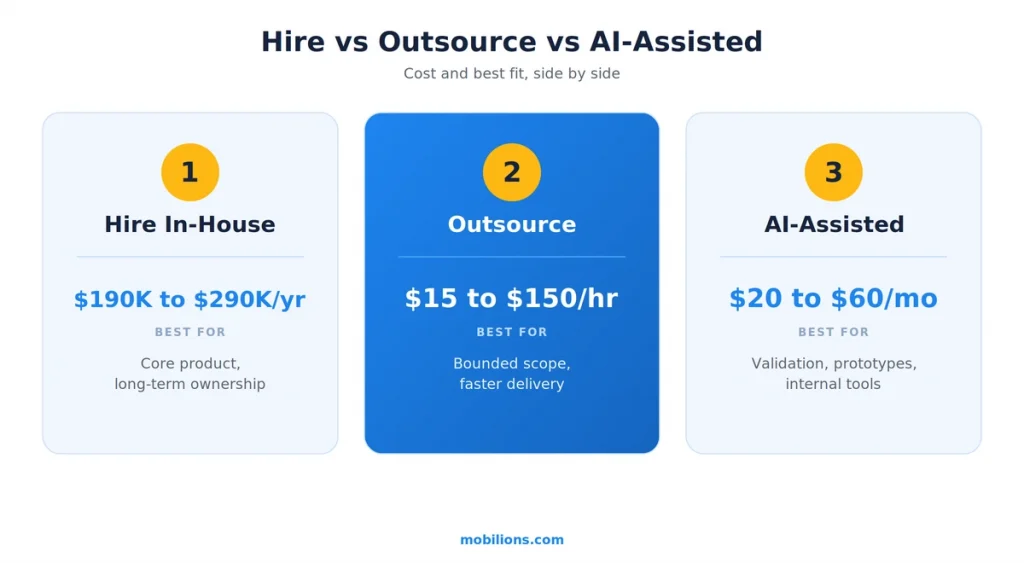
    • The cost gap is large, not marginal. Hiring in-house runs roughly $190,000 to $290,000 a year fully loaded. Outsourcing runs $15 to $150 an hour depending on region and model. AI tooling runs $20 to $60 per seat a month.
    • Staff augmentation, dedicated teams, and project outsourcing are three different arrangements, not synonyms. The wrong model for your stage is riskier than the wrong vendor.
    • AI adoption is high but trust is falling. 84 percent of developers use or plan to use AI tools per Stack Overflow, yet 45.7 percent actively distrust its accuracy.
    • AI-assisted solo building is right before you validate demand. It becomes the wrong call once the product is customer-facing and needs to scale securely.
    • It is rarely one path for the whole company. The winning pattern is the right path for each piece of work, matched to how core, how bounded, and how validated it is.

    What does hire vs outsource vs AI actually mean for a SaaS startup?

    Before you can choose, it helps to be precise about what each path really is, because the words get used loosely.

    Hiring in-house means putting a salaried engineer on your own team, under your own management, building your product as their full-time job. You own the recruiting, the ramp-up, the retention risk, and the long-term knowledge that stays inside your company.

    Outsourcing means paying an external company to deliver working software. That could be a feature, a module, or an entire product build. The outside company manages its own people and is accountable for the result. You are buying an outcome, not a headcount.

    AI-assisted development means using tools like GitHub Copilot, Cursor, or Claude Code to write, review, or refactor code faster. A human still directs the work, reviews the output, and owns the architecture. That human can be yours, a contractor’s, or an agency’s.

    There is a fourth term worth knowing, because people confuse it with outsourcing constantly. Staff augmentation means you bring in external engineers who work inside your team, under your management. It is a hybrid of hiring and outsourcing, and it changes both the cost and the risk profile.

    In practice, the saas startup hire vs outsource vs ai choice usually shows up as one of four situations. A technical co-founder codes a first version alone with an AI assistant. A seed-stage team brings on a nearshore partner to build one well-defined module.

    A newly funded company hires its first two or three in-house engineers to own the core product. Or, most often, some blend of all three runs at once as the product matures.

    None of these paths are mutually exclusive. Plenty of the SaaS teams we have worked with run all three together: a small in-house core, an outsourced partner for a bounded module, and AI tools speeding up both.

    What does each path actually cost in 2026?

    This is where most comparisons of the saas startup hire vs outsource vs ai decision go vague. Here is the real range, fully loaded, not just the sticker price.

    In-house hiring. A base salary is roughly half the real story. Once you add payroll taxes, benefits, equipment, recruiting, and the ramp time before someone is fully productive, a senior US engineer costs around $190,000 to $250,000 a year fully loaded.

    The true first-year cost, including recruiting and onboarding, often reaches $205,000 to $290,000. Industry salary research puts the average base near $129,000, then notes that benefits, taxes, and overhead typically inflate the total employee cost by 100 to 170 percent, landing in a similar range for a senior hire.

    Outsourcing. Rates vary enormously by region and engagement model. Offshore teams, such as India-based partners, commonly run $15 to $30 an hour. Nearshore Latin American teams run $30 to $60 an hour, and US-based contract engineers run $90 to $150 an hour.

    A typical outsourced MVP build lands between $60,000 and $130,000 for a nearshore partner, and between $150,000 and $350,000 or more for a US agency, depending on scope.

    AI-assisted tooling. This is the cheapest line item by far. Individual AI coding seats typically run $20 to $60 per developer a month, which is a rounding error next to either path above.

    The catch is that an AI tool has no accountability, no architectural judgment, and no ability to own a roadmap. It multiplies whatever human capacity you already have. It does not replace it.

    PathTypical CostWhat You Are Actually Buying
    In-house hire (senior, US, fully loaded)About $190K to $290K a yearFull-time ownership, institutional knowledge, direct management
    Outsourced build (nearshore)About $60K to $130K a project, or $30 to $60 an hourAn external team accountable for a defined outcome
    Outsourced build (US agency)About $150K to $350K a project, or $90 to $150 an hourThe same, at a domestic quality and communication premium
    AI-assisted tooling (per seat)About $20 to $60 a monthA productivity multiplier, not a substitute for judgment or ownership
    Hire vs outsource vs AI cost comparison

    Here is why this matters more than a simple search for the cheapest option. AI tooling now costs so little next to headcount or outsourcing spend that it is rarely the deciding factor. The real decision is still hire versus outsource. AI just makes whichever one you pick faster.

    Staff augmentation, outsourcing, or a dedicated team: what is the real difference?

    This is the distinction that trips up most first-time SaaS founders, because outsourcing gets used as a catch-all for three genuinely different arrangements.

    Staff augmentation. The external engineer works inside your team and takes direction from your own managers day to day. You are responsible for the outcome. The augmentation partner is responsible for supplying qualified people.

    Project-based outsourcing. You hand a scoped deliverable to an external company, and they manage the work from start to finish. You are buying an outcome. They own the process and the accountability for hitting it.

    A dedicated development team. This sits between the two. It is a stable group of external engineers who work only on your product over time. You give more oversight than pure project outsourcing, but carry less day-to-day management than staff augmentation.

    ModelWho Manages Daily WorkWho Is Accountable for the ResultBest Fit
    Staff augmentationYouYouShort, bounded gaps where you already have strong internal leads
    Dedicated teamSharedMostly the vendor, with your product inputAn ongoing roadmap without full in-house hiring
    Project outsourcingThe vendorThe vendorA defined deliverable with clear scope and an end date

    If you already have a technical co-founder or a strong lead who can direct daily work, staff augmentation is usually the cheapest way to add capacity. If you do not have that internal capacity yet, project outsourcing or a dedicated team shifts more of the delivery risk onto the vendor. You pay a real premium for that risk transfer, and it is often worth it.

    Outsourcing SaaS development: when it makes sense

    Outsourcing SaaS development means bringing in an outside engineering team to build or extend your product instead of hiring in-house. It works best when you need to move fast, lack a specific skill, or want senior engineers without the cost of full-time hires. The trade-off is picking a partner who ships to production and hands you full ownership.

    Can AI actually replace your development team in 2026?

    I build production AI systems for a living, so here is the answer I will actually stand behind rather than the one that makes a better headline. Not yet, and the data backs that up more clearly than the hype suggests.

    Start with adoption, because it is genuinely high. Stack Overflow’s 2025 Developer Survey found that 84 percent of professional developers are using or planning to use AI tools, with just over half using them daily. That is real, broad adoption, not a niche experiment.

    The tools themselves have gotten good at specific jobs. GitHub Copilot and Cursor are strongest at autocomplete and boilerplate, such as scaffolding a CRUD endpoint, writing a test skeleton, or converting a function from one language to another. Claude Code and similar agentic tools go further, handling multi-file changes across a codebase.

    In our own work building production systems, none of them replace the step where a senior engineer decides what the system should do and why. They replace typing, not judgment.

    Adoption is not the same as trust, though, and the same survey shows trust moving in the opposite direction from the headlines. Favorable sentiment toward AI tools fell to 61 percent, down from over 70 percent the previous year. On raw accuracy, 45.7 percent of developers actively distrust AI output, versus 29.6 percent who somewhat trust it.

    Where developers say they will not hand work to AI is the more telling data point. Per the same survey, 75.8 percent will not use it for deployment and monitoring, 69.2 percent will not use it for project planning, and 58.7 percent will not use it for code review.

    That is precisely the judgment-heavy work that separates a shipped product from a pile of generated code. The most common complaint, cited by 66 percent of developers, is AI output that is almost right but not quite. Plausible-looking code that takes longer to debug than it would have taken to write.

    The productivity data tells a similarly two-sided story. Developers report saving real time, with estimates from GitHub and academic studies putting time savings on coding and documentation tasks at 30 to 60 percent.

    But the quality picture is mixed. GitHub Copilot’s own data shows only about 46 percent of suggestions get completed, and roughly 30 percent actually get accepted. Google’s DORA research found a 7.2 percent decrease in delivery stability even as raw speed improved, which means teams shipped faster and broke more. Code-analytics firm GitClear measured roughly four times more duplicated code in AI-assisted codebases, a leading indicator of technical debt that shows up eighteen months later, not eighteen days later.

    Security is the sharpest edge of this. Independent research has found that 48 percent of AI-generated code samples contain at least one security vulnerability, and a Black Duck audit flagged 40 percent of programs written with GitHub Copilot for insecure patterns. That is not a reason to avoid AI tools. It is a reason every team using them needs a human doing real security review rather than a rubber stamp.

    So what does all of this mean for your decision? AI tools are a genuine multiplier on whichever team you choose. They measurably speed up boilerplate, tests, and documentation.

    They are not yet a substitute for the architectural judgment, security review, and production ownership that a hire or an outsourced team provides. That is the same reason our own AI development work always pairs AI-assisted coding with senior engineering review before anything reaches a customer.

    The tools make the first draft fast. The review is what makes it safe to ship. If your plan is AI instead of a team, the data says that plan has a gap. If your plan is AI and a team, whether hired, outsourced, or a mix, the data actively supports it.

    When hiring in-house is the right call

    Hire in-house when the thing you are building is the durable competitive advantage. That means the core product logic, the data model, and the parts of the system that will still matter in three years.

    In-house makes the most sense once you are past initial validation and into a phase where institutional knowledge compounds. Think of the fourth or fifth engineer who needs deep context on why the system is shaped the way it is, not just the ability to ship a ticket.

    It is also the right call when you need someone who can push back on product decisions with real ownership. An outsourced partner can execute a well-specified brief exceptionally well, but they are structurally less positioned to tell you the brief itself is wrong. Full-time engineers who live with the consequences tend to raise that flag earlier.

    The tradeoff is time and cost. Hiring well takes months, not weeks, and the fully loaded cost of a senior in-house hire is the highest of the three paths. Use our custom software development team as a sounding board if you are unsure whether a piece of scope is core enough to justify a hire, versus building it externally first and bringing it in-house later.

    When outsourcing makes more sense

    Outsourcing wins when you need production-grade work delivered against a clear scope, faster than you could hire for it, without the long-term overhead of a full-time role. It is the right tool for a bounded module such as a payments integration, a redesign, or a migration, where the requirements are knowable in advance and the work has a natural end date.

    It is also the more honest choice before product-market fit, when you genuinely do not know if a role will still be needed in six months. Paying a premium for flexibility is cheaper than a bad hire followed by a severance conversation.

    The real skill in outsourcing well is picking the right model for your stage. Choose staff augmentation if you already have a strong internal lead directing the work. Choose a dedicated team if you have an ongoing roadmap but no in-house capacity yet, and choose project-based outsourcing for a single, well-specified deliverable. Getting that model wrong is a bigger risk than picking the wrong vendor.

    When AI-assisted building is genuinely enough for now

    There is a real, narrow window where AI-assisted building alone is the right call. It is the pre-validation stage, when you are testing whether an idea deserves a team at all.

    A technical founder using Cursor or Claude Code to build a scrappy first version, validate demand, and get real user feedback before committing real payroll is making a good decision, not cutting a corner.

    The same is true for genuinely bounded, low-stakes internal tooling, such as an admin dashboard, a one-off data migration script, or a prototype for a sales demo. The failure modes above, including security gaps, technical debt, and brittle architecture, matter far less when the blast radius is small and the code is not customer-facing.

    Where this stops working is the moment the thing you built becomes customer-facing infrastructure that needs to scale, stay secure, and evolve for years. At that point you need the judgment layer, in-house or outsourced, that AI tools are not yet a substitute for.

    Where each path actually fails

    Every path in the saas startup hire vs outsource vs ai decision has a real, measurable failure rate. The honest version of this guide includes them.

    Outsourcing fails more often than most founders expect. DemandSage research puts the failure rate of outsourcing relationships at 20 to 25 percent within two years.

    Deloitte’s analysis of why engagements fail points less to vendor competence and more to process. In failed engagements, 55 percent lacked proper benefit tracking, 53 percent suffered from inadequate change management, and 47 percent had poor integration between the vendor and the client’s own team. Engagements with a clearly defined sourcing strategy succeeded 57 percent of the time. The difference is usually preparation on the client side, not vendor quality.

    In-house hiring fails in quieter, slower ways. A bad senior hire can cost six figures and eighteen months before the mismatch becomes undeniable. Small teams also carry serious key-person risk when critical system knowledge lives in one person’s head.

    AI-only building fails in the ways the previous section covered in detail. You get technical debt from duplicated code, a measurable drop in delivery stability even as raw speed improves, and security vulnerabilities that do not surface until an audit or an incident forces the issue.

    PathPrimary Failure ModeReal-World Rate
    OutsourcingPoor sourcing strategy, weak vendor integration20 to 25 percent fail within 2 years
    In-house hiringBad senior hire, key-person riskSix-figure cost, about 12 to 18 months to detect
    AI-only buildingTechnical debt, security gaps, no ownership48 percent of AI-generated code has at least 1 vulnerability

    So how do you actually decide? A simple framework

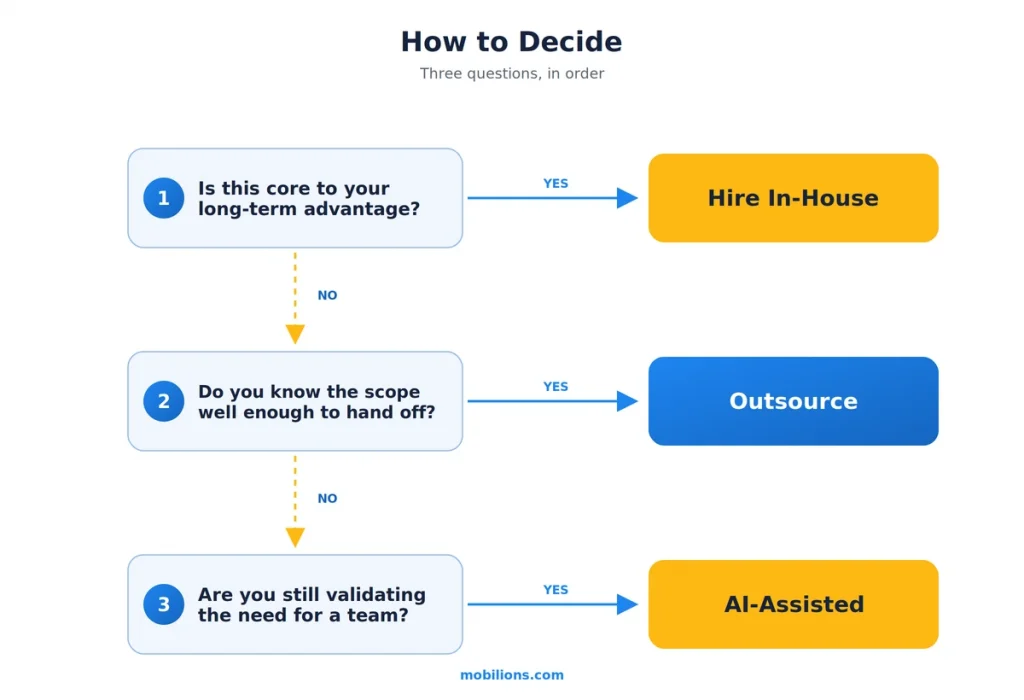
    Strip away the frameworks and the saas startup hire vs outsource vs ai decision comes down to three questions, asked in order.

    First, is this core to your product’s long-term advantage? If yes, lean in-house, eventually, even if not on day one. The parts of the system that define why customers pick you over a competitor are the parts worth owning directly.

    Second, do you know the scope well enough to hand it to someone else? If yes, and it is bounded, then outsourcing or staff augmentation is faster and cheaper than hiring. If the scope is genuinely unknown, that is a sign you are not ready to outsource it yet. Vague scope is how engagements end up in the 20 to 25 percent that fail.

    Third, are you still validating whether this needs a team at all? If yes, AI-assisted building by a technical founder or a single contractor is the right-sized answer. Do not hire or outsource before you know what you are building.

    SaaS hire outsource AI decision framework

    That is the whole saas startup hire vs outsource vs ai decision in three questions. Whichever path you pick, use AI tools to make that team faster, not as a reason to skip having one. There is also a middle path many founders miss. You can bring in a fractional CTO to own the technical decisions part-time, then let an outsourced team or your own juniors build under that senior direction. It gives you the judgment layer without a full-time salary, and it often de-risks all three paths at once.

    A real-world scenario

    Picture a seed-stage SaaS company with a technical co-founder and $1.2 million in the bank. They have a working prototype, their first ten paying customers, and a roadmap with three big items: a billing overhaul, a mobile app, and a core analytics engine that is quickly becoming the reason customers stay.

    A systematic reading of the three questions above sorts this quickly. The analytics engine is core to their long-term advantage, so it goes in-house, and their next hire is a senior engineer to own it.

    The billing overhaul is bounded and well understood, with clear requirements and a natural end date, so it goes to an outsourced partner or staff augmentation while the founder keeps directing the analytics work. The mobile app is still unproven, so a contractor builds a lean first version with heavy AI assistance to test demand before anyone commits a full-time role.

    That is the pattern in practice. It is rarely one path for the whole company. It is the right path for each piece of work, matched to how core, how bounded, and how validated that piece is.

    Common mistakes to avoid

    A few errors show up again and again in the saas startup hire vs outsource vs ai decision, and all of them are avoidable.

    The first is hiring too early. Bringing on a full-time engineer before you know what you are building locks in cost and slows you down at exactly the stage when speed and flexibility matter most.

    The second is outsourcing work you cannot specify. If you cannot write the requirements down clearly enough for a stranger to build the right thing, handing it to a vendor does not remove that problem. It hides it until the invoice and the wrong feature both arrive.

    The third is treating AI as a headcount replacement rather than a multiplier. The data on security gaps and technical debt is clear. AI accelerates a team; it does not replace the judgment a team provides.

    The fourth is confusing cheaper per hour with cheaper overall. Offshore rates look dramatically lower on a spreadsheet, but ramp time, communication overhead, and the long-term value of knowledge staying in-house all change the real total.

    Why Mobilions

    Mobilions has been building custom software, mobile apps, and AI solutions since 2016. We have delivered more than 250 projects for over 100 clients across 20-plus countries, which means we have watched the saas startup hire vs outsource vs ai decision play out at every stage, from first prototype to funded scale-up.

    When we take on custom software development or staff augmentation work, we pair it with senior engineering review rather than treating any single tool or model as a silver bullet. If you are weighing hire versus outsource versus AI for a specific piece of your roadmap, that is the conversation we have with founders every week.

    Frequently asked questions

    Should a SaaS startup hire, outsource, or use AI to build its product?

    Use all three, matched to the work. Use AI to prototype fast and multiply your team, outsource well-scoped or non-core features to move quickly, and hire in-house for the core product logic that becomes your long-term advantage. The mistake is treating it as one permanent choice instead of a mix that shifts as you grow.

    Should a SaaS startup outsource its software development?

     Yes, for bounded, well-scoped work, especially before product-market fit when you do not yet know if a role should be permanent. Outsourcing is the wrong call for the core logic that defines your long-term advantage, which is worth hiring for. A simple test: if you can write the requirements clearly enough for a stranger to build it correctly, it is usually safe to outsource.

    When should a startup hire its first in-house engineer?

    Once you are past initial validation and the work involves core product logic that must compound over time. Hiring too early, before you know what you are building, is a common and expensive mistake. Outsourcing or AI-assisted building is usually the better fit at that earlier, pre-validation stage.

    Do you need a CTO, or can you outsource everything?

    You can outsource the building, but someone on your side has to own the technical direction. Early on that can be a technical co-founder or a fractional or advisory CTO rather than a full-time hire. What you cannot outsource is the judgment about architecture, security, and what to build. Handing that entirely to a vendor is how startups lose control of their own product.

    How many developers do you actually need to build a SaaS?

    Fewer than most founders expect. A first version often needs one or two strong full-stack engineers, or a small outsourced team, plus AI to speed up routine work. You scale the team with validated demand, not ambition. Hiring a large team before product-market fit is one of the most common and expensive startup mistakes.

    Is it cheaper to hire in-house or outsource development?

    Outsourcing is almost always cheaper per hour. Offshore rates run $15 to $60 an hour, versus a fully loaded in-house senior engineer at roughly $190,000 to $290,000 a year. But cheaper per hour and cheaper overall differ once you count ramp time, communication overhead, and the long-term value of keeping core knowledge in-house.

    How much does it cost to outsource software development?

    Typical rates run $15 to $30 an hour for offshore teams, $30 to $60 for nearshore, and $90 to $150 for US-based contractors. A full MVP build usually lands between $60,000 for nearshore work and $350,000 or more for a US agency, depending on scope and complexity.

    How much does it cost to hire an in-house developer in the US?

    A senior US software engineer’s fully loaded cost, salary plus benefits, taxes, and overhead, typically runs $190,000 to $250,000 a year. Counting recruiting and ramp time, the true first-year cost reaches $205,000 to $290,000, which is why early-stage teams often start with outsourcing or AI.

    What are the hidden costs of outsourcing development?

    Beyond the quoted hourly rate, the real costs are management time, communication overhead across time zones, rework from unclear requirements, onboarding and knowledge transfer, and rebuilding poor-quality code later. These are why outsourcing sometimes feels more expensive than hiring. You control them with clear specs, active management, and owning the code from day one.

    Can AI replace a software development team in 2026?

    Not yet. Adoption is high, around 84 percent of developers use or plan to use AI tools per Stack Overflow, but the same survey found trust in AI accuracy falling. Most teams will not hand AI the judgment-heavy work like architecture, deployment, and code review. AI is a strong multiplier on a team, not a replacement for one.

    Can AI build a SaaS product on its own?

    It can build a prototype or a simple internal tool, but not a production SaaS that must scale securely. AI accelerates coding, yet it still needs a human to own architecture, security, data design, and the judgment calls that decide whether the product survives real users. Treat AI as a fast builder under human ownership, not an autonomous one.

    Is AI-assisted development enough to skip hiring developers entirely?

    For pre-validation prototypes and internal tools, often yes. For anything customer-facing that must scale securely over time, no. AI-generated code still carries security gaps and technical debt, so a human owner, in-house or outsourced, is a requirement rather than a nice-to-have once real users and data are involved.

    What is the difference between staff augmentation and outsourcing?

    Staff augmentation adds external engineers to your team under your own day-to-day management, so you own the outcome. Outsourcing hands a scoped deliverable to a vendor who manages the work and owns the result. Pick staff augmentation when you have strong internal leads to direct the work, and outsourcing when you want a whole piece delivered.

    Is it better to hire a freelancer or an agency for a startup?

    A freelancer is cheaper and fine for a single, well-defined task or a short gap. An agency costs more but brings a managed team, process, and continuity, which matters for anything larger than one person can own. For a startup building its first real product, an agency or a dedicated team usually beats juggling several freelancers.

    What percentage of software outsourcing relationships fail?

    Around 20 to 25 percent fail within two years, according to research cited by DemandSage. The leading causes are usually client-side process failures, such as unclear scope, missing benefit tracking, and weak change management, more often than vendor incompetence. Clear requirements and active management prevent most failures.