AI agent development services are the design, build, and support work that turns a large language model into software that can actually do a job: read a request, decide what to do, use your tools and data, and complete the task with human oversight where it matters. That is the short version. The longer version is what most buyers really want, because “we build AI agents” is written on a thousand agency sites and tells you almost nothing about what you get, what it costs, or whether the thing will survive contact with your real systems.
This guide is written for the person deciding whether to hire for this, not for engineers. It covers what these services include, what an agent actually costs in 2026, how long a real build takes, when a custom agent beats an off-the-shelf tool like ChatGPT, and how to pick a partner without getting burned. Having shipped production AI for clients since 2016, we will be honest about where agents pay off and where they are the wrong tool.
Key takeaways
- AI agent development services cover the full path: strategy, architecture, the agent build, integrations, testing, and support after launch. The build is one part of it.
- Most production agents in 2026 cost 40,000 to 150,000 dollars. A proof of concept can start near 10,000, and a multi-agent enterprise platform runs past 150,000.
- An agent that only answers questions is cheap. An agent that takes actions in your live systems is where the cost and the value both sit.
- A custom agent beats ChatGPT when it needs your private data, your tools, and reliable behavior you can trust without watching it.
- The biggest risk is not the model. It is weak integration, no evaluation, and no human checkpoints, which is what separates a demo from a system.
What AI agent development services include
The phrase covers a lot, so here is the actual scope a serious provider delivers. AI agent development services usually run across six areas, and a real project touches most of them.
- Strategy and use-case scoping. Before any code, a good team decides whether an agent is even the right answer, which task it should own, and how you will measure success. This is the cheapest place to kill a bad idea, and the step most vendors skip to look fast.
- Architecture and reasoning design. How the agent thinks: the model choice, the reasoning approach (patterns like chain-of-thought and ReAct), how it plans multi-step work, and where a simpler workflow beats a fully autonomous agent.
- Tool use and integration. An agent that cannot touch your systems is a chatbot. This work wires the agent into your CRM, ERP, databases, and APIs through function calling, so it can fetch data and take actions, not just talk about them.
- Memory and retrieval. For an agent to answer from your knowledge rather than the model’s training, it needs retrieval, usually a RAG setup with a vector database. This lets an agent cite your policies, your docs, and your live records.
- Guardrails, testing, and human-in-the-loop. Confidence thresholds, audit logs, and human approval on consequential steps, plus real evaluation, because an agent that is right 80 percent of the time can be worse than none if the other 20 percent is silent and wrong.
- Deployment, monitoring, and support. Shipping it, watching how it behaves on real traffic, and improving it. Agents drift as your data and tools change, so the work after launch is not optional.
If a quote does not mention integration, evaluation, and support, you are being quoted for a demo. Anthropic’s guidance on building effective agents makes the same point we do: start with the simplest thing that works and add autonomy only when it earns its place. Our own AI agent development services are scoped across all six areas, because the last three decide whether the agent still works in month six.
The types of AI agents these services build
“AI agent” is a category, not one thing. Most of what clients ask for falls into a few types, and the type drives the cost and the timeline more than anything else.
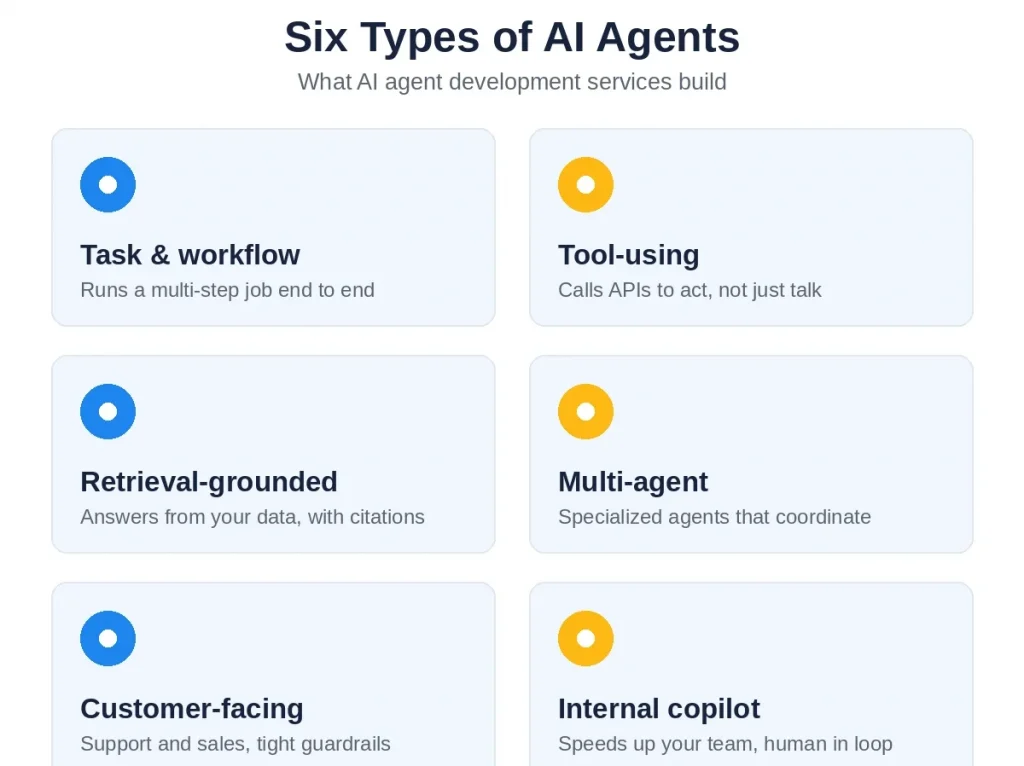
- Task and workflow agents. They run a defined multi-step job end to end: pull a record, check it against a rule, update three systems, and report back. The workhorse of business automation.
- Tool-using agents. Agents that call APIs and functions to act in the real world, from booking to updating a ticket to running a query. The value is in the actions, so integration is the hard part.
- Retrieval-grounded agents. Agents wired to your knowledge base so answers come from your data with citations, not from the model’s memory. The pattern behind trustworthy internal assistants.
- Multi-agent systems. Several specialized agents that coordinate, with one planning and others handling focused parts. Powerful, and the most expensive to build and keep stable, so worth it only when a single agent genuinely cannot do the job. Choosing the right framework matters, which we cover in our guide to AI agent frameworks.
- Customer-facing agents. Support, sales, and onboarding agents that talk to your customers. These need the tightest guardrails because mistakes are public.
- Internal copilots. Agents that sit beside your team and speed up research, drafting, and triage, with a person always in the loop.
Many of these overlap with broader AI automation, and the line between “an agent” and “automation with a model inside it” is blurry on purpose. What matters is the outcome, not the label.
How much do AI agent development services cost in 2026?
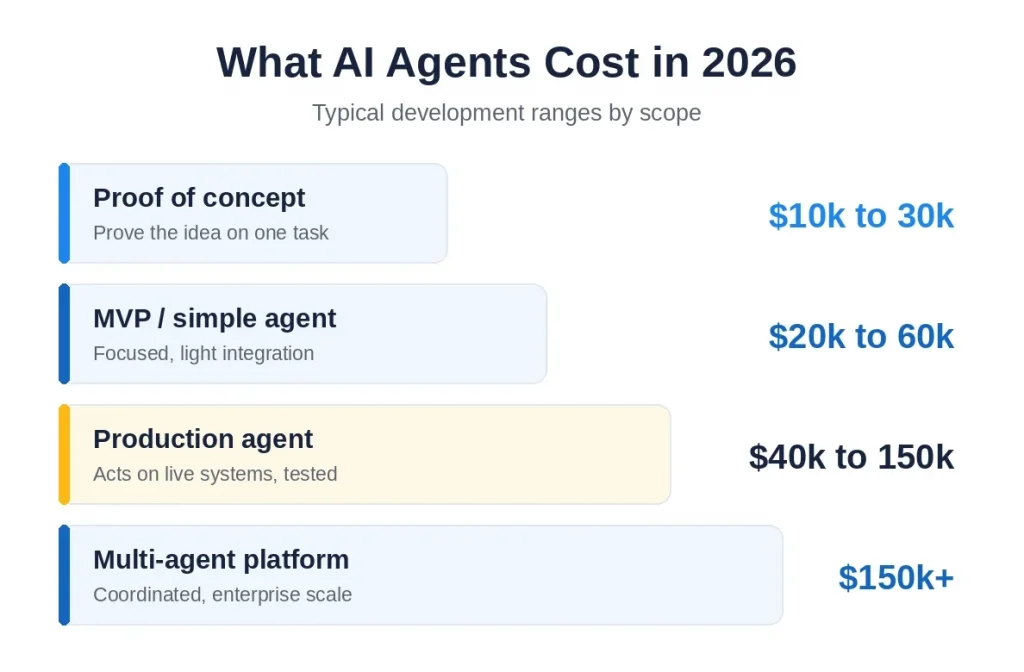
Straight answer: most production agents land between 40,000 and 150,000 dollars, but the range is wide because the word “agent” hides a huge span of complexity. Here is how it breaks down across the market in 2026.
| Scope | Typical 2026 cost | What you get |
|---|---|---|
| Proof of concept | 10,000 to 30,000 | A working prototype to prove the idea on one task |
| MVP / simple agent | 20,000 to 60,000 | A focused agent, light integration, real but narrow |
| Production agent with integrations | 40,000 to 150,000 | Acts against live systems, retrieval, guardrails, testing |
| Multi-agent / enterprise platform | 150,000 to 500,000+ | Coordinated agents, deep integration, compliance |
The cost drivers are consistent. An agent that only retrieves and answers is cheap. An agent that takes actions in your live systems, across several integrations, with security and compliance, is where the money goes. Regulated work in healthcare or finance sits at the top of every range because of the review and audit burden.
Then there is the part buyers forget: running costs. Model API usage can run from about 100 dollars a month to several thousand for heavy use, cloud hosting adds a few hundred to a few thousand, and sensible teams budget 15 to 30 percent of the build cost each year for maintenance. An agent is a product you operate, not a project you finish. For a vendor-neutral primer on what agents are before you price one, IBM’s explainer on AI agents is a solid read.
How long does it take to build a custom AI agent?
Faster than a full app, slower than a weekend demo. Timelines track the same complexity that drives cost.
| Scope | Typical timeline |
|---|---|
| Proof of concept | 2 to 4 weeks |
| MVP / simple agent | 1 to 3 months |
| Production agent with integrations | 3 to 6 months |
| Multi-agent / enterprise platform | 6 to 12 months |
The slow parts are almost never the model. They are access to your systems, cleaning the data the agent will rely on, and the evaluation loop that proves the agent is safe to trust. Teams that move fast on agents usually got their data and integrations sorted early, not because they wrote code quicker.
Custom AI agents vs ChatGPT and off-the-shelf tools
This is the question behind half the threads on the topic, so here is the honest cut. ChatGPT and similar tools are excellent for general work and need zero development. They fall short the moment you need three things: your private data, reliable access to your systems, and behavior you can trust without a person watching every output.
A custom agent is worth building when the task uses knowledge the public model does not have, when it must take real actions in your tools, and when being wrong has a cost. If you just want better drafting or a smarter search box, an off-the-shelf tool is the cheaper, smarter call, and a good partner will tell you so.
There is also a middle path that gets missed. There is a useful line between a workflow, where the steps are fixed and a model fills them in, and a true agent, where the model decides the steps. Plenty of “agent” projects are really workflows, and that is good news, because workflows are cheaper, more predictable, and easier to trust. The skill is knowing which one your problem actually needs.
Freelancer, agency, or in-house?
All three can work. They fail in different ways.
A skilled freelancer is fine for a proof of concept or a narrow agent, and cheaper up front. The risk is production: security, integration, evaluation, and someone to call in month four when it breaks. A specialist agency costs more but carries the strategy, engineering, and support in one place, which matters most for anything customer-facing or regulated. Building in-house makes sense once agents are core to your product and you can keep the talent, but the learning curve and hiring market are steep in 2026.
For most companies shipping their first serious agent, a specialist partner is the lower-risk choice, because the hard part is not the first version, it is keeping it correct and secure once real users touch it.
How AI agents integrate with your systems, and stay secure
An agent is only as useful as what it can reach and only as safe as its weakest connection. Integration happens through function calling and APIs into your CRM, ERP, databases, and internal tools, plus retrieval so the agent works from your current data. The more it can touch, the more careful the security has to be.
Good providers build in authentication, least-privilege access, encrypted data handling, audit logs, and human approval on any step that spends money, sends a message, or changes a record. Human-in-the-loop is not a limitation here, it is the design that lets you deploy an agent you can actually trust. For regulated data, compliance is designed in from the start, not bolted on before launch.
How to measure ROI on an AI agent
Decide the number before you build, not after. The agents that prove their worth are the ones with a clear success metric from day one: hours saved on a specific task, faster response or resolution times, more work handled without adding headcount, or fewer errors in a process. Tie the agent to one of those and you can judge it honestly. The agents that quietly get switched off are the ones nobody could measure, so nobody could defend at budget time. Pick the metric first, instrument it, and review it after a few weeks of real use.
How to choose an AI agent development company
The short version: look for a team that starts from your outcome, shows real shipped work rather than demos, is clear about integration and security, and stays for support after launch. Be wary of anyone who quotes without scoping, promises to replace your staff, or cannot explain how they will evaluate the agent. We wrote a full, practical breakdown, including the exact questions to ask and the red flags to watch, in our guide on how to choose an AI agent development company. Read that before you take any sales call.
Why Mobilions for AI agent development
Mobilions has built custom software, mobile apps, and AI since 2016. We have delivered more than 250 projects for over 100 clients across 20-plus countries, and the same senior engineers who scope your agent also build, launch, and support it. We start from the outcome, tell you honestly when a workflow or an off-the-shelf tool beats a custom agent, and design guardrails and human checkpoints in from the start so you get automation without losing control. You own the code, the integrations, and the data throughout.
If you are weighing a build, our AI agent development services cover strategy through support, and for broader autonomous systems our agentic AI development work goes further. Tell us the task and we will tell you straight whether an agent is the right call, or book a discovery call.
Frequently asked questions
What are AI agent development services?
AI agent development services are the strategy, architecture, build, integration, testing, and support work that turns a language model into software that can complete real tasks. They cover the full path from scoping the use case to running the agent in production, not just writing the model prompts.
How much does it cost to build an AI agent in 2026?
Most production agents cost 1000 to 50,000 dollars. A proof of concept can start around 10,000, a simple MVP runs 20,000 to 60,000, and a multi-agent enterprise platform can pass 500,000. Cost tracks how many live systems the agent acts on, plus security and compliance.
How long does it take to build a custom AI agent?
A proof of concept takes two to four weeks, an MVP one to three months, a production agent with integrations three to six months, and a multi-agent platform six to twelve months. The slow parts are data access, integration, and evaluation, not the model itself.
What is the difference between ChatGPT and a custom AI agent?
ChatGPT is a general tool that needs no development and works well for drafting and general questions. A custom agent is built around your private data, connects to your systems to take actions, and behaves predictably enough to trust without supervision. You build custom when the task needs your data, your tools, and reliable action.
Can AI agents replace human employees?
Usually no, and the good ones are not designed to. Agents take over repetitive, rule-heavy, or high-volume parts of a job so people spend time on judgment and exceptions. The strongest deployments keep a human in the loop for consequential decisions.
Can AI agents replace human employees?
Usually no, and the good ones are not designed to. Agents take over repetitive, rule-heavy, or high-volume parts of a job so people spend time on judgment and exceptions. The strongest deployments keep a human in the loop for consequential decisions.
What tasks can AI agents actually automate?
Multi-step work across systems, research and triage, drafting, customer support, data entry and reconciliation, and routing. The best fit is a task that is repetitive, has clear rules or a clear goal, and touches systems the agent can be given access to.
Should I hire a freelancer or an agency for AI agent development?
A freelancer can be fine for a prototype or a narrow agent and costs less up front. An agency is the safer choice for anything customer-facing, regulated, or meant for production, because it carries strategy, engineering, security, and long-term support in one place.
How do AI agents integrate with my existing systems?
Through function calling and APIs into your CRM, ERP, databases, and internal tools, plus retrieval so the agent uses your current data. A good build adds authentication, least-privilege access, audit logs, and human approval on sensitive actions.
Are custom AI agents secure for business use?
They can be, when security is designed in. That means encrypted data handling, least-privilege access to systems, audit logging, and human approval on consequential steps, with compliance built in for regulated data. An agent expands your attack surface, so security is core to the build, not an add-on.
What ongoing support do AI agents need after launch?
Monitoring how the agent behaves on real traffic, fixing issues, updating it as your tools and data change, and re-checking accuracy. Budget 15 to 30 percent of the build cost per year, plus model API and hosting costs, because an agent is a product you operate over time.

Mayank Makwana is an AI Solution Architect and Full Stack Developer at Mobilions, where he designs and ships production AI systems — grounded, governed, and owned by the client. He specializes in LLM applications, retrieval-augmented generation (RAG), and AI agents, and also builds modern web applications. He writes senior-level guides on AI architecture, applied machine learning, and web engineering.