Great experience working with this team. They completed the development work quickly and efficiently without wasting time. Communication was clear and consistent, they understood the requirements well, gave smart suggestions, and delivered exactly as discussed. I'd highly recommend them to anyone looking for a reliable, fast, and skilled app development team.
Scannur: Inventory in the Phone in Your Pocket
Scannur is a native inventory app for iOS and Android that lets warehouse and retail teams scan, catalog and manage stock from a phone. Mobilions built it with on-device barcode scanning, an AI reverse image search for unbarcoded items, and a Laravel backend that holds steady from 50 to 50,000 items.
Project Overview
A snapshot of what Scannur is and what Mobilions delivered.
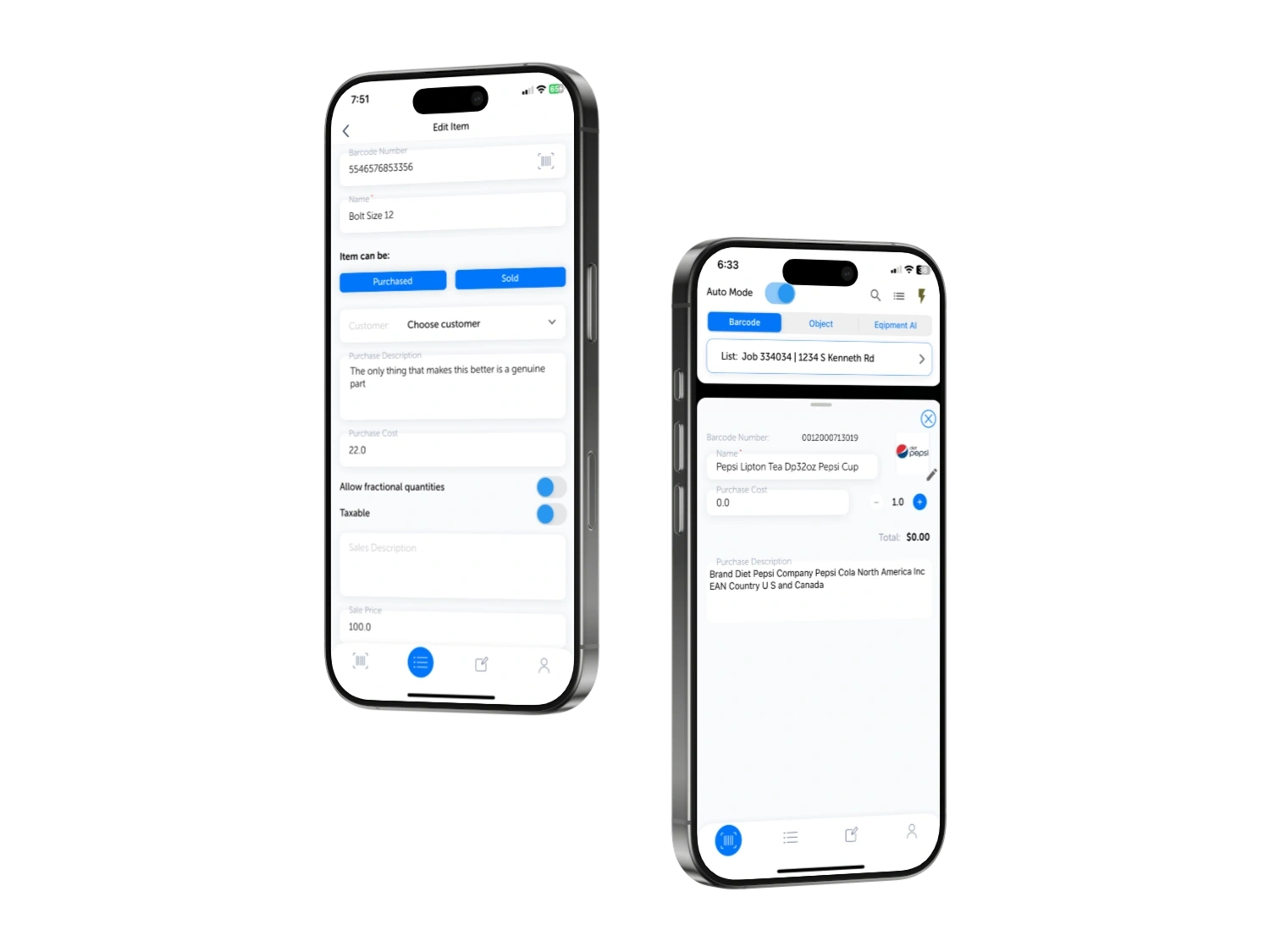
Scannur is a native inventory management app for iOS and Android that lets warehouse and retail teams scan, catalog and manage stock from a phone. A barcode scanner reads coded items instantly, while an AI reverse image search identifies products that have no barcode. Lists, categories and stock counts all sit in one place.
Mobilions replaced three separate tools — a barcode scanner, a clipboard or spreadsheet, and a separate product-identification method — with a single app. Purchase orders, stock-takes and categories all sit on top of the same item library, so there is one source of truth and nothing gets retyped.
The app keeps native code where speed matters and moves the heavy machine-learning work to the cloud. Native camera and haptics live on the phone; catalog, auth, orders and image search live on the server.
Client Snapshot
The essential facts about the product and its audience.
Productivity & Business Tools
iOS (Swift), Android (Kotlin), React Native
Information not available in source documents.
Services Delivered
The scope of work Mobilions handled on Scannur.
- Mobile App Development
- UX & UI Design
- Backend Development
- ML Integration
- Deployment
Technology Stack
The core technologies behind the app and its vision pipeline.
- Mobile: Swift (iOS), Kotlin (Android), React Native
- Backend: Laravel
- Database: PostgreSQL
- Cloud: AWS
- ML: AWS Lambda running a vision model for reverse image search
The Challenge
The business and technical problems Scannur had to solve.
Business Challenge
Stock management on the floor usually means juggling three things: a barcode scanner for coded items, a clipboard or spreadsheet for counts, and a separate way to identify products with no barcode. Switching between them is slow, and retyping numbers between tools is where errors creep in.
Technical Challenge
Several distinct technical problems had to be solved together: reverse image search had to run fast from the floor even though a phone cannot hold a model that heavy; barcode scanning had to feel instant on any platform and any label; a single data model had to serve 50 items and 50,000 without changing what the user sees; and list management had to feel as familiar as a spreadsheet.
Our Approach
How Mobilions moved from problem to working inventory tool.
Discovery
Information not available in source documents.
Architecture
The app stays native where speed matters and moves heavy work to the cloud. Native camera and haptics live on the phone, while catalog, auth, orders and image search live on the server. AWS Lambda handles the machine learning on demand, keeping the server simple and the phone light.
Execution
Scanning was built natively, with Swift on iOS and Kotlin on Android so camera access, haptics and scan feedback feel right on each platform. Barcode reads are processed on-device to avoid network delay. Reverse image search uploads a photo to a vision model on AWS Lambda, which returns candidate matches in under a second. List management sits on top of the item library so every list is a view into the catalog.
Engineering Decisions
The pivotal calls that shaped how Scannur works.
Native on the phone, cloud for the heavy lifting
A mobile phone cannot hold a vision model heavy enough for reliable reverse image search, so that work was moved to AWS Lambda. A photo uploads, the model runs, and candidate matches come back in under a second, keeping the phone light while the server does the lifting.
On-device barcode scanning
Barcode scanning was built natively so reads are processed on-device with no network delay between scanning a code and seeing the result. The same approach delivers consistent speed on a kitchen label and a warehouse pallet alike.
One data model from 50 to 50,000 items
A corner shop with 50 items and a warehouse with 50,000 use the same screens. The item library indexes and caches for speed at any scale, so the data model grows underneath without changing what the user sees.
Technology Considerations
Why the stack was chosen and what it traded off.
Why These Technologies
Native Swift and Kotlin give the best camera and haptics performance for speed-critical scanning. A Laravel backend with PostgreSQL handles the catalog and orders, and AWS Lambda runs the vision model on demand. This split — native on the phone, cloud for the heavy lifting — keeps phones light and the server simple.
Tradeoffs
Information not available in source documents.
Scalability Considerations
The item library indexes and caches so search, pagination and filtering stay quick from 50 items to 50,000+ without changing the data model. A small business and a large warehouse get an identical experience that simply holds more.
Implementation Highlights
The features that turn a phone into a floor-level inventory tool.
Barcode Scanning
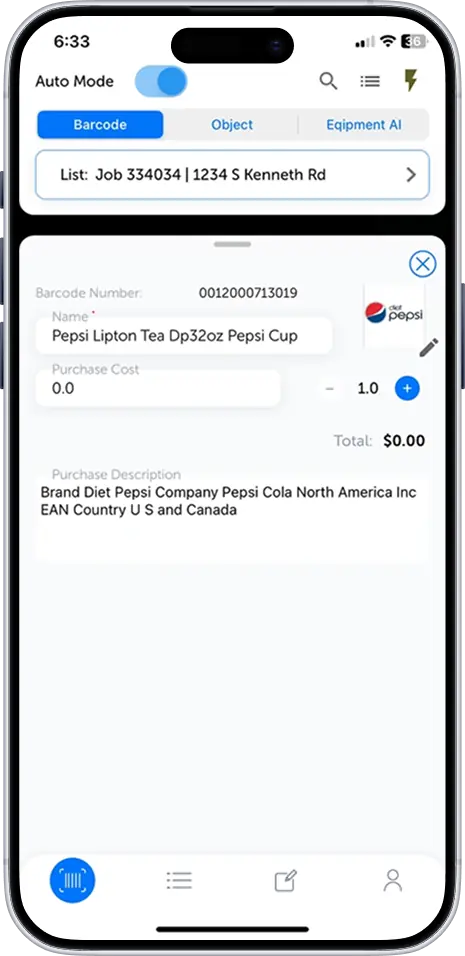
On-device reads for EAN, UPC, Code 128, QR and Data Matrix. The camera reads, the app responds, and there are no extra taps between scanning a code and seeing the item.
AI Image Search
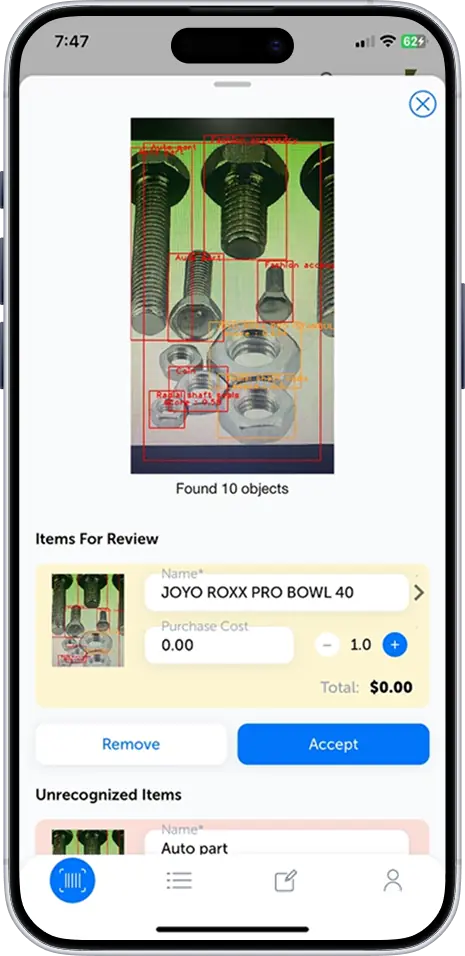
When an item has no barcode, a photo is sent to a vision model running on AWS Lambda, and the matching catalog item comes back in under a second. The operator accepts, rejects or edits, and the catalog learns from every decision.
Lists & Catalogs
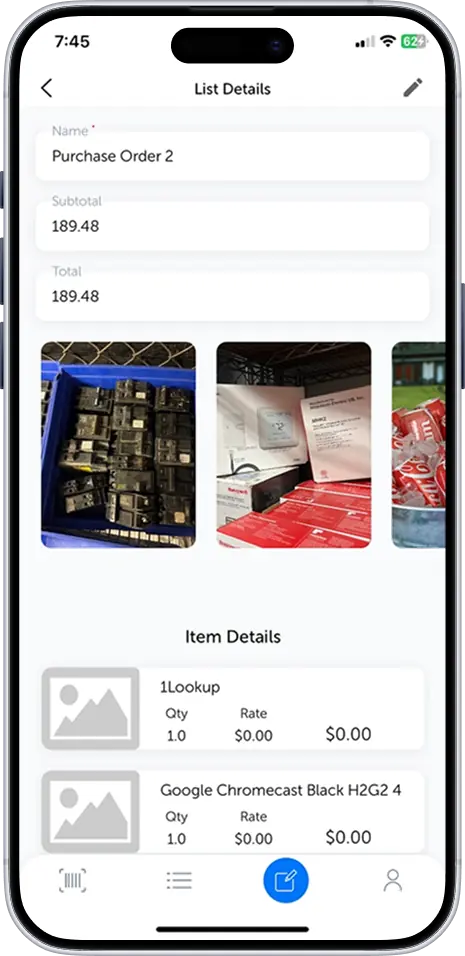
Purchase orders, stock-takes and receiving lists all sit on top of the item library, giving one source of truth and no retyping between tools. A Monday stock-take flows into a Friday order without anyone re-entering a number. (A fourth capability, Object Detection, draws bounding boxes on a shelf for quick visual counts.)
Key Engineering Highlights
A closer look at the system underneath the app.
Architecture
Native camera and haptics on the phone; catalog, auth, orders and image search on the server. AWS Lambda handles ML on demand.
Data Layer
PostgreSQL stores the catalog and orders. The item library indexes and caches for speed at any scale, and any list is a view into the catalog.
Performance
On-device barcode reads avoid network delay, and the AWS Lambda reverse image search returns matches in under a second.
Security
Data is encrypted in transit and at rest, access is controlled by authenticated user accounts with role-based permissions, and the backend sits behind standard cloud security on AWS. For stricter requirements, audit logs and single sign-on integration can be added.
Information not available in source documents.
Gallery
A look at the product across screens.
Ready to build something like Scannur?
If you need an inventory, barcode scanning or AI vision app that stays fast from 50 to 50,000 items, let us show you how we would build it.
What Clients Say
Mobilions' clients describe fast delivery, clear communication, and senior, trustworthy engineering—in their own words.
We worked with Ankit, Mayur, and Tushar to build the first version of Baba Hebrew for iOS and Android, and they delivered super fast. The team was responsive, reliable, and efficient, taking the idea from zero to a working app in record time. I'd recommend them to anyone who wants to get an MVP live quickly.
Tushar and Ankit did an outstanding job developing our native iOS (Swift) and Android (Kotlin) apps. They were efficient, responsive, and technically strong throughout. Thanks to their work, we launched successfully and gained over 1,000 users in the first 30 days. Highly recommend this team for quality mobile app development.
It was a wonderful experience working with Tushar, Ankit, and their team. They built a great mobile app for me and truly brought my vision to life. What stood out was not just their technical skill but their attitude: always positive, solution-oriented, and incredibly patient. They went above and beyond at every step, finding creative workarounds and staying committed even when things got challenging. Extremely professional and trustworthy. I would absolutely hire them again.
Great experience working with this team. They completed the development work quickly and efficiently without wasting time. Communication was clear and consistent, they understood the requirements well, gave smart suggestions, and delivered exactly as discussed. I'd highly recommend them to anyone looking for a reliable, fast, and skilled app development team.
We worked with Ankit, Mayur, and Tushar to build the first version of Baba Hebrew for iOS and Android, and they delivered super fast. The team was responsive, reliable, and efficient, taking the idea from zero to a working app in record time. I'd recommend them to anyone who wants to get an MVP live quickly.
Tushar and Ankit did an outstanding job developing our native iOS (Swift) and Android (Kotlin) apps. They were efficient, responsive, and technically strong throughout. Thanks to their work, we launched successfully and gained over 1,000 users in the first 30 days. Highly recommend this team for quality mobile app development.
It was a wonderful experience working with Tushar, Ankit, and their team. They built a great mobile app for me and truly brought my vision to life. What stood out was not just their technical skill but their attitude: always positive, solution-oriented, and incredibly patient. They went above and beyond at every step, finding creative workarounds and staying committed even when things got challenging. Extremely professional and trustworthy. I would absolutely hire them again.
Frequently Asked Questions
Answers to the questions teams ask before commissioning a build like this.
It depends on scope. The cost of a build like this is driven by scope, features, integrations, compliance requirements, team composition, and infrastructure complexity. We provide a fixed estimate after a short discovery call once those are defined.
The app sends a photo of an item to a vision model, usually running in the cloud because the model is too large for a phone. The model compares the image against the catalog and returns the closest matches. In Scannur this round trip completes in under a second, and the operator confirms or corrects the result.
For speed-critical scanning, native Swift and Kotlin give the best camera and haptics performance. A Laravel or Node.js backend with PostgreSQL handles the catalog and orders, and cloud functions like AWS Lambda are ideal for running the ML on demand. That is the split used for Scannur — native on the phone, cloud for the heavy lifting.
A barcode-and-lists app can ship in three to four months. Adding AI reverse image search, object detection and ERP integration pushes it to five to eight months, since the vision model and integrations need their own development and testing time.
Yes. Most ERP systems expose APIs, so the inventory app can push counts, orders and stock movements into the ERP and pull product data back. The fields are mapped during discovery and a sync layer is built, so the app becomes the floor-level front end to the system the business already runs.
Often, yes. Warehouses and stockrooms frequently have poor connectivity. Mobilions designs for offline-first where it matters: scans and edits queue locally and sync once a connection returns, so a dropped signal never stops a stock-take. Cloud features like image search need connectivity, but core scanning keeps working.
At minimum EAN and UPC for retail products, Code 128 for logistics, and QR and Data Matrix for internal labeling. Scannur supports all of these and more. The right set depends on your industry, which is confirmed during discovery.
Data is encrypted in transit and at rest, access is controlled by authenticated user accounts with role-based permissions, and the backend sits behind standard cloud security on AWS. For businesses with stricter requirements, audit logs and single sign-on integration are added.
Let's build your next big thing
Let's build your next big thing. Share your idea and get a free consultation—we respond within one business day.