Great experience working with this team. They completed the development work quickly and efficiently without wasting time. Communication was clear and consistent, they understood the requirements well, gave smart suggestions, and delivered exactly as discussed. I'd highly recommend them to anyone looking for a reliable, fast, and skilled app development team.
IDCU: A Curated Date-Planning App That Turns Ideas Into Booked Plans
IDCU is a curated date-plan discovery app concept built by Mobilions in Flutter. It surfaces personalized date plans and venue details with AI summaries, then helps users act on them through Google Maps and Uber integration, in-app reservations, reviews, favorites, calendar scheduling, and deep-link sharing.

Project Overview
What IDCU is and what Mobilions built.
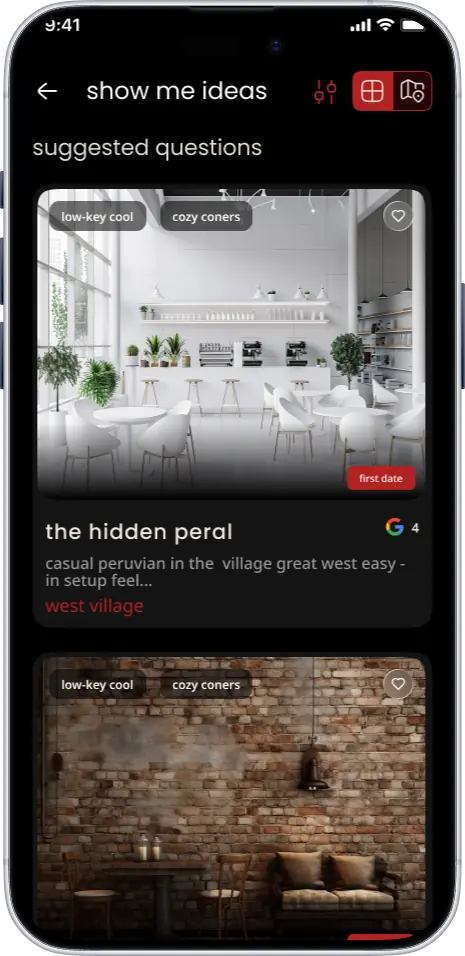
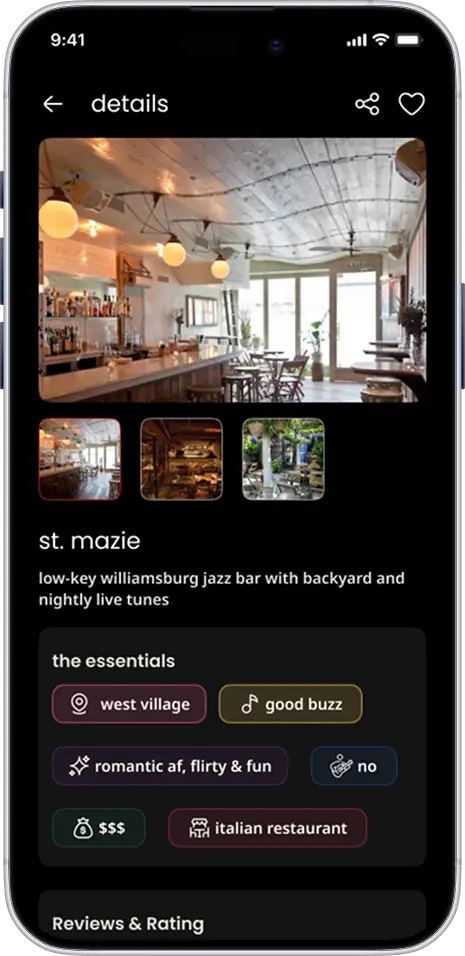
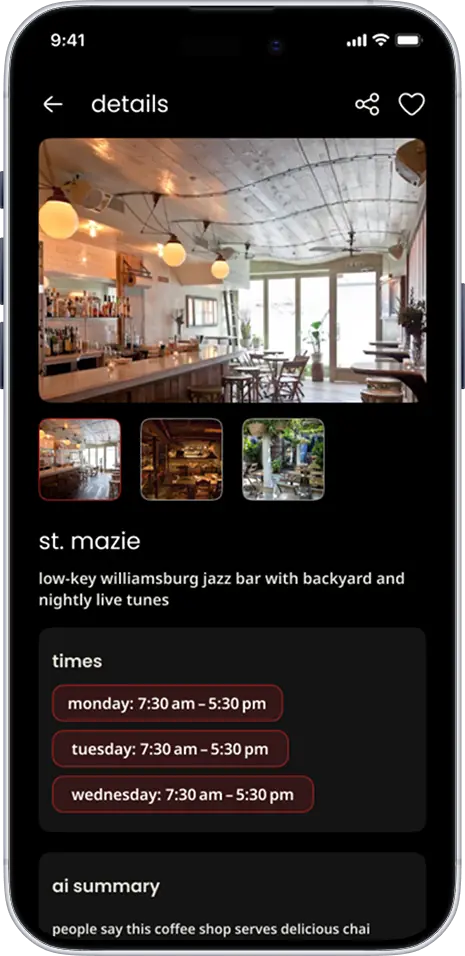
IDCU is a lifestyle app for curated date-plan discovery. Instead of leaving users to plan a date from scratch, it presents curated plans and personalized suggestions, with rich venue detail pages that include photos, hours, AI-generated summaries, and contact information.
Mobilions built IDCU as a cross-platform app in Flutter. Beyond discovery, the concept closes the loop from idea to action: users can get directions through Google Maps, book a ride through Uber, reserve a table in-app, leave reviews and ratings, save favorites, schedule plans to their calendar, sign in socially, and share plans through deep links.
The result is a single app that moves a user from "what should we do?" to a booked, scheduled, shareable plan, personalized to their date preferences.
Client Snapshot
Key facts about the product and engagement.
Lifestyle / consumer (no exact standard cluster)
iOS / cross-platform (Flutter)
Services Delivered
The services Mobilions provided to build this app.
- Cross-platform application development (Flutter)
- Curated content and personalized recommendation experience
- Venue detail pages with AI-generated summaries
- Google Maps and Uber integrations
- In-app table reservations
- Reviews, ratings, and favorites
- Calendar scheduling
- Social sign-in (authentication)
- Deep-link sharing
- UI/UX design for a lifestyle discovery experience
Technology Stack
The core technologies behind the app.
- Flutter: cross-platform application framework
- Google Maps integration for venue locations and directions
- Uber integration for ride booking
- AI/ML services for venue summaries and personalization
- Social authentication providers for sign-in
- Deep linking for plan sharing
The Challenge
The problem space this app addresses.
Business Challenge
Planning a date starts from a blank page, and that is where most plans stall. People know roughly what they want but not where to go, so the idea gets pushed to another day. Even when someone does decide, the plan is scattered across a search engine, a maps app, a ride app and a booking page, and each hop is a chance to give up. The product had to carry a user from a vague idea to something actually booked and scheduled, without that journey feeling like work.
Technical Challenge
The app leans on several third-party services, including Google Maps for directions, Uber for rides, reservations, social sign-in and deep links, and every one of them had to feel like part of a single flow rather than a handoff to another app. AI-generated venue summaries had to be quick enough to read at a glance and consistent enough to trust. All of it had to run from one Flutter codebase while still feeling native on each platform.
Our Approach
How a curated discovery app is typically built.
Discovery
We mapped the journey from "what should we do?" to a plan that is booked, scheduled and shared, then decided which of those steps had to stay inside the app and which could be handed to a service that already does the job well. That decision set the feature list: curation and personalization are the product, while directions, rides and reservations are integrations worth borrowing rather than rebuilding.
Architecture
Flutter gives one codebase for iOS and Android, which suits a design-led app where the same curated content and layout should look right on both. The third-party services sit behind an integration layer rather than being called directly from the screens, so Google Maps, Uber, reservations, social sign-in and deep links can each be changed or swapped without the discovery flow being rewritten around them.
Execution
Discovery came first: curated plans, personalized suggestions and venue detail pages carrying photos, hours, contact information and AI-generated summaries. The actions were layered on top of that foundation, so directions, ride booking, in-app reservations, calendar scheduling, reviews, favorites and deep-link sharing all attach to a venue the user is already looking at instead of starting a new flow.
Engineering Decisions
Notable build choices for this app.
One codebase for a design-led app
IDCU is carried by its content and layout more than by platform-specific behavior, so Flutter was the right fit. A single codebase keeps the curated plans, venue pages and imagery identical on iOS and Android, and a design change lands in both places at once instead of being rebuilt twice and drifting apart.
Borrow the services users already trust
Directions, rides and reservations are solved problems, so the app integrates Google Maps and Uber rather than reinventing them. That keeps the build focused on the part that is actually differentiated, the curation and personalization, and it means users act through services they already have accounts with and trust.
Keep every action on the venue the user is viewing
The actions were deliberately attached to the venue page instead of living in separate flows. From one screen a user can get directions, book a ride, reserve a table, save a favorite, add the plan to their calendar or share it by deep link, so momentum is never lost to a back button.
Technology Considerations
Why the stack fits this kind of app.
Why These Technologies
Flutter is a cross-platform framework that lets a single codebase target iOS and Android, well-suited to a content-rich, design-led discovery app with many third-party integrations.
Tradeoffs
One codebase is faster to build and keeps the design consistent, but anything genuinely platform-specific has to be bridged to native code rather than written directly, and each third-party integration adds a dependency the app does not control. The trade was accepted because the value here is the curated content and the flow between screens, not deep platform features.
Scalability Considerations
A discovery app grows by adding venues and plans, so the content side has to stay quick as the catalog fills up. Listings page and cache rather than loading everything at once, imagery loads lazily so a long scroll stays smooth, and AI summaries are generated once and stored with the venue instead of being produced on every visit.
Implementation Highlights
The app's core capabilities, as conceived.
Curated Plans & Personalization
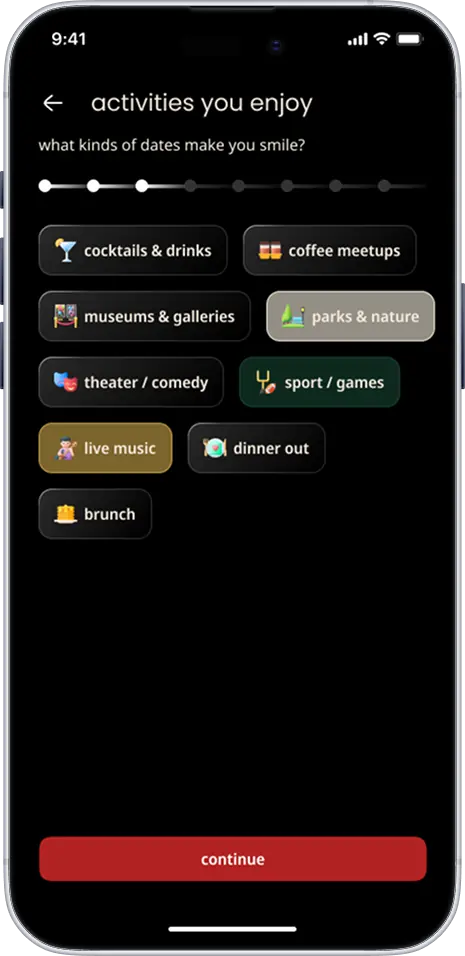
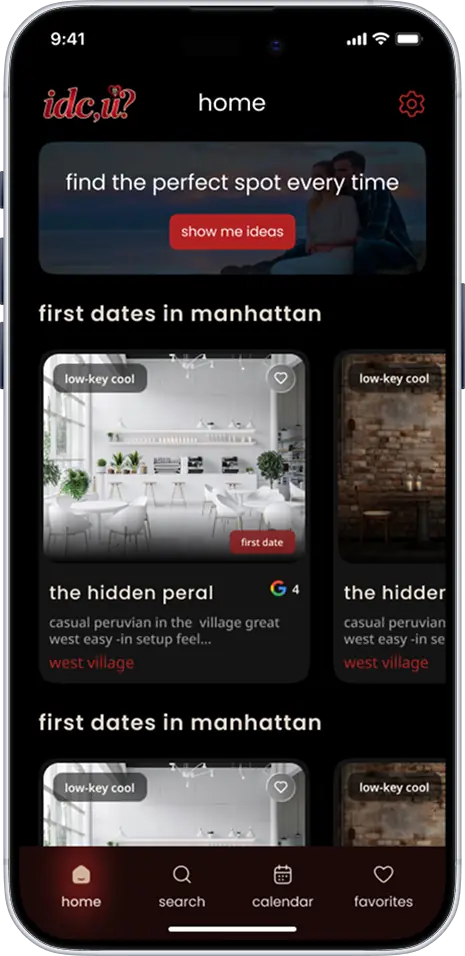
The app presents curated date plans and personalized suggestions tuned to each user's date preferences, removing the blank-page problem of planning a date.
Venue Details with AI Summaries
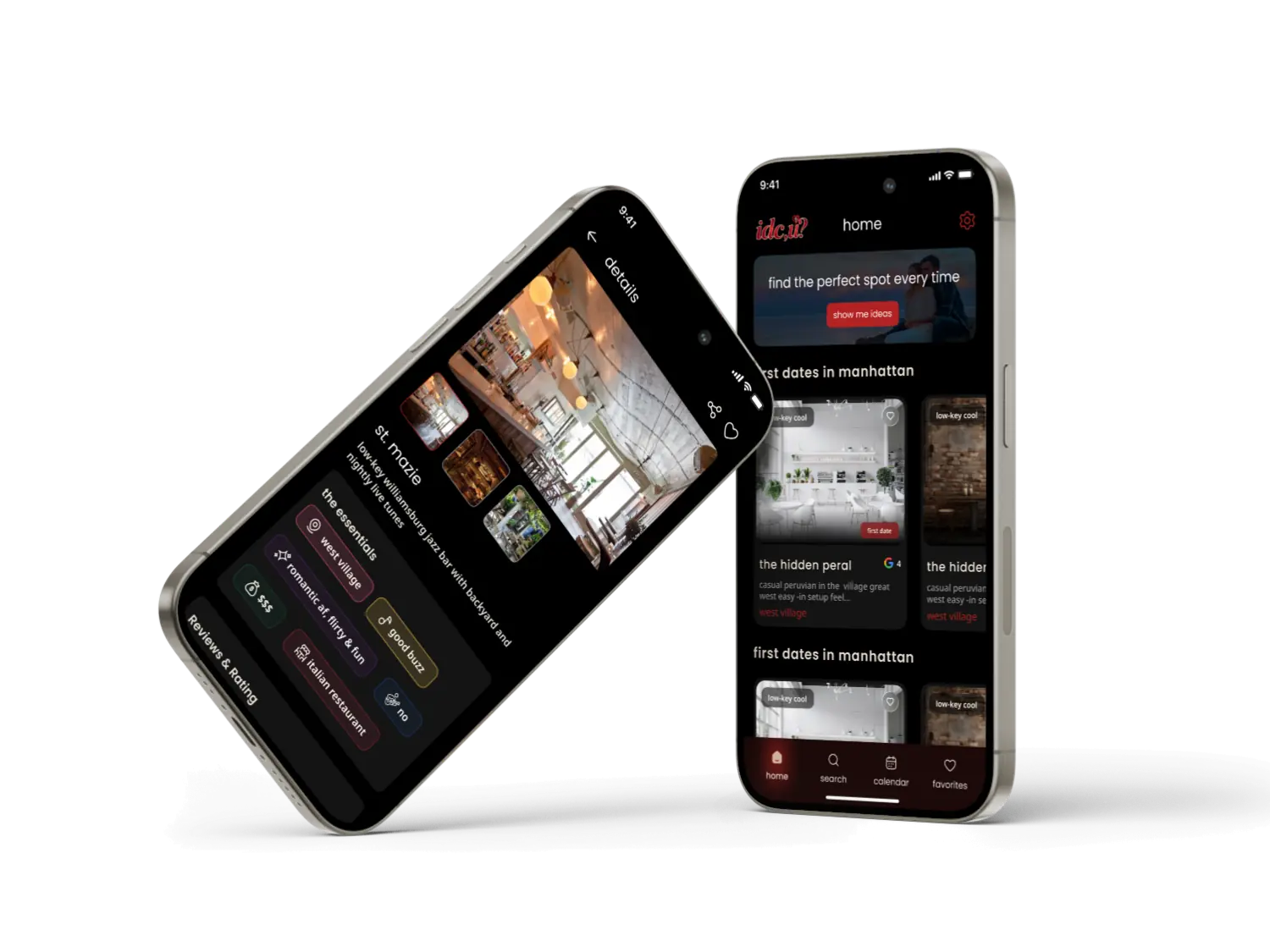
Venue pages bring together photos, hours, contact information, and AI-generated summaries, giving users a fast, digestible read on each place.
Google Maps & Uber Integration
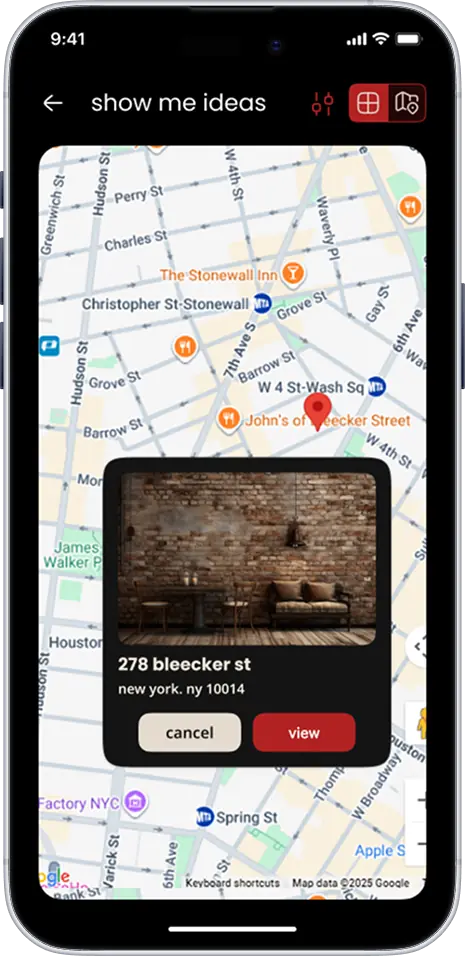
Built-in Google Maps and Uber integrations let users get directions and book a ride to a venue without leaving the planning flow.
In-App Reservations
Users can reserve a table from inside the app, turning a chosen plan into a confirmed booking in one place.
Reviews, Favorites & Calendar
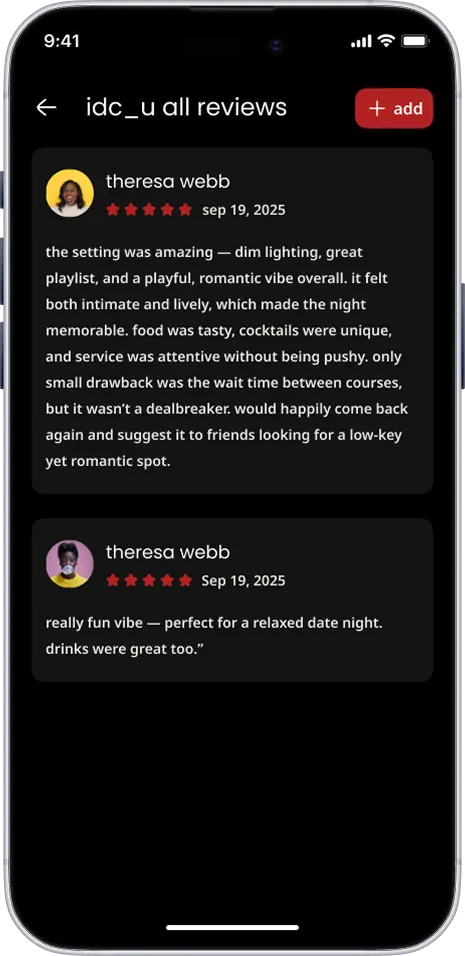
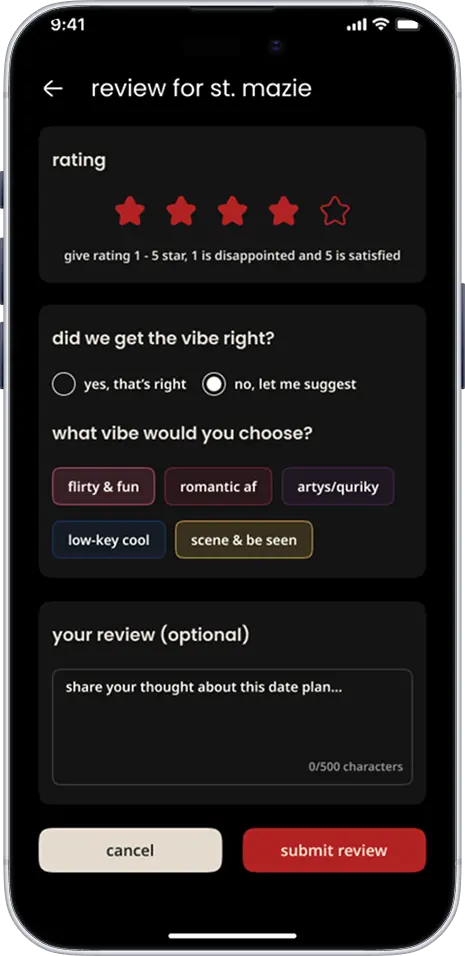
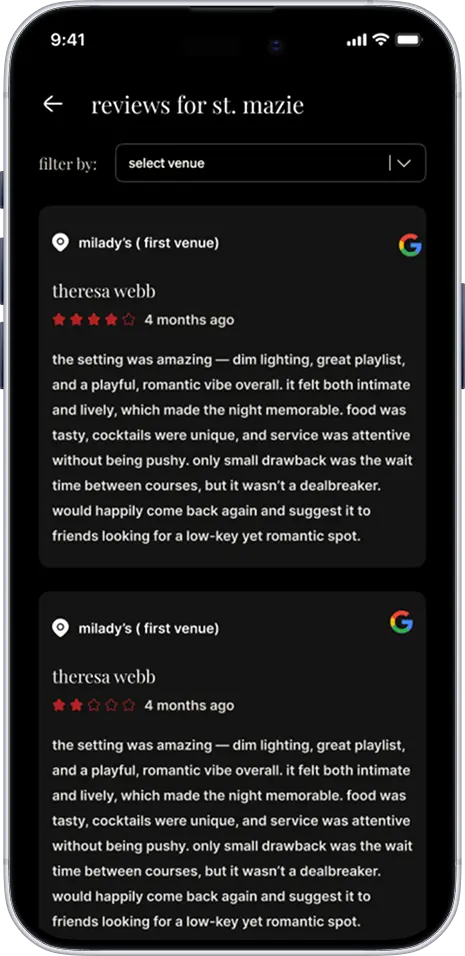
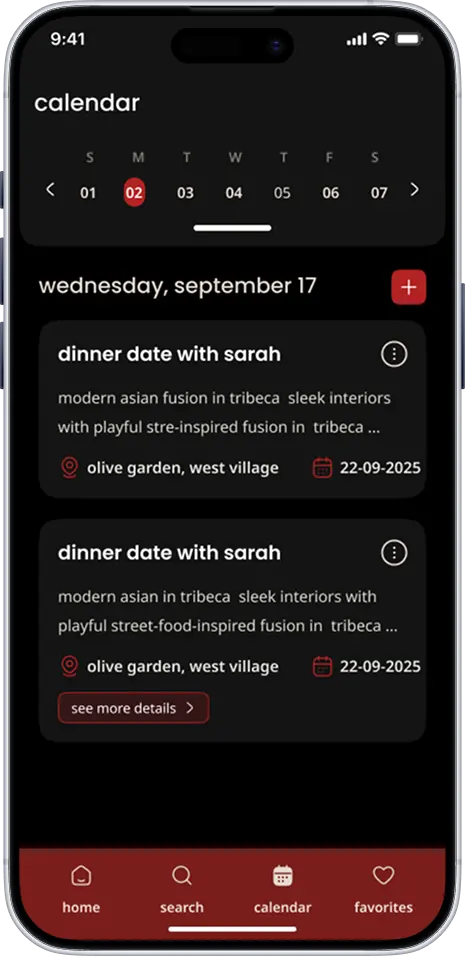
Users can leave reviews and ratings, save favorite plans and venues, and schedule plans to their calendar so a chosen date actually lands on the day.
Social Sign-In & Deep-Link Sharing
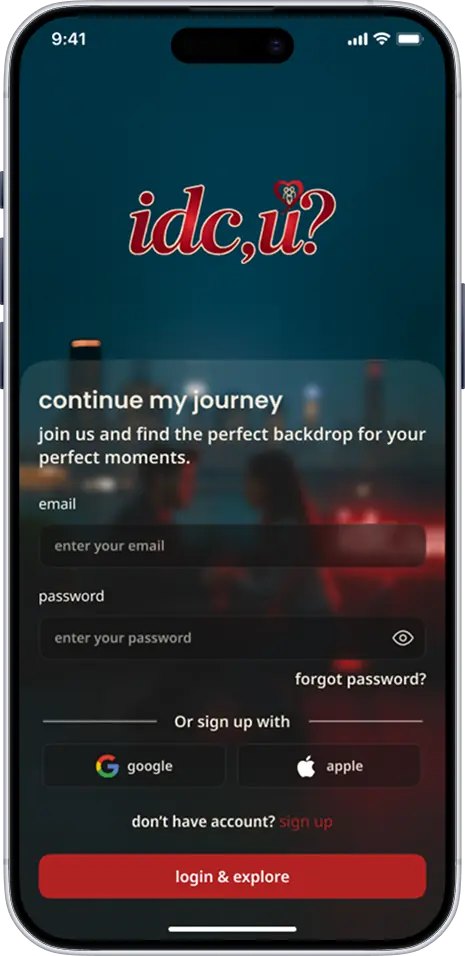
Social sign-in keeps onboarding quick, while deep-link sharing lets users send a specific plan to a partner or friend that opens straight to that content.
Key Engineering Highlights
Technical notes on the build.
Architecture
A Flutter client for iOS and Android, with Google Maps, Uber, reservations, social sign-in and deep linking sitting behind an integration layer so the discovery flow stays independent of any one provider.
Data Layer
Venue records hold photos, opening hours, contact details and an AI-generated summary, and user data covers date preferences, favorites, reviews and scheduled plans. Personalization reads from the preference data, so suggestions sharpen as a user saves and reviews more places.
Performance
The app is image-heavy by nature, so listings page and cache rather than loading everything at once and imagery loads lazily to keep scrolling smooth. Storing AI summaries with the venue means a detail page renders straight from data instead of waiting on a model.
Security
Social sign-in keeps credentials with the identity providers rather than the app, and personal data such as preferences, favorites, reviews and scheduled plans is tied to the authenticated account. Third-party calls run through scoped integrations, so each service only receives what that action needs.
Gallery
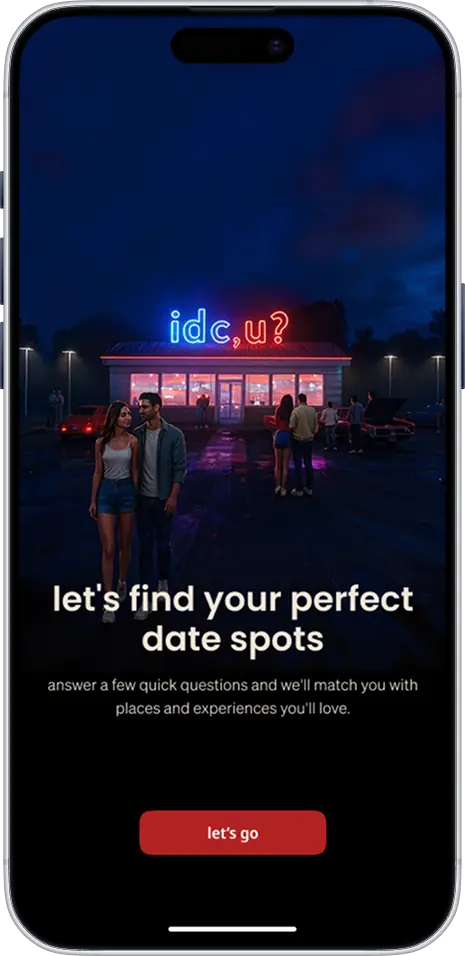
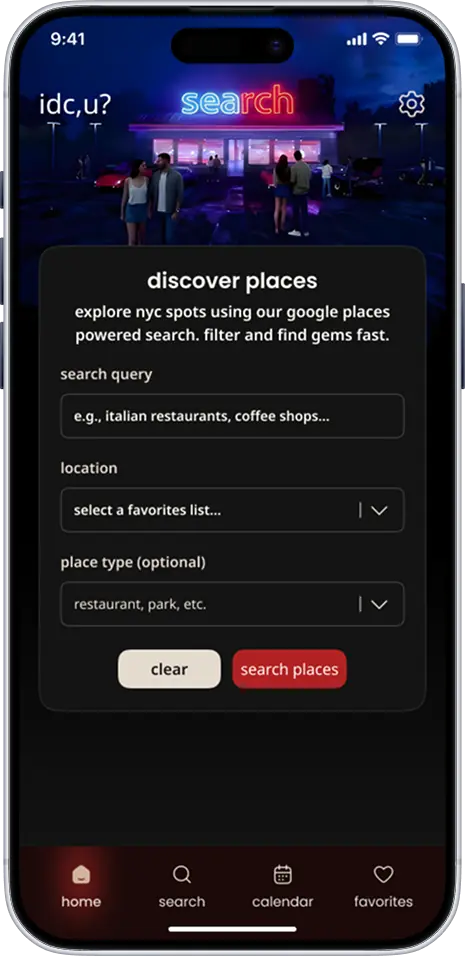
A look at the product across screens.
Ready to build something like IDCU?
If you need a lifestyle, discovery or planning app with curation, AI summaries and third-party integrations like Maps, Uber and reservations, let us show you how we would build it.
What Clients Say
In their own words, Mobilions' clients describe fast delivery, clear communication, and senior, trustworthy engineering.
We worked with Ankit, Mayur, and Tushar to build the first version of Baba Hebrew for iOS and Android, and they delivered super fast. The team was responsive, reliable, and efficient, taking the idea from zero to a working app in record time. I'd recommend them to anyone who wants to get an MVP live quickly.
Tushar and Ankit did an outstanding job developing our native iOS (Swift) and Android (Kotlin) apps. They were efficient, responsive, and technically strong throughout. Thanks to their work, we launched successfully and gained over 1,000 users in the first 30 days. Highly recommend this team for quality mobile app development.
It was a wonderful experience working with Tushar, Ankit, and their team. They built a great mobile app for me and truly brought my vision to life. What stood out was not just their technical skill but their attitude: always positive, solution-oriented, and incredibly patient. They went above and beyond at every step, finding creative workarounds and staying committed even when things got challenging. Extremely professional and trustworthy. I would absolutely hire them again.
Frequently Asked Questions
Common questions about building a curated discovery or planning app.
Flutter lets you ship one codebase to both iOS and Android, which suits content-rich, design-led apps with shared features. Native can be better when you depend heavily on platform-specific capabilities. We recommend an approach based on your features, budget, and target platforms.
Both offer developer interfaces that an app can call directly. That means Maps for locations and directions, and Uber for ride requests. We handle the integration, the API keys and accounts, and the in-app flows that make them feel native to your product.
AI summaries are produced by feeding venue data to an AI/ML service that condenses it into a short, readable description. We design how the app sources that data, calls the service, and caches results, and we will advise on cost and quality tradeoffs.
Yes. In-app reservations are typically built by integrating with a reservations provider or a custom booking backend. We design the booking flow and the integration so users can reserve without leaving the app.
Deep links let a shared link open the app directly to a specific plan or venue rather than the home screen. We set up the links, the routing, and the fallback for users who do not yet have the app installed.
It depends on how much of the idea-to-action loop ships at launch. A curated date-planner like IDCU stitches together several third-party services alongside AI-generated venue summaries and the curation engine behind the plans. Those services include Google Maps directions, Uber rides, in-app reservations, calendar scheduling, and deep-link sharing. Each integration adds build and testing time. We usually start with discovery and one core action like reservations, then layer on the rest, and give a realistic timeline after a short discovery call.
Curated content is usually managed through a content backend or CMS so it can be updated without an app release. We design that pipeline and, where useful, combine it with AI assistance to scale curation.
Yes. Many lifestyle apps begin exactly that way. We turn a concept and feature list into a scoped plan and build iteratively from a working core outward.
Let's build your next big thing
Let's build your next big thing. Share your idea and get a free consultation. We respond within one business day.